


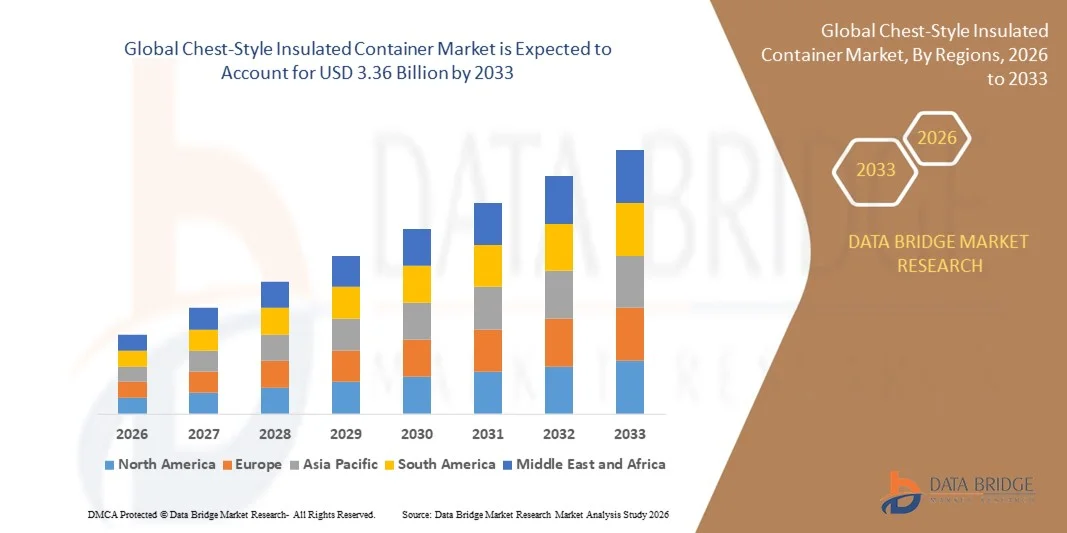
What is the Global Chest-Style Insulated Container Market Size and Growth Rate?
- The global chest-style insulated container market size was valued at USD 2.10 billion in 2025 and is expected to reach USD 3.36 billion by 2033, at a CAGR of 6.07% during the forecast period
- The chest-style insulated container market is rising in demand owing to the increasing shipment of pharmaceutical goods over the longer distance which requires optimum temperature handling for the longer period of time. The rapid increasing logistics of clinical testing, that requires a temperature chest-style insulated solution is also highly impacting the growth of the market
- Also, the Increasing rental packaging solution adoption is also raising chest-style insulated container demand in the market. In addition, the chest-style insulated containers are largely used in the food and beverage, healthcare and chemical industries to transfer and store temperature sensitive goods at a temperature preserving environment which is also fueling the growth of the chest-style insulated container market
What are the Major Takeaways of Chest-Style Insulated Container Market?
- The major factor which actively drives the demand of chest-style insulated container market is the rising trend of major players captivating smart strategies such as mergers and acquisitions to expand their presence
- However, the high cost coupled with the chest-style insulated container products will obstruct the growth of the chest-style insulated container market in the above mentioned forecast period, whereas such highly developed technologies such as vacuum insulated panels are expensive when compared to traditional PUR and EPS shippers which have the potential to challenge the growth of the target market.
- Asia-Pacific dominated the chest-style insulated container market with the largest revenue share of 41.6% in 2025, driven by strong demand from the pharmaceutical, food, and beverage industries and the rapid expansion of cold chain logistics across emerging economies such as China, India, and Japan
- The North America chest-style insulated container market is projected to register the fastest CAGR of 13.1% from 2026 to 2033, driven by increasing demand for biopharmaceutical transport, temperature-sensitive food delivery, and reusable packaging systems
- The Frozen segment dominated the market with the largest revenue share of 46.8% in 2025, primarily due to the rising global demand for temperature-sensitive products such as vaccines, biologics, and frozen foods
Report Scope and Chest-Style Insulated Container Market Segmentation
|
Attributes |
Chest-Style Insulated Container Key Market Insights |
|
Segments Covered |
|
|
Countries Covered |
North America
Europe
Asia-Pacific
Middle East and Africa
South America
|
|
Key Market Players |
|
|
Market Opportunities |
|
|
Value Added Data Infosets |
In addition to the insights on market scenarios such as market value, growth rate, segmentation, geographical coverage, and major players, the market reports curated by the Data Bridge Market Research also include in-depth expert analysis, pricing analysis, brand share analysis, consumer survey, demography analysis, supply chain analysis, value chain analysis, raw material/consumables overview, vendor selection criteria, PESTLE Analysis, Porter Analysis, and regulatory framework. |
What is the Key Trend in the Chest-Style Insulated Container Market?
Sustainable and Smart Cooling Solutions Driving Market Transformation
- A prominent and accelerating trend in the global chest-style insulated container market is the growing shift toward eco-friendly materials and smart temperature management technologies. Manufacturers are integrating IoT-based sensors, phase change materials (PCMs), and AI-driven temperature control systems to ensure product safety, reduce waste, and enhance logistics efficiency
- For instance, Cold Chain Technologies has introduced smart insulated containers equipped with real-time temperature and humidity monitoring to ensure pharmaceutical shipments maintain integrity throughout transit. Similarly, VA-Q-tec has developed vacuum-insulated packaging solutions utilizing energy-efficient PCM technology, reducing environmental impact and improving thermal performance
- The demand for reusable and recyclable materials such as HDPE and bio-based foams is rapidly increasing, driven by global sustainability initiatives and stricter regulations on single-use plastics. Companies are investing in green packaging innovations that align with circular economy principles, minimizing carbon emissions across cold chain logistics
- The integration of digital tracking systems allows logistics operators to monitor temperature variations, location, and handling conditions in real time, significantly improving reliability and traceability in temperature-sensitive supply chains such as pharmaceuticals, food, and biotechnology
- Leading companies such as Sonoco ThermoSafe are developing AI-integrated insulated containers that adapt insulation performance based on external conditions, optimizing thermal efficiency and energy consumption. These innovations are setting new industry benchmarks for sustainability and operational intelligence
- The ongoing adoption of smart, sustainable, and reusable insulated containers is expected to redefine market standards by offering eco-conscious, high-performance solutions that cater to both environmental and operational needs across industries
What are the Key Drivers of Chest-Style Insulated Container Market?
- The rising demand for temperature-sensitive product transportation, particularly in pharmaceutical, biotechnology, and food sectors, is a major driver fueling market growth. Increasing global trade of vaccines, biologics, and perishable goods is boosting the need for reliable cold chain infrastructure
- For instance, in June 2025, Thermo Fisher Scientific expanded its cold chain packaging portfolio with innovative insulated container designs tailored for biologics and cell therapy logistics, ensuring precise temperature control across long-distance shipping
- The growing focus on reducing food and medical waste is also accelerating the adoption of high-quality insulated containers. These containers preserve temperature consistency, minimizing spoilage and ensuring compliance with global health and safety standards
- In addition, government initiatives promoting sustainable packaging and reusable cold chain solutions are driving widespread industry transformation. Manufacturers are increasingly adopting energy-efficient materials and renewable energy-powered production to meet sustainability goals
- The demand for customized, multi-use insulated containers is rising among logistics providers seeking operational efficiency and cost-effectiveness. The increasing prevalence of e-commerce-driven grocery and pharmaceutical delivery services is further contributing to market expansion
- As the global logistics ecosystem evolves, the integration of smart technologies and durable, sustainable materials continues to propel the Chest-Style Insulated Container market toward innovation and long-term resilience
Which Factor is Challenging the Growth of the Chest-Style Insulated Container Market?
- Despite promising growth, the market faces challenges related to high manufacturing costs and limited affordability of advanced insulated containers, particularly in emerging economies. The use of premium insulation materials and embedded sensors increases production costs, impacting market penetration in price-sensitive regions
- For instance, smart insulated systems incorporating real-time tracking or active cooling mechanisms require costly components, making them less accessible for small-scale distributors or local food suppliers
- Another major concern is the environmental disposal of traditional polymer-based containers, which can contribute to plastic waste if not properly recycled. Companies are under growing pressure to develop sustainable disposal and take-back programs to meet international environmental regulations
- Technical challenges in maintaining consistent temperature during extreme environmental conditions or extended transit durations also hinder market performance. Continuous innovation is required to enhance insulation durability and performance under variable external conditions
- Moreover, logistical complexities and return management for reusable containers pose challenges for large-scale adoption, especially in regions lacking developed reverse logistics infrastructure
- Overcoming these barriers through cost optimization, advanced recycling systems, and scalable smart cooling technologies will be crucial for sustaining growth and ensuring the Chest-Style Insulated Container market achieves its full potential globally
How is the Chest-Style Insulated Container Market Segmented?
The market is segmented on the basis of application type and end user type.
- By Application Type
On the basis of application type, the chest-style insulated container market is segmented into Frozen, Chilled, and Ambient. The Frozen segment dominated the market with the largest revenue share of 46.8% in 2025, primarily due to the rising global demand for temperature-sensitive products such as vaccines, biologics, and frozen foods. Frozen insulated containers are designed to maintain sub-zero temperatures over long durations, making them essential for pharmaceutical cold chain logistics and frozen food exports. Their superior insulation properties and compatibility with dry ice and PCM packs enhance product preservation during transit.
The Chilled segment is projected to witness the fastest growth rate of 22.4% from 2026 to 2033, driven by the increasing distribution of fresh produce, dairy, and ready-to-eat meals. Growing consumer preference for fresh and short-shelf-life items, coupled with expanding e-commerce grocery networks, is fueling the demand for reliable chilled storage solutions across regional and global logistics channels.
- By End User Type
On the basis of end user type, the chest-style insulated container market is segmented into Pharmaceuticals, Food and Beverages, and Others. The Pharmaceuticals segment held the largest market revenue share of 52.3% in 2025, owing to the surging demand for temperature-controlled transport of vaccines, biologics, and diagnostic samples. Stringent global regulations on drug safety and quality assurance have accelerated the adoption of insulated containers that maintain precise temperature ranges and prevent spoilage during extended transit. Major pharmaceutical firms and healthcare logistics providers are increasingly investing in reusable, validated insulated systems to ensure product integrity.
The Food and Beverages segment is anticipated to record the fastest CAGR of 21.1% from 2026 to 2033, fueled by the growth of online food delivery, meal kits, and international perishable food trade. Rising consumer demand for fresh, high-quality food products is driving the need for efficient insulated containers to ensure safe, temperature-stable deliveries worldwide.
Which Region Holds the Largest Share of the Chest-Style Insulated Container Market?
- Asia-Pacific dominated the chest-style insulated container market with the largest revenue share of 41.6% in 2025, driven by strong demand from the pharmaceutical, food, and beverage industries and the rapid expansion of cold chain logistics across emerging economies such as China, India, and Japan
- The region’s increasing investment in healthcare infrastructure, vaccine distribution networks, and temperature-controlled food exports has accelerated the adoption of chest-style insulated containers. Furthermore, government initiatives promoting food safety, sustainable packaging, and cold storage development have contributed to market growth
- The combination of rising disposable incomes, expanding e-commerce, and growing demand for ready-to-eat and frozen products is driving adoption across both industrial and consumer segments. As a result, Asia-Pacific has emerged as a global hub for insulated container production and consumption, supported by affordable manufacturing and advanced logistics infrastructure
China Chest-Style Insulated Container Market Insight
The China chest-style insulated container market captured the largest revenue share of 48.3% in 2025 within Asia-Pacific, supported by the nation’s strong food export industry and expanding pharmaceutical supply chains. China’s growing network of vaccine storage and cold chain logistics facilities has significantly boosted demand for durable, reusable insulated containers. The surge in e-commerce grocery delivery and the preference for fresh and frozen goods are further fueling market growth. In addition, government emphasis on eco-friendly packaging and energy-efficient transport solutions continues to shape innovation among local manufacturers.
India Chest-Style Insulated Container Market Insight
The India market is expected to witness one of the fastest growth rates across Asia-Pacific, driven by the country’s expanding pharmaceutical manufacturing base, agricultural exports, and demand for temperature-sensitive food storage. The government’s focus on cold chain modernization and food preservation infrastructure under initiatives such as Pradhan Mantri Kisan SAMPADA Yojana is propelling adoption. Increasing collaborations between logistics providers and packaging firms are enhancing efficiency and affordability, making India a key emerging market for insulated container solutions.
Japan Chest-Style Insulated Container Market Insight
The Japan chest-style insulated container market continues to grow steadily due to the nation’s strong emphasis on quality assurance, precision logistics, and sustainable packaging. The use of insulated containers for pharmaceutical and medical applications has surged, supported by advancements in smart temperature monitoring and IoT-based cold storage. Japan’s strict food safety regulations and high standards for product integrity are also encouraging the adoption of advanced insulated container systems. The integration of digital tracking and energy-efficient insulation technologies reflects the country’s ongoing transition toward smart and sustainable logistics solutions.
Which Region is the Fastest Growing Region in the Chest-Style Insulated Container Market?
The North America chest-style insulated container market is projected to register the fastest CAGR of 13.1% from 2026 to 2033, driven by increasing demand for biopharmaceutical transport, temperature-sensitive food delivery, and reusable packaging systems. The region’s focus on sustainability, innovation, and regulatory compliance is accelerating the transition from single-use to multi-use insulated solutions. Growing investments by cold chain logistics providers, coupled with strong consumer demand for frozen and perishable food products, are reinforcing market expansion. In addition, the U.S. and Canada are witnessing heightened adoption of smart insulated containers equipped with IoT-based temperature tracking to ensure real-time visibility across supply chains.
U.S. Chest-Style Insulated Container Market Insight
The U.S. accounted for nearly 79% of the North America market share in 2025, supported by strong growth in the biotech, healthcare, and frozen food industries. Increasing emphasis on vaccine distribution logistics and biological sample preservation continues to drive demand for high-performance insulated containers. In addition, government and private sector investments in green packaging technologies and digital cold chain monitoring systems are promoting market maturity.
Canada Chest-Style Insulated Container Market Insight
The Canada market is witnessing significant growth, driven by the expanding demand for temperature-controlled food exports and healthcare shipments. Cold storage infrastructure development, supported by government sustainability programs and incentives for reusable packaging, is encouraging adoption. Canada’s growing focus on reducing food waste and enhancing cross-border pharmaceutical distribution efficiency positions it as a key contributor to North America’s rapid insulated container market growth.
Which are the Top Companies in Chest-Style Insulated Container Market?
The chest-style insulated container industry is primarily led by well-established companies, including:
- Sonoco Products Company (U.S.)
- Cold Chain Technologies (U.S.)
- Thermo Fisher Scientific (U.S.)
- Pelican BioThermal (U.S.)
- Envirotainer (Sweden)
- Snyder Industries, LLC (U.S.)
- Thomas Scientific (U.S.)
- Saeplast (Iceland)
- Reusable Transport Packaging (U.S.)
- Snyder Industries (U.S.)
- SOFRIGRAM (France)
- Olivo (France)
- Creopack (Canada)
- Inno Cool India Private Limited (India)
- The Cary Company (U.S.)
- Inmark Packaging (U.S.)
- VA-Q-tec (Germany)
- Sonoco ThermoSafe (U.S.)
- Arctic Zone Products Inc. (U.S.)

- Interactive Data Analysis Dashboard
- Company Analysis Dashboard for high growth potential opportunities
- Research Analyst Access for customization & queries
- Competitor Analysis with Interactive dashboard
- Latest News, Updates & Trend analysis
- Harness the Power of Benchmark Analysis for Comprehensive Competitor Tracking
Global Chest Style Insulated Container Market, Supply Chain Analysis and Ecosystem Framework
To support market growth and help clients navigate the impact of geopolitical shifts, DBMR has integrated in-depth supply chain analysis into its Global Chest Style Insulated Container Market research reports. This addition empowers clients to respond effectively to global changes affecting their industries. The supply chain analysis section includes detailed insights such as Global Chest Style Insulated Container Market consumption and production by country, price trend analysis, the impact of tariffs and geopolitical developments, and import and export trends by country and HSN code. It also highlights major suppliers with data on production capacity and company profiles, as well as key importers and exporters. In addition to research, DBMR offers specialized supply chain consulting services backed by over a decade of experience, providing solutions like supplier discovery, supplier risk assessment, price trend analysis, impact evaluation of inflation and trade route changes, and comprehensive market trend analysis.
Data collection and base year analysis are done using data collection modules with large sample sizes. The stage includes obtaining market information or related data through various sources and strategies. It includes examining and planning all the data acquired from the past in advance. It likewise envelops the examination of information inconsistencies seen across different information sources. The market data is analysed and estimated using market statistical and coherent models. Also, market share analysis and key trend analysis are the major success factors in the market report. To know more, please request an analyst call or drop down your inquiry.
The key research methodology used by DBMR research team is data triangulation which involves data mining, analysis of the impact of data variables on the market and primary (industry expert) validation. Data models include Vendor Positioning Grid, Market Time Line Analysis, Market Overview and Guide, Company Positioning Grid, Patent Analysis, Pricing Analysis, Company Market Share Analysis, Standards of Measurement, Global versus Regional and Vendor Share Analysis. To know more about the research methodology, drop in an inquiry to speak to our industry experts.
Data Bridge Market Research is a leader in advanced formative research. We take pride in servicing our existing and new customers with data and analysis that match and suits their goal. The report can be customized to include price trend analysis of target brands understanding the market for additional countries (ask for the list of countries), clinical trial results data, literature review, refurbished market and product base analysis. Market analysis of target competitors can be analyzed from technology-based analysis to market portfolio strategies. We can add as many competitors that you require data about in the format and data style you are looking for. Our team of analysts can also provide you data in crude raw excel files pivot tables (Fact book) or can assist you in creating presentations from the data sets available in the report.













