


Chinese Hamster Ovary (CHO) K1 ATCC Cells Market Size
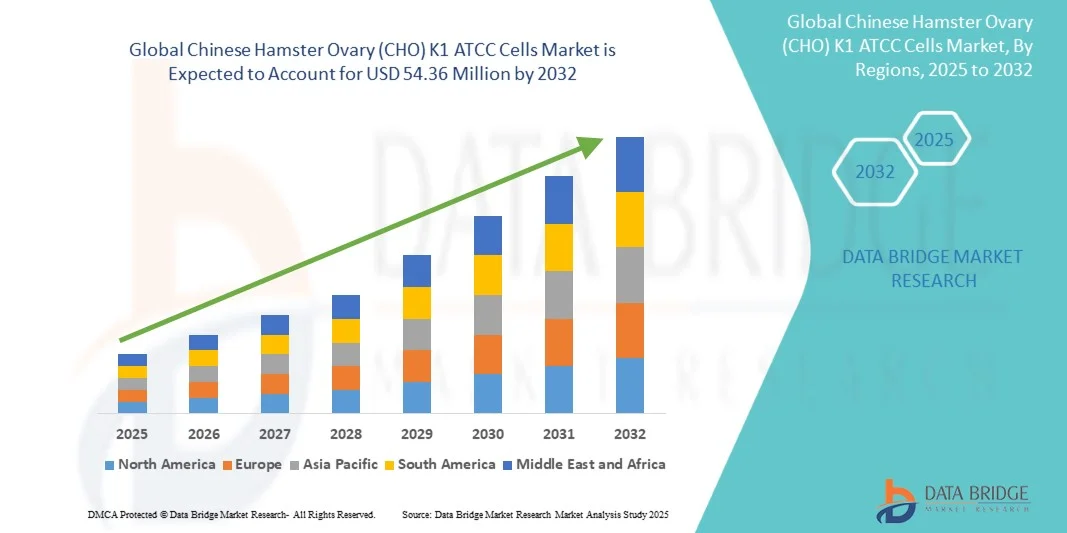
- The global chinese hamster Ovary (CHO) K1 ATCC cells market size was valued at USD 26.98 Million in 2024 and is expected to reach USD 54.36 Million by 2032, at a CAGR of 9.15% during the forecast period
- The market growth is largely fueled by the increasing demand for biopharmaceuticals and advancements in genetic engineering, leading to enhanced production efficiency and consistency in therapeutic protein manufacturing
- Furthermore, rising investments in research and development, coupled with the growing adoption of recombinant protein therapies and monoclonal antibodies, are accelerating the uptake of Chinese Hamster Ovary (CHO) K1 ATCC Cells solutions, thereby significantly boosting the industry's growth
Chinese Hamster Ovary (CHO) K1 ATCC Cells Market Analysis
- The Chinese Hamster Ovary (CHO) K1 ATCC Cells are increasingly vital components in modern biopharmaceutical research and therapeutic protein production due to their high productivity, scalability, and compatibility with recombinant protein expression systems
- The escalating demand for CHO K1 ATCC Cells is primarily fueled by the rapid growth of biologics, rising biopharma R&D investments, and the increasing adoption of advanced cell culture technologies globally
- North America dominated the chinese hamster Ovary (CHO) K1 ATCC cells market with the largest revenue share of 36.7% in 2024, characterized by advanced biopharmaceutical research infrastructure, high investment in cell line development, and a strong presence of key industry players. The U.S. experienced substantial growth in CHO K1 ATCC Cells adoption in biopharma R&D and manufacturing, driven by innovations from both established biotech companies and startups focusing on recombinant protein and monoclonal antibody production
- Asia-Pacific is expected to be the fastest growing region in the Chinese Hamster Ovary (CHO) K1 ATCC Cells market during the forecast period, with a projected CAGR of 9.3% from 2025 to 2032, due to increasing investments in biopharmaceutical manufacturing, rising government initiatives supporting life sciences, and expansion of contract research organizations (CROs) in countries such as China and India
- The Monoclonal Antibody Production segment dominated the largest market revenue share of 42.7% in 2024, owing to the surge in demand for therapeutic antibodies in oncology, autoimmune diseases, and infectious disorders
Report Scope and Chinese Hamster Ovary (CHO) K1 ATCC Cells Market Segmentation
|
Attributes |
Chinese Hamster Ovary (CHO) K1 ATCC Cells Key Market Insights |
|
Segments Covered |
|
|
Countries Covered |
North America
Europe
Asia-Pacific
Middle East and Africa
South America
|
|
Key Market Players |
|
|
Market Opportunities |
|
|
Value Added Data Infosets |
In addition to the insights on market scenarios such as market value, growth rate, segmentation, geographical coverage, and major players, the market reports curated by the Data Bridge Market Research also include in-depth expert analysis, pricing analysis, brand share analysis, consumer survey, demography analysis, supply chain analysis, value chain analysis, raw material/consumables overview, vendor selection criteria, PESTLE Analysis, Porter Analysis, and regulatory framework. |
Chinese Hamster Ovary (CHO) K1 ATCC Cells Market Trends
“Advancements Driving Efficiency and Precision”
- A significant and accelerating trend in the global chinese hamster Ovary (CHO) K1 ATCC cells market is the increasing adoption of advanced cell culture techniques and optimized bioprocessing protocols. These advancements are significantly improving cell productivity, consistency, and scalability for pharmaceutical and biotechnological applications
- For instance, several biopharmaceutical companies are implementing optimized CHO K1 cell lines with enhanced growth characteristics and recombinant protein expression, enabling higher yields for monoclonal antibody production and other therapeutic proteins. Similarly, innovations in chemically defined media and fed-batch processes are offering more reproducible and high-quality outputs
- The integration of automated bioreactor systems and real-time monitoring tools facilitates centralized control over culture conditions, allowing precise regulation of temperature, pH, dissolved oxygen, and nutrient supply. Through this approach, researchers and manufacturers can achieve consistent product quality while minimizing manual intervention and operational variability
- This trend towards more reliable, scalable, and high-performing CHO K1 cell platforms is fundamentally reshaping expectations in biopharmaceutical production. Consequently, companies such as Lonza, Cytiva, and Thermo Fisher Scientific are developing CHO K1 ATCC cell solutions with enhanced growth rates, productivity, and compatibility with modern bioprocessing workflows
- The demand for high-performance CHO K1 ATCC cells is growing rapidly across both research and commercial biomanufacturing sectors, as organizations increasingly prioritize efficiency, reproducibility, and scalable protein production
Chinese Hamster Ovary (CHO) K1 ATCC Cells Market Dynamics
Driver
“Increasing Demand for High-Yield Biopharmaceutical Production”
- The rising global demand for therapeutic proteins, monoclonal antibodies, and vaccines is a significant driver for the Chinese Hamster Ovary (CHO) K1 ATCC Cells market. Optimized cell lines help meet stringent quality standards while supporting large-scale production requirements
- For instance, the adoption of fed-batch and perfusion culture systems has enabled manufacturers to enhance volumetric productivity and reduce production timelines. Such advancements are expected to drive the CHO K1 ATCC Cells industry growth during the forecast period
- Furthermore, the growing emphasis on biosimilar development and personalized medicine is encouraging the use of robust and high-yield CHO K1 cell platforms. Consistent cell performance and scalability are critical to supporting regulatory compliance and therapeutic efficacy
- Enhanced culture media, process optimization, and automated bioreactor systems are key factors propelling the adoption of CHO K1 ATCC cells in both laboratory research and commercial biomanufacturing sectors.
Restraint/Challenge
“High Production Costs and Complex Regulatory Requirements”
- The relatively high cost of optimized CHO K1 ATCC cells, along with expensive culture media and supplements, poses a challenge for widespread adoption, particularly among small-scale biopharma companies or academic laboratories
- Complexity in scaling up processes from lab-scale to commercial bioreactors may result in inconsistent yields and quality, affecting overall productivity
- Strict regulatory requirements for biologics and recombinant protein production necessitate rigorous quality control, characterization, and validation protocols, which can increase time and cost of development
- Contamination risks, genetic instability of cell lines over prolonged culture, and sensitivity to culture conditions are additional barriers that manufacturers must address to ensure reliable performance
- Overcoming these challenges through cost-effective media formulations, standardized protocols, and robust cell line characterization will be vital for sustained market growth
- Continuous innovation in bioprocess optimization, scalable culture platforms, and advanced monitoring systems is essential to minimize operational complexity and maximize production efficiency in CHO K1 ATCC cell-based workflows
Chinese Hamster Ovary (CHO) K1 ATCC Cells Market Scope
The market is segmented on the basis of type, application, end user, and distribution channel.
• By Type
On the basis of type, the Chinese Hamster Ovary (CHO) K1 ATCC Cells market is segmented into Adherent CHO K1 Cells, Suspension CHO K1 Cells, Serum-Free Adapted CHO K1 Cells, Recombinant CHO K1 Cells, and Others. The Suspension CHO K1 Cells segment dominated the largest market revenue share of 38.5% in 2024, driven by its ability to support large-scale cultivation and high-density growth in bioreactors. These cells are preferred for monoclonal antibody production, recombinant protein expression, and large-scale biopharmaceutical manufacturing. Their robustness, reproducibility, and regulatory acceptance contribute to their widespread adoption. Strong demand from biopharmaceutical companies and contract research organizations (CROs) further reinforces this dominance. Rising investments in R&D and process optimization ensure consistent product quality and enhance scalability. The availability of specialized culture media and optimized growth protocols adds to the segment's attractiveness. Continuous technological improvements in suspension culture systems also support its leadership in the market.
The Recombinant CHO K1 Cells segment is expected to witness the fastest CAGR of 11.8% from 2025 to 2032, fueled by the increasing adoption in gene therapy, personalized medicine, and advanced biologics production. These cells are favored for their high protein expression efficiency and ability to produce complex therapeutic molecules. Growth is further supported by rising R&D expenditure and collaborations between CROs and biopharma companies. Expansion of gene therapy pipelines, especially in oncology and rare diseases, drives demand for these cells. Continuous innovation in cell line engineering enhances productivity and reduces production timelines. The rising need for targeted and scalable therapeutic solutions in emerging markets also accelerates segment growth.
• By Application
On the basis of application, the Chinese Hamster Ovary (CHO) K1 ATCC Cells market is segmented into Monoclonal Antibody Production, Recombinant Protein Production, Vaccine Development, Gene Therapy, and Others. The Monoclonal Antibody Production segment dominated the largest market revenue share of 42.7% in 2024, owing to the surge in demand for therapeutic antibodies in oncology, autoimmune diseases, and infectious disorders. CHO K1 cells are highly suitable for monoclonal antibody synthesis due to their stable expression, post-translational modifications, and regulatory familiarity. Pharmaceutical companies extensively use these cells for industrial-scale production. The growth is reinforced by increasing contract manufacturing, advancements in bioprocessing technology, and rising investments in clinical development programs. Ongoing optimization of bioreactor processes improves yield and reduces production costs. The segment benefits from government incentives supporting biologics manufacturing. Increasing prevalence of chronic diseases worldwide also drives demand.
The Gene Therapy segment is expected to witness the fastest CAGR of 12.5% from 2025 to 2032, supported by the growing focus on personalized and targeted treatments. CHO K1 cells are increasingly used to produce viral vectors and recombinant proteins for gene therapy applications. Rising clinical trials, collaborations between biotech firms and academic institutions, and advancements in vector production technologies contribute to rapid growth. Adoption is further accelerated by the expanding gene therapy pipeline for rare and genetic disorders. Improved scalability and automation in gene therapy manufacturing enhance segment potential.
• By End User
On the basis of end user, the Chinese Hamster Ovary (CHO) K1 ATCC Cells market is segmented into Biopharmaceutical Companies, Research Institutes, Contract Research Organizations (CROs), and Universities. The Biopharmaceutical Companies segment dominated the largest market revenue share of 45.2% in 2024, driven by large-scale production of therapeutic proteins and monoclonal antibodies. These companies invest heavily in optimized CHO K1 cell lines to meet stringent regulatory standards and ensure high yields. The demand is fueled by continuous product development, clinical trials, and commercial manufacturing. Long-term contracts and strategic partnerships with cell line suppliers strengthen market dominance. Technological innovations in cell line engineering and bioprocess optimization enhance process efficiency. The need for consistent quality and scalable production systems further solidifies this segment's leadership.
The Contract Research Organizations (CROs) segment is anticipated to witness the fastest CAGR of 11.3% from 2025 to 2032, driven by the rising outsourcing of cell line development, process optimization, and scale-up services. CROs support pharmaceutical companies in accelerating drug discovery and biologics production. The increasing number of biotech start-ups and small-scale research labs further boosts demand for CRO services. Collaborations between CROs and academic institutions enable technology transfer and skill development. Automation in cell culture and analytical services accelerates adoption. The segment also benefits from cost-efficiency, rapid turnaround times, and access to specialized expertise.
• By Distribution Channel
On the basis of distribution channel, the Chinese Hamster Ovary (CHO) K1 ATCC Cells market is segmented into Direct Sales, Online Sales, Distributors, and Bioreagent Suppliers. The Direct Sales segment dominated the largest market revenue share of 39.6% in 2024, owing to long-term supply contracts, technical support, and bulk supply agreements with biopharmaceutical companies and CROs. Direct engagement allows personalized solutions, reliable logistics, and consistent product quality. Strong supplier relationships and after-sales support reinforce market leadership. Strategic partnerships with global manufacturers further strengthen dominance. The segment benefits from robust regulatory compliance and streamlined procurement processes. The reliability and traceability offered by direct channels are critical for industrial applications.
The Online Sales segment is expected to witness the fastest CAGR of 10.7% from 2025 to 2032, driven by the convenience of e-commerce platforms and increased accessibility for research labs and small-scale biopharma companies. Online procurement reduces lead times, simplifies logistics, and provides a broader product range. Rising digitalization of supply chains and improved payment and delivery infrastructure further fuel growth. Adoption is accelerated in emerging markets where direct sales channels are limited. Cost-effectiveness and transparency make online channels attractive.
Chinese Hamster Ovary (CHO) K1 ATCC Cells Market Regional Analysis
- North America dominated the chinese hamster ovary (CHO) K1 ATCC cells market with the largest revenue share of 36.7% in 2024, characterized by advanced biopharmaceutical research infrastructure, high investment in cell line development, and a strong presence of key industry players
- The market experienced substantial growth in CHO K1 ATCC Cells adoption in biopharma R&D and manufacturing, driven by innovations from both established biotech companies and startups focusing on recombinant protein and monoclonal antibody production
- The region’s emphasis on process optimization, automation, and high-yield cell line utilization is supporting scalable and consistent production of therapeutic proteins and vaccines
U.S. Chinese Hamster Ovary (CHO) K1 ATCC Cells Market Insight
The U.S. chinese hamster ovary (CHO) K1 ATCC cells market dominated the North America Chinese Hamster Ovary (CHO) K1 ATCC Cells market in 2024, capturing the largest revenue share within the region. This growth is fueled by advanced biopharmaceutical research infrastructure, high adoption of CHO K1 ATCC Cells in recombinant protein and monoclonal antibody production, and ongoing innovations from both established biotech companies and emerging startups. Increasing investments in biopharmaceutical R&D, process optimization, and high-yield cell line development are further driving the U.S. market. The strong presence of contract research organizations (CROs) and continuous focus on scalable manufacturing for therapeutic proteins and biologics is significantly contributing to market expansion.
Europe Chinese Hamster Ovary (CHO) K1 ATCC Cells Market Insight
The Europe chinese hamster ovary (CHO) K1 ATCC cells market is projected to expand at a substantial CAGR throughout the forecast period, driven by growing investments in biopharmaceutical research, the presence of established biotech hubs, and increasing adoption of advanced cell culture techniques. Germany, the U.K., and France are witnessing increased implementation of high-performance CHO K1 cell lines in monoclonal antibody production, biosimilar development, and vaccine manufacturing. The region’s focus on regulatory compliance, high-quality standards, and technological innovation is further propelling market growth.
U.K. Chinese Hamster Ovary (CHO) K1 ATCC Cells Market Insight
The U.K. chinese hamster ovary (CHO) K1 ATCC cells market is anticipated to grow at a noteworthy CAGR during the forecast period, driven by the expansion of biopharma manufacturing facilities and strong government support for life sciences research. The country’s investment in R&D infrastructure and growing contract research organizations (CROs) are encouraging the adoption of optimized CHO K1 cell lines for therapeutic protein and antibody production.
Germany Chinese Hamster Ovary (CHO) K1 ATCC Cells Market Insight
The Germany chinese hamster ovary (CHO) K1 ATCC cells market is expected to expand at a considerable CAGR during the forecast period, fueled by robust biopharmaceutical manufacturing infrastructure, high adoption of recombinant protein production, and increasing focus on innovation in cell line development. Germany’s emphasis on sustainability, process efficiency, and regulatory compliance supports the large-scale adoption of CHO K1 ATCC cells across pharmaceutical and biotech companies.
Asia-Pacific Chinese Hamster Ovary (CHO) K1 ATCC Cells Market Insight
The Asia-Pacific chinese hamster ovary (CHO) K1 ATCC cells market is poised to grow at the fastest CAGR of 9.3% during the forecast period of 2025 to 2032, driven by increasing investments in biopharmaceutical manufacturing, rising government initiatives supporting life sciences, and expansion of contract research organizations (CROs) in countries such as China and India. The region is experiencing growing adoption of optimized CHO K1 cell lines in therapeutic protein production, monoclonal antibodies, and vaccine development, supported by improvements in healthcare infrastructure, biotechnology hubs, and research capabilities.
Japan Chinese Hamster Ovary (CHO) K1 ATCC Cells Market Insight
The Japan chinese hamster ovary (CHO) K1 ATCC cells market is gaining momentum due to the country’s strong biotechnology sector, focus on high-quality cell line development, and adoption of advanced cell culture technologies. Japanese biopharma companies are increasingly leveraging CHO K1 cells for monoclonal antibody and recombinant protein production, bolstered by government support for innovation in life sciences and healthcare research.
China Chinese Hamster Ovary (CHO) K1 ATCC Cells Market Insight
The China chinese hamster ovary (CHO) K1 ATCC cells market accounted for the largest market revenue share in Asia-Pacific in 2024, attributed to expanding biopharmaceutical infrastructure, increasing government investment in life sciences, and strong adoption of advanced CHO K1 cell lines. China is emerging as a key hub for therapeutic protein and vaccine production, supported by a rapidly growing CRO sector, improvements in manufacturing capabilities, and the presence of leading domestic biotech companies. The country’s focus on biomanufacturing innovation and scalable cell line platforms is propelling market growth across research and commercial production.
Chinese Hamster Ovary (CHO) K1 ATCC Cells Market Share
The Chinese Hamster Ovary (CHO) K1 ATCC Cells industry is primarily led by well-established companies, including:
- Lonza Group AG (Switzerland)
- Cytiva (U.S.)
- Thermo Fisher Scientific, Inc. (U.S.)
- Merck KGaA (Germany)
- Samsung Biologics Co., Ltd. (South Korea)
- FujiFilm Diosynth Biotechnologies (Japan)
- Biocon Biologics Ltd. (India)
- WuXi AppTec Co., Ltd. (China)
- GE Healthcare Life Sciences (U.S.)
- Selexis SA (Switzerland)
- Aldevron, LLC (U.S.)
- Polyplus-transfection SA (France)
- Sartorius AG (Germany)
- Cobra Biologics (U.K.)
- Cellca GmbH (Germany)
Latest Developments in Global Chinese Hamster Ovary (CHO) K1 ATCC Cells Market
- In July 2023, Lonza launched the TheraPRO CHO Media System, a chemically defined, animal-component-free two-part medium system designed to increase protein titers and simplify scale-up for GS-CHO cell lines
- In April 2025, Cytiva and Asimov announced a collaboration to integrate Asimov’s CHO Edge cell line development platform with Cytiva’s HyClone media and Fast Trak process development services, enabling a more streamlined end-to-end workflow for biologics production
- In July 2024, Asimov unveiled its 4th generation AI-driven CHO Edge System, offering a guaranteed minimum titer of 5 g/L for IgG monoclonal antibodies and leveraging AI models to predict key molecular process

- Interactive Data Analysis Dashboard
- Company Analysis Dashboard for high growth potential opportunities
- Research Analyst Access for customization & queries
- Competitor Analysis with Interactive dashboard
- Latest News, Updates & Trend analysis
- Harness the Power of Benchmark Analysis for Comprehensive Competitor Tracking
Data collection and base year analysis are done using data collection modules with large sample sizes. The stage includes obtaining market information or related data through various sources and strategies. It includes examining and planning all the data acquired from the past in advance. It likewise envelops the examination of information inconsistencies seen across different information sources. The market data is analysed and estimated using market statistical and coherent models. Also, market share analysis and key trend analysis are the major success factors in the market report. To know more, please request an analyst call or drop down your inquiry.
The key research methodology used by DBMR research team is data triangulation which involves data mining, analysis of the impact of data variables on the market and primary (industry expert) validation. Data models include Vendor Positioning Grid, Market Time Line Analysis, Market Overview and Guide, Company Positioning Grid, Patent Analysis, Pricing Analysis, Company Market Share Analysis, Standards of Measurement, Global versus Regional and Vendor Share Analysis. To know more about the research methodology, drop in an inquiry to speak to our industry experts.
Data Bridge Market Research is a leader in advanced formative research. We take pride in servicing our existing and new customers with data and analysis that match and suits their goal. The report can be customized to include price trend analysis of target brands understanding the market for additional countries (ask for the list of countries), clinical trial results data, literature review, refurbished market and product base analysis. Market analysis of target competitors can be analyzed from technology-based analysis to market portfolio strategies. We can add as many competitors that you require data about in the format and data style you are looking for. Our team of analysts can also provide you data in crude raw excel files pivot tables (Fact book) or can assist you in creating presentations from the data sets available in the report.












