


Chlor-Alkali Market Overview
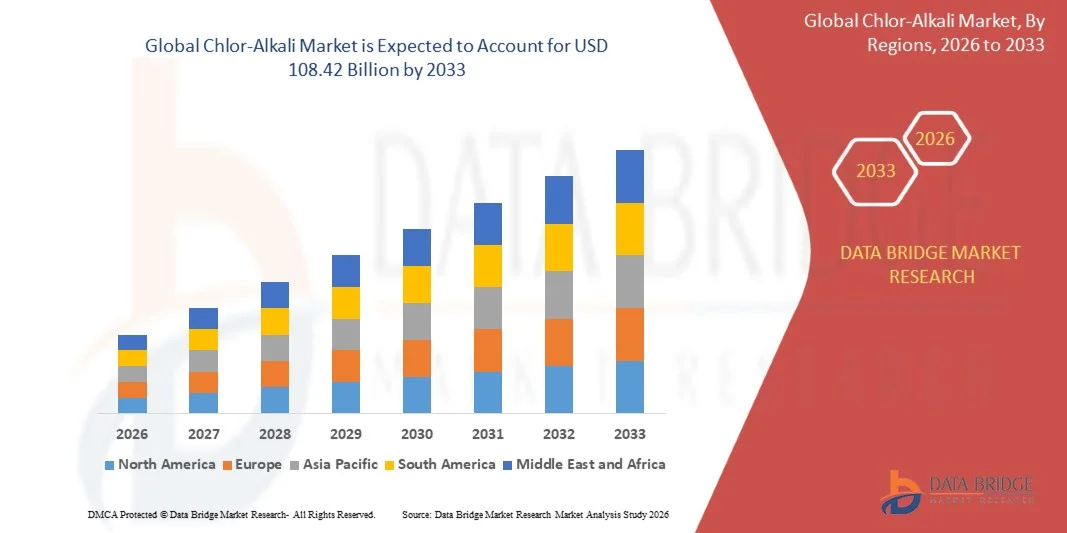
As per Data Bridge Market Research analysis the chlor-alkali market was valued at USD 75.66 billion in 2025 and is projected to reach USD 108.42 billion by 2033, growing at a CAGR of 4.60% from 2026 to 2033. The market is experiencing steady growth driven by increasing demand for chlorine and caustic soda across the chemicals, water treatment, pulp and paper, alumina, and construction industries, along with expanding industrialization and infrastructure development worldwide.
The growing need for safe drinking water, rising consumption of PVC in construction and automotive applications, and increasing demand for alumina used in aluminum production are accelerating chlor-alkali production ly. In addition, continued investments in membrane cell technology, energy-efficient manufacturing processes, and capacity expansions by leading chemical producers are improving production efficiency while supporting sustainability objectives, reinforcing the long-term growth of the chlor-alkali market.
Market Size & Forecast
- Market Value (2025): USD 75.66 Billion
- Expected Market Value (2033): USD 108.42 Billion
- Forecast CAGR (2026–2033): 4.60%
- Leading Region in 2025: Asia-Pacific
- Fastest Growing Region: North America
Key Market Trends & Insights
- Asia-Pacific dominated the chlor-alkali market with the largest revenue share of 62.72% in 2025, supported by rapid industrialization, urbanization, expanding chemical manufacturing, and rising investments in infrastructure across China, India, Japan, and Southeast Asia.
- North America chlor-alkali market is expected to witness the fastest growth rate from 2026 to 2033, supported by a well-established chemical manufacturing industry, abundant shale gas resources, and strong demand from PVC, water treatment, pulp and paper, and industrial chemical applications.
- The caustic soda lye segment held the largest market revenue share in 2025, driven by its extensive use across pulp and paper, alumina refining, water treatment, textiles, and chemical manufacturing industries. Its ease of handling in bulk industrial processes, consistent concentration levels, and widespread application in continuous production systems make it the preferred form of caustic soda for large-scale industrial consumers.
- The caustic soda flakes segment is expected to witness the fastest growth from 2026 to 2033, driven by increasing demand from soap and detergent manufacturing, pharmaceuticals, food processing, and export markets where solid-form transportation, longer shelf life, and easier storage offer operational advantages.
- The chlorine segment accounted for the largest market revenue share of 41.39% in 2025, owing to its extensive consumption in PVC manufacturing, water disinfection, chemical synthesis, pharmaceuticals, and paper bleaching. Growing investments in infrastructure and water treatment continue to support strong demand for chlorine worldwide.
- The sodium hypochlorite segment is projected to register the fastest growth from 2026 to 2033, driven by increasing investments in municipal water treatment, wastewater disinfection, healthcare sanitation, and industrial cleaning applications. Rising public health awareness and stricter water quality regulations are further accelerating segment growth.
Report Scope and Chlor-Alkali Market Segmentation
|
Attributes |
Chlor-Alkali Key Market Insights |
|
Segments Covered |
|
|
Countries Covered |
NorthAmerica
Europe
Asia-Pacific
MiddleEastandAfrica
SouthAmerica
|
|
Key Market Players |
|
|
Market Opportunities |
|
|
Value Added Data Infosets |
In addition to the insights on market scenarios such as market value, growth rate, segmentation, geographical coverage, and major players, the market reports curated by the Data Bridge Market Research also include import export analysis, production capacity overview, production consumption analysis, price trend analysis, climate change scenario, supply chain analysis, value chain analysis, raw material/consumables overview, vendor selection criteria, PESTLE Analysis, Porter Analysis, and regulatory framework. |
Chlor-Alkali Market Trends
Trend: Increasing Adoption Of Energy-Efficient Membrane Cell Technology
Growing emphasis on energy efficiency, lower carbon emissions, and sustainable chemical manufacturing is accelerating the adoption of membrane cell technology across the chlor-alkali industry. Manufacturers are increasingly replacing older mercury and diaphragm cell processes with membrane technology to reduce electricity consumption, improve product purity, and comply with stringent environmental regulations. This transition is strengthening operational efficiency while supporting sustainability initiatives.
For instance, in December 2025, Orbia announced that its Fluor & Energy Materials business completed the startup of a new chlor-alkali plant at the La Porte, Texas facility. The plant utilizes advanced membrane cell technology to improve energy efficiency, increase chlorine and caustic soda production, and strengthen supply for downstream PVC manufacturing in North America. The investment reflects the industry's continued transition toward modern, energy-efficient chlor-alkali production.
The growing transition toward membrane cell technology and continued investments in energy-efficient production facilities are expected to reinforce long-term growth of the chlor-alkali market by improving sustainability, reducing operating costs, and supporting increasing demand.
Chlor-Alkali Market Dynamics
Key Market Driver: Rising Demand For Chlorine And Caustic Soda Across Industrial Applications
The chlor-alkali industry continues to experience rising demand from water treatment, alumina refining, pulp and paper, chemicals, soaps and detergents, and PVC manufacturing. Increasing urbanization, infrastructure development, and industrial expansion are driving higher consumption of chlorine and caustic soda, making chlor-alkali products essential feedstocks for numerous downstream industries.
For instance, Olin Corporation reported in its 2024 Annual Report that its Chlor Alkali Products and Vinyls segment generated approximately USD 3.6 billion in sales during 2024. The company highlighted sustained demand for caustic soda and chlorine across water treatment, construction, and industrial manufacturing, while continuing investments to improve operational reliability and production efficiency.
As industrial manufacturing, infrastructure development, and water treatment activities continue to expand ly, chlor-alkali manufacturers are expected to benefit from sustained demand across a broad range of end-use industries.
Key Restraint/Challenge: High Energy Consumption And Electricity Cost Volatility
Chlor-alkali manufacturing remains one of the most electricity-intensive chemical production processes, making producers highly vulnerable to fluctuations in electricity prices and energy supply disruptions. Rising energy costs continue to pressure production economics and manufacturing profitability, particularly in regions with volatile electricity markets.
For instance, Occidental Petroleum Corporation stated in its 2024 Annual Report that its chemical business, OxyChem, remains significantly exposed to fluctuations in electricity and natural gas costs because chlor-alkali production requires substantial electrical energy. The company continues investing in operational efficiency initiatives to mitigate energy-related cost pressures.
Despite strong market demand, improving energy efficiency, optimizing manufacturing operations, and securing reliable power supplies will remain essential for chlor-alkali manufacturers to maintain long-term competitiveness.
Key Market Opportunity: Expansion Of Water Treatment And Sustainable Chemical Manufacturing
Governments worldwide continue increasing investments in drinking water treatment, wastewater management, and sustainable chemical manufacturing, creating substantial long-term demand for chlorine and caustic soda. Chlorine remains one of the most widely used disinfectants in municipal water treatment, while caustic soda plays a vital role in water purification, pulp and paper production, and alumina refining.
For instance, in April 2025, INEOS Inovyn announced the completion of the acquisition of the chlor-alkali business of Vynova Wilhelmshaven in Germany, strengthening its production network and improving long-term supply of chlorine and caustic soda for customers across water treatment, construction, healthcare, and industrial manufacturing. The acquisition supports INEOS Inovyn's strategy to expand sustainable chlor-alkali production capacity across Europe.
As governments strengthen investments in water infrastructure and sustainable industrial development, increasing demand for chlorine and caustic soda is expected to create substantial long-term growth opportunities for the chlor-alkali market.
Chlor-Alkali Market Scope
The market is segmented on the basis of type, product, production process, distribution channel, and end-user.
- By Type
On the basis of type, the chlor-alkali market is segmented into caustic soda flakes, caustic soda lye, and others. The caustic soda lye segment held the largest market revenue share in 2025, driven by its extensive use across pulp and paper, alumina refining, water treatment, textiles, and chemical manufacturing industries. Its ease of handling in bulk industrial processes, consistent concentration levels, and widespread application in continuous production systems make it the preferred form of caustic soda for large-scale industrial consumers.
The caustic soda flakes segment is expected to witness the fastest growth from 2026 to 2033, driven by increasing demand from soap and detergent manufacturing, pharmaceuticals, food processing, and export markets where solid-form transportation, longer shelf life, and easier storage offer operational advantages.
- By Product
On the basis of product, the chlor-alkali market is segmented into chlorine, sodium hydroxide and potassium hydroxide, caustic soda, sodium hypochlorite, vinyl chloride monomer, hydrogen chloride, and others. The chlorine segment accounted for the largest market revenue share of 41.39% in 2025, owing to its extensive consumption in PVC manufacturing, water disinfection, chemical synthesis, pharmaceuticals, and paper bleaching. Growing investments in infrastructure and water treatment continue to support strong demand for chlorine worldwide.
The sodium hypochlorite segment is projected to register the fastest growth from 2026 to 2033, driven by increasing investments in municipal water treatment, wastewater disinfection, healthcare sanitation, and industrial cleaning applications. Rising public health awareness and stricter water quality regulations are further accelerating segment growth.
- By Production Process
On the basis of production process, the chlor-alkali market is segmented into membrane cell process, diaphragm cell process, and mercury cell process. The membrane cell process segment held the largest market revenue share of 63.28% in 2025, driven by its superior energy efficiency, high product purity, and compliance with increasingly stringent environmental regulations. Continuous replacement of older mercury and diaphragm technologies has further strengthened the dominance of membrane cell production ly.
The membrane cell process is also expected to witness the fastest growth from 2026 to 2033, supported by ongoing modernization of chlor-alkali manufacturing facilities, increasing sustainability initiatives, and growing investments in energy-efficient chemical production technologies.
- By Distribution Channel
On the basis of distribution channel, the chlor-alkali market is segmented into B2B/direct sales, warehouses, e-commerce, specialty stores, and others. The B2B/direct sales segment accounted for the largest market revenue share in 2025, driven by long-term supply agreements between chlor-alkali manufacturers and major industrial consumers across the chemical processing, pulp and paper, alumina, water treatment, and PVC industries. Bulk purchasing and integrated supply chain management continue to support segment dominance.
The warehouses segment is expected to witness the fastest growth from 2026 to 2033, owing to increasing regional storage infrastructure, improved logistics capabilities, and growing demand for timely product availability across expanding industrial markets.
- By End-User
On the basis of end-user, the chlor-alkali market is segmented into soaps and detergents, paper and pulp, pharmaceuticals, organics, inorganics, textiles, water treatment, chemical processing, and others. The chemical processing segment held the largest market revenue share in 2025, driven by the extensive use of chlorine and caustic soda as essential feedstocks in the production of PVC, organic chemicals, inorganic chemicals, solvents, and numerous specialty chemicals. Continued industrial expansion and downstream chemical manufacturing are supporting sustained segment growth.
The water treatment segment is projected to register the fastest growth from 2026 to 2033, driven by increasing investments in drinking water infrastructure, wastewater treatment facilities, and industrial water purification systems. Rising environmental regulations and growing concerns regarding water quality are expected to further accelerate demand for chlor-alkali products in municipal and industrial water treatment applications.
Chlor-Alkali Market Regional Analysis
Asia-Pacific Chlor-Alkali Market Insight
The Asia-Pacific dominated the chlor-alkali market with the largest revenue share of 62.72% in 2025, supported by rapid industrialization, urbanization, expanding chemical manufacturing, and rising investments in infrastructure across China, India, Japan, and Southeast Asia. Increasing demand for PVC, alumina, paper and pulp, textiles, and water treatment chemicals is significantly driving regional consumption. The growing establishment of large-scale chlor-alkali production facilities further enhances the region's market growth.
Japan Chlor-Alkali Market Insight
The Japan chlor-alkali market is expected to witness the fastest growth rate from 2026 to 2033 due to increasing demand for high-purity chlor-alkali products across electronics, specialty chemicals, pharmaceuticals, and water treatment applications. The country's strong focus on technological innovation, energy-efficient manufacturing processes, and environmental sustainability is encouraging modernization of chlor-alkali production facilities. Continued investments in advanced membrane cell technology are further supporting market development.
China Chlor-Alkali Market Insight
The China chlor-alkali market accounted for the largest market revenue share in Asia-Pacific in 2025, attributed to the country's large chemical manufacturing sector, extensive PVC production capacity, and strong demand from construction, textiles, alumina refining, and water treatment industries. Rapid industrialization, expanding infrastructure projects, and continuous investments in modern chlor-alkali production facilities continue to strengthen China's leadership in the regional market. Government support for cleaner production technologies and increasing adoption of membrane cell processes further contribute to long-term market growth.
North America Chlor-Alkali Market Insight
North America chlor-alkali market is expected to witness the fastest growth rate from 2026 to 2033, supported by a well-established chemical manufacturing industry, abundant shale gas resources, and strong demand from PVC, water treatment, pulp and paper, and industrial chemical applications. The region also benefits from widespread adoption of energy-efficient membrane cell technology and the presence of major chlor-alkali producers with integrated production facilities. Continued investments in infrastructure, water treatment, and downstream chemical manufacturing further reinforce North America's leadership in the market.
U.S. Chlor-Alkali Market Insight
The U.S. chlor-alkali market captured the largest revenue share in 2025 within North America, fueled by extensive demand for chlorine and caustic soda across construction, water treatment, alumina refining, and chemical processing industries. The country's large integrated chlor-alkali and vinyl production facilities, coupled with competitive energy availability and ongoing investments in manufacturing modernization, continue to support market expansion. Rising infrastructure development and increasing PVC production further contribute to sustained market growth.
Europe Chlor-Alkali Market Insight
The Europe chlor-alkali market is expected to witness the fastest growth rate from 2026 to 2033, primarily driven by increasing investments in sustainable chemical manufacturing, stringent environmental regulations, and continued replacement of older production technologies with energy-efficient membrane cell processes. Rising demand from water treatment, pharmaceuticals, construction chemicals, and specialty chemical industries is further supporting market expansion. The region's strong emphasis on decarbonization and circular economy initiatives continues to accelerate adoption of advanced chlor-alkali production technologies.
U.K. Chlor-Alkali Market Insight
The U.K. chlor-alkali market is expected to witness the fastest growth rate from 2026 to 2033, driven by increasing investments in water treatment infrastructure, pharmaceutical manufacturing, and industrial chemical production. Growing emphasis on reducing industrial emissions and improving manufacturing efficiency is encouraging wider adoption of membrane cell technology. In addition, continued demand for chlorine-based water disinfection and caustic soda across multiple industries is expected to support market growth.
Germany Chlor-Alkali Market Insight
The Germany chlor-alkali market is expected to witness the fastest growth rate from 2026 to 2033, fueled by the country's strong chemical manufacturing base and increasing demand for chlorine and caustic soda across automotive, pharmaceuticals, construction, and industrial processing industries. Germany's focus on energy-efficient manufacturing, sustainable production technologies, and advanced chemical processing continues to strengthen the adoption of modern chlor-alkali facilities. Growing investments in industrial modernization further support market expansion.
Chlor-Alkali Market Share
The Chlor-Alkali industry is primarily led by well-established companies, including:
- Olin Corporation (U.S.)
- Westlake Corporation (U.S.)
- Occidental Petroleum Corporation (U.S.)
- INEOS Inovyn (U.K.)
- Formosa Plastics Corporation (Taiwan)
- Tosoh Corporation (Japan)
- AGC Inc. (Japan)
- Hanwha Solutions Corporation (South Korea)
- Solvay SA (Belgium)
- Tata Chemicals Limited (India)
- Nirma Limited (India)
- Xinjiang Zhongtai Chemical Co., Ltd. (China)
- Wanhua Chemical Group Co., Ltd. (China)
- Covestro AG (Germany)
- Vynova Group (Belgium)
Latest Developments in Chlor-Alkali Market
- In January 2025, Şişecam completed the acquisition of Ciner Group's remaining shares in its U.S. soda ash operations, securing 100% ownership of Pacific Soda LLC and increasing its stake in Şişecam Wyoming LLC to 51%. The transaction significantly expands the company's natural soda ash production capacity and strengthens its position in the North American market. The investment supports long-term supply security and moves Şişecam closer to becoming the leader in natural soda ash production.
- In November 2024, Genesis Alkali, a subsidiary of Genesis Energy, entered into a multi-year supply agreement with SOLARCYCLE to provide Ecosoda, a low-carbon natural soda ash produced at its Granger, Wyoming facility. The agreement supports domestic production of ultra-low-carbon solar glass while helping reduce greenhouse gas emissions across the solar manufacturing supply chain. It also strengthens demand for sustainable soda ash in the rapidly growing renewable energy sector.

- Interactive Data Analysis Dashboard
- Company Analysis Dashboard for high growth potential opportunities
- Research Analyst Access for customization & queries
- Competitor Analysis with Interactive dashboard
- Latest News, Updates & Trend analysis
- Harness the Power of Benchmark Analysis for Comprehensive Competitor Tracking
Global Chlor Alkali Market, Supply Chain Analysis and Ecosystem Framework
To support market growth and help clients navigate the impact of geopolitical shifts, DBMR has integrated in-depth supply chain analysis into its Global Chlor Alkali Market research reports. This addition empowers clients to respond effectively to global changes affecting their industries. The supply chain analysis section includes detailed insights such as Global Chlor Alkali Market consumption and production by country, price trend analysis, the impact of tariffs and geopolitical developments, and import and export trends by country and HSN code. It also highlights major suppliers with data on production capacity and company profiles, as well as key importers and exporters. In addition to research, DBMR offers specialized supply chain consulting services backed by over a decade of experience, providing solutions like supplier discovery, supplier risk assessment, price trend analysis, impact evaluation of inflation and trade route changes, and comprehensive market trend analysis.
Data collection and base year analysis are done using data collection modules with large sample sizes. The stage includes obtaining market information or related data through various sources and strategies. It includes examining and planning all the data acquired from the past in advance. It likewise envelops the examination of information inconsistencies seen across different information sources. The market data is analysed and estimated using market statistical and coherent models. Also, market share analysis and key trend analysis are the major success factors in the market report. To know more, please request an analyst call or drop down your inquiry.
The key research methodology used by DBMR research team is data triangulation which involves data mining, analysis of the impact of data variables on the market and primary (industry expert) validation. Data models include Vendor Positioning Grid, Market Time Line Analysis, Market Overview and Guide, Company Positioning Grid, Patent Analysis, Pricing Analysis, Company Market Share Analysis, Standards of Measurement, Global versus Regional and Vendor Share Analysis. To know more about the research methodology, drop in an inquiry to speak to our industry experts.
Data Bridge Market Research is a leader in advanced formative research. We take pride in servicing our existing and new customers with data and analysis that match and suits their goal. The report can be customized to include price trend analysis of target brands understanding the market for additional countries (ask for the list of countries), clinical trial results data, literature review, refurbished market and product base analysis. Market analysis of target competitors can be analyzed from technology-based analysis to market portfolio strategies. We can add as many competitors that you require data about in the format and data style you are looking for. Our team of analysts can also provide you data in crude raw excel files pivot tables (Fact book) or can assist you in creating presentations from the data sets available in the report.













