


Chlorinating Agents Market Size
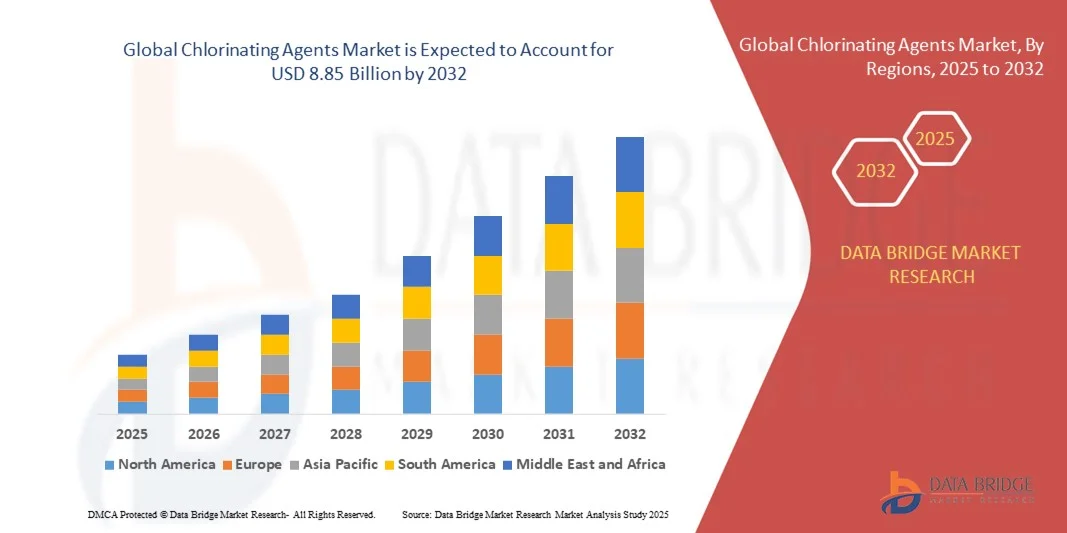
- The global chlorinating agents market size was valued at USD 5.77 billion in 2024 and is expected to reach USD 8.85 billion by 2032, at a CAGR of 5.50% during the forecast period
- The market growth is largely fueled by increasing demand for safe and clean water, coupled with the expanding use of chlorinating agents in water and wastewater treatment, industrial applications, and pharmaceuticals. The strong oxidative and disinfectant properties of chlorinating agents make them indispensable for municipal water supply, industrial processes, and hygiene applications, thereby driving widespread adoption
- Furthermore, rising industrialization, urbanization, and government initiatives to improve public health and water quality are boosting the consumption of chlorinating agents. For instance, companies such as BASF SE and Dow are investing in production and distribution capacities to meet growing regional demand, accelerating market growth and solidifying the role of chlorinating agents as essential chemicals in industrial and municipal sectors
Chlorinating Agents Market Analysis
- Chlorinating agents are increasingly vital in specialty applications, including medical, food, and personal care sectors, due to their effectiveness in sterilization, preservation, and hygiene. Their versatility across multiple industries is strengthening their market relevance
- The escalating demand for chlorinating agents is supported by technological advancements in production and formulation, including safer handling, higher purity products, and eco-friendly solutions. These innovations encourage adoption among industries prioritizing sustainability, regulatory compliance, and operational efficiency
- Asia-Pacific dominated the chlorinating agents market in 2024, due to expanding water and wastewater treatment infrastructure, increasing industrialization, and a strong presence of chemical manufacturing hubs
- North America is expected to be the fastest growing region in the chlorinating agents market during the forecast period due to strong demand for water treatment, pharmaceutical, and industrial applications
- Inorganic segment dominated the market with a market share of 69% in 2024, due to its widespread use in water treatment and industrial applications. Inorganic chlorinating agents, such as sodium hypochlorite and calcium hypochlorite, are preferred for their high stability, strong oxidative properties, and cost-effectiveness, making them suitable for large-scale operations. Their efficacy in disinfection, bleaching, and sanitization processes has established them as the standard choice across multiple industries. Manufacturers also favor inorganic agents due to their long shelf life and ease of handling, which enhances operational efficiency. The segment’s dominance is further supported by regulatory approvals and extensive application knowledge among industrial users
Report Scope and Chlorinating Agents Market Segmentation
|
Attributes |
Chlorinating Agents Key Market Insights |
|
Segments Covered |
|
|
Countries Covered |
North America
Europe
Asia-Pacific
Middle East and Africa
South America
|
|
Key Market Players |
|
|
Market Opportunities |
|
|
Value Added Data Infosets |
In addition to the insights on market scenarios such as market value, growth rate, segmentation, geographical coverage, and major players, the market reports curated by the Data Bridge Market Research also include import export analysis, production capacity overview, production consumption analysis, price trend analysis, climate change scenario, supply chain analysis, value chain analysis, raw material/consumables overview, vendor selection criteria, PESTLE Analysis, Porter Analysis, and regulatory framework. |
Chlorinating Agents Market Trends
Rising Use of Chlorinating Agents in Pharmaceuticals, Food, and Personal Care
- A key trend shaping the chlorinating agents market is the growing utilization of these compounds across pharmaceutical, food processing, and personal care industries. Chlorinating agents are widely employed for their disinfectant, bleaching, and sterilizing properties, making them indispensable in applications requiring hygiene and microbial control under stringent quality standards
- For instance, companies such as BASF SE and Occidental Petroleum Corporation have expanded their chlorinated compound portfolios to cater to the pharmaceutical and food sectors. These solutions are used in manufacturing active pharmaceutical ingredients (APIs) and ensuring microbial safety in beverage and dairy processing plants, reflecting the compound’s versatility and role in maintaining product integrity
- In pharmaceuticals, chlorinating agents support key synthesis processes for antibiotics, anti-inflammatory medications, and intermediates. Their controlled reactivity ensures high chemical purity and efficiency in compound production, making them a critical component in chemical manufacturing chains
- In addition, the food and personal care industries have increasingly adopted chlorinating agents for sanitation and bleaching purposes. Chlorine-based agents such as sodium hypochlorite are used extensively for surface sterilization in food processing units and cosmetic product formulation, ensuring preservation and hygiene compliance
- The development of safer and more controlled chlorine delivery systems is helping manufacturers minimize by-product formation and enhance safety during use. Continuous research is also being directed toward eco-friendlier alternatives that maintain efficacy while meeting sustainability standards in regulated markets
- Overall, the increasing cross-sector integration of chlorinating agents into health, food, and consumer product manufacturing is reinforcing their strategic significance. This trend highlights their importance as essential chemical intermediates for maintaining hygiene, quality, and performance across multiple industrial and consumer applications
Chlorinating Agents Market Dynamics
Driver
Growing Demand for Safe Water and Industrial Applications
- The accelerating global demand for safe and drinkable water, coupled with industrial requirements for effective disinfection, is a primary driver supporting the chlorinating agents market. Chlorination remains one of the most widely adopted methods for water treatment due to its efficiency in neutralizing pathogens and providing residual protection throughout distribution systems
- For instance, The Chemours Company and Ercros S.A. have expanded their chlorine-based water disinfection product lines targeting municipal water treatment facilities and industrial processing units. Their focus on maintaining consistent chlorine dosing capacity enables compliance with global health and safety standards in both developed and emerging regions
- Chlorinating agents are also extensively used in pulp and paper, textiles, and chemical manufacturing where oxidation and bleaching processes are critical. Their role in maintaining microbial control and product consistency across industrial water systems ensures both operational safety and cost efficiency
- In addition, urbanization and population growth have led to heightened demand for clean water infrastructure, driving major government investments in advanced water purification and sanitation systems. Chlorine-based agents are integral components of these mechanisms due to their affordability and established efficacy
- The long-standing reliability of chlorination technology, combined with advances in distribution and automation systems for water dosage control, continues to reinforce the dominance of chlorinating agents in industrial and domestic disinfection. This sustained reliance underscores their necessity for global public health maintenance and essential industrial performance applications
Restraint/Challenge
Regulatory and Environmental Pressures on Chlorine Handling
- A significant challenge impacting the chlorinating agents market is the increasing intensity of environmental and regulatory pressures concerning chlorine handling, transportation, and disposal. Strict regulations are being implemented to mitigate the risks associated with chlorine’s hazardous nature and its potential to produce toxic by-products during application
- For instance, several regions, including the European Union and the United States, have updated their chemical management frameworks, such as REACH and EPA guidelines, requiring manufacturers such as Occidental Petroleum Corporation and BASF SE to enhance worker safety and emission control. Compliance with such frameworks raises production and logistics costs for chlorine-based agents
- Chlorine gas and its derivatives can pose handling and exposure hazards if not properly contained or managed. This necessitates investments in advanced containment systems, safety monitoring, and emergency response infrastructure, putting financial strain on small and midsized producers
- In addition, growing awareness of environmental contamination linked to chlorination by-products such as trihalomethanes has led to the reconsideration of usage limits or substitution with safer oxidative agents in sensitive applications. Such shifts have encouraged the development of non-chlorine alternatives such as ozone-based and ultraviolet disinfection systems
- Balancing regulatory compliance with operational efficiency remains a key challenge to ensure safe, sustainable chlorination processes. Industry adaptation through innovation in safer formulations, upgraded containment technologies, and adherence to global sustainability goals will be essential for mitigating environmental risks while maintaining the market’s critical functional roles across sectors
Chlorinating Agents Market Scope
The market is segmented on the basis of product type, application, and end-user.
- By Product Type
On the basis of product type, the chlorinating agents market is segmented into inorganic and organic. The inorganic segment dominated the market with the largest revenue share of 69% in 2024, driven by its widespread use in water treatment and industrial applications. Inorganic chlorinating agents, such as sodium hypochlorite and calcium hypochlorite, are preferred for their high stability, strong oxidative properties, and cost-effectiveness, making them suitable for large-scale operations. Their efficacy in disinfection, bleaching, and sanitization processes has established them as the standard choice across multiple industries. Manufacturers also favor inorganic agents due to their long shelf life and ease of handling, which enhances operational efficiency. The segment’s dominance is further supported by regulatory approvals and extensive application knowledge among industrial users.
The organic segment is expected to witness the fastest growth rate from 2025 to 2032, fueled by increasing demand in specialty chemical applications and pharmaceutical synthesis. Organic chlorinating agents provide targeted reactivity and milder reaction conditions, making them ideal for high-value applications where precision and selectivity are critical. The rising adoption in pharmaceutical and fine chemical industries, supported by research and development in greener and safer chlorination processes, is driving growth. Their compatibility with advanced chemical synthesis methods and versatility in producing complex compounds further contributes to their accelerating demand.
- By Application
On the basis of application, the chlorinating agents market is segmented into medical application, biological activity, antioxidants, food additive reagent, and others. The water treatment application dominated the market with the largest revenue share in 2024 due to the essential role of chlorinating agents in disinfecting potable water and controlling microbial contamination. High efficiency, cost-effectiveness, and reliability in large-scale water treatment facilities make chlorinating agents indispensable. Their strong oxidative properties ensure rapid elimination of pathogens and algae, ensuring safe water supply in municipal and industrial sectors. Government regulations and public health policies mandating water disinfection further reinforce the demand for chlorinating agents in this application.
The antioxidant and food additive reagent segment is expected to witness the fastest growth from 2025 to 2032, driven by increasing demand for food safety, shelf-life extension, and preservation of nutrients. For instance, chlorinating agents are employed to maintain product quality in beverages, processed foods, and dietary supplements by inhibiting microbial growth and oxidative spoilage. Rising consumer awareness regarding food safety and regulatory compliance in the food industry is accelerating the adoption of these agents. In addition, innovation in functional foods and natural preservatives is expanding opportunities for chlorinating agents in this application segment.
- By End Users
On the basis of end users, the chlorinating agents market is segmented into water and wastewater treatment, pharmaceutical, cosmetics and personal care, ink and dye, food and feed industry, electronic industry, paper industry, and others. The water and wastewater treatment segment dominated the market with the largest revenue share in 2024, owing to the critical need for safe and clean water globally. Chlorinating agents ensure efficient microbial control, reduce odor and color in water, and prevent biofilm formation in treatment facilities. Municipal authorities and industrial operators prioritize these agents due to their proven reliability, high oxidative strength, and ease of application in both centralized and decentralized water systems. In addition, stringent environmental regulations mandating effective water disinfection contribute to sustained demand in this segment.
The pharmaceutical segment is expected to witness the fastest growth from 2025 to 2032, fueled by rising usage of chlorinating agents in drug synthesis, sterilization, and formulation processes. For instance, organic and mild inorganic chlorinating agents are increasingly used for controlled chlorination reactions in active pharmaceutical ingredient (API) production. The growth is further supported by expanding pharmaceutical manufacturing in emerging markets and increased research in advanced therapeutic compounds. In addition, the demand for high-purity chemicals in medicinal and healthcare applications continues to drive adoption of specialized chlorinating agents.
Chlorinating Agents Market Regional Analysis
- Asia-Pacific dominated the chlorinating agents market with the largest revenue share in 2024, driven by expanding water and wastewater treatment infrastructure, increasing industrialization, and a strong presence of chemical manufacturing hubs
- The region’s cost-effective production landscape, rising investments in specialty chemicals, and growing exports of chlorinating compounds are accelerating market growth
- Availability of skilled labor, supportive government policies, and rapid industrialization across developing economies are contributing to increased consumption of chlorinating agents in municipal, pharmaceutical, and industrial sectors
China Chlorinating Agents Market Insight
China held the largest share in the Asia-Pacific chlorinating agents market in 2024, owing to its leadership in chemical production, large-scale water treatment projects, and robust industrial base. Favorable government policies promoting chemical sector expansion, extensive export capabilities, and investments in specialty chemicals are key growth drivers. The country’s rising demand for potable water treatment, pharmaceuticals, and industrial applications is further strengthening the market.
India Chlorinating Agents Market Insight
India is witnessing the fastest growth in the Asia-Pacific region, fueled by rapid urbanization, increasing water treatment projects, and rising investments in specialty chemical manufacturing. Government initiatives aimed at improving water quality, along with expanding pharmaceutical and food processing sectors, are driving demand for chlorinating agents. In addition, growing exports of chemicals and the establishment of advanced production facilities are supporting strong market expansion.
Europe Chlorinating Agents Market Insight
The Europe chlorinating agents market is expanding steadily, supported by stringent regulatory standards, high demand for safe water treatment, and increasing investments in sustainable chemical production. The region emphasizes environmental compliance, high-purity chemical use, and advanced formulations, particularly in pharmaceuticals, personal care, and industrial applications. Rising adoption of chlorinating agents in specialty and fine chemical production is further boosting market growth.
Germany Chlorinating Agents Market Insight
Germany’s chlorinating agents market is driven by its established chemical industry, high-precision manufacturing capabilities, and focus on sustainability and regulatory compliance. The country has strong R&D networks fostering innovation in chemical production and water treatment solutions. Demand is particularly strong for use in pharmaceuticals, specialty chemicals, and industrial processes requiring high-purity chlorinating agents.
U.K. Chlorinating Agents Market Insight
The U.K. market is supported by a mature life sciences sector, increasing focus on sustainable chemical practices, and growth in pharmaceutical and personal care industries. Rising investments in research, specialty chemicals, and advanced water treatment technologies are enhancing market adoption. The country’s focus on high-quality, compliant chemical production contributes to steady market growth.
North America Chlorinating Agents Market Insight
North America is projected to grow at the fastest CAGR from 2025 to 2032, driven by strong demand for water treatment, pharmaceutical, and industrial applications. Advancements in chemical manufacturing, growing reliance on high-purity intermediates, and reshoring of chemical production are boosting market expansion. Increasing regulatory compliance, infrastructure modernization, and collaboration between chemical producers and end-user industries support rapid growth.
U.S. Chlorinating Agents Market Insight
The U.S. accounted for the largest share in the North America market in 2024, underpinned by its expansive pharmaceutical, water treatment, and specialty chemical industries. The country’s strong R&D infrastructure, focus on sustainability, and regulatory standards promote the use of high-purity chlorinating agents. Presence of key market players and a mature distribution network further solidify the U.S.’s leading position in the region.
Chlorinating Agents Market Share
The chlorinating agents industry is primarily led by well-established companies, including:
- BASF SE (Germany)
- Dow (U.S.)
- DIC CORPORATION (Japan)
- AGC Chemicals Americas (U.S.)
- HPL Additives Limited (U.K.)
- Nouryon (Netherlands)
- Heetu Chemicals & Alkalies Limited (India)
- Kemira (Finland)
- ACURO ORGANICS LIMITED (India)
- Evonik Industries AG (Germany)
- ORGANICS INDUSTRIES PVT. LTD. (India)
- TGV Group (India)
- PPG Industries, Inc. (U.S.)
- Supraveni Chemicals Pvt. Ltd. (India)
- Spartan Chemical Company, Inc. (U.S.)
- Siemer Milling Company (U.S.)
- Solvay (Belgium)
- Ajanta Group (India)
- Lords Chloro Alkali Limited (India)
- Aditya Birla Chemicals (India)
Latest Developments in Global Chlorinating Agents Market
- In April 2025 the Gazechim Group acquired the liquefied chlorine‑gas distribution operations of Brenntag Química in Spain, significantly strengthening Gazechim’s regional distribution network for chlorine‑based products. This acquisition allows the company to streamline its supply chain for municipal water treatment and industrial applications, improving delivery efficiency and expanding its market presence in Southern Europe. By controlling key distribution channels, Gazechim is positioned to respond faster to customer demand and capitalize on the growing requirement for safe and reliable water treatment chemicals
- In August 2025 Shivtek Spechemi Industries Ltd acquired approximately eight acres of land from Bodal Chemicals Ltd in Rajpura, India, to establish a specialty chemical manufacturing facility focusing on chlorinated paraffin, chlorinated polyethylene, and related chlorinating agents. This strategic move enables Shivtek to scale production for both domestic and export markets, targeting rising demand in specialty chlorinated products. The investment positions the company to meet regulatory and environmental standards, while also tapping into high-growth sectors such as pharmaceuticals, plastics, and industrial chemicals
- In May 2025 HASA, Inc. completed the acquisition of key assets from Clearwater Chemicals, a Texas-based company specializing in liquid sodium hypochlorite and water-treatment chemicals. This acquisition expands HASA’s footprint in the North American water-treatment market, providing enhanced production capacity and stronger distribution capabilities. It also allows HASA to offer a wider range of chlorinating solutions for municipal, industrial, and commercial applications, increasing its competitive advantage and reinforcing its leadership in safe and effective water disinfection
- In April 2025 Tokyo Chemical Industry Co., Ltd. (TCI) launched a series of high-performance chlorinating reagents, including products such as N‑Acetoxy‑N‑chloro‑4‑nitrobenzamide, targeting fine-chemical and specialty synthesis markets. These product launches strengthen TCI’s portfolio in high-value, selective chlorination applications, addressing demand from pharmaceutical, agrochemical, and specialty chemical manufacturers. By offering reagents that enable more precise and milder reaction conditions, TCI supports innovation in complex chemical synthesis while differentiating itself from commodity chlorinating products
- In March 2024 Bondalti Industries announced plans to acquire Ercros, a Spanish chlor-alkali and PVC producer, in a move worth approximately €329 million. This acquisition enables Bondalti to diversify its portfolio into chlorine derivatives, strengthen its European market presence, and integrate downstream operations. By consolidating production capabilities and expanding its range of chlorinated products, Bondalti is positioned to meet increasing industrial and municipal demand, while also achieving operational efficiencies and reinforcing its competitive standing in the global chlorinating agents market

- Interactive Data Analysis Dashboard
- Company Analysis Dashboard for high growth potential opportunities
- Research Analyst Access for customization & queries
- Competitor Analysis with Interactive dashboard
- Latest News, Updates & Trend analysis
- Harness the Power of Benchmark Analysis for Comprehensive Competitor Tracking
Global Chlorinating Agents Market, Supply Chain Analysis and Ecosystem Framework
To support market growth and help clients navigate the impact of geopolitical shifts, DBMR has integrated in-depth supply chain analysis into its Global Chlorinating Agents Market research reports. This addition empowers clients to respond effectively to global changes affecting their industries. The supply chain analysis section includes detailed insights such as Global Chlorinating Agents Market consumption and production by country, price trend analysis, the impact of tariffs and geopolitical developments, and import and export trends by country and HSN code. It also highlights major suppliers with data on production capacity and company profiles, as well as key importers and exporters. In addition to research, DBMR offers specialized supply chain consulting services backed by over a decade of experience, providing solutions like supplier discovery, supplier risk assessment, price trend analysis, impact evaluation of inflation and trade route changes, and comprehensive market trend analysis.
Data collection and base year analysis are done using data collection modules with large sample sizes. The stage includes obtaining market information or related data through various sources and strategies. It includes examining and planning all the data acquired from the past in advance. It likewise envelops the examination of information inconsistencies seen across different information sources. The market data is analysed and estimated using market statistical and coherent models. Also, market share analysis and key trend analysis are the major success factors in the market report. To know more, please request an analyst call or drop down your inquiry.
The key research methodology used by DBMR research team is data triangulation which involves data mining, analysis of the impact of data variables on the market and primary (industry expert) validation. Data models include Vendor Positioning Grid, Market Time Line Analysis, Market Overview and Guide, Company Positioning Grid, Patent Analysis, Pricing Analysis, Company Market Share Analysis, Standards of Measurement, Global versus Regional and Vendor Share Analysis. To know more about the research methodology, drop in an inquiry to speak to our industry experts.
Data Bridge Market Research is a leader in advanced formative research. We take pride in servicing our existing and new customers with data and analysis that match and suits their goal. The report can be customized to include price trend analysis of target brands understanding the market for additional countries (ask for the list of countries), clinical trial results data, literature review, refurbished market and product base analysis. Market analysis of target competitors can be analyzed from technology-based analysis to market portfolio strategies. We can add as many competitors that you require data about in the format and data style you are looking for. Our team of analysts can also provide you data in crude raw excel files pivot tables (Fact book) or can assist you in creating presentations from the data sets available in the report.













