


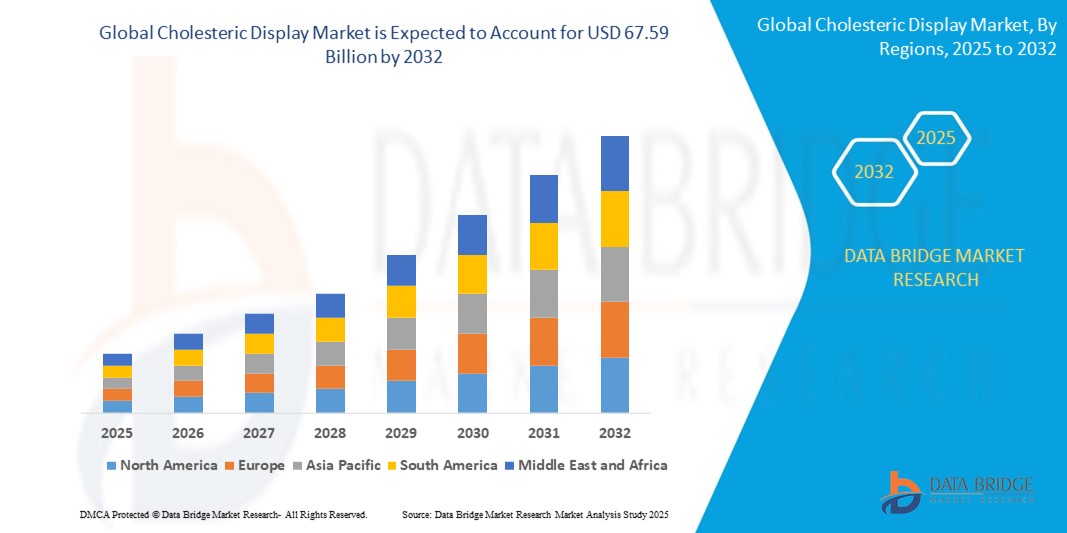
Cholesteric Display Market Size
- The global cholesteric display market size was valued at USD 8.36 billion in 2024 and is expected to reach USD 67.59 billion by 2032, at a CAGR of 29.85% during the forecast period
- The market growth is primarily driven by the increasing adoption of energy-efficient display technologies and advancements in flexible and foldable display solutions, fostering greater integration in consumer electronics and smart devices
- Rising consumer demand for low-power, high-visibility displays in applications such as e-readers, wearables, and electronic shelf labels is positioning cholesteric displays as a preferred choice for modern display solutions. These factors are significantly accelerating market expansion
Cholesteric Display Market Analysis
- Cholesteric displays, known for their low power consumption and bistable properties, are becoming essential components in modern electronic devices, offering high readability in various lighting conditions and seamless integration with IoT-enabled ecosystems
- The growing demand for cholesteric displays is fueled by the widespread adoption of smart devices, increasing emphasis on energy-efficient technologies, and the rising popularity of flexible and wearable electronics
- North America dominated the cholesteric display market with the largest revenue share of 35.9% in 2024, driven by early adoption of advanced display technologies, high consumer spending on electronics, and the presence of key industry players
- Asia-Pacific is expected to be the fastest-growing region during the forecast period, propelled by rapid urbanization, increasing disposable incomes, and growing demand for consumer electronics and smart retail solutions
- The E-Readers segment dominated the largest market revenue share of 32.5% in 2024, driven by the widespread adoption of e-readers for their low power consumption, paper-such as readability, and increasing demand for digital reading solutions
Report Scope and Cholesteric Display Market Segmentation
|
Attributes |
Cholesteric Display Key Market Insights |
|
Segments Covered |
|
|
Countries Covered |
North America
Europe
Asia-Pacific
Middle East and Africa
South America
|
|
Key Market Players |
|
|
Market Opportunities |
|
|
Value Added Data Infosets |
In addition to the insights on market scenarios such as market value, growth rate, segmentation, geographical coverage, and major players, the market reports curated by the Data Bridge Market Research also include in-depth expert analysis, geographically represented company-wise production and capacity, network layouts of distributors and partners, detailed and updated price trend analysis and deficit analysis of supply chain and demand. |
Cholesteric Display Market Trends
“Increasing Integration of Advanced Reflective Technologies and IoT Connectivity”
- The global cholesteric display market is experiencing a notable trend toward integrating advanced reflective technologies and Internet of Things (IoT) connectivity
- These advancements enable cholesteric displays to deliver superior readability in diverse lighting conditions, particularly in direct sunlight, due to their reflective properties, while consuming minimal power
- IoT-enabled cholesteric displays facilitate real-time data updates and remote management, making them ideal for applications such as electronic shelf labels, smart cards, and digital signage
- For instances, companies are developing IoT-driven cholesteric display platforms for retail environments, allowing dynamic pricing updates and inventory tracking, or for wearables that provide real-time health data with minimal battery drain
- This trend enhances the functionality and appeal of cholesteric displays, driving their adoption across consumer electronics, retail, and healthcare sectors
- Advanced algorithms are being utilized to optimize display performance, enabling features such as color e-paper displays and flexible form factors for innovative applications
Cholesteric Display Market Dynamics
Driver
“Rising Demand for Energy-Efficient and Eco-Friendly Display Solutions”
- The growing consumer and industry demand for energy-efficient and sustainable display technologies is a key driver for the global cholesteric display market
- Cholesteric displays, known for their low power consumption and paper-such as readability, are increasingly adopted in applications such as e-readers, wearables, and electronic shelf labels
- Government initiatives promoting eco-friendly technologies, particularly in regions such as Europe and North America, are encouraging the adoption of cholesteric displays to reduce carbon footprints
- The proliferation of smart city infrastructure and IoT applications is further expanding the use of cholesteric displays, leveraging their low power requirements and high visibility for smart signage and IoT-enabled devices
- Manufacturers are increasingly integrating cholesteric displays as standard features in devices such as e-readers and smart wearables to meet consumer expectations for sustainable and high-performance products
Restraint/Challenge
“High Development Costs and Limited Color Capabilities”
- The high initial costs associated with the development and integration of cholesteric display technologies can be a significant barrier, particularly for small-scale manufacturers or in cost-sensitive markets
- Designing and producing cholesteric displays, especially flexible and foldable variants, involves complex processes and expensive materials, increasing overall costs
- In addition, limited color richness and video capability compared to traditional LCD and OLED displays pose challenges, restricting their use in applications requiring vibrant visuals or dynamic content
- The fragmented regulatory landscape across regions regarding electronic waste and recycling standards for display technologies can complicate compliance for manufacturers operating globally
- These factors may deter widespread adoption in certain markets and applications, particularly where cost sensitivity or the need for high-definition visuals is a priority
Cholesteric Display market Scope
The market is segmented on the basis of product, end-user, and type.
- By Product
On the basis of product, the global cholesteric display market is segmented into E-Readers, Mobile Devices, Smart Cards, Poster & Signage, Auxiliary Displays, Electronic Shelf Label, and Wearables. The E-Readers segment dominated the largest market revenue share of 32.5% in 2024, driven by the widespread adoption of e-readers for their low power consumption, paper-such as readability, and increasing demand for digital reading solutions.
The Electronic Shelf Label segment is expected to witness the fastest growth rate from 2025 to 2032, fueled by the rising adoption in retail for dynamic pricing, real-time product information updates, and energy-efficient display solutions. Advancements in IoT integration and smart retail technologies further accelerate adoption, enhancing operational efficiency and customer experience.
- By End-User
On the basis of end-user, the global cholesteric display market is segmented into Automotive, Consumer Electronics, Retail, Healthcare, and Media & Entertainment. The Consumer Electronics segment dominated the market revenue share of 38.5% in 2024, driven by the high demand for cholesteric displays in e-readers, wearables, and mobile devices due to their energy efficiency and sunlight readability.
The Retail segment is anticipated to experience the fastest growth rate of 18.2% from 2025 to 2032, propelled by the increasing use of electronic shelf labels and digital signage for dynamic pricing and advertising. The shift toward smart retail and the need for eco-friendly, low-power displays are key growth drivers.
- By Type
On the basis of type, the global cholesteric display market is segmented into Flat EPDs, Curved EPDs, Flexible EPDs, and Foldable EPDs. The Flat EPDs segment held the largest market revenue share of 45.0% in 2024, owing to their widespread use in e-readers and electronic shelf labels, where their simple design and cost-effectiveness ensure robust performance and reliability.
The Flexible EPDs segment is expected to witness the fastest growth rate from 2025 to 2032, driven by the rising demand for innovative form factors in wearables, mobile devices, and foldable displays. Advancements in material science and increasing consumer preference for lightweight, durable, and versatile displays are accelerating adoption.
Cholesteric Display Market Regional Analysis
- North America dominated the cholesteric display market with the largest revenue share of 35.9% in 2024, driven by early adoption of advanced display technologies, high consumer spending on electronics, and the presence of key industry players
- Consumers prioritize cholesteric displays for their low power consumption, readability in sunlight, and versatility across applications such as e-readers, wearables, and electronic shelf labels
- Growth is supported by advancements in display technology, including flexible and foldable electronic paper displays (EPDs), alongside rising adoption in both consumer and industrial segments
U.S. Cholesteric Display Market Insight
The U.S. cholesteric display market captured the largest revenue share of 74.8% in 2024 within North America, fueled by strong demand in consumer electronics and retail applications. Growing consumer awareness of energy-efficient displays and their benefits in reducing eye strain drives market expansion. The trend toward smart retail solutions, such as electronic shelf labels, and increasing integration in OEM products further boost market growth.
Europe Cholesteric Display Market Insight
The Europe cholesteric display market is expected to witness significant growth, supported by regulatory emphasis on energy efficiency and sustainable technology. Consumers seek displays that offer high readability and low power consumption for applications in automotive and retail sectors. The growth is prominent in both new product integrations and retrofit projects, with countries such as Germany and France showing significant uptake due to rising environmental concerns and smart city initiatives.
U.K. Cholesteric Display Market Insight
The U.K. market for cholesteric displays is expected to witness rapid growth, driven by demand for energy-efficient solutions in consumer electronics and retail settings. Increased interest in smart wearables and e-readers, coupled with rising awareness of display readability benefits, encourages adoption. Evolving regulations promoting sustainable technology influence consumer choices, balancing performance with compliance.
Germany Cholesteric Display Market Insight
Germany is expected to witness rapid growth in the cholesteric display market, attributed to its advanced automotive and consumer electronics sectors and high consumer focus on energy efficiency. German consumers prefer technologically advanced displays that reduce power consumption and enhance visibility. The integration of these displays in premium vehicles, wearables, and retail applications supports sustained market growth.
Asia-Pacific Cholesteric Display Market Insight
The Asia-Pacific region is expected to witness the fastest growth rate, driven by expanding consumer electronics production and rising disposable incomes in countries such as China, India, and Japan. Increasing awareness of energy-efficient displays, readability, and versatility is boosting demand. Government initiatives promoting smart retail and sustainable technology further encourage the use of advanced cholesteric displays.
Japan Cholesteric Display Market Insight
Japan’s cholesteric display market is expected to witness rapid growth due to strong consumer preference for high-quality, energy-efficient displays that enhance usability in e-readers, wearables, and automotive applications. The presence of major electronics manufacturers and integration of cholesteric displays in OEM products accelerate market penetration. Rising interest in aftermarket customization also contributes to growth.
China Cholesteric Display Market Insight
China holds the largest share of the Asia-Pacific cholesteric display market, propelled by rapid urbanization, rising consumer electronics ownership, and increasing demand for energy-efficient display solutions. The country’s growing middle class and focus on smart retail and mobility support the adoption of advanced cholesteric displays. Strong domestic manufacturing capabilities and competitive pricing enhance market accessibility.
Cholesteric Display Market Share
The cholesteric display industry is primarily led by well-established companies, including:
- E Ink Holdings (Taiwan)
- Visionox (China)
- Plastic Logic (Germany)
- Pervasive Displays (Taiwan)
- Kent Displays (U.S.)
- LG Display (South Korea)
- Samsung Display (South Korea)
- BOE Technology (China)
- AU Optronics (Taiwan)
- FlexEnable (U.K.)
- CLEARink Displays (U.S.)
- Densitron Technologies (U.K.)
- Varitronix (Hong Kong)
- GDS (Italy)
- Sony Corporation (Japan)
What are the Recent Developments in Global Cholesteric Display Market?
- In July 2025, Iris Optronics advanced its work in material science to improve the performance of its cholesteric liquid crystal displays (ChLCDs). These efforts focused on enhancing color saturation and viewing angles, reinforcing the company’s commitment to delivering high-performance, energy-efficient display solutions. The improvements support applications in outdoor signage, healthcare, and smart infrastructure, where vivid visuals and low power consumption are essential. Iris’s innovations, including the Infinity Display®, reflect its strategic push to lead in sustainable e-paper technologies and expand its presence in the global ChLCD market
- In June 2025, Kent Displays showcased new flexible cholesteric display prototypes, reinforcing their push into markets demanding bendable, energy-efficient display technologies. These prototypes are designed for wearable devices, smart cards, and e-skins, where durability, low power consumption, and form factor adaptability are critical. The displays utilize bistable cholesteric liquid crystal technology, which maintains images without continuous power and offers excellent visibility in ambient light. This development aligns with Kent Displays’ broader strategy to expand the versatility of ChLCDs across emerging applications in consumer electronics, healthcare, and smart infrastructure
- In May 2025, researchers published a study on chiral unsymmetrical bent-shaped dimers that exhibit cholesteric and smectic mesophases, advancing the field of liquid crystal science. These newly synthesized compounds combine a bent-core mesogen with a cholesterol-based unit, connected via a flexible spacer. Their phase behavior—affected by alkyl chain length and fluorine substitution—was analyzed using DSC and polarizing optical microscopy, revealing wide thermal stability and tunable helical pitch. This foundational research enhances the understanding of self-assembled liquid crystal structures, paving the way for next-generation display technologies and photonic applications
- In June 2024, researchers published a review titled "Dynamically Adjustable Cholesteric Liquid Crystal Structural Color Actuators", detailing breakthroughs in cholesteric liquid crystal (CLC) photonic actuators. These materials feature helical nanostructures that selectively reflect light, enabling vivid, tunable structural colors. The study explores multi-stimuli responsiveness—including mechanical, thermal, electrical, optical, and magnetic triggers—allowing real-time control over color and shape. Inspired by natural camouflage systems, such as chameleons and squid, these actuators offer promising applications in smart windows, adaptive signage, wearable sensors, and anti-counterfeiting technologies. This work marks a significant step toward versatile, dynamic display systems using soft photonic materials
- In December 2022, researchers reported a breakthrough in bistable cholesteric liquid crystal films designed for reflective displays. The study introduced a liquid-crystalline epoxy/thiol polymer network that enhances electro-optical performance and spacing stability, enabling the films to maintain either a transparent planar state or an opaque focal conic state without continuous power. These bistable properties are achieved through frequency-dependent electric field switching, offering energy-efficient operation. This advancement addresses key challenges in flexible display technologies, paving the way for broader adoption in e-readers, smart cards, and photonic paper

- Interactive Data Analysis Dashboard
- Company Analysis Dashboard for high growth potential opportunities
- Research Analyst Access for customization & queries
- Competitor Analysis with Interactive dashboard
- Latest News, Updates & Trend analysis
- Harness the Power of Benchmark Analysis for Comprehensive Competitor Tracking
Global Cholesteric Display Market, Supply Chain Analysis and Ecosystem Framework
To support market growth and help clients navigate the impact of geopolitical shifts, DBMR has integrated in-depth supply chain analysis into its Global Cholesteric Display Market research reports. This addition empowers clients to respond effectively to global changes affecting their industries. The supply chain analysis section includes detailed insights such as Global Cholesteric Display Market consumption and production by country, price trend analysis, the impact of tariffs and geopolitical developments, and import and export trends by country and HSN code. It also highlights major suppliers with data on production capacity and company profiles, as well as key importers and exporters. In addition to research, DBMR offers specialized supply chain consulting services backed by over a decade of experience, providing solutions like supplier discovery, supplier risk assessment, price trend analysis, impact evaluation of inflation and trade route changes, and comprehensive market trend analysis.
Data collection and base year analysis are done using data collection modules with large sample sizes. The stage includes obtaining market information or related data through various sources and strategies. It includes examining and planning all the data acquired from the past in advance. It likewise envelops the examination of information inconsistencies seen across different information sources. The market data is analysed and estimated using market statistical and coherent models. Also, market share analysis and key trend analysis are the major success factors in the market report. To know more, please request an analyst call or drop down your inquiry.
The key research methodology used by DBMR research team is data triangulation which involves data mining, analysis of the impact of data variables on the market and primary (industry expert) validation. Data models include Vendor Positioning Grid, Market Time Line Analysis, Market Overview and Guide, Company Positioning Grid, Patent Analysis, Pricing Analysis, Company Market Share Analysis, Standards of Measurement, Global versus Regional and Vendor Share Analysis. To know more about the research methodology, drop in an inquiry to speak to our industry experts.
Data Bridge Market Research is a leader in advanced formative research. We take pride in servicing our existing and new customers with data and analysis that match and suits their goal. The report can be customized to include price trend analysis of target brands understanding the market for additional countries (ask for the list of countries), clinical trial results data, literature review, refurbished market and product base analysis. Market analysis of target competitors can be analyzed from technology-based analysis to market portfolio strategies. We can add as many competitors that you require data about in the format and data style you are looking for. Our team of analysts can also provide you data in crude raw excel files pivot tables (Fact book) or can assist you in creating presentations from the data sets available in the report.













