


Chromatography Data Systems (CDS) Market Overview
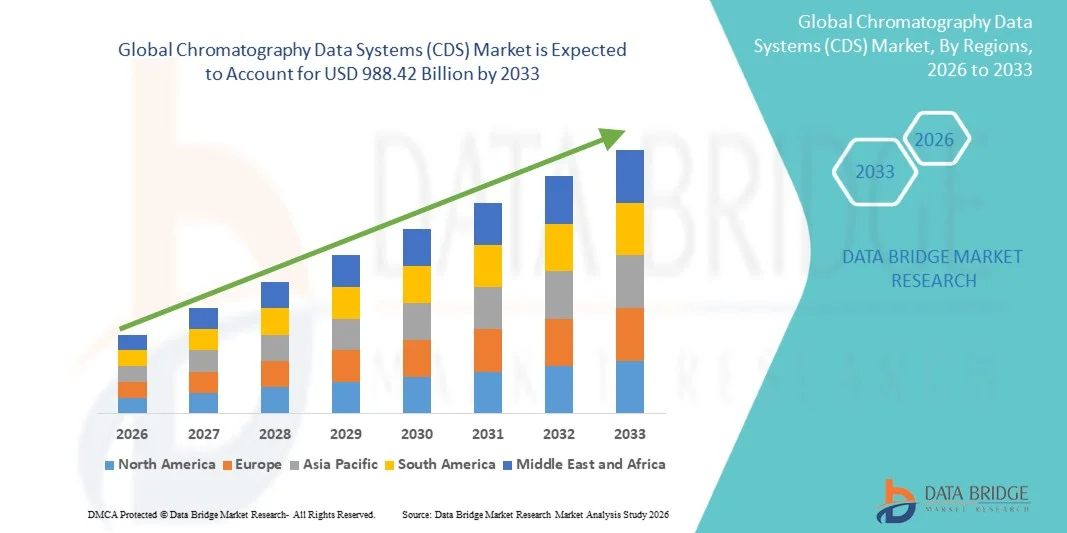
The Chromatography Data Systems (CDS) Market was valued at USD 554.21 billion in 2025 and is projected to reach USD 988.42 billion by 2033, growing at a CAGR of 7.50% from 2026 to 2033. The Chromatography Data Systems (CDS) Market is experiencing steady growth driven by increasing demand for accurate laboratory data management, rising adoption of digital laboratory workflows, and expanding applications in pharmaceutical, biotechnology, food safety, and environmental testing industries. The growing need for regulatory-compliant data handling and improved laboratory efficiency is further accelerating the adoption of advanced CDS platforms across research and quality control environments.
The increasing complexity of analytical testing in drug development, combined with stringent regulatory requirements from agencies such as the FDA and EMA, is compelling pharmaceutical and life sciences companies to adopt integrated chromatography data systems. These platforms enable secure data acquisition, real-time instrument control, and automated reporting, reducing manual errors and improving traceability. In addition, the rising shift toward cloud-based laboratory informatics solutions, integration with laboratory information management systems (LIMS), and adoption of AI-enabled analytics are transforming traditional chromatography workflows into fully digital, high-efficiency systems across laboratories worldwide.
Key Market Trends & Insights
- North America dominated the Chromatography Data Systems (CDS) Market with the largest revenue share of 38.42% in 2025, supported by strong pharmaceutical R&D infrastructure, high adoption of laboratory automation, stringent regulatory compliance requirements (FDA 21 CFR Part 11), and widespread deployment of digital laboratory informatics systems across the United States and Canada. The region benefits from early adoption of cloud-based CDS platforms, strong presence of leading life sciences companies, and increasing integration of CDS with LIMS and ELN systems for advanced data management and regulatory reporting.
- The standalone software segment dominated the market with a 54.26% share in 2025, owing to its cost-effectiveness, ease of deployment, and strong adoption in small and mid-scale laboratories
- Asia-Pacific is expected to be the fastest-growing region in the Chromatography Data Systems (CDS) Market at a CAGR of 8.1% from 2026 to 2033, fueled by rapid expansion of pharmaceutical manufacturing, increasing clinical research activity, and growing investments in laboratory automation across China, India, and Japan. Rising adoption of generic drug production, expanding biotechnology sector, and increasing government support for healthcare infrastructure are further accelerating CDS deployment. The shift toward digital laboratories and cloud-based informatics solutions is significantly boosting regional growth.
- The On-Premise deployment segment dominated the market with a 57.36% share in 2025, due to strong preference among pharmaceutical companies, contract research organizations (CROs), and quality control laboratories for secure, validated, and regulatory-compliant data storage. On-premise CDS solutions are widely preferred for their ability to ensure full data control, system validation, and compliance with strict regulatory standards. High reliability, low cybersecurity risk exposure, and integration with existing laboratory instruments further reinforce segment dominance globally.
- The Cloud-Based deployment segment is expected to register the fastest CAGR of 9.2% from 2026 to 2033, driven by increasing demand for remote data access, real-time collaboration, and scalable laboratory informatics solutions. Cloud CDS platforms are gaining traction among small and mid-sized laboratories due to lower infrastructure costs and easier system upgrades. Growing adoption of hybrid laboratory environments, AI-driven analytics, and integration with IoT-enabled analytical instruments is further accelerating cloud deployment across life sciences organizations
- The Pharmaceutical & Biotechnology segment dominated the market with a 44.28% share in 2025, owing to high utilization of chromatography techniques in drug discovery, quality testing, and regulatory compliance workflows. Increasing biologics production, rising clinical trial activity, and stringent quality assurance requirements are driving heavy dependence on CDS platforms. Pharmaceutical companies extensively use CDS for secure data acquisition, instrument control, and audit-ready reporting, making it the leading end-use segment globally
- The Contract Research Organizations (CROs) segment is expected to grow at the fastest CAGR of 8.4% from 2026 to 2033, driven by rising outsourcing of analytical testing and increasing demand for flexible, multi-client laboratory informatics systems. CROs are rapidly adopting cloud-enabled CDS platforms to manage large volumes of chromatographic data efficiently across multiple projects. Expansion of global clinical trials, increasing demand for cost-effective R&D outsourcing, and rising regulatory compliance requirements are further fueling segment growth
Market Size & Forecast
- Global Market Value (2025): USD 554.21 Billion
- Expected Market Value (2033): USD 988.42 Billion
- Forecast CAGR (2026–2033): 7.50%
- Leading Region in 2025: North America
- Fastest Growing Region: Asia-Pacific
Report Scope and Chromatography Data Systems (CDS) Market Segmentation
|
Attributes |
Chromatography Data Systems (CDS) Key Market Insights |
|
Segments Covered |
|
|
Countries Covered |
North America · U.S. · Canada · Mexico Europe · Germany · France · U.K. · Netherlands · Switzerland · Belgium · Russia · Italy · Spain · Turkey · Rest of Europe Asia-Pacific · China · Japan · India · South Korea · Singapore · Malaysia · Australia · Thailand · Indonesia · Philippines · Rest of Asia-Pacific Middle East and Africa · Saudi Arabia · U.A.E. · South Africa · Egypt · Israel · Rest of Middle East and Africa South America · Brazil · Argentina · Rest of South America |
|
Key Market Players |
• Thermo Fisher Scientific Inc. (U.S.) |
|
Market Opportunities |
· Growing demand for laboratory digitalization and automation · Expansion of cloud-based and remote laboratory informatics solutions · Increasing demand from biologics, gene therapy, and advanced drug development |
|
Value Added Data Infosets |
In addition to the insights on market scenarios such as market value, growth rate, segmentation, geographical coverage, and major players, the market reports curated by the Data Bridge Market Research also include in-depth expert analysis, geographically represented company-wise production and capacity, network layouts of distributors and partners, detailed and updated price trend analysis and deficit analysis of supply chain and demand. |
Chromatography Data Systems (CDS) Market Trends
Trend: Expansion of Digital Laboratories and Data Integrity-Driven Compliance
The Chromatography Data Systems (CDS) Market is witnessing strong growth driven by the rapid digital transformation of analytical laboratories and increasing regulatory emphasis on data integrity and traceability. Pharmaceutical and biotechnology companies are increasingly adopting CDS platforms integrated with LIMS and ELN systems to ensure secure data acquisition, audit trails, and compliance with regulations such as FDA 21 CFR Part 11 and EU Annex 11. For example, leading laboratories are shifting from standalone chromatography software to fully integrated enterprise informatics ecosystems to streamline quality control and reduce manual errors. In addition, rising adoption of cloud-enabled CDS platforms is enabling multi-site collaboration and real-time analytical monitoring across global R&D networks.
Chromatography Data Systems (CDS) Market Dynamics
Key Market Driver: Rising Demand for Regulatory-Compliant Pharmaceutical and Biopharmaceutical Analytics
The growing complexity of drug development, particularly in biologics and biosimilars, is significantly driving demand for Chromatography Data Systems (CDS). Pharmaceutical companies such as Pfizer, Novartis, and Roche rely heavily on CDS platforms to manage high-volume analytical data generated during drug discovery, validation, and quality control processes. According to industry estimates, over 80% of pharmaceutical quality control laboratories globally now utilize digital chromatography data systems to ensure accuracy, traceability, and regulatory compliance. Increasing adoption of advanced techniques such as HPLC, GC, and LC-MS further strengthens the need for automated data acquisition and reporting systems. The expansion of clinical trials globally is also accelerating CDS deployment across contract research organizations (CROs).
Key Restraint/Challenge: High Cost of Implementation and System Validation Requirements
A major challenge in the global CDS market is the high cost associated with system deployment, validation, and long-term maintenance. Large-scale CDS platforms require significant investment in software licensing, instrument integration, cybersecurity compliance, and periodic validation updates. In regulated environments, system re-validation under FDA and EMA guidelines adds additional operational burden and cost. For small and mid-sized laboratories, especially in emerging markets, these costs limit adoption. For instance, full enterprise CDS deployment in a mid-sized pharmaceutical lab can require significant upfront capital investment along with recurring compliance maintenance costs, making adoption challenging for cost-sensitive organizations.
Key Market Opportunity: Integration of AI, Cloud Platforms, and Advanced Analytics in Chromatography Workflows
The integration of artificial intelligence, machine learning, and cloud computing is creating major growth opportunities in the CDS market. AI-enabled CDS platforms are increasingly being used for automated peak detection, predictive analytics, and anomaly identification in chromatographic data. Companies are also deploying cloud-based CDS solutions to enable remote data access, real-time collaboration, and centralized laboratory management across multiple sites. For example, global life sciences organizations are investing in digital laboratory ecosystems where CDS is integrated with AI-driven quality control systems to accelerate decision-making. In addition, the rising demand for decentralized clinical trials and remote analytical testing is further expanding the adoption of cloud-native CDS platforms across North America, Europe, and Asia-Pacific.
Chromatography Data Systems (CDS) Market Scope
The Chromatography Data Systems (CDS) market is segmented on the basis of product type, delivery mode, and end user.
- By Product Type
On the basis of product type, the Chromatography Data Systems (CDS) Market is segmented into standalone software and integrated software. The standalone software segment dominated the market with a 54.26% share in 2025, owing to its cost-effectiveness, ease of deployment, and strong adoption in small and mid-scale laboratories. These systems provide flexible data acquisition, processing, and reporting capabilities without requiring complex system integration, making them widely preferred in academic and research environments. Increasing demand for simplified chromatography data management in quality control laboratories is further strengthening segment growth. Growing adoption in pharmaceutical testing, environmental analysis, and food safety applications is also supporting market expansion. However, limited scalability and integration constraints restrict usage in large enterprises. Despite this, continuous software upgrades and user-friendly interfaces are enhancing adoption. Regulatory compliance requirements such as FDA 21 CFR Part 11 further drive demand for validated standalone systems.
The integrated software segment is expected to register the fastest CAGR of 6.9% from 2026 to 2033, driven by increasing demand for unified laboratory data management platforms. These systems enable seamless integration with laboratory information management systems (LIMS), enterprise resource planning (ERP), and advanced analytics tools. Rising adoption in pharmaceutical and biopharmaceutical companies for end-to-end workflow automation is accelerating growth. Integrated CDS solutions improve operational efficiency, reduce manual errors, and enhance data traceability. Increasing investment in digital transformation of laboratories is further boosting adoption. Cloud-enabled integration capabilities are supporting remote accessibility and real-time collaboration. Growing regulatory pressure for data integrity is encouraging shift toward integrated platforms. Expansion of high-throughput laboratories and large-scale drug discovery programs is further strengthening segment momentum.
- By Delivery Mode
On the basis of delivery mode, the Chromatography Data Systems (CDS) Market is segmented into web-based, on-premise, and cloud-based systems. The on-premise segment dominated the market with a 46.83% share in 2025, driven by high data security requirements in pharmaceutical and biopharmaceutical industries. Organizations prefer on-premise systems due to full control over sensitive laboratory data and compliance with strict regulatory frameworks. These systems are widely deployed in quality control laboratories, research institutions, and manufacturing facilities. Strong infrastructure availability in developed regions further supports adoption. However, high maintenance and IT infrastructure costs remain a limitation. Despite this, reliability and low latency performance continue to sustain demand. Regulatory validation requirements also favor on-premise deployment in critical applications.
The cloud-based segment is expected to witness the fastest CAGR of 7.4% from 2026 to 2033, driven by increasing digital transformation in laboratory environments. Cloud-based CDS enables remote access, real-time data sharing, and scalable storage capabilities. Rising adoption of SaaS-based laboratory solutions is accelerating market penetration. These systems reduce infrastructure costs and improve operational flexibility. Pharmaceutical companies are increasingly adopting cloud platforms for multi-site collaboration. Integration with AI-driven analytics and machine learning tools is enhancing data interpretation. Growing demand for decentralized clinical trials is further boosting adoption. Improved cybersecurity frameworks are increasing trust in cloud deployment models.
- By End User
On the basis of end user, the Chromatography Data Systems (CDS) Market is segmented into academic and research institutes, pharmaceutical and biopharmaceutical industry, biotechnology industry, food and beverage industry, environmental testing, and others. The pharmaceutical and biopharmaceutical industry segment dominated the market with a 38.72% share in 2025, owing to extensive use of chromatography in drug discovery, quality control, and regulatory compliance. Increasing demand for biologics and biosimilars is further driving adoption of CDS solutions. Strong regulatory requirements for data integrity and validation are reinforcing market dominance. High investment in R&D pipelines by global pharmaceutical companies is also supporting growth. Continuous expansion of clinical trials is increasing data management needs. Integration of CDS with automated laboratory systems is improving efficiency. Rising focus on precision medicine is further strengthening segment leadership.
The biotechnology industry segment is expected to register the fastest CAGR of 7.1% from 2026 to 2033, driven by rapid advancements in genetic engineering and molecular diagnostics. Increasing use of chromatography in protein purification and biomarker analysis is accelerating adoption. Expansion of biotech startups and research initiatives is boosting demand. Growing investment in personalized medicine and cell-based therapies is further supporting growth. High-throughput screening applications are increasing reliance on CDS platforms. Integration with bioinformatics tools is enhancing analytical capabilities. Rising government funding for biotechnology research is contributing to market expansion. Continuous innovation in bioprocessing technologies is strengthening segment growth globally.
Chromatography Data Systems (CDS) Market Regional Analysis
North America dominated the Chromatography Data Systems (CDS) market and accounted for the largest revenue share of 38.42% in 2025, supported by strong pharmaceutical R&D infrastructure, high adoption of laboratory automation, stringent regulatory compliance requirements (FDA 21 CFR Part 11), and widespread deployment of digital laboratory informatics systems across the United States and Canada. The region benefits from early adoption of cloud-based CDS platforms, strong presence of leading life sciences companies, and increasing integration of CDS with LIMS and ELN systems for advanced data management and regulatory reporting. Growing investment in drug discovery, biologics development, and precision medicine continues to strengthen regional dominance in the global market.
U.S. Chromatography Data Systems (CDS) Market Insight
The U.S. Chromatography Data Systems (CDS) market is witnessing strong growth due to advanced pharmaceutical R&D activities, high regulatory compliance standards, and rapid adoption of laboratory digitalization. The country hosts major global pharmaceutical and biotechnology companies that extensively use CDS for quality control, analytical testing, and drug development workflows. Increasing integration of AI-enabled analytics, cloud-based laboratory platforms, and automated chromatography instruments is further accelerating market growth. In addition, strong FDA regulatory frameworks and 21 CFR Part 11 compliance requirements are driving continuous demand for validated CDS solutions across laboratories and research centers.
Europe Chromatography Data Systems (CDS) Market Insight
The Europe Chromatography Data Systems (CDS) market remains a key contributor to global revenue, supported by strong regulatory frameworks such as EMA guidelines, increasing pharmaceutical manufacturing, and high adoption of digital laboratory technologies. Countries such as Germany, France, and the U.K. are witnessing strong implementation of CDS platforms in pharmaceutical QA/QC, clinical research, and environmental testing applications. Growing focus on laboratory automation, sustainability in pharmaceutical production, and increasing adoption of cloud-based informatics solutions are further strengthening regional market expansion.
U.K. Chromatography Data Systems (CDS) Market Insight
The U.K. Chromatography Data Systems (CDS) market is expanding steadily due to strong pharmaceutical research activity, increasing clinical trials, and growing adoption of digital laboratory systems. Rising investment in life sciences innovation and strong presence of contract research organizations (CROs) are supporting CDS adoption. Integration of chromatography systems with AI-based analytics, cloud computing platforms, and laboratory automation tools is improving operational efficiency. In addition, strict compliance requirements under MHRA regulations are driving demand for validated and secure CDS platforms.
Germany Chromatography Data Systems (CDS) Market Insight
The Germany Chromatography Data Systems (CDS) market is growing due to its strong pharmaceutical manufacturing base, advanced chemical industry, and leadership in laboratory automation technologies. German laboratories are increasingly adopting CDS platforms for high-precision analytical testing and regulatory compliance. Strong focus on Industry 4.0, digital laboratories, and automated quality control systems is further driving adoption. In addition, integration of CDS with robotics and AI-enabled laboratory systems is enhancing efficiency in research and production environments.
Asia-Pacific Chromatography Data Systems (CDS) Market Insight
The Asia-Pacific Chromatography Data Systems (CDS) market is expected to witness the fastest growth at a CAGR of 8.1% from 2026 to 2033, driven by rapid expansion of pharmaceutical manufacturing, increasing clinical research activities, and growing investments in laboratory automation across China, India, and Japan. Rising production of generic drugs, expanding biotechnology sector, and increasing government support for healthcare infrastructure are significantly boosting CDS adoption. The shift toward digital laboratories, cloud-based informatics platforms, and AI-integrated analytical systems is further accelerating regional growth.
Japan Chromatography Data Systems (CDS) Market Insight
The Japan Chromatography Data Systems (CDS) market is witnessing steady growth due to strong pharmaceutical R&D capabilities, advanced biotechnology research, and increasing adoption of automated laboratory systems. Japanese companies are integrating CDS platforms with high-precision analytical instruments to improve data accuracy and regulatory compliance. Rising investment in regenerative medicine and biologics research is further supporting market expansion. In addition, increasing adoption of cloud-based laboratory systems and AI-driven analytics is enhancing workflow efficiency.
China Chromatography Data Systems (CDS) Market Insight
The China Chromatography Data Systems (CDS) market is growing rapidly due to expanding pharmaceutical manufacturing, increasing clinical trials, and strong government support for biotechnology development. Rising demand for generic drug production and growing investment in laboratory modernization are driving CDS adoption. Integration of AI, big data analytics, and cloud-based laboratory platforms is further enhancing operational efficiency. In addition, increasing focus on regulatory compliance and quality assurance in drug manufacturing is positioning China as one of the fastest-growing CDS markets globally.
Chromatography Data Systems (CDS) Market Share
The Chromatography Data Systems (CDS) industry is primarily led by well-established companies, including:
- Thermo Fisher Scientific Inc. (U.S.)
- Agilent Technologies Inc. (U.S.)
- Waters Corporation (U.S.)
- Shimadzu Corporation (Japan)
- PerkinElmer Inc. (U.S.)
- Sartorius AG (Germany)
- Bruker Corporation (U.S.)
- Restek Corporation (U.S.)
- Phenomenex Inc. (U.S.)
- Bio-Rad Laboratories Inc. (U.S.)
- GE Healthcare (Cytiva) (U.S./U.K.)
- Danaher Corporation (SCIEX) (U.S.)
- Hitachi High-Tech Corporation (Japan)
- JASCO Inc. (Japan)
- KNAUER Wissenschaftliche Geräte GmbH (Germany)
- DataApex Ltd. (Czech Republic)
- Chromatography Software Inc. (U.S.)
- LabSolutions (Shimadzu Software Division) (Japan)
- OpenLab CDS (Agilent Technologies) (U.S.)
- Empower CDS (Waters Corporation) (U.S.)
- Clarity CDS (DataApex) (Czech Republic)
- CDS Analytical Software Providers Consortium (Global)
- AB Sciex LLC (U.S.)
- Knauer CDS Systems Division (Germany)
- LECO Corporation (U.S.)
- Metrohm AG (Switzerland)
- Young In Chromass (South Korea)
- Yokogawa Electric Corporation (Japan)
- Avantor Inc. (U.S.)
- Dionex (Thermo Fisher Scientific) (U.S.)
- Merck KGaA (Germany)
- Hitachi High-Tech Analytical Science (Japan)
Latest Developments in Chromatography Data Systems (CDS) Market
- In March 2022, Agilent Technologies enhanced its OpenLab CDS platform with advanced cloud connectivity and improved data integrity features, enabling laboratories to streamline chromatography workflows while ensuring compliance with FDA 21 CFR Part 11 regulations. The upgrade strengthened automation in analytical laboratories and improved real-time data access across multi-site research environments, supporting faster decision-making in pharmaceutical and biopharmaceutical R&D operations
- In August 2023, Thermo Fisher Scientific expanded its Chromeleon Chromatography Data System with AI-assisted data processing capabilities and enhanced instrument integration across chromatography and mass spectrometry platforms. The update enabled improved peak detection accuracy, automated reporting, and better scalability for high-throughput laboratories, reinforcing its adoption in pharmaceutical quality control and clinical research applications
- In February 2024, Shimadzu Corporation introduced enhanced LabSolutions CDS features with integrated cloud data management and strengthened cybersecurity architecture for laboratory environments. The system upgrade improved remote accessibility for multi-location laboratories and enabled seamless integration with laboratory information management systems (LIMS), supporting increasing demand for digital transformation in analytical testing workflows
- In October 2024, Waters Corporation upgraded its Empower CDS platform with advanced predictive analytics tools and expanded multi-vendor instrument compatibility, allowing laboratories to unify chromatography data from different systems into a single centralized platform. This development significantly improved operational efficiency in pharmaceutical manufacturing and regulatory reporting environments
- In May 2025, Sartorius AG introduced next-generation CDS integration capabilities within its laboratory ecosystem, enabling real-time data synchronization between chromatography instruments, bioprocessing systems, and cloud-based analytics platforms. The enhancement improved data traceability, reduced manual intervention, and strengthened support for biologics and cell therapy development workflows
- In January 2026, global life sciences companies increasingly adopted AI-driven Chromatography Data Systems (CDS) platforms featuring automated method optimization, anomaly detection, and predictive maintenance capabilities. This shift reflects the growing industry focus on digital laboratories, smart analytics, and fully connected laboratory ecosystems to accelerate drug discovery and improve regulatory compliance efficiency

- Interactive Data Analysis Dashboard
- Company Analysis Dashboard for high growth potential opportunities
- Research Analyst Access for customization & queries
- Competitor Analysis with Interactive dashboard
- Latest News, Updates & Trend analysis
- Harness the Power of Benchmark Analysis for Comprehensive Competitor Tracking
Data collection and base year analysis are done using data collection modules with large sample sizes. The stage includes obtaining market information or related data through various sources and strategies. It includes examining and planning all the data acquired from the past in advance. It likewise envelops the examination of information inconsistencies seen across different information sources. The market data is analysed and estimated using market statistical and coherent models. Also, market share analysis and key trend analysis are the major success factors in the market report. To know more, please request an analyst call or drop down your inquiry.
The key research methodology used by DBMR research team is data triangulation which involves data mining, analysis of the impact of data variables on the market and primary (industry expert) validation. Data models include Vendor Positioning Grid, Market Time Line Analysis, Market Overview and Guide, Company Positioning Grid, Patent Analysis, Pricing Analysis, Company Market Share Analysis, Standards of Measurement, Global versus Regional and Vendor Share Analysis. To know more about the research methodology, drop in an inquiry to speak to our industry experts.
Data Bridge Market Research is a leader in advanced formative research. We take pride in servicing our existing and new customers with data and analysis that match and suits their goal. The report can be customized to include price trend analysis of target brands understanding the market for additional countries (ask for the list of countries), clinical trial results data, literature review, refurbished market and product base analysis. Market analysis of target competitors can be analyzed from technology-based analysis to market portfolio strategies. We can add as many competitors that you require data about in the format and data style you are looking for. Our team of analysts can also provide you data in crude raw excel files pivot tables (Fact book) or can assist you in creating presentations from the data sets available in the report.













