


Chronic Disease AI Telemonitoring Services Market Overview
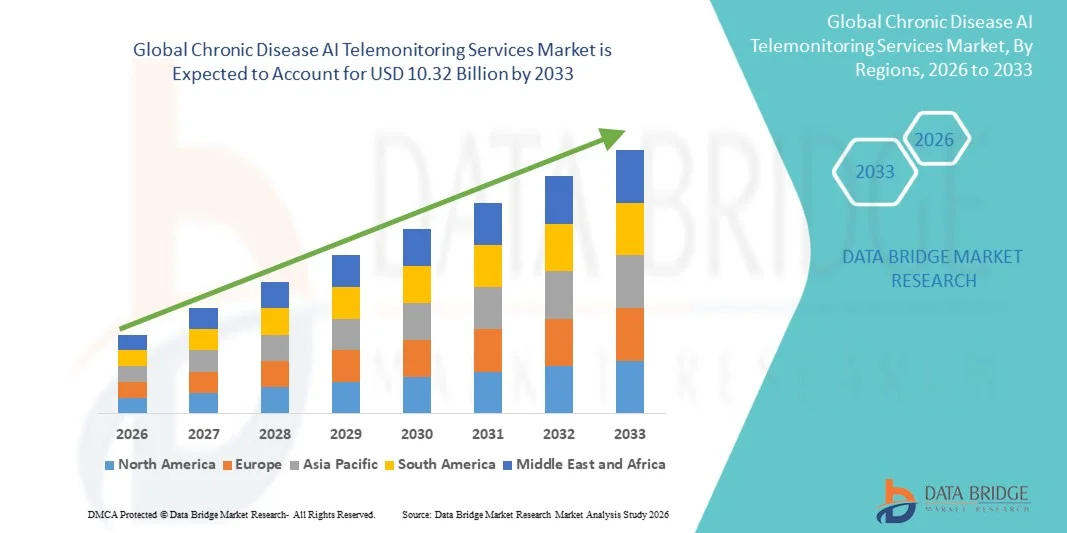
The Chronic Disease AI Telemonitoring Services Market was valued at USD 2.98 billion in 2025 and is projected to reach USD 10.32 billion by 2033, growing at a CAGR of 16.80% from 2026 to 2033. The market is experiencing consistent growth driven by rising prevalence of chronic diseases such as diabetes, cardiovascular disorders, chronic respiratory diseases, and neurological conditions, along with increasing demand for continuous remote patient monitoring and personalized care delivery. Healthcare providers and payers are increasingly adopting AI-powered telemonitoring solutions to enable early detection of disease deterioration, reduce hospital readmissions, and improve long-term patient outcomes through real-time data-driven interventions.
The growing geriatric population globally, combined with the rising burden on healthcare infrastructure, is accelerating the shift toward home-based and remote care models. AI-driven telemonitoring platforms integrated with wearable devices, IoT-enabled sensors, and predictive analytics are replacing traditional episodic care in many markets, offering cost-effective, scalable, and proactive disease management solutions. Increasing government support for digital health, expansion of telehealth reimbursement policies, and rapid advancements in AI algorithms and cloud-based healthcare platforms are further strengthening market adoption across both developed and emerging economies.
Key Market Trends & Insights
- North America dominated the Chronic Disease AI Telemonitoring Services Market with the largest revenue share of 34.6% in 2025, supported by advanced digital healthcare infrastructure, strong adoption of AI-powered remote patient monitoring (RPM) solutions, favorable reimbursement frameworks, and the presence of leading health-tech and telemedicine providers. The region also benefits from high prevalence of chronic diseases such as diabetes, cardiovascular disorders, and hypertension, driving large-scale deployment of AI-enabled monitoring platforms.
- The Remote Patient Monitoring Services segment dominated the market in 2025 with 39.8% share, owing to its widespread adoption in continuous health tracking, real-time vitals monitoring, and integration with wearable devices and IoT-enabled medical sensors.
- Asia-Pacific is expected to be the fastest-growing region in the Chronic Disease AI Telemonitoring Services Market, projected to expand at a CAGR of 8.4% from 2026 to 2033, fueled by rapid digital health transformation, rising chronic disease burden, increasing smartphone penetration, and government investments in telehealth infrastructure across countries such as China, India, and Japan.
- The Cardiovascular Disease monitoring segment dominated the application category with a 39.8% revenue share in 2025, driven by high global incidence of heart-related conditions and growing adoption of AI-powered ECG monitoring and remote cardiac alert systems.
- The Remote Patient Monitoring (RPM) devices integration segment accounted for 57.9% of the market in 2025, supported by widespread use of wearable sensors, connected medical devices, and IoT-enabled health tracking systems for continuous patient monitoring.
Market Size & Forecast
- Global Market Value (2025): USD 2.98 Billion
- Expected Market Value (2033): USD 10.32 Billion
- Forecast CAGR (2026–2033): 16.80%
- Leading Region in 2025: North America
- Fastest Growing Region: Asia-Pacific
Report Scope and Chronic Disease AI Telemonitoring Services Market Segmentation
|
Attributes |
Chronic Disease AI Telemonitoring Services Key Market Insights |
|
Segments Covered |
|
|
Countries Covered |
North America · U.S. · Canada · Mexico Europe · Germany · France · U.K. · Netherlands · Switzerland · Belgium · Russia · Italy · Spain · Turkey · Rest of Europe Asia-Pacific · China · Japan · India · South Korea · Singapore · Malaysia · Australia · Thailand · Indonesia · Philippines · Rest of Asia-Pacific Middle East and Africa · Saudi Arabia · U.A.E. · South Africa · Egypt · Israel · Rest of Middle East and Africa South America · Brazil · Argentina · Rest of South America |
|
Key Market Players |
• Koninklijke Philips N.V. (Netherlands) |
|
Market Opportunities |
· Expansion of AI-Driven Predictive Care for High-Risk Populations · Integration with Wearables and IoT-Based Remote Monitoring Ecosystems · Growth in Emerging Markets Through Digital Health Infrastructure Expansion |
|
Value Added Data Infosets |
In addition to the insights on market scenarios such as market value, growth rate, segmentation, geographical coverage, and major players, the market reports curated by the Data Bridge Market Research also include in-depth expert analysis, geographically represented company-wise production and capacity, network layouts of distributors and partners, detailed and updated price trend analysis and deficit analysis of supply chain and demand. |
Chronic Disease AI Telemonitoring Services Market Trends
Trend: Rapid Expansion of AI-Enabled Remote Patient Monitoring and Home-Based Chronic Care
The Chronic Disease AI Telemonitoring Services Market is witnessing strong growth due to the rapid adoption of AI-powered remote patient monitoring (RPM) systems for chronic conditions such as diabetes, cardiovascular diseases, chronic respiratory disorders, and hypertension. Increasing integration of wearable sensors, connected medical devices, and cloud-based health platforms is enabling continuous real-time patient monitoring outside hospital settings. According to industry health analytics reports, over 1.7 billion people globally live with chronic diseases, and nearly 70% of healthcare spending in developed countries is linked to chronic disease management, significantly driving demand for cost-efficient telemonitoring solutions. Post-2021, telehealth adoption increased sharply, with RPM program enrollment in the U.S. Medicare system growing by over 30–40% annually, supporting AI-based disease tracking platforms. AI algorithms are increasingly used to analyze ECG signals, glucose trends, blood pressure variability, and oxygen saturation patterns, enabling early detection of deterioration and reducing hospital readmission rates by 15–25% in chronic care programs.
Chronic Disease AI Telemonitoring Services Market Dynamics
Key Market Driver: Rising Burden of Chronic Diseases and Expansion of Value-Based Healthcare Models
A major driver of the market is the global rise in chronic disease prevalence combined with the shift toward value-based healthcare delivery. According to the World Health Organization (WHO), chronic diseases account for 74% of all global deaths annually, highlighting the urgent need for continuous monitoring and preventive intervention. Healthcare systems in North America and Europe are increasingly adopting AI-enabled telemonitoring platforms to reduce hospital burden and improve patient outcomes. Hospitals and insurers are deploying remote monitoring programs for heart failure, COPD, diabetes, and post-surgical recovery, which have been shown to reduce hospitalization costs by up to 20–30% in managed care programs. Large-scale deployments such as Medicare Remote Patient Monitoring (RPM) reimbursement expansion in the U.S. (post-2021) have significantly accelerated adoption of AI-powered chronic care platforms.
Key Restraint/Challenge: Data Privacy Concerns, Regulatory Compliance, and Interoperability Issues
A key restraint in the Chronic Disease AI Telemonitoring Services market is the complex regulatory environment and concerns over patient data privacy and security. AI-based telemonitoring systems continuously collect sensitive health data such as heart rhythm patterns, glucose levels, and respiratory metrics, raising concerns regarding compliance with frameworks like HIPAA (U.S.), GDPR (Europe), and national digital health laws in emerging markets. In addition, lack of interoperability between healthcare systems, wearable devices, and electronic health records (EHRs) limits seamless data integration across platforms. Studies indicate that nearly 40–50% of healthcare IT systems face integration challenges, slowing down full-scale AI telemonitoring adoption. Another major challenge is algorithmic bias and clinical validation gaps, where AI models trained on limited datasets may not perform consistently across diverse populations, delaying regulatory approvals and clinical trust in some regions.
Key Market Opportunity: Expansion of AI-Powered Predictive Care and Hospital-at-Home Models
The market presents significant opportunities through the expansion of AI-driven predictive analytics, hospital-at-home programs, and fully integrated digital chronic care ecosystems. AI-enabled platforms are increasingly capable of predicting heart failure decompensation, diabetic complications, and COPD exacerbations days in advance using continuous biometric data streams. For instance, predictive models in chronic heart failure management have demonstrated the ability to reduce emergency admissions by up to 25% through early alerts and intervention systems. The rise of hospital-at-home programs in North America and Europe post-2021, supported by CMS reimbursement expansions and digital health policy reforms, is accelerating adoption of telemonitoring platforms. In addition, Asia-Pacific countries such as China and India are rapidly investing in national digital health missions, expanding access to AI-powered chronic disease management systems in rural and semi-urban populations. The integration of cloud-based AI analytics, wearable IoT ecosystems, and mobile health applications is expected to significantly democratize access to chronic disease monitoring, creating strong long-term growth opportunities in both developed and emerging healthcare markets.
Chronic Disease AI Telemonitoring Services Market Scope
The Chronic Disease AI Telemonitoring Services market is segmented on the basis of service type and disease type.
- By Service Type
On the basis of service type, the Chronic Disease AI Telemonitoring Services Market is segmented into remote patient monitoring services, predictive AI analytics services, virtual care & teleconsultation services, and chronic disease management platforms. The Remote Patient Monitoring Services segment dominated the market in 2025 with 39.8% share, owing to its widespread adoption in continuous health tracking, real-time vitals monitoring, and integration with wearable devices and IoT-enabled medical sensors. Hospitals, homecare providers, and healthcare systems increasingly rely on RPM solutions to reduce hospital readmissions and improve long-term disease management outcomes. Strong adoption across cardiovascular, diabetes, and respiratory care pathways further strengthens its dominance. Integration with cloud platforms and AI-based alert systems enhances clinical responsiveness. Expanding reimbursement support for remote monitoring services is accelerating deployment. Rising geriatric population and chronic disease burden globally is reinforcing demand. Healthcare providers prefer RPM for cost-effective long-term monitoring. Continuous advancements in sensor accuracy and interoperability are supporting scalability. Increasing hospital-at-home programs are further boosting usage. Regulatory support for telehealth expansion is strengthening market penetration.
The Predictive AI Analytics Services segment is expected to register the fastest growth with a CAGR of 13.6% from 2026 to 2033, driven by rising adoption of AI-powered predictive models for early detection of disease deterioration and risk stratification. These solutions enable clinicians to anticipate complications in chronic conditions such as heart failure, diabetes, and COPD before clinical symptoms worsen. Growing integration of machine learning algorithms with real-time patient data is improving diagnostic accuracy. Increasing demand for personalized treatment planning is accelerating adoption. Healthcare systems are investing heavily in predictive analytics platforms to reduce emergency care costs. Expansion of big data in healthcare is enabling deeper clinical insights. Rising use of cloud-based AI engines is supporting scalability. Growing collaboration between medtech companies and AI startups is strengthening innovation. Continuous improvement in algorithm accuracy is boosting clinical trust. Regulatory encouragement for value-based care models is further driving growth.
- By Disease Type
On the basis of disease type, the Chronic Disease AI Telemonitoring Services Market is segmented into cardiovascular diseases, diabetes, chronic respiratory diseases, cancer, neurological disorders, and others. The Cardiovascular Diseases segment dominated the market in 2025 with 34.2% share, driven by the high global prevalence of hypertension, coronary artery disease, and heart failure, which require continuous monitoring and early intervention. AI telemonitoring systems are widely used for ECG tracking, blood pressure monitoring, and arrhythmia detection in real time. Increasing adoption of wearable cardiac monitoring devices is strengthening data collection and analysis capabilities. Hospitals and cardiology centers are heavily investing in remote monitoring infrastructure. Rising incidence of lifestyle-related heart diseases is significantly boosting demand. Integration of AI-based risk prediction models is improving patient outcomes. Expanding telecardiology services in both developed and emerging markets is reinforcing dominance. Government initiatives focused on cardiovascular health screening are supporting adoption. Insurance providers are increasingly covering remote cardiac monitoring services. Continuous innovation in wearable cardiac sensors is further strengthening market leadership.
The Diabetes segment is expected to witness the fastest growth with a CAGR of 14.1% from 2026 to 2033, driven by the rising global diabetic population and increasing demand for continuous glucose monitoring and insulin management solutions. AI-enabled telemonitoring platforms help in real-time glucose tracking and personalized insulin dosing recommendations. Growing prevalence of type 2 diabetes due to sedentary lifestyles is accelerating adoption. Expansion of wearable CGM devices is improving patient adherence. Healthcare providers are increasingly adopting digital diabetes management ecosystems. Rising awareness about early diabetes detection and prevention is supporting growth. Integration of mobile health apps with AI analytics is improving patient engagement. Increasing reimbursement support for diabetes digital care solutions is boosting accessibility. Pharmaceutical companies are collaborating with digital health providers for integrated care solutions. Growing focus on preventive healthcare is strengthening long-term adoption.
Chronic Disease AI Telemonitoring Services Market Regional Analysis
North America dominated the Chronic Disease AI Telemonitoring Services Market and accounted for the largest revenue share of 34.6% in 2025, supported by advanced digital healthcare infrastructure, strong adoption of AI-powered remote patient monitoring (RPM) solutions, favorable reimbursement frameworks, and the presence of leading health-tech and telemedicine providers. The region also benefits from a high prevalence of chronic diseases such as diabetes, cardiovascular disorders, and hypertension, which has driven large-scale deployment of AI-enabled monitoring platforms across hospitals, homecare settings, and insurance-backed care programs. Increasing use of wearable devices, IoT-enabled health trackers, and cloud-based AI analytics platforms continues to strengthen real-time patient monitoring capabilities, improving early intervention and reducing hospital readmission rates in chronic care management programs.
U.S. Chronic Disease AI Telemonitoring Services Market Insight
The U.S. Chronic Disease AI Telemonitoring Services market is witnessing strong growth due to rising adoption of remote patient monitoring (RPM) programs under Medicare and private insurance systems, along with increasing investment in AI-driven healthcare analytics. The country’s advanced healthcare ecosystem, strong presence of digital health companies, and widespread use of connected medical devices for continuous monitoring of heart failure, diabetes, and respiratory diseases are key growth drivers. In addition, hospitals are increasingly adopting AI-based predictive alerts and clinical decision support systems, which help reduce emergency admissions and improve long-term disease outcomes.
Europe Chronic Disease AI Telemonitoring Services Market Insight
The Europe Chronic Disease AI Telemonitoring Services market remains a major contributor to global revenue, driven by strong government support for digital health transformation, chronic disease management programs, and telemedicine adoption. Countries across the region are actively deploying AI-enabled monitoring systems to manage aging populations and rising chronic disease prevalence. Strict healthcare regulations under frameworks such as GDPR and national digital health strategies are also pushing adoption of secure, interoperable telemonitoring platforms across hospitals and homecare networks. Increasing investment in value-based healthcare models continues to support regional market expansion.
U.K. Chronic Disease AI Telemonitoring Services Market Insight
The U.K. Chronic Disease AI Telemonitoring Services market is experiencing steady growth, supported by the expansion of the NHS digital health ecosystem and remote monitoring initiatives. Increasing deployment of AI-based platforms for managing cardiovascular diseases, diabetes, and chronic respiratory conditions is improving patient outcomes and reducing hospital burden. Integration of wearable health devices, mobile health applications, and predictive AI tools is enhancing early disease detection and enabling more personalized chronic care management across the healthcare system.
Germany Chronic Disease AI Telemonitoring Services Market Insight
The Germany Chronic Disease AI Telemonitoring Services market is expanding steadily due to strong healthcare infrastructure, rising chronic disease prevalence, and increasing adoption of AI-driven clinical monitoring solutions. Hospitals and healthcare providers are increasingly using telemonitoring platforms for long-term management of cardiovascular and metabolic disorders. Germany’s focus on healthcare digitization and strong medical technology ecosystem is further accelerating deployment of secure, data-driven remote monitoring systems across both public and private healthcare sectors.
Asia-Pacific Chronic Disease AI Telemonitoring Services Market Insight
The Asia-Pacific Chronic Disease AI Telemonitoring Services market is expected to be the fastest-growing region, projected to expand at a CAGR of 8.4% from 2026 to 2033, driven by rapid digital health transformation, rising chronic disease burden, increasing smartphone penetration, and government investments in telehealth infrastructure. Countries such as China, India, and Japan are witnessing strong adoption of AI-based remote patient monitoring systems, particularly for diabetes, hypertension, and cardiovascular disease management. Expanding healthcare access, growing hospital digitization, and increasing use of mobile health platforms are further accelerating regional market growth.
Japan Chronic Disease AI Telemonitoring Services Market Insight
Japan’s Chronic Disease AI Telemonitoring Services market is witnessing consistent growth due to its rapidly aging population and increasing burden of chronic diseases. Healthcare providers are adopting AI-powered monitoring systems for long-term care of cardiovascular diseases, diabetes, and respiratory disorders. Strong integration of wearable devices, robotics-assisted care systems, and predictive analytics platforms is enhancing patient monitoring efficiency and supporting Japan’s advanced healthcare infrastructure.
China Chronic Disease AI Telemonitoring Services Market Insight
The China Chronic Disease AI Telemonitoring Services market is growing rapidly, driven by rising chronic disease prevalence, expanding healthcare digitization, and strong government support for AI-powered healthcare infrastructure development. Increasing deployment of telemedicine platforms, wearable monitoring devices, and cloud-based AI diagnostic tools is improving chronic disease management across urban and rural populations. China’s large patient base and rapid adoption of digital health technologies are positioning it as one of the most important growth markets globally.
Chronic Disease AI Telemonitoring Services Market Share
The Chronic Disease AI Telemonitoring Services industry is primarily led by well-established companies, including:
- Koninklijke Philips N.V. (Netherlands)
- Medtronic plc (Ireland)
- GE HealthCare Technologies Inc. (U.S.)
- Siemens Healthineers AG (Germany)
- Abbott Laboratories (U.S.)
- Boston Scientific Corporation (U.S.)
- IBM Corporation (U.S.)
- Oracle Corporation (U.S.)
- Honeywell International Inc. (U.S.)
- ResMed Inc. (Australia)
- Teladoc Health Inc. (U.S.)
- Cerner Corporation (U.S.)
- Koninklijke Philips (BioTelemetry division) (U.S.)
- Allscripts Healthcare Solutions Inc. (U.S.)
- Dexcom Inc. (U.S.)
- Apple Inc. (U.S.)
- Alphabet Inc. (Google Health) (U.S.)
- Microsoft Corporation (U.S.)
- NVIDIA Corporation (U.S.)
- iRhythm Technologies Inc. (U.S.)
- AliveCor Inc. (U.S.)
- Biofourmis Inc. (U.S.)
- Current Health (U.S.)
- Resideo Technologies Inc. (U.S.)
- VitalConnect Inc. (U.S.)
- Huma Therapeutics Ltd. (U.K.)
- Cardiologs (France)
- Tricog Health (India)
- Dozee (India)
- Predible Health (India)
- Cloudphysician Healthcare (India)
Latest Developments in Chronic Disease AI Telemonitoring Services Market
- In March 2021, Philips Healthcare (Netherlands), a global leader in health technology, expanded its AI-enabled remote patient monitoring ecosystem by enhancing its Philips eCareCoordinator platform, integrating predictive analytics for chronic disease management across cardiovascular and respiratory patients. The upgrade enabled hospitals and care providers to monitor patients remotely with improved early warning capabilities for clinical deterioration, strengthening Philips’ position in AI-driven telehealth solutions. This development highlighted the growing shift toward hospital-at-home models and continuous chronic disease surveillance using AI-based monitoring systems
- In February 2023, GE HealthCare (United States) announced a strategic collaboration with Biofourmis (United States), a digital therapeutics and AI-based remote monitoring company, to integrate AI-powered analytics into hospital-at-home and chronic disease management workflows. The partnership focused on enhancing real-time patient monitoring, predictive risk scoring, and early intervention for chronic conditions such as heart failure and respiratory diseases. This initiative strengthened the use of AI-driven telemonitoring platforms in reducing hospital readmissions and improving long-term disease outcomes
- In September 2024, Roche Diabetes Care (Switzerland) launched its Accu-Chek SmartGuide Continuous Glucose Monitoring (CGM) system in Europe, integrating AI-based predictive alerts for diabetes management. The system enabled chronic disease patients to receive real-time glucose trend analysis and personalized alerts through connected digital platforms, improving long-term disease control and remote monitoring efficiency. This launch reinforced Roche’s expansion into AI-enabled chronic disease telemonitoring ecosystems focused on diabetes care

- Interactive Data Analysis Dashboard
- Company Analysis Dashboard for high growth potential opportunities
- Research Analyst Access for customization & queries
- Competitor Analysis with Interactive dashboard
- Latest News, Updates & Trend analysis
- Harness the Power of Benchmark Analysis for Comprehensive Competitor Tracking
Data collection and base year analysis are done using data collection modules with large sample sizes. The stage includes obtaining market information or related data through various sources and strategies. It includes examining and planning all the data acquired from the past in advance. It likewise envelops the examination of information inconsistencies seen across different information sources. The market data is analysed and estimated using market statistical and coherent models. Also, market share analysis and key trend analysis are the major success factors in the market report. To know more, please request an analyst call or drop down your inquiry.
The key research methodology used by DBMR research team is data triangulation which involves data mining, analysis of the impact of data variables on the market and primary (industry expert) validation. Data models include Vendor Positioning Grid, Market Time Line Analysis, Market Overview and Guide, Company Positioning Grid, Patent Analysis, Pricing Analysis, Company Market Share Analysis, Standards of Measurement, Global versus Regional and Vendor Share Analysis. To know more about the research methodology, drop in an inquiry to speak to our industry experts.
Data Bridge Market Research is a leader in advanced formative research. We take pride in servicing our existing and new customers with data and analysis that match and suits their goal. The report can be customized to include price trend analysis of target brands understanding the market for additional countries (ask for the list of countries), clinical trial results data, literature review, refurbished market and product base analysis. Market analysis of target competitors can be analyzed from technology-based analysis to market portfolio strategies. We can add as many competitors that you require data about in the format and data style you are looking for. Our team of analysts can also provide you data in crude raw excel files pivot tables (Fact book) or can assist you in creating presentations from the data sets available in the report.













