


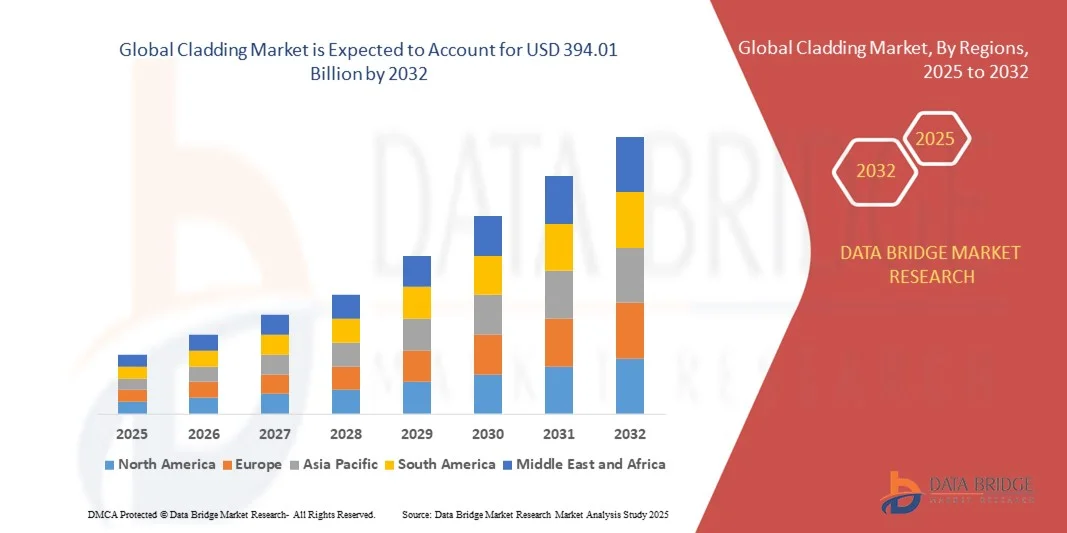
Cladding Market Size
- The global cladding market size was valued at USD 253.84 billion in 2024 and is expected to reach USD 394.01 billion by 2032, at a CAGR of 5.65% during the forecast period
- The market growth is largely fueled by the increasing adoption of modern construction materials and growing demand for energy-efficient, durable, and aesthetically appealing building exteriors in both residential and commercial construction projects
- Furthermore, rising consumer and developer preference for low-maintenance, sustainable, and fire-resistant cladding solutions is establishing advanced cladding materials as the preferred choice for building façades. These converging factors are accelerating the adoption of cladding solutions, thereby significantly boosting the industry's growth
Cladding Market Analysis
- Cladding, providing protective and decorative layers for walls and roofs, is increasingly vital in modern construction due to its ability to enhance structural longevity, thermal insulation, and exterior aesthetics across residential and commercial buildings
- The escalating demand for cladding is primarily driven by rapid urbanization, increasing infrastructure projects, and heightened focus on energy efficiency and regulatory compliance in construction projects. In addition, technological advancements in materials such as fiber cement, metal, and composite panels are enabling manufacturers to offer innovative, high-performance, and customizable cladding solutions, meeting diverse architectural and environmental requirements
- Asia-Pacific dominated the cladding market with a share of 35.1% in 2024, due to rapid urbanization, growing construction activities, and increasing demand for energy-efficient and aesthetically appealing building exteriors
- North America is expected to be the fastest growing region in the cladding market during the forecast period due to increasing demand for durable, energy-efficient, and low-maintenance exterior solutions
- Walls segment dominated the market with a market share of 52.6% in 2024, due to the critical role cladding plays in enhancing structural insulation, thermal efficiency, and aesthetic appeal of building exteriors. Wall cladding provides protection against environmental elements while contributing to energy savings, which is increasingly important in both residential and commercial construction. Architects and builders often prioritize wall cladding for its ability to enhance building durability while complementing modern architectural designs. In addition, advancements in cladding technologies and materials have enabled customizable finishes and textures, meeting diverse client preferences. The integration of fire-resistant and weatherproof options further strengthens its market dominance
Report Scope and Cladding Market Segmentation
|
Attributes |
Cladding Key Market Insights |
|
Segments Covered |
|
|
Countries Covered |
North America
Europe
Asia-Pacific
Middle East and Africa
South America
|
|
Key Market Players |
|
|
Market Opportunities |
|
|
Value Added Data Infosets |
In addition to the insights on market scenarios such as market value, growth rate, segmentation, geographical coverage, and major players, the market reports curated by the Data Bridge Market Research also include import export analysis, production capacity overview, production consumption analysis, price trend analysis, climate change scenario, supply chain analysis, value chain analysis, raw material/consumables overview, vendor selection criteria, PESTLE Analysis, Porter Analysis, and regulatory framework. |
Cladding Market Trends
Growing Use of Sustainable and Energy-Efficient Materials
- The global cladding market is experiencing significant transformation as builders, architects, and developers increasingly prioritize sustainable and energy-efficient materials for both residential and commercial projects. The shift toward eco-conscious construction practices is driving the adoption of cladding systems that minimize environmental impact, enhance insulation, and promote building longevity
- For instance, companies such as Kingspan Group and Rockwool A/S are introducing advanced cladding panels made from recyclable metals and stone wool insulation that deliver improved thermal performance and reduced carbon footprint. These sustainable innovations are reshaping market dynamics by combining aesthetic flexibility with high energy efficiency standards
- Growing awareness of green building certifications such as LEED and BREEAM is influencing material selection across new construction and renovation projects. Builders are increasingly adopting composite and ventilated façade systems that contribute to better indoor comfort and reduced energy consumption through improved heat regulation
- Technological advancements in manufacturing processes are facilitating the use of lightweight, high-strength, and weather-resistant materials such as fiber cement, aluminum composites, and terracotta panels. These materials support modern architectural designs while achieving sustainability objectives through enhanced recyclability and lifespan extension
- Rising urbanization and government incentives promoting energy-efficient infrastructure are further catalyzing the widespread implementation of eco-friendly cladding systems. Municipal regulations targeting energy conservation and emission reduction are stimulating innovation in façade materials compatible with modern insulation technologies
- As the construction industry moves toward circular design strategies, sustainable cladding materials are becoming a cornerstone of net-zero building initiatives. This evolution toward renewable and recyclable components underscores the sector’s commitment to balancing functionality, aesthetics, and environmental responsibility in the built environment
Cladding Market Dynamics
Driver
Rising Demand for Durable and Low-Maintenance Façades
- The growing focus on building resilience and long-term performance is driving demand for durable and low-maintenance cladding materials. Developers are preferring solutions that provide superior weather resistance, thermal efficiency, and aesthetic endurance while minimizing ongoing maintenance requirements
- For instance, Alcoa Corporation and Nichiha Corporation have launched premium-grade aluminum composite and fiber-cement cladding products designed to deliver exceptional durability against UV radiation, corrosion, and moisture infiltration. These innovations demonstrate how material engineering is evolving to ensure façade performance and extended service life
- Commercial and residential developers are increasingly incorporating advanced coating technologies that protect surfaces from pollutants, staining, and color fading. This trend ensures that façades retain their visual appeal while reducing repair and cleaning costs over long operational periods
- The application of modular and pre-engineered cladding panels is also reducing installation time and minimizing structural wear, supporting cost efficiency in large-scale developments. Moreover, such solutions enable design flexibility and structural integrity across diverse architectural contexts
- The continuing convergence of strength, sustainability, and ease of maintenance is reinforcing the adoption of modern cladding systems across both retrofitting and new construction projects. This alignment with performance and longevity standards is expected to sustain robust market growth worldwide
Restraint/Challenge
High Initial Costs and Complex Installation
- Despite their advantages, advanced cladding systems often involve high initial investment costs, posing financial challenges particularly for small-scale builders and residential projects. The combination of premium raw material expenses and specialized fabrication techniques elevates project budgets compared with traditional wall finishes
- For instance, companies such as Fundermax GmbH and Trespa International B.V. have cited substantial installation costs linked to precision engineering and structural compatibility checks required for ventilated façades. These expenses increase overall project value despite long-term cost-saving potential through reduced maintenance
- Installation complexity and the need for highly skilled labor further contribute to extended timelines and operational risks. Errors in alignment or moisture barrier placement can compromise insulation performance and façade safety, necessitating rigorous supervision throughout the process
- Fluctuating raw material prices, particularly for aluminum, steel, and composites, also affect pricing consistency and contractor profitability. Unpredictable supply chain conditions can delay material procurement, extending completion schedules and driving additional costs
- Encouraging advancements in installation technologies, prefabricated modules, and cost-efficient composite materials will be key to overcoming these barriers. As innovation continues to reduce complexity and initial expenses, cladding solutions will gain wider adoption across diverse construction sectors globally
Cladding Market Scope
The market is segmented on the basis of material, application, and end-user.
- By Material
On the basis of material, the cladding market is segmented into Stucco and EIFS, Metal, Fiber Cement, Vinyl, Wood, Ceramic, Brick and Stone, and Others. The Metal segment dominated the market with the largest revenue share in 2024, driven by its durability, low maintenance requirements, and aesthetic versatility. Metal cladding, including aluminum and steel variants, is widely preferred for both residential and commercial structures due to its ability to withstand harsh weather conditions and offer long-term protection. The rising trend of modern architectural designs and industrial-style buildings has further fueled demand for metal cladding. In addition, its compatibility with fire-resistant and energy-efficient construction standards enhances its adoption across multiple construction projects. Strong manufacturer support and a wide variety of finishes and coatings make metal cladding an appealing choice for developers and homeowners alike.
The Fiber Cement segment is anticipated to witness the fastest growth rate from 2025 to 2032, driven by increasing awareness of sustainable and eco-friendly building materials. Fiber cement cladding offers high resistance to moisture, fire, and pests while providing design flexibility with textured finishes that mimic wood, stone, or brick. For instance, companies such as James Hardie are expanding their product portfolios to meet growing demand in both residential and commercial construction. Its low maintenance and long lifespan make it suitable for regions with extreme weather conditions, supporting rapid adoption. The material’s adaptability in both retrofit and new construction projects further contributes to its projected growth trajectory.
- By Application
On the basis of application, the cladding market is segmented into Roofs, Walls, and Others. The Walls segment held the largest market revenue share of 52.6% in 2024, driven by the critical role cladding plays in enhancing structural insulation, thermal efficiency, and aesthetic appeal of building exteriors. Wall cladding provides protection against environmental elements while contributing to energy savings, which is increasingly important in both residential and commercial construction. Architects and builders often prioritize wall cladding for its ability to enhance building durability while complementing modern architectural designs. In addition, advancements in cladding technologies and materials have enabled customizable finishes and textures, meeting diverse client preferences. The integration of fire-resistant and weatherproof options further strengthens its market dominance.
The Roofs segment is expected to witness the fastest growth from 2025 to 2032, driven by increasing demand for protective and energy-efficient roofing solutions. Roof cladding helps reduce heat transfer, prevent water leakage, and improve overall building longevity. For instance, companies such as Tata Steel are promoting metal roof cladding systems that combine durability with eco-friendly attributes, appealing to both residential and commercial sectors. Rising construction activities in urban and industrial regions have accelerated adoption of roof cladding, particularly in areas prone to extreme weather conditions. Its multifunctional benefits, including insulation and low maintenance, are expected to sustain its rapid market expansion.
- By End User
On the basis of end user, the cladding market is segmented into Residential and Commercial. The Commercial segment dominated the market with the largest revenue share in 2024, driven by rapid urbanization and increasing investments in office complexes, shopping centers, hotels, and industrial facilities. Commercial construction projects often prioritize cladding materials for their combination of aesthetic appeal, durability, and compliance with building codes. Large-scale projects favor materials that provide low maintenance, long-term protection, and design flexibility, making commercial applications a key revenue driver for cladding manufacturers. In addition, smart building initiatives and energy-efficient construction standards have reinforced the adoption of advanced cladding solutions. Developers are increasingly leveraging cladding for branding, modern designs, and enhanced structural performance.
The Residential segment is anticipated to witness the fastest growth rate from 2025 to 2032, fueled by rising disposable incomes and demand for visually appealing, energy-efficient homes. For instance, companies such as Alucobond are introducing lightweight, customizable cladding solutions tailored for modern residential architecture. Homeowners increasingly prefer cladding materials that offer thermal insulation, weather resistance, and minimal maintenance. The growing trend of home renovations and exterior upgrades also contributes to the adoption of cladding in residential buildings. In addition, the availability of diverse materials and finishes enables personalization, further driving the segment’s rapid growth.
Cladding Market Regional Analysis
- Asia-Pacific dominated the cladding market with the largest revenue share of 35.1% in 2024, driven by rapid urbanization, growing construction activities, and increasing demand for energy-efficient and aesthetically appealing building exteriors
- The region’s cost-effective labor, expanding infrastructure projects, and rising adoption of modern construction materials are accelerating market growth
- Favorable government policies, availability of raw materials, and increasing investments in residential and commercial real estate are contributing to heightened consumption of cladding solutions across the region
China Cladding Market Insight
China held the largest share in the Asia-Pacific cladding market in 2024, owing to its position as a global construction and manufacturing hub. The country’s strong industrial base, extensive infrastructure projects, and government initiatives promoting energy-efficient buildings are major growth drivers. Rising urbanization and large-scale commercial and residential developments further support demand for cladding materials. In addition, increasing adoption of modern construction technologies and aesthetic façade solutions is bolstering market expansion.
India Cladding Market Insight
India is witnessing the fastest growth in the Asia-Pacific region, fueled by rapid urban development, rising disposable incomes, and growing residential construction projects. For instance, initiatives such as “Smart Cities Mission” and government incentives for sustainable building materials are strengthening cladding adoption. Increasing commercial construction, along with a focus on durable and low-maintenance exterior solutions, is further accelerating demand. Rising awareness of energy efficiency and modern architectural designs also contributes to robust market expansion.
Europe Cladding Market Insight
The Europe cladding market is expanding steadily, supported by stringent building regulations, high demand for durable and sustainable materials, and increasing renovation activities. The region emphasizes energy-efficient construction, façade aesthetics, and compliance with environmental standards. Demand is particularly strong in countries with advanced infrastructure projects and heritage building restoration initiatives. In addition, growth in commercial and residential real estate development is reinforcing adoption of innovative cladding materials.
Germany Cladding Market Insight
Germany’s cladding market is driven by its leadership in sustainable and high-quality construction, strong architectural innovation, and focus on energy-efficient buildings. The country has well-established construction and manufacturing sectors supporting the adoption of advanced cladding solutions. Demand is particularly strong for commercial complexes, industrial facilities, and modern residential projects. In addition, emphasis on low-maintenance and long-lasting exterior materials further boosts market growth.
U.K. Cladding Market Insight
The U.K. market is supported by increasing investments in commercial and residential construction, rising refurbishment activities, and a growing focus on sustainable and fire-resistant cladding solutions. With strong regulatory frameworks, emphasis on façade safety, and adoption of modern building technologies, the region continues to play a significant role in the cladding market. In addition, demand for energy-efficient and aesthetically appealing materials is driving steady market growth.
North America Cladding Market Insight
North America is projected to grow at the fastest CAGR from 2025 to 2032, driven by increasing demand for durable, energy-efficient, and low-maintenance exterior solutions. Rising construction activities, urban expansion, and modernization of commercial and residential buildings are key growth factors. For instance, integration of sustainable and high-performance materials in new projects is fueling adoption across the U.S. and Canada. In addition, technological advancements and a focus on architectural aesthetics are further supporting market expansion.
U.S. Cladding Market Insight
The U.S. accounted for the largest share in the North America market in 2024, underpinned by extensive commercial and residential construction projects, strong demand for sustainable materials, and significant investments in modern building technologies. The country’s focus on energy efficiency, façade durability, and architectural design is encouraging adoption of advanced cladding solutions. Presence of major construction and cladding manufacturers, along with supportive regulatory frameworks, further solidify the U.S.’s leading position in the region.
Cladding Market Share
The cladding industry is primarily led by well-established companies, including:
- Compagnie de Saint-Gobain (France)
- DuPont (U.S.)
- Tata Steel (India)
- Arconic (U.S.)
- Westlake Chemical Corporation (U.S.)
- Carea Community Health Centre (U.A.E.)
- Al Ghurair Group (U.A.E.)
- GB Architectural Cladding Products Ltd (U.K.)
- Etex Group (Belgium)
- James Hardie Industries plc (Ireland)
- CSR Limited (Australia)
- Euramax (Netherlands)
- NICHIHA (Japan)
- Boral (Australia)
- Cembrit (Denmark)
- Louisiana Pacific Corporation (U.S.)
- Kingspan Group (Ireland)
Latest Developments in Global Cladding Market
- In April 2025, James Hardie announced the acquisition of AZEK, expanding its exterior building products portfolio. This strategic move strengthens the company’s position in the cladding and exterior building materials market, enabling it to offer a broader range of sustainable and innovative solutions. The acquisition enhances market reach, supports cross-selling opportunities, and reinforces James Hardie’s competitive edge in both residential and commercial segments, meeting growing demand for durable and low-maintenance façade solutions
- In March 2025, the California Building Officials published amendments effective July 2025, tightening single-family and multifamily building envelope standards. These regulatory changes are expected to drive increased adoption of high-performance cladding and insulation materials across residential and commercial construction. The updated standards will encourage builders and developers to invest in energy-efficient, weather-resistant, and sustainable exterior solutions, thereby positively impacting the cladding and façade materials market in the state and potentially influencing broader regional demand
- In February 2025, Kingspan reported FY 2024 results, demonstrating a 6% revenue growth alongside EUR 714 million (USD 787.9 million) in acquisitions and capital expenditures. This robust financial performance underlines the company’s continued investment in expanding its portfolio of insulation and cladding solutions. The increased acquisitions and capex highlight Kingspan’s focus on market expansion, technological innovation, and enhanced manufacturing capabilities, supporting stronger penetration in key global markets and meeting the rising demand for sustainable building envelope materials
- In June 2023, Etex completed its acquisition of UK-based insulation manufacturer Superglass. This acquisition expanded Etex’s European footprint in sustainable insulation materials and complemented its existing product range, including glass mineral wool and extruded polystyrene through URSA. The move strengthens Etex’s position in the building materials market, enhances product diversity, and increases its capacity to cater to growing demand for eco-friendly and energy-efficient insulation solutions across Europe
- In June 2023, Saint-Gobain announced a definitive agreement to acquire Building Products of Canada Corp., a privately owned manufacturer of residential roofing shingles and wood fiber insulation panels in Canada. This acquisition enables Saint-Gobain to expand its Canadian market presence, diversify its product offerings, and strengthen its footprint in sustainable and high-performance residential building materials. The move is expected to drive growth in the North American cladding and roofing market by enhancing product availability and supporting integrated exterior building solutions

- Interactive Data Analysis Dashboard
- Company Analysis Dashboard for high growth potential opportunities
- Research Analyst Access for customization & queries
- Competitor Analysis with Interactive dashboard
- Latest News, Updates & Trend analysis
- Harness the Power of Benchmark Analysis for Comprehensive Competitor Tracking
Global Cladding Market, Supply Chain Analysis and Ecosystem Framework
To support market growth and help clients navigate the impact of geopolitical shifts, DBMR has integrated in-depth supply chain analysis into its Global Cladding Market research reports. This addition empowers clients to respond effectively to global changes affecting their industries. The supply chain analysis section includes detailed insights such as Global Cladding Market consumption and production by country, price trend analysis, the impact of tariffs and geopolitical developments, and import and export trends by country and HSN code. It also highlights major suppliers with data on production capacity and company profiles, as well as key importers and exporters. In addition to research, DBMR offers specialized supply chain consulting services backed by over a decade of experience, providing solutions like supplier discovery, supplier risk assessment, price trend analysis, impact evaluation of inflation and trade route changes, and comprehensive market trend analysis.
Data collection and base year analysis are done using data collection modules with large sample sizes. The stage includes obtaining market information or related data through various sources and strategies. It includes examining and planning all the data acquired from the past in advance. It likewise envelops the examination of information inconsistencies seen across different information sources. The market data is analysed and estimated using market statistical and coherent models. Also, market share analysis and key trend analysis are the major success factors in the market report. To know more, please request an analyst call or drop down your inquiry.
The key research methodology used by DBMR research team is data triangulation which involves data mining, analysis of the impact of data variables on the market and primary (industry expert) validation. Data models include Vendor Positioning Grid, Market Time Line Analysis, Market Overview and Guide, Company Positioning Grid, Patent Analysis, Pricing Analysis, Company Market Share Analysis, Standards of Measurement, Global versus Regional and Vendor Share Analysis. To know more about the research methodology, drop in an inquiry to speak to our industry experts.
Data Bridge Market Research is a leader in advanced formative research. We take pride in servicing our existing and new customers with data and analysis that match and suits their goal. The report can be customized to include price trend analysis of target brands understanding the market for additional countries (ask for the list of countries), clinical trial results data, literature review, refurbished market and product base analysis. Market analysis of target competitors can be analyzed from technology-based analysis to market portfolio strategies. We can add as many competitors that you require data about in the format and data style you are looking for. Our team of analysts can also provide you data in crude raw excel files pivot tables (Fact book) or can assist you in creating presentations from the data sets available in the report.













