


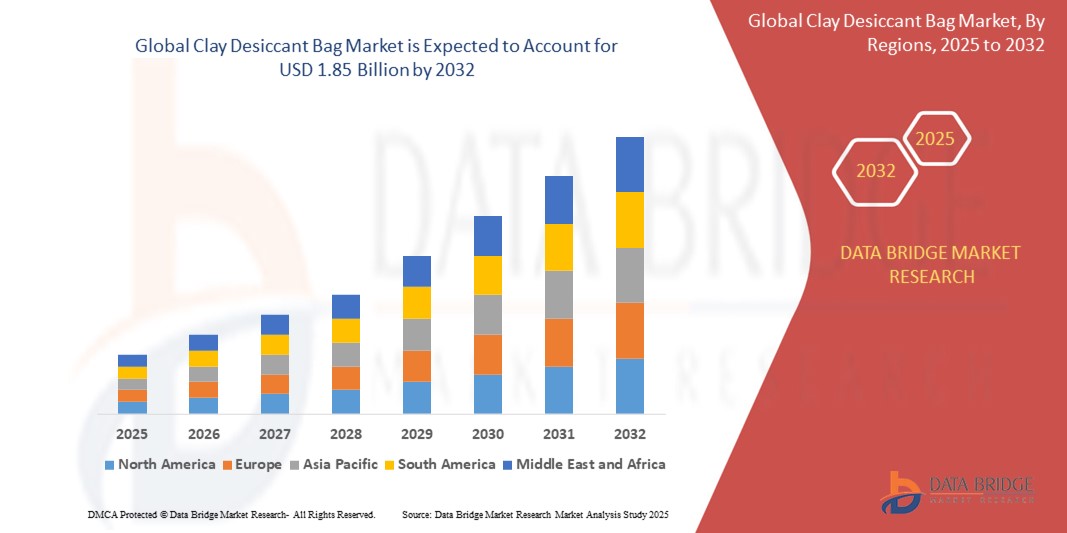
Clay Desiccant Bag Market Size
- The global clay desiccant bag market size was valued at USD 1.24 billion in 2024 and is expected to reach USD 1.85 billion by 2032, at a CAGR of 5.1% during the forecast period
- The market growth is primarily driven by increasing demand for moisture control solutions across various industries, particularly in electronics, pharmaceuticals, and food packaging, due to heightened awareness of product preservation and quality
- Rising industrialization, coupled with the need for cost-effective and eco-friendly moisture-absorbing solutions, is boosting the adoption of clay desiccant bags as a preferred choice for protecting goods during storage and transportation
Clay Desiccant Bag Market Analysis
- Clay desiccant bags, made from natural bentonite clay, are widely used for their ability to absorb moisture and protect products from humidity-related damage, making them essential in industries requiring stringent moisture control
- The growing demand for clay desiccant bags is fueled by their eco-friendly nature, cost-effectiveness, and non-toxic properties, which align with increasing regulatory and consumer preferences for sustainable packaging solutions
- North America dominated the clay desiccant bag market with the largest revenue share of 38.5% in 2024, driven by advanced manufacturing sectors, high adoption of moisture-sensitive products, and the presence of key industry players
- Asia-Pacific is expected to be the fastest-growing region during the forecast period, attributed to rapid industrialization, increasing exports of moisture-sensitive goods, and growing investments in sustainable packaging technologies
- The less than 20 grams segment dominated the largest market revenue share of 38.5% in 2024, driven by its widespread use in small-scale packaging for electronics, pharmaceuticals, and food products, where precise moisture control is critical to maintain product integrity
Report Scope and Clay Desiccant Bag Market Segmentation
|
Attributes |
Clay Desiccant Bag Key Market Insights |
|
Segments Covered |
|
|
Countries Covered |
North America
Europe
Asia-Pacific
Middle East and Africa
South America
|
|
Key Market Players |
|
|
Market Opportunities |
|
|
Value Added Data Infosets |
In addition to the insights on market scenarios such as market value, growth rate, segmentation, geographical coverage, and major players, the market reports curated by the Data Bridge Market Research also include import export analysis, production capacity overview, production consumption analysis, price trend analysis, climate change scenario, supply chain analysis, value chain analysis, raw material/consumables overview, vendor selection criteria, PESTLE Analysis, Porter Analysis, and regulatory framework. |
Clay Desiccant Bag Market Trends
“Increasing Adoption of Eco-Friendly and Sustainable Packaging Solutions”
- The global clay desiccant bag market is experiencing a notable trend toward the adoption of eco-friendly and sustainable packaging solutions
- Clay desiccants, made from natural materials such as montmorillonite clay, are gaining popularity due to their non-toxic, chemically inert, and reusable properties, aligning with growing environmental consciousness
- These solutions are being integrated across industries to protect products from moisture damage, with companies developing innovative packaging designs to enhance sustainability and reduce environmental impact
- For instances, manufacturers are creating clay desiccant bags with biodegradable or recyclable outer materials, such as Tyvek, to meet regulatory and consumer demands for greener alternatives
- This trend is increasing the appeal of clay desiccant bags for industries such as pharmaceuticals, electronics, and food, where sustainable moisture control is critical
- Advanced manufacturing processes are also being employed to optimize the moisture absorption capacity of clay desiccants, ensuring high performance while maintaining eco-friendly credentials
Clay Desiccant Bag Market Dynamics
Driver
“Rising Demand for Moisture-Sensitive Products across Industries”
- The increasing demand for moisture-sensitive products in industries such as electronics, pharmaceuticals, and food packaging is a key driver for the global clay desiccant bag market
- Clay desiccant bags provide effective moisture control, preventing corrosion, mold, and degradation, thereby extending the shelf life and ensuring the quality of products during storage and transportation
- Regulatory mandates in regions such as North America, which emphasize stringent quality standards for pharmaceuticals and food safety, are boosting the adoption of clay desiccant bags
- The growth of e-commerce and global trade is further driving demand, as products require robust moisture protection during long-haul shipments across diverse climatic conditions
- Manufacturers are increasingly integrating clay desiccant bags into packaging as a standard solution to meet industry requirements and consumer expectations for product integrity
Restraint/Challenge
“High Production Costs and Competition from Alternative Desiccants”
- The high production and material costs associated with manufacturing clay desiccant bags can be a significant barrier, particularly for small and medium-sized enterprises in cost-sensitive markets
- The process of sourcing and processing high-quality bentonite clay, along with ensuring compliance with industry standards, adds to the overall cost of production
- In addition, competition from alternative desiccants, such as silica gel and calcium chloride, which may offer higher moisture absorption rates or lower costs, poses a challenge to market growth
- Concerns about the scalability of sustainable clay desiccant solutions in large-scale industrial applications, coupled with varying regulatory requirements across regions, can complicate market expansion
- These factors may deter adoption in emerging markets or industries where cost considerations outweigh the benefits of eco-friendly solutions, limiting the market's growth potential
Clay Desiccant Bag market Scope
The market is segmented on the basis of weight and end-user industry.
- By Weight
On the basis of weight, the global clay desiccant bag market is segmented into less than 20 grams, 21 to 100 grams, 101 to 200 grams, 201 to 500 grams, and above 500 grams. The less than 20 grams segment dominated the largest market revenue share of 38.5% in 2024, driven by its widespread use in small-scale packaging for electronics, pharmaceuticals, and food products, where precise moisture control is critical to maintain product integrity. These lightweight desiccant bags are cost-effective and ideal for compact applications.
The above 500 grams segment is expected to witness the fastest growth rate of 6.8% from 2025 to 2032, fueled by rising demand in industrial applications such as automotive components, manufacturing, and marine cargo. These heavyweight desiccant bags offer high moisture absorption capacities, making them suitable for large-scale storage and transportation needs.
- By End-User Industry
On the basis of end-user industry, the Global Clay Desiccant Bag Market is segmented into electronic and electric equipment, medical devices, pharmaceuticals, automotive components, food, and other industrial applications. The Electronic and Electric equipment segment dominated the market with a revenue share of 32.5% in 2024, driven by the need to protect sensitive components such as semiconductors and circuit boards from moisture-induced corrosion and malfunctions during storage and transportation. The growth of the electronics industry, particularly in North America, further bolsters this segment.
The pharmaceuticals segment is anticipated to experience the fastest growth rate of 7.2% from 2025 to 2032. The increasing global demand for pharmaceuticals, coupled with stringent regulatory requirements for moisture control to preserve drug efficacy and safety, drives the adoption of clay desiccant bags. Their non-toxic and eco-friendly properties make them a preferred choice in this industry.
Clay Desiccant Bag Market Regional Analysis
- North America dominated the clay desiccant bag market with the largest revenue share of 38.5% in 2024, driven by advanced manufacturing sectors, high adoption of moisture-sensitive products, and the presence of key industry players
- Consumers prioritize clay desiccant bags for their natural, non-toxic properties, which effectively absorb moisture to prevent damage to sensitive products such as electronics, pharmaceuticals, and food. This is particularly crucial in regions with diverse climatic conditions
- Market growth is supported by advancements in desiccant technology, such as improved moisture absorption capacities and eco-friendly packaging, alongside rising adoption in both OEM and aftermarket segments
U.S. Clay Desiccant Bag Market Insigh
The U.S. clay desiccant bag market captured the largest revenue share of 76.6% in 2024 within North America, fueled by strong demand in the aftermarket and increasing awareness of moisture protection benefits. The trend toward sustainable packaging and stringent regulations ensuring product safety further boost market expansion. The integration of clay desiccants in industries such as electronics and pharmaceuticals, combined with robust manufacturing capabilities, supports a diverse product ecosystem.
Europe Clay Desiccant Bag Market Insight
The Europe clay desiccant bag market is expected to witness significant growth, supported by regulatory emphasis on product safety and environmental sustainability. Consumers seek desiccants that ensure product integrity while adhering to eco-friendly standards. Growth is prominent in both industrial applications and consumer goods, with countries such as Germany and France showing notable uptake due to advanced manufacturing and increasing environmental concerns.
U.K. Clay Desiccant Bag Market Insight
The U.K. market for clay desiccant bags is expected to experience strong growth, driven by demand for moisture control in industries such as food and electronics in urban and suburban settings. Increased awareness of the benefits of protecting products from moisture damage and a focus on sustainable packaging solutions encourage adoption. Evolving regulations balancing environmental impact and product safety influence consumer choices.
Germany Clay Desiccant Bag Market Insight
Germany is expected to witness robust growth in the clay desiccant bag market, attributed to its advanced manufacturing sector and high consumer focus on product quality and sustainability. German industries prefer clay desiccants for their cost-effectiveness and ability to protect sensitive goods such as automotive components and pharmaceuticals. The integration of these desiccants in premium products and aftermarket applications supports sustained market growth.
Asia-Pacific Clay Desiccant Bag Market Insight
The Asia-Pacific region is expected to witness the fastest growth rate, driven by rapid industrialization and expanding manufacturing in countries such as China, India, and Japan. Increasing awareness of moisture control for product preservation, coupled with rising disposable incomes, boosts demand. Government initiatives promoting sustainable packaging and product safety further encourage the adoption of advanced clay desiccant bags.
Japan Clay Desiccant Bag Market Insight
Japan’s clay desiccant bag market is expected to see strong growth due to consumer preference for high-quality, eco-friendly moisture control solutions that enhance product safety and longevity. The presence of major manufacturers and the integration of desiccants in OEM applications accelerate market penetration. Rising interest in aftermarket solutions for electronics and food packaging also contributes to growth.
China Clay Desiccant Bag Market Insight
China holds the largest share of the Asia-Pacific clay desiccant bag market, propelled by rapid urbanization, increasing industrial output, and growing demand for moisture protection solutions. The country’s expanding manufacturing sector and focus on cost-effective, sustainable packaging support the adoption of clay desiccants. Strong domestic production capabilities and competitive pricing enhance market accessibility.
Clay Desiccant Bag Market Share
The clay desiccant bag industry is primarily led by well-established companies, including:
- Flow Dry Technology, Inc. (U.S.)
- International Plastics Inc. (U.S.)
- Clariant (Switzerland)
- SORBEAD INDIA (India)
- Propagroup (Italy)
- VA Pharma Pack. (India)
- DESICCARE, INC. (U.S.)
- Graphic Packaging International, LLC (U.S.)
- WestRock Company (U.S.)
- Smurfit Kappa (Ireland)
- Krones AG (Germany)
- Amcor plc (Switzerland)
- Graham Packaging Company (U.S.)
- Sonoco Products Company (U.S.)
- Sealed Air (U.S.)
What are the Recent Developments in Global Clay Desiccant Bag Market?
- In February 2024, Impak Corporation expanded its operations by acquiring a regional clay desiccant manufacturer in North America. This strategic move strengthens its production capabilities and broadens its product range. With this acquisition, Impak can now provide tailored clay desiccant solutions for the food and electronics industries, reinforcing its position in the global market. In addition, the company aims to meet the rising demand for sustainable packaging, offering environmentally friendly moisture control solutions. This development enhances Impak’s competitive edge and aligns with industry trends toward eco-conscious materials
- In January 2024, Desiccare, Inc. unveiled a new range of high-capacity clay desiccant bags specifically designed for automotive component packaging. These bags, exceeding 500 grams in size, offer enhanced moisture absorption, ensuring the protection of sensitive parts during global shipping. This product launch highlights Desiccare’s commitment to customized solutions for industrial applications, reinforcing its role in providing effective moisture control for critical components
- In June 2023, Clariant advanced its sustainability efforts by launching plastic-free Desi Pak ECO moisture-absorbing packets. These bio-based desiccants, made from responsibly sourced bentonite clay, help manufacturers and distributors protect sealed packaged goods from moisture damage. The eco-friendly design features sustainably grown raw materials, non-toxic water-based inks, and adhesives, reducing environmental impact compared to synthetic alternatives. This innovation aligns with Clariant’s commitment to sustainable packaging solutions
- In April 2023, Clariant inaugurated its latest CATOFIN catalyst production facility in Jiaxing, Zhejiang Province, China. This CHF 80 million investment strengthens Clariant’s regional footprint, expanding its catalyst production capabilities to meet growing demand in propylene manufacturing. The facility integrates advanced Heat Generating Material (HGM) technology, reducing energy consumption by up to one-third. While not directly related to clay desiccant bags, this expansion aligns with Clariant’s broader industrial strategy, potentially influencing high-tech material applications
- In March 2023, Micro-Pak Dri Clay® Kraft is a certified plastic-free desiccant made from natural bentonite clay, packaged in biodegradable FSC Kraft paper. This eco-friendly solution outperforms synthetic desiccants and provides superior protection against mold and moisture damage. Designed for textiles, home furnishings, electronics, food, pharmaceuticals, and metal components, it ensures safe and sustainable moisture control. The Plastic Free Certification confirms its 100% plastic-free composition, reinforcing the industry's shift toward high-performance, environmentally responsible solutions

- Interactive Data Analysis Dashboard
- Company Analysis Dashboard for high growth potential opportunities
- Research Analyst Access for customization & queries
- Competitor Analysis with Interactive dashboard
- Latest News, Updates & Trend analysis
- Harness the Power of Benchmark Analysis for Comprehensive Competitor Tracking
Global Clay Desiccant Bag Market, Supply Chain Analysis and Ecosystem Framework
To support market growth and help clients navigate the impact of geopolitical shifts, DBMR has integrated in-depth supply chain analysis into its Global Clay Desiccant Bag Market research reports. This addition empowers clients to respond effectively to global changes affecting their industries. The supply chain analysis section includes detailed insights such as Global Clay Desiccant Bag Market consumption and production by country, price trend analysis, the impact of tariffs and geopolitical developments, and import and export trends by country and HSN code. It also highlights major suppliers with data on production capacity and company profiles, as well as key importers and exporters. In addition to research, DBMR offers specialized supply chain consulting services backed by over a decade of experience, providing solutions like supplier discovery, supplier risk assessment, price trend analysis, impact evaluation of inflation and trade route changes, and comprehensive market trend analysis.
Data collection and base year analysis are done using data collection modules with large sample sizes. The stage includes obtaining market information or related data through various sources and strategies. It includes examining and planning all the data acquired from the past in advance. It likewise envelops the examination of information inconsistencies seen across different information sources. The market data is analysed and estimated using market statistical and coherent models. Also, market share analysis and key trend analysis are the major success factors in the market report. To know more, please request an analyst call or drop down your inquiry.
The key research methodology used by DBMR research team is data triangulation which involves data mining, analysis of the impact of data variables on the market and primary (industry expert) validation. Data models include Vendor Positioning Grid, Market Time Line Analysis, Market Overview and Guide, Company Positioning Grid, Patent Analysis, Pricing Analysis, Company Market Share Analysis, Standards of Measurement, Global versus Regional and Vendor Share Analysis. To know more about the research methodology, drop in an inquiry to speak to our industry experts.
Data Bridge Market Research is a leader in advanced formative research. We take pride in servicing our existing and new customers with data and analysis that match and suits their goal. The report can be customized to include price trend analysis of target brands understanding the market for additional countries (ask for the list of countries), clinical trial results data, literature review, refurbished market and product base analysis. Market analysis of target competitors can be analyzed from technology-based analysis to market portfolio strategies. We can add as many competitors that you require data about in the format and data style you are looking for. Our team of analysts can also provide you data in crude raw excel files pivot tables (Fact book) or can assist you in creating presentations from the data sets available in the report.













