


Clean Label Household Care Market Overview
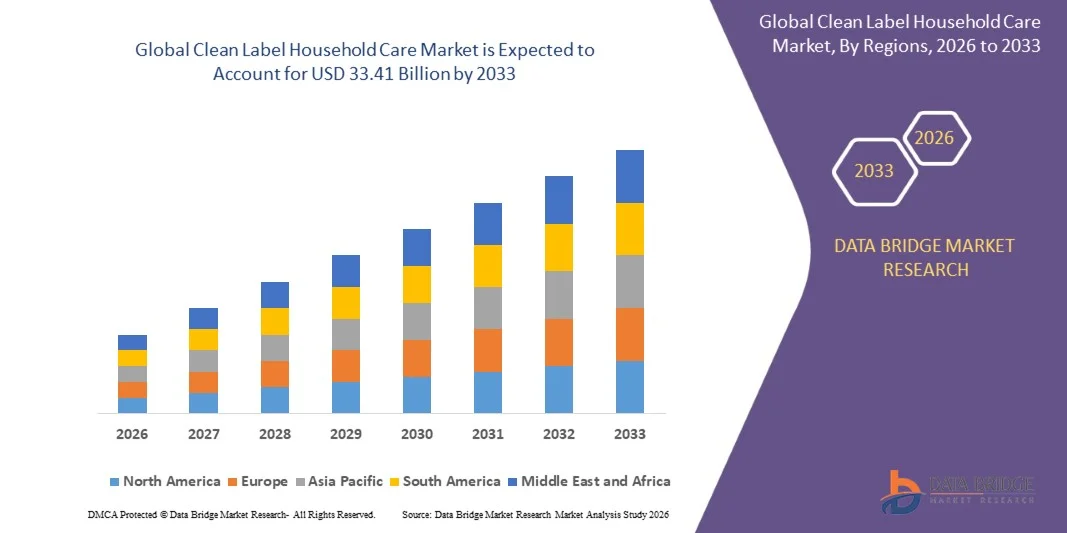
As per Data Bridge Market Research Analysis the Clean Label Household Care Market was valued at USD 14.5 billion in 2025 and is projected to reach USD 33.41 billion by 2033, growing at a CAGR of 11% from 2026 to 2033. This expansion reflects a fundamental change from traditional chemical-based cleaning to formulations that use recognizable, naturally derived, and transparently sourced ingredients. Consumers are increasingly scrutinizing ingredient lists for household care products, similar to their approach to food and personal care, seeking to avoid harsh chemicals, synthetic fragrances, and artificial dyes in favor of plant-based and biodegradable alternatives.
The market's growth is underpinned by rising health and wellness consciousness, particularly in the wake of the COVID-19 pandemic, which heightened awareness of indoor air quality and the potential health impacts of chemical residues. Consumers are actively seeking non-toxic, hypoallergenic, and fragrance-free options, driving demand for products free from parabens, phthalates, and other potentially harmful substances. Furthermore, a strong sustainability narrative is propelling the market, with brands innovating in formulations and adopting eco-friendly packaging to meet the expectations of ethically-minded shoppers.
Key Market Trends & Insights
- The Laundry Detergents segment is a significant market driver, with a growing shift toward concentrated, plant-based, and enzyme-powered formulas that offer effective cleaning without synthetic additives.
- Online Retail is the fastest-growing distribution channel, offering consumers greater access to niche, specialist brands, detailed ingredient information, and subscription-based models for home delivery.
- Europe is estimated to be a leading region, benefiting from stringent regulatory frameworks like the EU Ecolabel, high consumer awareness, and strong retail support for sustainable products.
- The Asia-Pacific region is the fastest-growing market, fueled by rapid urbanization, rising disposable incomes, and increasing consumer awareness of product ingredients and sustainability in countries like India and China.
- Key market drivers include the influence of social media and wellness advocates, which are accelerating informed purchasing decisions and brand transparency.
Market Size & Forecast
- Global Market Value (2025): USD 14.5 Billion
- Expected Market Value (2033): USD 33.41 Billion
- Forecast CAGR (2026–2033): 11%
- Leading Region in 2025: Europe
- Fastest Growing Region: Asia-Pacific
Report Scope and Clean Label Household Care Market Segmentation
|
Attributes |
Clean Label Household Care Key Market Insights |
|
Segments Covered |
|
|
Countries Covered |
North America · U.S. · Canada · Mexico Europe · Germany · France · U.K. · Netherlands · Switzerland · Belgium · Russia · Italy · Spain · Turkey · Rest of Europe Asia-Pacific · China · Japan · India · South Korea · Singapore · Malaysia · Australia · Thailand · Indonesia · Philippines · Rest of Asia-Pacific Middle East and Africa · Saudi Arabia · U.A.E. · South Africa · Egypt · Israel · Rest of Middle East and Africa South America · Brazil · Argentina · Rest of South America |
|
Key Market Players |
· Procter & Gamble Co. (U.S.) · Unilever PLC (U.K.) · Henkel AG & Co. KGaA (Germany) · Reckitt Benckiser Group plc (U.K.) · S. C. Johnson & Son, Inc. (U.S.) · The Clorox Company (U.S.) · Kao Corporation (Japan) · Church & Dwight Co., Inc. (U.S.) · Colgate-Palmolive Company (U.S.) · Godrej Consumer Products Limited (India) · Seventh Generation, Inc. (U.S.) · ECOS (Earth Friendly Products) (U.S.) · Blueland (U.S.) · Branch Basics (U.S.) · Method Products PBC (U.S.) |
|
Market Opportunities |
· Expansion of Refillable and Concentrated Cleaning Products · Rising Demand for Plant-Based and Bio-Based Ingredients · Expansion Through E-commerce and Direct-to-Consumer (DTC) Channels |
|
Value Added Data Infosets |
In addition to the insights on market scenarios such as market value, growth rate, segmentation, geographical coverage, and major players, the market reports curated by the Data Bridge Market Research also include in-depth expert analysis, pricing analysis, brand share analysis, consumer survey, demography analysis, supply chain analysis, value chain analysis, raw material/consumables overview, vendor selection criteria, PESTLE Analysis, Porter Analysis, and regulatory framework. |
Clean Label Household Care Market Trends
Trend: Growth of Probiotic and Bio-based Cleaners
An emerging trend in household care is the use of probiotics and other bio-based ingredients that leverage naturally occurring bacteria for cleaning . These products move beyond traditional "100% germ-kill" messaging to focus on microbial balance, using competitive exclusion to create a healthier home environment. This innovation is driven by consumer demand for more natural, sustainable, and longer-lasting cleaning performance, with probiotic cleaners remaining active for up to 72 hours after application . This trend reflects a broader shift toward formulations that work in harmony with natural systems.
Clean Label Household Care Market Dynamics
Key Market Driver: Rising Health and Wellness Consciousness
A primary driver is the intensifying consumer focus on health and wellness, which now extends to the home environment. Consumers are increasingly aware of the potential health impacts of synthetic chemicals and volatile organic compounds found in conventional cleaning products, linking them to respiratory issues, allergies, and skin irritation. This concern is pushing demand for clean label alternatives that are free from artificial fragrances, dyes, and harsh chemicals like phthalates and parabens. Social media and wellness influencers play a crucial role in educating consumers and amplifying the demand for transparency
In August 2025, Marie Claire UK reported a growing trend toward non-toxic homecare, with consumers increasingly choosing products free from bleach, ammonia, phthalates, and synthetic dyes. The article highlights rising awareness of indoor air quality, skin health, and sustainable living, encouraging demand for clean-label cleaning products.
Key Restraint/Challenge: High Production and Sourcing Costs
A significant challenge is the higher cost associated with producing clean label household care products . Sourcing certified organic, plant-based, or biodegradable raw materials often requires specialized and more expensive supply chains compared to conventional synthetic ingredients. Manufacturers must also invest in R&D to maintain product efficacy without relying on traditional chemical agents and navigate complex certification processes to validate their claims . These costs are often passed on to consumers, making clean label products less accessible to price-sensitive shoppers and limiting market penetration in cost-conscious demographics.
In July 2025, Foodcom S.A. highlighted continued volatility in plant-based ingredient markets, noting that producers are facing raw material price fluctuations and supply chain challenges, prompting greater emphasis on strategic sourcing and procurement management.
Key Market Opportunity: Technological Innovation in Preservation and Formulation
Technological innovation presents a significant opportunity to overcome the cost and performance challenges of clean label products . Advances in preservation techniques, such as high-pressure processing (HPP) and the use of natural antimicrobial solutions, allow manufacturers to extend shelf life and ensure product safety without synthetic additives . Similarly, the development of more efficient plant-based surfactants and enzymes is improving cleaning performance while maintaining a natural ingredient profile. These innovations help bridge the gap between consumer expectations for both safety and efficacy, making clean label products more competitive with mainstream alternatives.
In July 2025, BASF expanded its Lavergy® liquid enzyme portfolio by introducing new lipase, cellulase, and amylase enzymes for laundry and home care formulations. The biodegradable enzymes improve stain removal, fabric care, and cleaning performance at low washing temperatures, enabling manufacturers to formulate high-performance, clean-label household products.
Clean Label Household Care Market Scope
The clean label household care market is segmented on the basis of product type, distribution channel and end-use.
- By Product Type
On the basis of product type, The Clean Label Household Care Market is segmented into laundry detergents, fabric softeners, surface cleaners, dishwashing liquids, and air care. The Laundry Detergents segment holds a significant share, driven by the essential nature of the product and the strong consumer preference for plant-based, enzyme-powered formulations that are effective and eco-friendly.
The Surface Cleaners and Dishwashing Liquids segments are also growing rapidly, fueled by demand for non-toxic, biodegradable options for everyday cleaning.
- By Distribution Channel Type
On the basis of distribution channel type, the Clean Label Household Care Market is segmented into hypermarkets/supermarkets, online retail, convenience stores, and specialty stores. Hypermarkets/Supermarkets remain a significant channel due to high consumer traffic.
Online Retail is the fastest-growing segment, offering a wider selection of niche brands and the convenience of home delivery. Direct-to-consumer (DTC) models are also gaining traction, allowing brands to build direct relationships with consumers and communicate their sustainability message clearly.
Global Driving Simulators Clean Label Household Care Market Regional Analysis
Europe is estimated to dominate the clean label household care market, holding the largest share in 2025. This leadership is attributed to the region's high consumer awareness regarding food safety, nutrition, and sustainability, as well as robust regulatory frameworks like the EU Ecolabel that enforce strict product standards. Countries such as Germany, France, and the UK are key markets with high penetration of organic and natural personal care and home products, with retailers actively promoting private-label sustainable offerings.
Asia-Pacific is the fastest-growing region, driven by rapid urbanization and rising disposable incomes. The growing middle-class populations in China, India, and Southeast Asia are fueling demand for premium, healthier FMCG products as awareness of food adulteration and chemical exposure rises. Expansion of modern retail and e-commerce platforms is improving product accessibility, with brands increasingly launching clean label products tailored for the region.
Germany Clean Label Household Care Market Insight
Germany is a leading market in Europe, known for its discerning consumers who prioritize natural, organic, and additive-free products. The country's robust regulatory framework, including standards set by the Federal Office of Consumer Protection and Food Safety (BVL), enforces strict labeling requirements and encourages manufacturers to prioritize simplicity and transparency. This creates a thriving market where clean, natural, and trustworthy products are central to consumer choice.
U.S. Clean Label Household Care Market Insight
The U.S. market is witnessing strong growth, driven by high consumer awareness and willingness to pay a premium for products that are healthier and more sustainable. The market is characterized by dynamic innovation, with a strong presence of both established multinational brands and niche direct-to-consumer startups. The demand for plant-based, gluten-free, and non-GMO products is robust, and retailers are expanding organic and natural aisles in response
India Clean Label Household Care Market Insight
The Indian market is expanding significantly, propelled by urbanization, rising household incomes, and increasing awareness of health and sustainability . Consumers are becoming more ingredient-conscious, with a growing preference for Ayurvedic, natural, and plant-based formulations that align with cultural dietary preferences. Local and international brands are actively competing by introducing region-specific products, with a strong focus on affordability and effective communication through digital channels.
Clean Label Household Care Market Share
The Clean label household care industry is primarily led by well-established companies, including:
- Procter & Gamble Co. (U.S.)
- Unilever PLC (U.K.)
- Henkel AG & Co. KGaA (Germany)
- Reckitt Benckiser Group plc (U.K.)
- S. C. Johnson & Son, Inc. (U.S.)
- The Clorox Company (U.S.)
- Kao Corporation (Japan)
- Church & Dwight Co., Inc. (U.S.)
- Colgate-Palmolive Company (U.S.)
- Godrej Consumer Products Limited (India)
- Seventh Generation, Inc. (U.S.)
- ECOS (Earth Friendly Products) (U.S.)
- Blueland (U.S.)
- Branch Basics (U.S.)
- Method Products PBC (U.S.)
Latest Developments in Clean Label Household Care Market
- In January 2025, Natural Grocers®, a specialty retailer of organic and natural products, expanded its private-label line with six new household cleaning products. These products are formulated without parabens, phthalates, sulfates, and synthetic fragrances and utilize containers made from sustainable sugar cane.
- In July 2025, Orange House, an eco-friendly home care brand, launched a U.S. expansion campaign through Costco Roadshow events to introduce its natural, food-grade orange oil-based cleaning products to a mainstream audience .
- In June 2026, Ecostore launched a refreshed range of household cleaners, including a new Floor & all Purpose Cleaner and a Lemon & Lime Toilet Cleaner. The brand also introduced 100ml Cleaner Refill Concentrates as a sustainable alternative to buying new plastic bottles.
- In October 2025, Sasol International Chemicals commercialized LIVINEX IO 7, the first bio-circular, nonionic surfactant derived from insect oils for the home care market. This palm and deforestation-free ingredient serves as a sustainable "drop-in" replacement for traditional surfactants .
- In October 2025, Croda launched NeutraFresh™ BD, a biodegradable version of its proven odour-neutralising technology for the home care sector.
- In November 2025, PineCare, a Vietnamese brand, partnered with distributor NAMSAPA to introduce a line of biodegradable dishwasher tablets made with pine essential oil and plant enzymes.
- In April 2026, Peels & Co, a new plant-based home cleaning brand, was launched in India by a former CarDekho executive. The brand focuses on bio-enzyme-based products made from fruit peels.
- In April 2026, Truly Free Home launched a plant-powered, refillable multi-surface cleaner scented with real essential oils.

- Interactive Data Analysis Dashboard
- Company Analysis Dashboard for high growth potential opportunities
- Research Analyst Access for customization & queries
- Competitor Analysis with Interactive dashboard
- Latest News, Updates & Trend analysis
- Harness the Power of Benchmark Analysis for Comprehensive Competitor Tracking
Data collection and base year analysis are done using data collection modules with large sample sizes. The stage includes obtaining market information or related data through various sources and strategies. It includes examining and planning all the data acquired from the past in advance. It likewise envelops the examination of information inconsistencies seen across different information sources. The market data is analysed and estimated using market statistical and coherent models. Also, market share analysis and key trend analysis are the major success factors in the market report. To know more, please request an analyst call or drop down your inquiry.
The key research methodology used by DBMR research team is data triangulation which involves data mining, analysis of the impact of data variables on the market and primary (industry expert) validation. Data models include Vendor Positioning Grid, Market Time Line Analysis, Market Overview and Guide, Company Positioning Grid, Patent Analysis, Pricing Analysis, Company Market Share Analysis, Standards of Measurement, Global versus Regional and Vendor Share Analysis. To know more about the research methodology, drop in an inquiry to speak to our industry experts.
Data Bridge Market Research is a leader in advanced formative research. We take pride in servicing our existing and new customers with data and analysis that match and suits their goal. The report can be customized to include price trend analysis of target brands understanding the market for additional countries (ask for the list of countries), clinical trial results data, literature review, refurbished market and product base analysis. Market analysis of target competitors can be analyzed from technology-based analysis to market portfolio strategies. We can add as many competitors that you require data about in the format and data style you are looking for. Our team of analysts can also provide you data in crude raw excel files pivot tables (Fact book) or can assist you in creating presentations from the data sets available in the report.













