


Clean Label Plant-Based Dairy Market Overview
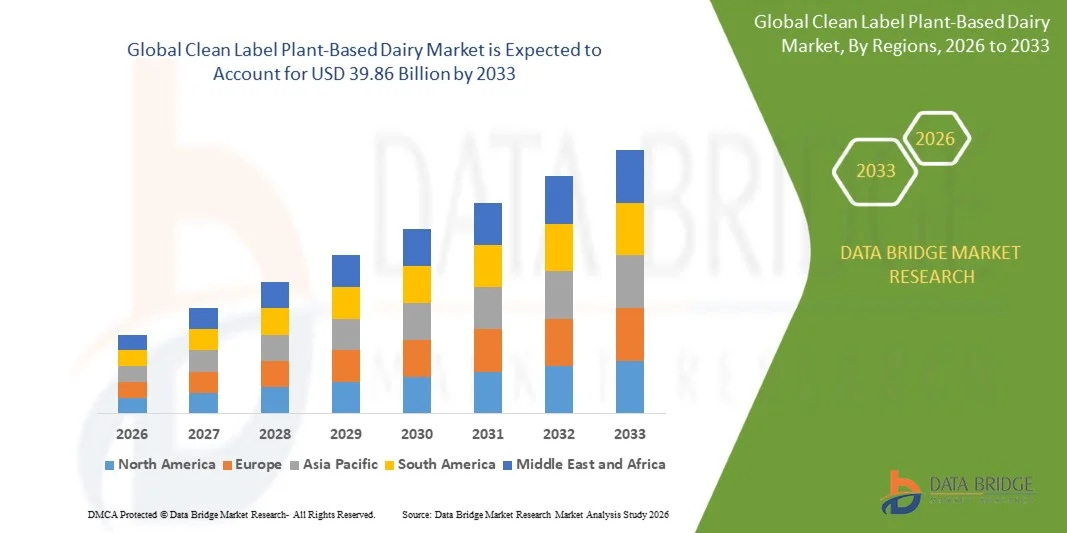
The Clean Label Plant-Based Dairy Market was valued at USD 18.74 billion in 2025 and is projected to reach USD 39.86 billion by 2033, growing at a CAGR of 9.9% from 2026 to 2033. The market is experiencing strong growth due to increasing consumer preference for plant-based foods formulated with simple, recognizable ingredients and free from artificial additives, preservatives, gums, and synthetic stabilizers. Consumers are increasingly scrutinizing product labels and choosing dairy alternatives made with natural ingredients such as oats, almonds, coconuts, soybeans, and natural flavors.
Manufacturers are responding by introducing products with shorter ingredient lists, organic certifications, non-GMO sourcing, and minimal processing. Leading companies such as Danone S.A., Oatly Group AB, Califia Farms, LLC, and The Hain Celestial Group, Inc. are expanding their clean label portfolios to meet rising demand for healthier and more transparent plant-based dairy products.
Key Market Trends & Insights
- North America dominated the global market with a revenue share of 36.18% in 2025, supported by strong demand for organic, non-GMO, and additive-free plant-based dairy products.
- Plant-Based Milk accounted for the largest product segment share of 47.26% in 2025, driven by widespread household consumption and versatile usage.
- Asia-Pacific is expected to be the fastest-growing region, registering a CAGR of 11.2% from 2026 to 2033.
- Oat-based products are witnessing the fastest growth due to their creamy texture, allergen-friendly positioning, and sustainable image.
- Supermarkets & Hypermarkets accounted for 44.83% of global sales in 2025 due to broad product assortment and high consumer accessibility.
- Online retail is expanding rapidly through direct-to-consumer subscriptions and health-focused e-commerce platforms.
- Brands are increasingly removing carrageenan, artificial emulsifiers, and refined sugars to align with clean label expectations.
Market Size & Forecast
- Global Market Value (2025): USD 18.74Billion
- Expected Market Value (2033): USD 39.86 Billion
- Forecast CAGR (2026–2033): 9.9%
- Leading Region in 2025: North America
- Fastest Growing Region: Asia-Pacific
Report Scope and Clean Label Plant-Based Dairy Market Segmentation
|
Attributes |
Clean Label Plant-Based Dairy Market Key Market Insights |
|
Segments Covered |
|
|
Countries Covered |
North America
Europe
Asia-Pacific
Middle East and Africa
South America
|
|
Key Market Players |
|
|
Market Opportunities |
|
|
Value Added Data Infosets |
In addition to the insights on market scenarios such as market value, growth rate, segmentation, geographical coverage, and major players, the market reports curated by the Data Bridge Market Research also include in-depth expert analysis, pricing analysis, brand share analysis, consumer survey, demography analysis, supply chain analysis, value chain analysis, raw material/consumables overview, vendor selection criteria, PESTLE Analysis, Porter Analysis, and regulatory framework. |
Clean Label Plant-Based Dairy Market Trends
Trend: Rising Demand for Minimal Ingredient and Transparent Plant-Based Formulations
Consumers are increasingly seeking plant-based dairy products that contain only essential ingredients and avoid artificial stabilizers, preservatives, and synthetic flavors. Products featuring labels such as “no gums,” “no carrageenan,” “organic,” and “non-GMO” are gaining significant traction. Oat milk, almond yogurt, and coconut creamers with simplified ingredient lists are particularly appealing to health-conscious consumers. In addition, brands are emphasizing sustainability, allergen-friendly formulations, and clean nutritional profiles, which is accelerating adoption across global markets.
Clean Label Plant-Based Dairy Market Dynamics
Key Market Driver: Increasing Consumer Preference for Natural and Transparent Food Products
Growing awareness regarding ingredient transparency and food processing has led consumers to prefer plant-based dairy products with short, recognizable ingredient lists. Demand is increasing for products free from artificial sweeteners, colors, emulsifiers, and preservatives. This trend is particularly strong among millennials, families with children, and consumers with dietary sensitivities.
Key Restraint/Challenge: Limited Shelf Stability and Formulation Complexity
Clean label formulations often require premium raw materials and advanced processing technologies to maintain taste, texture, and shelf stability without synthetic additives. This increases manufacturing costs and creates technical challenges, especially in categories such as cheese and yogurt alternatives where texture is critical.
Key Market Opportunity: Expansion of Functional and Fortified Clean Label Products
Manufacturers have significant opportunities to develop clean label products enriched with calcium, vitamin D, probiotics, and protein while maintaining natural ingredient profiles. Functional plant-based dairy products that support immunity, digestive health, and bone health are expected to drive future growth.
Clean Label Plant-Based Dairy Market Scope
The Clean Label Plant-Based Dairy Market is segmented on the basis of product type, source type, and distribution channel.
• By Product Type
The market is segmented into Plant-Based Milk, Plant-Based Yogurt, Plant-Based Cheese, and Plant-Based Creamers. The Plant-Based Milk segment dominated the market in 2025 with a share of 47.26%, owing to widespread use in beverages, cereals, and cooking applications. Plant-Based Yogurt is expected to witness the fastest growth due to increasing demand for probiotic and protein-enriched dairy alternatives.
• By Source Type
On the basis of source type, the market is segmented into Almond, Oat, Soy, and Coconut. Almond-based products dominated the market due to strong consumer familiarity and premium positioning. Oat-based products are projected to grow at the fastest rate owing to their creamy texture, sustainability profile, and allergen-friendly characteristics.
• By Distribution Channel
On the basis of distribution channel, the market is segmented into Supermarkets & Hypermarkets, Convenience Stores, Specialty Stores, and Online Retail. Supermarkets & Hypermarkets held the largest market share in 2025, while Online Retail is expected to record the fastest growth due to increasing digital grocery adoption and direct-to-consumer strategies.
Clean Label Plant-Based Dairy Market Regional Analysis
North America dominated the Clean Label Plant-Based Dairy Market and accounted for the largest revenue share of 36.18% in 2025. The region’s leadership is driven by strong consumer awareness regarding ingredient transparency, increasing adoption of vegan and flexitarian diets, and robust demand for organic and non-GMO products. Consumers in the U.S. and Canada actively seek plant-based milk, yogurt, and creamers formulated without artificial stabilizers, preservatives, and synthetic flavors. The presence of leading brands, advanced retail infrastructure, and widespread availability of premium clean label products continue to strengthen North America’s dominant position in the global market.
U.S. Clean Label Plant-Based Dairy Market Insight
The U.S. Clean Label Plant-Based Dairy Market is witnessing substantial growth due to rising health consciousness, increasing lactose intolerance, and strong demand for minimally processed plant-based products. Consumers are increasingly preferring oat milk, almond milk, and plant-based yogurts made with simple ingredient lists and free from gums and artificial additives. The country’s well-developed supermarket chains, natural food retailers, and e-commerce platforms are supporting widespread product accessibility. Continuous innovation by major brands and growing consumer focus on sustainability are further accelerating market expansion in the United States.
Europe Clean Label Plant-Based Dairy Market Insight
The Europe Clean Label Plant-Based Dairy Market represents a major share of global revenue, supported by strict food labeling regulations, strong environmental awareness, and growing consumer preference for natural and organic products. Consumers across the region increasingly choose plant-based dairy alternatives that are free from artificial preservatives, emulsifiers, and synthetic sweeteners. Established plant-based food cultures, advanced manufacturing capabilities, and widespread retail penetration continue to drive adoption. Rising demand for sustainable, allergen-friendly, and ethically sourced products further strengthens market growth throughout Europe.
U.K. Clean Label Plant-Based Dairy Market Insight
The U.K. Clean Label Plant-Based Dairy Market is expanding steadily due to increasing vegan and flexitarian lifestyles and strong consumer interest in transparent food labeling. British consumers are showing high demand for oat-based beverages, dairy-free yogurts, and clean label coffee creamers made with natural ingredients. The growth of private-label organic products, health-focused retailers, and online grocery platforms is improving product accessibility. In addition, government support for healthier diets and sustainability initiatives is contributing to increased market adoption in the United Kingdom.
Germany Clean Label Plant-Based Dairy Market Insight
The Germany Clean Label Plant-Based Dairy Market is experiencing robust growth due to the country’s strong organic food sector, environmentally conscious consumers, and high preference for additive-free products. German consumers actively seek non-GMO and minimally processed plant-based dairy alternatives with short ingredient lists and sustainable packaging. The country’s advanced food manufacturing capabilities and strong retail networks support rapid product innovation and commercialization. Growing popularity of oat and almond-based dairy alternatives continues to fuel market growth across Germany.
Asia-Pacific Clean Label Plant-Based Dairy Market Insight
The Asia-Pacific Clean Label Plant-Based Dairy Market is expected to witness the fastest growth during the forecast period. Growth is driven by rising lactose intolerance, increasing disposable incomes, rapid urbanization, and growing awareness of plant-based nutrition. Consumers in China, India, Japan, and Australia are increasingly adopting clean label dairy alternatives as part of healthier and more sustainable lifestyles. Expanding modern retail infrastructure and e-commerce penetration are further accelerating product availability and regional market expansion.
Japan Clean Label Plant-Based Dairy Market Insight
The Japan Clean Label Plant-Based Dairy Market is witnessing steady growth due to consumer preference for functional, high-quality, and minimally processed foods. Japanese consumers are increasingly adopting soy, oat, and almond-based dairy alternatives with clean ingredient profiles and nutritional fortification. Strong focus on product quality, food safety, and convenience is supporting market development. The expansion of plant-based product offerings in supermarkets and convenience stores is further contributing to growth in Japan.
China Clean Label Plant-Based Dairy Market Insight
The China Clean Label Plant-Based Dairy Market is growing rapidly due to increasing health awareness, rising prevalence of lactose intolerance, and expanding demand for premium and natural food products. Urban consumers are increasingly purchasing oat milk, almond beverages, and dairy-free yogurts with non-GMO and additive-free formulations. Strong growth in e-commerce and investments by domestic and international brands are enhancing market penetration. China is emerging as one of the most attractive markets for clean label plant-based dairy products in Asia-Pacific.
Clean Label Plant-Based Dairy Market Share
The Clean Label Plant-Based Dairy Market industry is primarily led by well-established companies, including:
- Danone S.A. (France)
- Oatly Group AB (Sweden)
- Califia Farms, LLC (U.S.)
- The Hain Celestial Group, Inc. (U.S.)
- SunOpta Inc. (Canada)
- Blue Diamond Growers (U.S.)
- Elmhurst 1925 (U.S.)
- Chobani, LLC (U.S.)
- Ripple Foods PBC (U.S.)
- Nestlé S.A. (Switzerland)
Latest Developments in Clean Label Plant-Based Dairy Market
- In February 2026, Danone S.A. expanded its Silk portfolio by introducing almond and oat beverages made with simplified ingredient lists and no artificial stabilizers. The launch strengthened the company’s clean label positioning and addressed increasing consumer demand for transparent and minimally processed plant-based dairy products.
- In September 2025, Oatly Group AB launched an updated oat milk formulation containing fewer ingredients and no added gums. The product was developed to enhance clean label appeal while preserving texture and performance in coffee and culinary applications.
- In June 2025, Califia Farms, LLC introduced Organic Oatmilk with non-GMO ingredients and no carrageenan. The product targeted consumers seeking premium, additive-free dairy alternatives with sustainable sourcing credentials.
- In April 2025, Elmhurst 1925 expanded distribution of its two-ingredient nut milks across North America. The company emphasized minimal processing and simple formulations to strengthen its clean label brand identity.
- In January 2026, Chobani, LLC launched clean label oat-based creamers formulated without artificial flavors or preservatives, broadening its presence in the natural plant-based dairy category.

- Interactive Data Analysis Dashboard
- Company Analysis Dashboard for high growth potential opportunities
- Research Analyst Access for customization & queries
- Competitor Analysis with Interactive dashboard
- Latest News, Updates & Trend analysis
- Harness the Power of Benchmark Analysis for Comprehensive Competitor Tracking
Global Clean Label Plant Based Dairy Market, Supply Chain Analysis and Ecosystem Framework
To support market growth and help clients navigate the impact of geopolitical shifts, DBMR has integrated in-depth supply chain analysis into its Global Clean Label Plant Based Dairy Market research reports. This addition empowers clients to respond effectively to global changes affecting their industries. The supply chain analysis section includes detailed insights such as Global Clean Label Plant Based Dairy Market consumption and production by country, price trend analysis, the impact of tariffs and geopolitical developments, and import and export trends by country and HSN code. It also highlights major suppliers with data on production capacity and company profiles, as well as key importers and exporters. In addition to research, DBMR offers specialized supply chain consulting services backed by over a decade of experience, providing solutions like supplier discovery, supplier risk assessment, price trend analysis, impact evaluation of inflation and trade route changes, and comprehensive market trend analysis.
Data collection and base year analysis are done using data collection modules with large sample sizes. The stage includes obtaining market information or related data through various sources and strategies. It includes examining and planning all the data acquired from the past in advance. It likewise envelops the examination of information inconsistencies seen across different information sources. The market data is analysed and estimated using market statistical and coherent models. Also, market share analysis and key trend analysis are the major success factors in the market report. To know more, please request an analyst call or drop down your inquiry.
The key research methodology used by DBMR research team is data triangulation which involves data mining, analysis of the impact of data variables on the market and primary (industry expert) validation. Data models include Vendor Positioning Grid, Market Time Line Analysis, Market Overview and Guide, Company Positioning Grid, Patent Analysis, Pricing Analysis, Company Market Share Analysis, Standards of Measurement, Global versus Regional and Vendor Share Analysis. To know more about the research methodology, drop in an inquiry to speak to our industry experts.
Data Bridge Market Research is a leader in advanced formative research. We take pride in servicing our existing and new customers with data and analysis that match and suits their goal. The report can be customized to include price trend analysis of target brands understanding the market for additional countries (ask for the list of countries), clinical trial results data, literature review, refurbished market and product base analysis. Market analysis of target competitors can be analyzed from technology-based analysis to market portfolio strategies. We can add as many competitors that you require data about in the format and data style you are looking for. Our team of analysts can also provide you data in crude raw excel files pivot tables (Fact book) or can assist you in creating presentations from the data sets available in the report.













