


Cleanroom Lighting Market Size
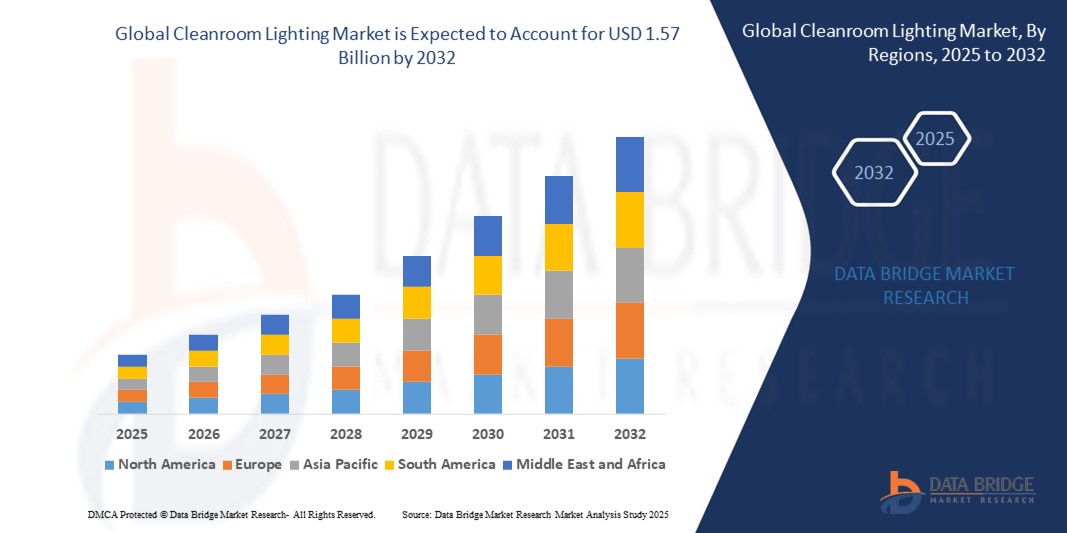
- The global cleanroom lighting market size was valued at USD 1.04 billion in 2024 and is expected to reach USD 1.57 billion by 2032, at a CAGR of 5.30% during the forecast period
- The market growth is largely fuelled by the rising demand for contamination-free environments across industries such as pharmaceuticals, biotechnology, semiconductors, and healthcare
- Rapid expansion of healthcare infrastructure and cleanroom-dependent production facilities, especially post-pandemic, is further accelerating the adoption of specialized lighting systems tailored for sterile environments
Cleanroom Lighting Market Analysis
- Increasing adoption of LED-based cleanroom lighting solutions due to their energy efficiency, low heat emission, and long operational life is driving the market forward
- Stringent regulatory standards regarding cleanroom conditions, particularly in pharmaceutical and microelectronics manufacturing, are boosting investments in specialized lighting systems designed to meet ISO and GMP classifications
- Asia-Pacific dominated the cleanroom lighting market with the largest revenue share of 39.56% in 2024, driven by the rapid expansion of the pharmaceutical, biotechnology, and semiconductor industries across key countries such as China, Japan, and India
- North America region is expected to witness the highest growth rate in the global cleanroom lighting market, driven by increasing adoption of LED-based cleanroom lighting, growing emphasis on energy-efficient systems, and stringent standards for hygiene and illumination in pharmaceutical and food processing industries
- The LED segment dominated the market with the largest market revenue share of 68.5% in 2024, driven by its energy efficiency, long lifespan, and minimal heat emission, which are crucial for temperature-sensitive cleanroom environments. LEDs also offer superior illumination quality, making them ideal for sterile settings such as pharmaceutical labs and semiconductor facilities. Their compatibility with smart control systems and lower maintenance requirements further support their widespread adoption in regulated industries
Report Scope and Cleanroom Lighting Market Segmentation
|
Attributes |
Cleanroom Lighting Key Market Insights |
|
Segments Covered |
|
|
Countries Covered |
North America
Europe
Asia-Pacific
Middle East and Africa
South America
|
|
Key Market Players |
|
|
Market Opportunities |
• Integration of Smart Lighting Controls in Cleanroom Infrastructure |
|
Value Added Data Infosets |
In addition to the market insights such as market value, growth rate, market segments, geographical coverage, market players, and market scenario, the market report curated by the Data Bridge Market Research team includes in-depth expert analysis, import/export analysis, pricing analysis, production consumption analysis, and pestle analysis. |
Cleanroom Lighting Market Trends
Rising Adoption of LED Technology in Cleanroom Applications
- The shift from traditional fluorescent lighting to light-emitting diode (LED) fixtures is reshaping the cleanroom lighting landscape by offering superior energy efficiency, longer operational life, and reduced maintenance costs. LED luminaires also generate less heat, making them ideal for temperature-sensitive cleanroom environments such as pharmaceuticals and microelectronics
- The demand for uniform illumination and minimized particle emission is accelerating the deployment of sealed LED panels. These fixtures are designed with anti-microbial coatings and flush surfaces, ensuring compliance with strict cleanroom standards while enhancing visibility and safety
- LED technology also supports smart integration capabilities, allowing for dimming, motion sensing, and centralized control. This not only reduces energy consumption but also enhances operational flexibility in dynamic cleanroom environments
- For instance, in 2023, several biotechnology labs across Europe adopted modular LED systems with customizable color temperatures to enhance visual comfort and accuracy during sensitive procedures. These installations improved energy savings while ensuring compliance with ISO cleanroom classifications
- While LED adoption continues to gain traction, its long-term success will depend on compatibility with cleanroom validation processes, industry-specific customizations, and cost-effective retrofitting strategies that encourage adoption in older facilities
Cleanroom Lighting Market Dynamics
Driver
Expansion of Pharmaceutical and Biotechnology Manufacturing Facilities
• The global expansion of pharmaceutical and biotech production is significantly driving the demand for cleanroom lighting. With stringent hygiene and sterility requirements, lighting solutions must meet ISO and GMP standards while supporting long operation hours without compromising environmental conditions. As pharmaceutical companies invest in advanced manufacturing capabilities, particularly for vaccines, biologics, and personalized medicine, the need for high-performance cleanroom lighting systems rises accordingly
• Manufacturers are increasingly seeking luminaires that offer consistent illumination, low particulate emission, and robust resistance to chemicals used during sterilization. These lighting solutions contribute directly to process reliability and contamination control, which are critical in ensuring product integrity and regulatory compliance
• Government-led healthcare reforms, public-private partnerships, and pandemic preparedness initiatives are further fueling investment in pharmaceutical infrastructure. Cleanroom lighting becomes a core component of facility design in this context
• For instance, in 2024, the U.S. Food and Drug Administration (FDA) announced support for upgrading cleanroom infrastructure in domestic biologics facilities, accelerating demand for ISO-certified lighting systems
• While pharmaceutical expansion drives the market forward, manufacturers must focus on product innovations tailored to sector-specific cleanroom requirements, including dimming functionality, wireless control, and low-glare performance to meet evolving user expectations
Restraint/Challenge
High Initial Investment and Complex Compliance Requirements
• One of the major restraints in the cleanroom lighting market is the high upfront cost associated with installing compliant lighting fixtures. These systems must be engineered to meet strict ISO standards, be resistant to corrosion and particulate accumulation, and often require customized designs that increase material and installation costs
• Cleanroom environments, especially those in advanced semiconductor manufacturing or sterile pharmaceutical production, demand rigorous validation of all components, including lighting. The extended testing and certification process can delay project timelines and limit the speed of upgrades, particularly for smaller facilities with limited capital
• Retrofitting existing facilities with advanced cleanroom lighting can also be labor-intensive, requiring significant downtime, electrical upgrades, and validation checks. This acts as a deterrent for many facilities still using legacy lighting systems
• For instance, in 2023, a medical device manufacturer in Southeast Asia reported a 15% project cost overrun due to cleanroom lighting upgrades, attributed to delayed product approvals and high customization needs
• Although the long-term benefits of energy efficiency and compliance are substantial, addressing the barrier of initial capital expenditure through modular lighting solutions, financing options, and streamlined compliance processes remains essential for broader market penetration
Cleanroom Lighting Market Scope
The market is segmented on the basis of light source, mounting type, component, and end user.
- By Light Source
On the basis of light source, the cleanroom lighting market is segmented into LED and fluorescent. The LED segment dominated the market with the largest market revenue share of 68.5% in 2024, driven by its energy efficiency, long lifespan, and minimal heat emission, which are crucial for temperature-sensitive cleanroom environments. LEDs also offer superior illumination quality, making them ideal for sterile settings such as pharmaceutical labs and semiconductor facilities. Their compatibility with smart control systems and lower maintenance requirements further support their widespread adoption in regulated industries.
The fluorescent segment is expected to witness the fastest growth rate from 2025 to 2032 due to rising energy costs and limited integration capabilities with smart infrastructure. However, it remains in use across smaller cleanroom facilities where initial cost constraints still favor traditional lighting technologies.
- By Mounting Type
On the basis of mounting type, the market is segmented into recessed mounted and surface mounted. The recessed mounted segment accounted for the highest market share in 2024 owing to its seamless integration into cleanroom ceilings, which helps maintain airflow patterns and reduces particle accumulation. These fixtures offer a flush finish, which supports stringent hygiene and contamination control protocols required in pharmaceutical, medical, and food processing cleanrooms.
The surface mounted segment is expected to witness the fastest growth rate from 2025 to 2032, supported by ease of installation and suitability for retrofitting older cleanroom structures. This mounting type is especially beneficial in facilities where structural modifications are constrained, allowing operators to upgrade lighting without altering ceiling panels.
- By Component
On the basis of component, the cleanroom lighting market is segmented into hardware, software, and services. The hardware segment led the market in 2024, backed by the continual demand for lighting fixtures, panels, and electronic drivers necessary for new installations and upgrades. With growing demand for energy-efficient and compliant lighting, manufacturers are investing in hardware innovations such as sealed luminaires and corrosion-resistant materials.
The software segment is expected to witness the fastest growth rate from 2025 to 2032, driven by the rise in intelligent lighting systems that incorporate dimming, occupancy sensing, and remote control features. Meanwhile, the services segment—which includes installation, maintenance, and compliance validation—continues to see growth as organizations seek turnkey lighting solutions to meet regulatory standards.
- By End User
On the basis of end user, the cleanroom lighting market is segmented into healthcare and life sciences, manufacturing, food and beverages, and others. The healthcare and life sciences segment dominated the market in 2024, driven by the expansion of pharmaceutical, biotechnology, and medical device production facilities. The need for strict contamination control and ISO-compliant lighting systems has boosted demand in this sector.
The food and beverages segment is expected to witness the fastest growth rate from 2025 to 2032, supported by increasing regulations around hygiene and safety in processing environments. Cleanroom lighting ensures a sterile atmosphere in food production lines, particularly in dairy, beverage bottling, and ready-to-eat meals. The manufacturing segment, including semiconductors and precision electronics, also contributes significantly due to the critical role lighting plays in precision-driven operations.
Cleanroom Lighting Market Regional Analysis
• Asia-Pacific dominated the cleanroom lighting market with the largest revenue share of 39.56% in 2024, driven by the rapid expansion of the pharmaceutical, biotechnology, and semiconductor industries across key countries such as China, Japan, and India
• The region’s focus on infrastructure development, rising healthcare expenditures, and increased demand for sterile environments are significantly driving the need for cleanroom lighting systems
• This robust growth is also supported by strong government initiatives promoting advanced manufacturing and healthcare upgrades, making cleanroom lighting solutions essential across hospitals, research facilities, and high-tech production environments
China Cleanroom Lighting Market Insight
The China cleanroom lighting market accounted for the largest revenue share in Asia-Pacific in 2024, bolstered by the country’s dominant semiconductor production base and rapidly growing pharmaceutical sector. The government's strong push toward high-end manufacturing and public health improvements is increasing cleanroom installations, especially in Tier 1 and Tier 2 cities. In addition, domestic investments in biotechnology and life sciences are expanding the need for energy-efficient, contaminant-free lighting systems to maintain regulatory compliance and operational efficiency.
Japan Cleanroom Lighting Market Insight
The Japan cleanroom lighting market is expected to witness the fastest growth rate from 2025 to 2032, driven by the country’s highly advanced electronics manufacturing and aging healthcare infrastructure. The need to maintain stringent hygiene standards in medical and research facilities is promoting the adoption of high-quality cleanroom lighting systems. Moreover, Japan’s continued investment in next-generation technologies such as photonics and regenerative medicine supports ongoing demand for reliable, long-lasting lighting that complies with strict industry standards.
North America Cleanroom Lighting Market Insight
The North America cleanroom lighting market is expected to witness the fastest growth rate from 2025 to 2032, propelled by technological advancements and rising demand for contamination-free environments in medical device manufacturing, pharmaceuticals, and semiconductor production. Stringent regulatory guidelines by agencies such as the Food and Drug Administration and Occupational Safety and Health Administration further enforce the use of certified cleanroom lighting across multiple industries. Modernization of healthcare infrastructure and a growing emphasis on energy efficiency also contribute to increased adoption.
U.S. Cleanroom Lighting Market Insight
The U.S. cleanroom lighting market is expected to witness the fastest growth rate from 2025 to 2032, driven by the country's strong pharmaceutical pipeline, expanding healthcare services, and leadership in microelectronics manufacturing. The adoption of LED-based cleanroom lighting systems is rising rapidly due to their energy efficiency and long lifespan. In addition, growing demand for controlled environments in research laboratories, life sciences facilities, and hospitals is enhancing market penetration across the U.S.
Europe Cleanroom Lighting Market Insight
The Europe cleanroom lighting market is expected to witness the fastest growth rate from 2025 to 2032, supported by stringent environmental and safety standards within the healthcare and electronics sectors. Increasing investments in research and development, particularly in Western European nations, are driving the need for highly controlled cleanroom environments. Growth in pharmaceutical exports and biotechnology innovations is encouraging the adoption of specialized lighting systems that meet European Union compliance and sustainability benchmarks.
Germany Cleanroom Lighting Market Insight
The Germany cleanroom lighting market is expected to witness the fastest growth rate from 2025 to 2032, driven by the country's robust pharmaceutical production and strong presence of electronics and automotive component manufacturers. Germany’s emphasis on industrial automation and innovation supports increased installations of high-performance cleanroom lighting systems. In addition, the integration of smart lighting technologies in cleanrooms is aligned with Germany’s energy transition goals and commitment to sustainable industrial operations.
U.K. Cleanroom Lighting Market Insight
The U.K. cleanroom lighting market is expected to witness the fastest growth rate from 2025 to 2032, driven by rising investment in public healthcare facilities and life sciences infrastructure. Increasing adoption of LED solutions and the ongoing upgrade of aging healthcare environments are key contributors to market expansion. Furthermore, the post-Brexit regulatory emphasis on domestic pharmaceutical production is expected to accelerate cleanroom deployments, boosting demand for compliant lighting solutions across hospitals and laboratories.
Cleanroom Lighting Market Share
The Cleanroom Lighting industry is primarily led by well-established companies, including:
- Signify Holding (Netherlands)
- Wipro Lighting (India)
- Crompton Greaves Consumer Electricals Ltd. (India)
- Eaton Corporation Inc. (Ireland)
- LUG Light Factory Sp. z o.o. (Poland)
- Terra Universal Inc. (U.S.)
- Kenall Manufacturing (U.S.)
- LEDspan Ltd (Ireland)
- Havells India Ltd (India)
- Thorlux Lighting (U.K.)
- CleanAir Solutions (U.S.)
Latest Developments in Global Cleanroom Lighting Market
- In July 2024, ELA + Synergy announced a strategic expansion of its partnership with FC Lighting and SSL Lighting into key regions including Eastern Pennsylvania, Southern New Jersey, Delaware, and Northern New Jersey. This development aims to broaden their distribution footprint and enhance accessibility to advanced lighting solutions. The expansion is expected to strengthen the company’s market presence, improve customer reach, and support continued growth in the commercial and architectural lighting segments
- In September 2023, Wipro Consumer Care & Lighting outlined a strategic growth ambition to become one of the top three players in the lighting sector by the end of FY2024-25. Despite prevailing market headwinds such as inflation and weak rural demand, the company extended its product portfolio into the mid to premium home appliances segment. This move is expected to diversify revenue streams and elevate Wipro’s competitive standing in the evolving consumer lighting and appliance market

- Interactive Data Analysis Dashboard
- Company Analysis Dashboard for high growth potential opportunities
- Research Analyst Access for customization & queries
- Competitor Analysis with Interactive dashboard
- Latest News, Updates & Trend analysis
- Harness the Power of Benchmark Analysis for Comprehensive Competitor Tracking
Data collection and base year analysis are done using data collection modules with large sample sizes. The stage includes obtaining market information or related data through various sources and strategies. It includes examining and planning all the data acquired from the past in advance. It likewise envelops the examination of information inconsistencies seen across different information sources. The market data is analysed and estimated using market statistical and coherent models. Also, market share analysis and key trend analysis are the major success factors in the market report. To know more, please request an analyst call or drop down your inquiry.
The key research methodology used by DBMR research team is data triangulation which involves data mining, analysis of the impact of data variables on the market and primary (industry expert) validation. Data models include Vendor Positioning Grid, Market Time Line Analysis, Market Overview and Guide, Company Positioning Grid, Patent Analysis, Pricing Analysis, Company Market Share Analysis, Standards of Measurement, Global versus Regional and Vendor Share Analysis. To know more about the research methodology, drop in an inquiry to speak to our industry experts.
Data Bridge Market Research is a leader in advanced formative research. We take pride in servicing our existing and new customers with data and analysis that match and suits their goal. The report can be customized to include price trend analysis of target brands understanding the market for additional countries (ask for the list of countries), clinical trial results data, literature review, refurbished market and product base analysis. Market analysis of target competitors can be analyzed from technology-based analysis to market portfolio strategies. We can add as many competitors that you require data about in the format and data style you are looking for. Our team of analysts can also provide you data in crude raw excel files pivot tables (Fact book) or can assist you in creating presentations from the data sets available in the report.













