


Climate Adaptation Market Overview
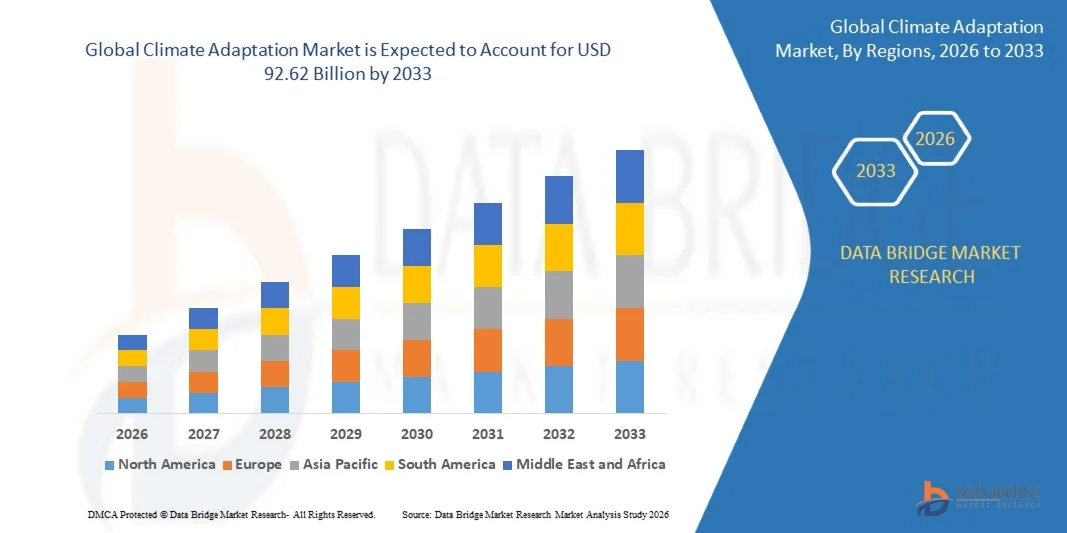
As per Data Bridge Market Research analysis, the climate adaptation market was valued at USD 36.10 billion in 2025 and is projected to reach USD 92.62 billion by 2033, growing at a CAGR of 12.50% from 2026 to 2033. The market is experiencing consistent growth driven by the increasing adoption of climate resilience strategies, rising investments in resilient infrastructure, and growing deployment of environmental monitoring and early warning systems to mitigate climate-related risks.
The increasing frequency and severity of extreme weather events, including floods, droughts, heatwaves, and storms, coupled with greater government and enterprise focus on reducing climate vulnerability, are accelerating the adoption of climate adaptation solutions worldwide. Technology-based solutions, nature-based approaches, and early climate warning and environmental monitoring systems are increasingly being implemented across public agencies, power generation, oil & gas, and other industrial sectors to strengthen disaster preparedness, improve infrastructure resilience, and enhance long-term climate risk management.
Market Size & Forecast
- Global Market Value (2025): USD 36.10 Billion
- Expected Market Value (2033): USD 92.62 Billion
- Forecast CAGR (2026–2033): 12.50%
- Leading Region in 2025: Asia Pacific
- Fastest Growing Region: Europe
Key Market Trends & Insights
- Asia Pacific dominated the climate adaptation market with the largest revenue share of 35.4% in 2025, supported by increasing investments in climate-resilient infrastructure, rising climate risk exposure, and strong government initiatives focused on adaptation and disaster preparedness
- The technology-based solutions segment led the market with a 30.2% share in 2025, driven by the growing adoption of climate risk analytics, environmental monitoring systems, artificial intelligence, satellite-based assessment tools, and resilient infrastructure technologies
- Europe is expected to be the fastest-growing region at a CAGR of 17.6% from 2026 to 2033, fueled by stringent climate resilience policies, increasing adaptation funding, and expanding deployment of climate monitoring and risk management solutions across the region
- Early warning and monitoring climate solutions are the fastest-growing solution type, projected to register a CAGR of 16.5%, reflecting the surge in demand for disaster preparedness, climate resilience planning, and multi-hazard forecasting systems.
- The large enterprises segment dominated the enterprise size category with a 68.0% revenue share in 2025, led by substantial financial resources, advanced sustainability programs, and greater exposure to climate-related operational risks
- Public sector accounted for 23.7% of the market, preferred by extensive government investments in climate resilience, disaster preparedness, infrastructure adaptation, and environmental protection initiatives
- The small and medium-sized enterprises (SMEs) segment is the fastest-growing enterprise size category, with a CAGR of 15.8%, driven by growing awareness of climate-related business risks and expanding access to affordable adaptation technologies
Report Scope and Climate Adaptation Market Segmentation
|
Attributes |
Climate Adaptation Key Market Insights |
|
Segments Covered |
|
|
Countries Covered |
North America
Europe
Asia-Pacific
Middle East and Africa
South America
|
|
Key Market Players |
|
|
Market Opportunities |
|
|
Value Added Data Infosets |
In addition to the market insights such as market value, growth rate, market segments, geographical coverage, market players, and market scenario, the market report curated by the Data Bridge Market Research team includes in-depth expert analysis, import/export analysis, pricing analysis, production consumption analysis, and pestle analysis. |
Climate Adaptation Market Trends
Trend: Growing Adoption of Climate Risk Analytics and Early Warning Systems
Governments, infrastructure operators, and private enterprises are increasingly adopting climate risk analytics, environmental monitoring platforms, and early warning systems to improve resilience against floods, droughts, heatwaves, and extreme weather events. The integration of artificial intelligence, satellite imagery, geospatial analytics, and predictive modeling enables stakeholders to identify vulnerabilities, anticipate climate-related disruptions, and optimize adaptation planning. Public agencies and critical infrastructure operators are similarly leveraging digital climate intelligence platforms to strengthen disaster preparedness, while real-time monitoring technologies provide actionable insights that support long-term resilience and sustainable development strategies. For instance, in September 2024, the World Meteorological Organization (WMO) published the "Handbook on the Use of Risk Knowledge for Multi-Hazard Early Warning Systems" under the Early Warnings for All initiative, providing guidance to strengthen disaster risk knowledge and accelerate implementation of multi-hazard early warning systems worldwide.
The growing use of climate intelligence and early warning technologies is accelerating the transition from reactive disaster response to proactive climate resilience planning.
Climate Adaptation Market Dynamics
Key Market Driver: Rising Investments in Climate-Resilient Infrastructure and Adaptation Programs
The increasing frequency and severity of climate-related events have created substantial demand for climate adaptation solutions that strengthen infrastructure resilience, water security, ecosystem protection, and disaster preparedness. Governments, development institutions, and private investors are deploying adaptation technologies as a core component of long-term climate strategies, reducing economic losses, improving community resilience, and supporting sustainable development goals. Growing policy support, climate financing mechanisms, and national adaptation frameworks are further accelerating adoption across transportation, energy, agriculture, and urban development sectors. For instance, in April 2024, the Global Center on Adaptation (GCA) published its State and Trends in Climate Adaptation Finance 2024 report, highlighting that climate-smart and resilient development pathways offer enormous investment opportunities with a triple dividend of avoided losses, positive economic gains, and enhanced social and environmental benefits, while emphasizing the urgent need to scale adaptation finance globally
Expanding investments in resilient infrastructure and adaptation initiatives continue to serve as the primary growth engine for the climate adaptation market.
Key Restraint/Challenge: High Funding Requirements and Limited Adaptation Finance Availability
A significant restraint in the climate adaptation market is the substantial financial investment required to implement large-scale resilience projects, environmental monitoring systems, resilient infrastructure upgrades, and ecosystem restoration initiatives. Many developing economies face challenges in securing adequate funding, technical expertise, and institutional capacity to deploy adaptation measures effectively. The adaptation financing gap remains considerable, while long project timelines, regulatory complexities, and uncertain return-on-investment profiles can delay implementation and limit market expansion in vulnerable regions. For instance, in November 2024, the United Nations Environment Programme (UNEP) released the Adaptation Gap Report 2024: Come Hell and High Water, estimating that developing countries require adaptation finance of approximately USD 215–387 billion per year this decade, while international public adaptation finance remains significantly below the level needed to address growing climate risks.
Addressing the global adaptation finance gap remains critical to enabling widespread deployment of climate resilience solutions and achieving long-term climate adaptation goals.
Key Market Opportunity: Expansion of Nature-Based Solutions and Climate Resilience Technologies
The integration of nature-based solutions with advanced climate resilience technologies presents a significant market opportunity. Ecosystem restoration, urban green infrastructure, climate-smart agriculture, and digital climate intelligence platforms can deliver cost-effective adaptation benefits while supporting biodiversity conservation and sustainable development objectives. Increasing public and private sector commitments toward resilience investments, combined with advances in climate analytics and environmental monitoring technologies, are creating new growth opportunities across coastal protection, water management, agriculture, and urban resilience applications. For instance, in December 2025, the Global Center on Adaptation (GCA) published “Adaptation Insights: Pathways to Scale Investments in Nature-Based Solutions for Climate Adaptation,” highlighting that investments in mangrove restoration and coastal ecosystem protection can deliver benefit-cost ratios exceeding 10:1, while reducing climate risks, protecting communities, and supporting local economic development.
The convergence of nature-based adaptation strategies and digital resilience technologies is expected to create substantial long-term growth opportunities across the climate adaptation market.
Climate Adaptation Market Scope
The climate adaptation market is segmented on the basis of solution, enterprise size, and end user.
- By Solution
On the basis of solution, the climate adaptation market is segmented into technology-based solutions, natural-based solutions, enhanced natural process solutions, and early warning and monitoring climate solutions. The technology-based solutions segment dominated the market with a 30.2% share in 2025, owing to the growing adoption of climate risk analytics, environmental monitoring systems, artificial intelligence, satellite-based assessment tools, and resilient infrastructure technologies. Governments and enterprises increasingly depend on these solutions to evaluate climate vulnerabilities and strengthen adaptation planning. These technologies support real-time monitoring, predictive risk assessment, and data-driven decision-making across critical sectors. Rising investments in digital climate intelligence platforms and smart infrastructure projects are further driving adoption. The segment also benefits from increasing deployment across energy, transportation, agriculture, and urban resilience applications. Continuous technological innovation and growing regulatory focus on climate resilience continue to reinforce its market leadership globally.
The early warning and monitoring climate solutions segment is projected to register the fastest growth at an estimated CAGR of 16.5% from 2026 to 2033, driven by rising demand for disaster preparedness, climate resilience planning, and multi-hazard forecasting systems. These solutions provide real-time monitoring and early detection of floods, droughts, storms, wildfires, and heatwaves. Governments and international organizations are increasing investments in advanced forecasting systems to reduce economic losses and protect vulnerable populations. Advancements in satellite technologies, remote sensing, artificial intelligence, and weather intelligence platforms are improving forecasting accuracy and response effectiveness. Growing climate-related disasters are accelerating deployment across both developed and developing economies. The increasing shift toward proactive disaster management and resilience planning is expected to support strong growth throughout the forecast period.
- By Enterprise Size
On the basis of enterprise size, the climate adaptation market is segmented into small and medium-sized enterprises (SMEs) and large enterprises. The large enterprises segment dominated the market with an estimated share of 68.0% in 2025, driven by substantial financial resources, advanced sustainability programs, and greater exposure to climate-related operational risks. Large organizations are investing heavily in climate risk assessment platforms, resilience planning solutions, and adaptation technologies to protect assets and ensure business continuity. Increasing environmental disclosure requirements and investor expectations are further encouraging climate adaptation investments. These enterprises also possess the capability to integrate adaptation strategies across geographically diverse operations. Adoption of advanced analytics, monitoring platforms, and resilient infrastructure solutions remains particularly high among multinational corporations. Their strong commitment to long-term sustainability objectives continues to support segment dominance.
The small and medium-sized enterprises (SMEs) segment is expected to witness the fastest growth at an estimated CAGR of 15.8% from 2026 to 2033, driven by growing awareness of climate-related business risks and expanding access to affordable adaptation technologies. Cloud-based climate analytics platforms and digital monitoring solutions are reducing implementation costs for smaller organizations. Government incentives, adaptation funding programs, and sustainability initiatives are further supporting adoption. SMEs are increasingly recognizing the need to strengthen resilience against extreme weather events, supply chain disruptions, and operational uncertainties. The growing availability of scalable and subscription-based adaptation solutions is improving accessibility. Rising stakeholder expectations and evolving climate regulations are also accelerating implementation across this segment.
- By End User
On the basis of end user, the climate adaptation market is segmented into public sector, research institute, industries, power generation, chemicals and petrochemicals, and others. The public sector segment dominated the market with a 23.7% share in 2025, supported by extensive government investments in climate resilience, disaster preparedness, infrastructure adaptation, and environmental protection initiatives. National adaptation plans and climate resilience strategies are driving widespread deployment of adaptation solutions globally. Public agencies play a critical role in implementing climate monitoring networks, early warning systems, and resilient infrastructure projects. Increasing climate-related policy measures and international funding support are further strengthening market demand. Governments are also investing in data-driven decision-making platforms to improve climate risk management capabilities. Their central role in climate adaptation planning and implementation continues to sustain segment leadership worldwide.
The power generation segment is anticipated to register the fastest growth at an estimated CAGR of 16.1% from 2026 to 2033, driven by increasing climate-related risks affecting energy infrastructure and electricity supply reliability. Rising temperatures, flooding events, extreme weather conditions, and water scarcity are creating significant operational challenges for power producers. Utilities are increasingly adopting climate adaptation solutions to improve infrastructure resilience and maintain uninterrupted energy delivery. Investments in climate risk assessment, grid modernization, environmental monitoring, and resilience planning are accelerating across the sector. Growing integration of renewable energy assets is also increasing the need for climate-resilient operational strategies. Expanding regulatory focus on energy security and infrastructure resilience is expected to further drive adoption throughout the forecast period.
Climate Adaptation Market Regional Analysis
Asia Pacific dominated the climate adaptation market with the largest revenue share of 35.4% in 2025, supported by increasing investments in climate-resilient infrastructure, rising climate risk exposure, and strong government initiatives focused on adaptation and disaster preparedness. The region also benefits from large-scale deployment of climate monitoring systems, early warning networks, and environmental risk assessment platforms across vulnerable coastal and urban areas. Growing investments in water resource management, climate-smart agriculture, and resilient energy infrastructure are accelerating market development. Increasing implementation of national adaptation plans, public-private resilience partnerships, and ecosystem restoration projects continues to strengthen Asia Pacific's leadership position in the global market. Rising urbanization, population growth, and climate vulnerability further support long-term demand for adaptation solutions across the region.
U.S. Climate Adaptation Market Insight
The U.S. climate adaptation market is witnessing strong growth due to rising investments in climate resilience programs, disaster risk reduction initiatives, and climate monitoring technologies. The country's advanced technological ecosystem, along with increasing adoption of climate risk analytics, artificial intelligence, satellite-based monitoring, and early warning systems, is driving demand across public infrastructure, energy, agriculture, and water management applications. In addition, growing emphasis on mitigating the impacts of floods, wildfires, hurricanes, and extreme heat events is accelerating adaptation solution deployment across federal, state, and local governments. In October 2024, the National Oceanic and Atmospheric Administration (NOAA) reported 27 weather and climate disasters exceeding USD 1 billion each in damages during 2024, reinforcing the need for climate resilience and adaptation investments across the United States.
Europe Climate Adaptation Market Insight
The Europe climate adaptation market is expected to witness rapid growth, driven by strong policy support, climate resilience investments, and growing adoption of adaptation technologies. The widespread implementation of climate monitoring systems, flood protection infrastructure, and nature-based solutions is supporting market expansion across the region. Increasing investments in climate risk assessment platforms, coupled with ambitious climate adaptation strategies and sustainability targets, continue to enhance the adoption of climate adaptation solutions throughout Europe. In March 2024, the European Environment Agency (EEA) published the European Climate Risk Assessment, identifying Europe as one of the fastest-warming continents and highlighting the urgent need for adaptation investments across energy, water, agriculture, and infrastructure sectors.
U.K. Climate Adaptation Market Insight
The U.K. climate adaptation market is experiencing steady growth, supported by increasing investments in flood resilience, environmental monitoring systems, and climate risk management programs. Growing demand for climate adaptation technologies across infrastructure, utilities, and local government sectors is contributing to market growth. Furthermore, integration of advanced climate analytics, digital monitoring platforms, and resilience planning tools is improving preparedness and response capabilities, positioning the U.K. as a key innovation hub in climate adaptation. In July 2023, the U.K. Climate Change Committee reported that the country is not adequately prepared for escalating climate risks and called for accelerated adaptation investments across critical sectors.
Germany Climate Adaptation Market Insight
The Germany climate adaptation market is expanding steadily due to the country's strong sustainability agenda, advanced research capabilities, and increasing adoption of climate resilience technologies. Government agencies, utilities, infrastructure operators, and industrial organizations are increasingly implementing adaptation solutions for climate risk management and operational resilience. Continuous advancements in environmental monitoring, climate modeling, and nature-based adaptation measures, along with strong public policy support, are further driving market growth in Germany. In July 2024, Germany updated its Climate Adaptation Strategy, outlining comprehensive measures to strengthen resilience against heatwaves, flooding, droughts, and other climate-related risks.
North America Climate Adaptation Market Insight
The North America accounted for a significant share of the global climate adaptation market in 2025, supported by substantial investments in climate resilience programs, advanced climate monitoring infrastructure, and widespread adoption of climate risk assessment technologies. The region benefits from strong government support, established environmental monitoring networks, and increasing deployment of artificial intelligence, geospatial analytics, and early warning systems across critical sectors. Growing investments in resilient infrastructure, wildfire management, flood mitigation, and water resource protection projects are accelerating market development. In January 2025, the National Oceanic and Atmospheric Administration (NOAA) reported that the United States experienced 27 separate billion-dollar weather and climate disasters during 2024, resulting in losses exceeding USD 182 billion, highlighting the growing need for climate adaptation and resilience investments across North America.
Japan Climate Adaptation Market Insight
The Japan climate adaptation market is witnessing consistent growth due to rising investments in disaster resilience, climate monitoring systems, and environmental risk management initiatives. Government agencies, utilities, infrastructure operators, and research institutes are increasingly adopting advanced adaptation technologies for climate risk assessment and resilience planning. Moreover, increasing integration of digital monitoring systems and the country's focus on disaster preparedness and sustainable development are further contributing to market growth.
Japan's Climate Change Adaptation Plan, revised in May 2023, expanded national adaptation measures across water resources, infrastructure, agriculture, health, and disaster risk reduction sectors.
China Climate Adaptation Market Insight
The China climate adaptation market is growing rapidly, driven by increasing urbanization, expanding infrastructure development, and rising government focus on climate resilience and disaster preparedness. Growing adoption of climate monitoring systems, environmental analytics platforms, and early warning technologies across public and industrial sectors is significantly boosting market demand. In addition, rising investments in resilient infrastructure, increasing awareness regarding climate risks, and rapid technological advancements are positioning China as one of the fastest-growing climate adaptation markets globally. In August 2024, China issued the Guidelines on Accelerating the Green Transition of Economic and Social Development, setting targets through 2035 and prioritizing green infrastructure, resilient urban development, ecosystem protection, and climate-resilient economic systems, which are expected to strengthen demand for climate adaptation solutions
Climate Adaptation Market Share
The climate adaptation industry is primarily led by well-established companies, including:
- Microsoft (U.S.)
- IBM (U.S.)
- AECOM (U.S.)
- Schneider Electric (France)
- Siemens AG (Germany)
- Hitachi, Ltd. (Japan)
- Jacobs Solutions Inc. (U.S.)
- Arup Group (U.K.)
- Esri (U.S.)
- Trimble Inc. (U.S.)
- Planet Labs PBC (U.S.)
- The Tomorrow Companies Inc. (U.S.)
- Jupiter Intelligence, Inc. (U.S.)
- Moody's Corporation (U.S.)
- S&P Global (U.S.)
- Climeworks AG (Switzerland)
- Bureau Veritas (France)
- DNV AS (Norway)
Latest Developments in Climate Adaptation Market
- In July 2025, Allianz Commercial launched Climate Adaptation & Resilience Services (CAReS), a climate risk assessment platform designed to help businesses evaluate physical climate risks, model future exposure to floods, wildfires, storms, and heat, and implement resilience strategies using data-driven analytics and expert consulting. The launch strengthens climate adaptation planning across industrial, commercial, and infrastructure sectors
- In May 2025, EcoOnline launched Climate Risk, a science-based climate risk software solution that enables organizations to identify, assess, and report physical climate risks while supporting compliance with sustainability reporting frameworks. The platform delivers climate risk dashboards, automated reporting, and resilience planning tools to strengthen long-term climate adaptation strategies
- In October 2024, AXA Climate launched Altitude, a digital climate adaptation platform that helps businesses quantify climate risks, assess the impact of extreme weather on operations, and implement adaptation strategies using IPCC-based climate data and localized risk assessments. The platform supports resilience planning and sustainability reporting across multiple industries
- In September 2024, XDI launched the XDI Climate Risk Hub, an on-demand physical climate risk analysis platform that enables governments, financial institutions, and enterprises to assess climate risks for assets worldwide using standardized climate models and real-time analytics. The platform supports investment planning and climate adaptation decision-making
- In January 2024, Tech Mahindra launched i.Riskman, an ESG risk assessment platform designed to help organizations identify, evaluate, and manage climate-related risks through centralized risk management, climate analytics, and real-time data visualization. The platform supports enterprises in strengthening climate resilience and sustainability governance

- Interactive Data Analysis Dashboard
- Company Analysis Dashboard for high growth potential opportunities
- Research Analyst Access for customization & queries
- Competitor Analysis with Interactive dashboard
- Latest News, Updates & Trend analysis
- Harness the Power of Benchmark Analysis for Comprehensive Competitor Tracking
Data collection and base year analysis are done using data collection modules with large sample sizes. The stage includes obtaining market information or related data through various sources and strategies. It includes examining and planning all the data acquired from the past in advance. It likewise envelops the examination of information inconsistencies seen across different information sources. The market data is analysed and estimated using market statistical and coherent models. Also, market share analysis and key trend analysis are the major success factors in the market report. To know more, please request an analyst call or drop down your inquiry.
The key research methodology used by DBMR research team is data triangulation which involves data mining, analysis of the impact of data variables on the market and primary (industry expert) validation. Data models include Vendor Positioning Grid, Market Time Line Analysis, Market Overview and Guide, Company Positioning Grid, Patent Analysis, Pricing Analysis, Company Market Share Analysis, Standards of Measurement, Global versus Regional and Vendor Share Analysis. To know more about the research methodology, drop in an inquiry to speak to our industry experts.
Data Bridge Market Research is a leader in advanced formative research. We take pride in servicing our existing and new customers with data and analysis that match and suits their goal. The report can be customized to include price trend analysis of target brands understanding the market for additional countries (ask for the list of countries), clinical trial results data, literature review, refurbished market and product base analysis. Market analysis of target competitors can be analyzed from technology-based analysis to market portfolio strategies. We can add as many competitors that you require data about in the format and data style you are looking for. Our team of analysts can also provide you data in crude raw excel files pivot tables (Fact book) or can assist you in creating presentations from the data sets available in the report.













