


What is the Climate Control System for Commercial Vehicle Market Size and Growth Rate?
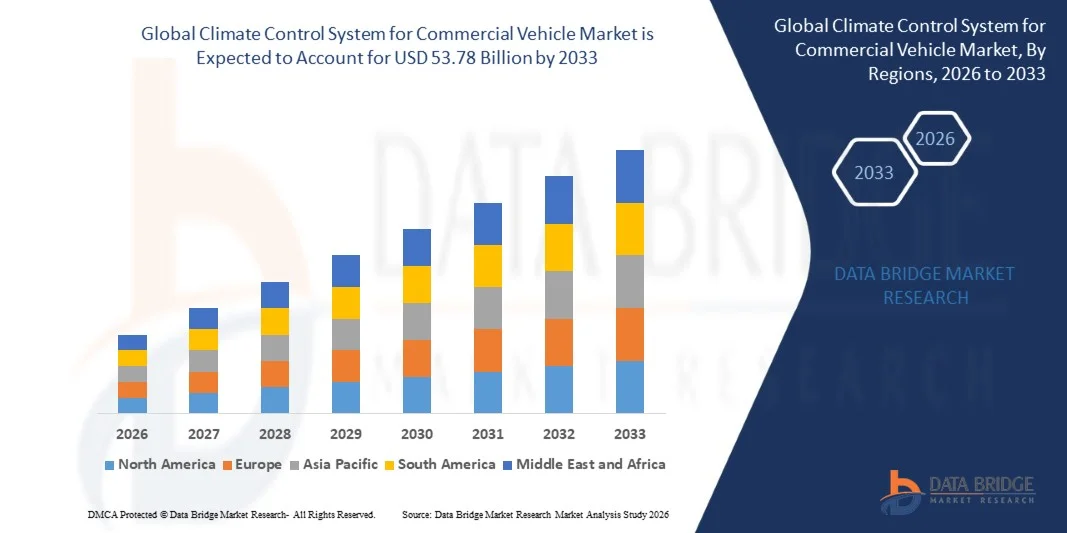
- As per Data Bridge Market Research analysis the climate control system for commercial vehicle market was valued at USD 26.02 billion in 2025 and is projected to reach USD 53.78 billion by 2033, growing at a CAGR of 9.50% from 2026 to 2033.
- The market is witnessing strong growth driven by increasing production of commercial vehicles, rising demand for enhanced driver comfort and passenger safety, and continuous advancements in energy-efficient HVAC and smart climate control technologies.
- Stringent emission regulations, growing adoption of electric and connected commercial vehicles, and increasing demand for advanced thermal management systems are encouraging fleet operators and vehicle manufacturers to invest in next-generation climate control solutions.
Market Size & Forecast
- Market Value (2025): USD 26.02 Billion
- Expected Market Value (2033): USD 53.78 Billion
- Forecast CAGR (2026–2033): 9.50%
- Leading Region in 2025: North America
- Fastest Growing Region: Asia-Pacific
What are the Major Takeaways of the Climate Control System for Commercial Vehicle Market?
- North America dominated the climate control system for commercial vehicle market with the largest revenue share of 40.5% in 2025, supported by the strong presence of leading commercial vehicle manufacturers, rising adoption of electric trucks and buses, and stringent vehicle safety and emission regulations.
- Asia-Pacific climate control system for commercial vehicle market is expected to witness the fastest growth rate from 2026 to 2033, supported by rapid urbanization, expanding logistics and e-commerce industries, increasing production of commercial vehicles, and growing investments in electric mobility across China, India, Japan, and South Korea.
- The compressor segment held the largest market revenue share of approximately 33.9% in 2025 driven by its critical role in refrigerant circulation and cabin cooling across trucks, buses, and electric commercial vehicles. Growing production of commercial vehicles and increasing adoption of energy-efficient HVAC systems continue to support segment growth.
- The sensor segment is projected to register the fastest growth at a CAGR of 11.7% from 2026 to 2033, driven by increasing integration of intelligent climate control systems, connected vehicle technologies, and automated temperature monitoring. Rising adoption of smart HVAC systems in electric and premium commercial vehicles is accelerating segment expansion.
- The truck segment accounted for the largest market revenue share of approximately 42.6% in 2025 driven by high global production volumes, expanding logistics operations, and growing demand for driver comfort during long-distance transportation. Increasing fleet modernization is further supporting market growth.
- The bus segment is expected to witness the fastest CAGR of 10.9% from 2026 to 2033, driven by rising investments in electric and public transportation fleets, stringent passenger comfort standards, and increasing deployment of advanced HVAC systems in urban transit buses.
Report Scope and Climate Control System for Commercial Vehicle Market Segmentation
|
Attributes |
Climate Control System for Commercial Vehicle Key Market Insights |
|
Segments Covered |
|
|
Countries Covered |
North America
Europe
Asia-Pacific
Middle East and Africa
South America
|
|
Key Market Players |
|
|
Market Opportunities |
|
|
Value Added Data Infosets |
In addition to the market insights such as market value, growth rate, market segments, geographical coverage, market players, and market scenario, the market report curated by the Data Bridge Market Research team includes in-depth expert analysis, import/export analysis, pricing analysis, production consumption analysis, and pestle analysis. |
What is the Key Trend in the Climate Control System for Commercial Vehicle Market?
- The growing adoption of intelligent thermal management systems and energy-efficient HVAC technologies in electric and commercial vehicles is emerging as a key trend, enabling improved cabin comfort, lower energy consumption, and extended vehicle range.
- For instance, in January 2025, Webasto introduced its Air Top Pro 25 and Cool Split 20 Evo engine-off heating and cooling systems for commercial fleets, designed to reduce fuel consumption and emissions while maintaining driver comfort during idle periods.
- Commercial vehicle manufacturers are increasingly integrating heat pumps, AI-enabled thermal management, and smart HVAC controls to optimize battery efficiency and improve climate performance in electric buses, trucks, and vans.
- For instance, in September 2025, Valeo announced new contracts to supply its next-generation Dual Layer HVAC system featuring AI-based temperature control algorithms and energy-efficient cabin climate management for a leading Chinese automaker.
- As commercial vehicle electrification accelerates and fleet operators prioritize energy efficiency, advanced thermal management and intelligent climate control systems are expected to become a standard feature across next-generation commercial vehicles.
What are the Key Drivers of the Climate Control System for Commercial Vehicle Market?
- The rapid expansion of electric commercial vehicles and increasingly stringent emission regulations are significantly driving demand for advanced climate control and thermal management systems that improve energy efficiency while maintaining cabin comfort.
- For instance, in March 2026, Webasto launched the Cool Top 120-e rooftop air-conditioning system for electric vans and minibuses, delivering high-efficiency cooling with intelligent compressor control and seamless CAN bus integration.
- Commercial vehicle OEMs and HVAC suppliers are investing in heat pump technologies, smart thermal management, and lightweight climate control systems to enhance vehicle range, reduce operating costs, and comply with evolving sustainability requirements.
- For instance, DENSO expanded its thermal management portfolio with advanced heat pump systems and compact HVAC solutions designed to improve battery efficiency, optimize energy consumption, and enhance cabin comfort in electrified commercial vehicles.
- As fleet electrification and sustainability initiatives continue to gain momentum worldwide, advanced climate control systems will remain essential for improving vehicle efficiency, driver comfort, and operational performance.
Which Factors are Challenging the Growth of the Climate Control System for Commercial Vehicle Market?
- Advanced climate control systems incorporating heat pumps, intelligent sensors, battery thermal management, and electronic control units involve high development and integration costs, increasing the overall cost of commercial vehicles.
- These elevated costs can limit adoption among small fleet operators and manufacturers operating in price-sensitive and emerging markets.
- For instance, in October 2024, Daimler Truck highlighted the advanced thermal management and heat pump technology integrated into its Mercedes-Benz eCitaro electric buses to maximize energy efficiency, demonstrating the significant investment required for next-generation HVAC systems.
- The high capital investment, integration complexity, and maintenance requirements associated with advanced thermal management systems continue to restrain widespread adoption, particularly among cost-sensitive commercial vehicle manufacturers and fleet operators, despite increasing demand for energy-efficient climate control solutions.
How is the Climate Control System for Commercial Vehicle Market Segmented?
The market is segmented on the basis of component, commercial vehicle type, electric vehicle type, application, voltage, and sales channel.
- By Component
On the basis of component, the climate control system for commercial vehicle market is segmented into compressor, condenser, receiver-drier, evaporator, control valves, actuators, thermostat, coils, relays, sensor, and others. The compressor segment held the largest market revenue share of approximately 33.9% in 2025 driven by its critical role in refrigerant circulation and cabin cooling across trucks, buses, and electric commercial vehicles. Growing production of commercial vehicles and increasing adoption of energy-efficient HVAC systems continue to support segment growth.
The sensor segment is projected to register the fastest growth at a CAGR of 11.7% from 2026 to 2033, driven by increasing integration of intelligent climate control systems, connected vehicle technologies, and automated temperature monitoring. Rising adoption of smart HVAC systems in electric and premium commercial vehicles is accelerating segment expansion.
- By Commercial Vehicle Type
On the basis of commercial vehicle type, the climate control system for commercial vehicle market is segmented into truck, bus, ambulance, minivan, cargo van, trailer, and others. The truck segment accounted for the largest market revenue share of approximately 42.6% in 2025 driven by high global production volumes, expanding logistics operations, and growing demand for driver comfort during long-distance transportation. Increasing fleet modernization is further supporting market growth.
The bus segment is expected to witness the fastest CAGR of 10.9% from 2026 to 2033, driven by rising investments in electric and public transportation fleets, stringent passenger comfort standards, and increasing deployment of advanced HVAC systems in urban transit buses.
- By Electric Vehicle Type
On the basis of electric vehicle type, the climate control system for commercial vehicle market is segmented into hybrid and full electric vehicle. The hybrid segment held the largest market revenue share of approximately 58.4% in 2025 driven by its widespread adoption across commercial fleets transitioning toward electrification while maintaining operational flexibility and lower emissions.
The full electric vehicle segment is projected to register the fastest growth at a CAGR of 12.8% from 2026 to 2033, driven by increasing government incentives, rapid expansion of zero-emission commercial fleets, and growing demand for advanced thermal management systems to maximize battery efficiency and driving range.
- By Application
On the basis of application, the climate control system for commercial vehicle market is segmented into long haul, regional, and specialty. The long haul segment accounted for the largest market revenue share of approximately 49.5% in 2025 driven by the increasing need for continuous cabin climate control during extended transportation operations and growing emphasis on driver comfort and operational efficiency.
The specialty segment is expected to witness the fastest CAGR of 11.5% from 2026 to 2033, driven by increasing demand for customized HVAC solutions in ambulances, refrigerated vehicles, defense vehicles, and other specialized commercial applications requiring precise temperature control.
- By Voltage
On the basis of voltage, the climate control system for commercial vehicle market is segmented into 12V, 24V, 48V, 350V, and 650V. The 24V segment held the largest market revenue share of approximately 45.8% in 2025 driven by its extensive use in heavy-duty trucks, buses, and commercial vehicles due to its reliability and compatibility with conventional electrical architectures.
The 350V segment is projected to register the fastest growth at a CAGR of 13.2% from 2026 to 2033, driven by the increasing production of battery electric commercial vehicles and rising adoption of high-voltage thermal management systems for improved energy efficiency and battery performance.
- By Sales Channel
On the basis of sales channel, the climate control system for commercial vehicle market is segmented into original equipment manufacturers and aftermarket. The original equipment manufacturers segment accounted for the largest market revenue share of approximately 69.1% in 2025 driven by increasing factory installation of advanced climate control systems, rising commercial vehicle production, and strong partnerships between OEMs and HVAC component suppliers.
The aftermarket segment is expected to witness the fastest CAGR of 10.6% from 2026 to 2033, driven by growing replacement demand for HVAC components, increasing commercial vehicle fleet age, and rising maintenance and retrofit activities across global transportation and logistics sectors.
Which Region Holds the Largest Share of the Climate Control System for Commercial Vehicle Market?
- North America dominated the climate control system for commercial vehicle market with the largest revenue share of 40.5% in 2025, supported by the strong presence of leading commercial vehicle manufacturers, rising adoption of electric trucks and buses, and stringent vehicle safety and emission regulations.
- Fleet operators across the region are increasingly investing in advanced HVAC and thermal management systems to improve driver comfort, energy efficiency, and operational performance. The growing focus on fleet electrification and connected commercial vehicles continues to strengthen demand for intelligent climate control technologies.
U.S. Climate Control System for Commercial Vehicle Market Insight
The U.S. climate control system for commercial vehicle market captured the largest revenue share in 2025 within North America, driven by increasing production of heavy-duty trucks, rapid electrification of commercial fleets, and rising investments in advanced thermal management technologies. Fleet operators are prioritizing energy-efficient HVAC systems to reduce operating costs while enhancing driver comfort. The growing deployment of electric delivery vehicles and zero-emission buses is further accelerating market expansion.
Europe Climate Control System for Commercial Vehicle Market Insight
Europe climate control system for commercial vehicle market is expected to witness the fastest growth rate from 2026 to 2033, primarily driven by stringent carbon emission regulations, increasing adoption of electric commercial vehicles, and strong investments in sustainable transportation. Commercial vehicle manufacturers are integrating advanced heat pumps and intelligent thermal management systems to improve battery performance and cabin comfort. Rising demand for energy-efficient HVAC solutions across logistics and public transportation fleets is supporting market growth.
U.K. Climate Control System for Commercial Vehicle Market Insight
The U.K. climate control system for commercial vehicle market is expected to witness the fastest growth rate from 2026 to 2033, driven by growing investments in electric buses, expanding zero-emission fleet initiatives, and increasing demand for energy-efficient thermal management systems. Fleet operators are increasingly adopting advanced HVAC technologies to improve operational efficiency, reduce emissions, and enhance driver and passenger comfort across commercial transportation applications.
Germany Climate Control System for Commercial Vehicle Market Insight
Germany climate control system for commercial vehicle market is expected to witness the fastest growth rate from 2026 to 2033, fueled by the country's strong automotive manufacturing base, rapid advancement in electric commercial vehicles, and increasing demand for innovative thermal management technologies. The growing emphasis on vehicle efficiency, sustainability, and intelligent climate control integration is supporting the adoption of next-generation HVAC systems across commercial vehicle fleets.
Asia-Pacific Climate Control System for Commercial Vehicle Market Insight
The Asia-Pacific climate control system for commercial vehicle market is expected to witness the fastest growth rate from 2026 to 2033, supported by rapid urbanization, expanding logistics and e-commerce industries, increasing production of commercial vehicles, and growing investments in electric mobility across China, India, Japan, and South Korea. Rising government initiatives promoting clean transportation and domestic manufacturing of automotive components are further accelerating market growth.
Japan Climate Control System for Commercial Vehicle Market Insight
Japan climate control system for commercial vehicle market is expected to witness the fastest growth rate from 2026 to 2033 due to the country's technological leadership in automotive innovation, increasing deployment of electric buses and commercial vehicles, and growing demand for high-efficiency thermal management systems. The integration of advanced heat pump technologies and intelligent climate control solutions is supporting greater energy efficiency and vehicle performance.
China Climate Control System for Commercial Vehicle Market Insight
The China climate control system for commercial vehicle market accounted for the largest market revenue share in Asia Pacific in 2025, attributed to the country's large commercial vehicle manufacturing industry, rapid electrification of buses and trucks, and strong government support for new energy vehicles. Increasing investments in battery thermal management technologies, expanding logistics networks, and the presence of leading automotive component manufacturers continue to drive demand for advanced climate control systems across the country.
Which are the Top Companies in Climate Control System for Commercial Vehicle Market?
The climate control system for commercial vehicle industry is primarily led by well-established companies, including:
- Continental AG (Germany)
- Valeo (France)
- DENSO CORPORATION (Japan)
- Hanon Systems (South Korea)
- MAHLE GmbH (Germany)
- Webasto SE (Germany)
- Eberspächer Group (Germany)
- Sanden Corporation (Japan)
- Bergstrom Climate Systems (U.S.)
- Mobile Climate Control (U.S.)
- Air International Thermal Systems (U.S.)
- Subros Limited (India)
- Visteon Corporation (U.S.)
- Japan Climate Systems Corporation (Japan)
- Behr-Hella Thermocontrol GmbH (Germany)
What are Latest Developments in Climate Control System for Commercial Vehicle Market?
- In September 2025, Carrier Transicold product launch, introduced the all-electric Pulsor eCool refrigeration unit in India, featuring advanced inverter technology that reduces cargo pre-cooling time from 30°C to -18°C by up to 31% while improving energy efficiency. The launch supports sustainable cold-chain transportation, strengthens electric commercial vehicle adoption, and drives demand for advanced thermal management solutions.
- In September 2025, Grayson Thermal Systems product showcase, unveiled its high-voltage RM-Series rooftop HVAC modules for electric buses at Busworld Europe, integrating cabin HVAC, battery, and powertrain thermal management into a compact solution. The development improves energy efficiency, extends electric bus operating range, and accelerates innovation in commercial vehicle climate control systems.
- In June 2025, Tata Motors product portfolio expansion, introduced factory-fitted air-conditioning across its complete truck portfolio, including cowl models, to improve driver comfort, productivity, and operational efficiency. This expansion increases the adoption of factory-installed HVAC systems and strengthens demand for advanced climate control technologies in commercial vehicles.
- In February 2025, Carrier Transicold product launch, launched the Vector S 15 semi-electric refrigeration unit, delivering diesel-mode cooling performance with lower fuel consumption and reduced emissions through semi-electric technology. The solution helps fleet operators reduce operating costs while supporting the transition toward sustainable refrigerated transport.

- Interactive Data Analysis Dashboard
- Company Analysis Dashboard for high growth potential opportunities
- Research Analyst Access for customization & queries
- Competitor Analysis with Interactive dashboard
- Latest News, Updates & Trend analysis
- Harness the Power of Benchmark Analysis for Comprehensive Competitor Tracking
Data collection and base year analysis are done using data collection modules with large sample sizes. The stage includes obtaining market information or related data through various sources and strategies. It includes examining and planning all the data acquired from the past in advance. It likewise envelops the examination of information inconsistencies seen across different information sources. The market data is analysed and estimated using market statistical and coherent models. Also, market share analysis and key trend analysis are the major success factors in the market report. To know more, please request an analyst call or drop down your inquiry.
The key research methodology used by DBMR research team is data triangulation which involves data mining, analysis of the impact of data variables on the market and primary (industry expert) validation. Data models include Vendor Positioning Grid, Market Time Line Analysis, Market Overview and Guide, Company Positioning Grid, Patent Analysis, Pricing Analysis, Company Market Share Analysis, Standards of Measurement, Global versus Regional and Vendor Share Analysis. To know more about the research methodology, drop in an inquiry to speak to our industry experts.
Data Bridge Market Research is a leader in advanced formative research. We take pride in servicing our existing and new customers with data and analysis that match and suits their goal. The report can be customized to include price trend analysis of target brands understanding the market for additional countries (ask for the list of countries), clinical trial results data, literature review, refurbished market and product base analysis. Market analysis of target competitors can be analyzed from technology-based analysis to market portfolio strategies. We can add as many competitors that you require data about in the format and data style you are looking for. Our team of analysts can also provide you data in crude raw excel files pivot tables (Fact book) or can assist you in creating presentations from the data sets available in the report.













