What is the Climate-Resilient Crop Technologies Market Size and Growth Rate?
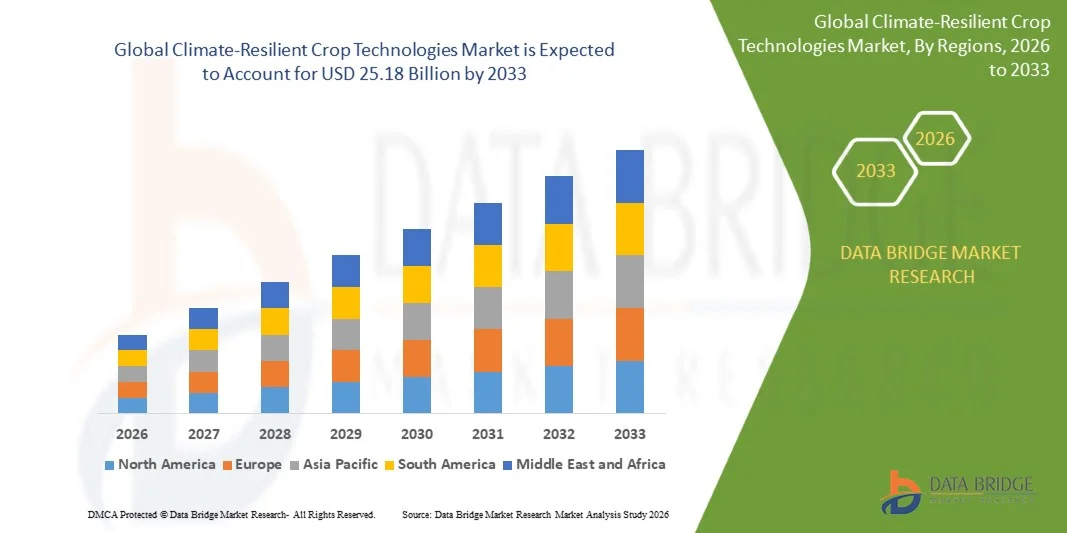
- As per Data Bridge Market Research analysis, the climate-resilient crop technologies market was valued at USD 10.10 billion in 2025 and is projected to reach USD 25.18 billion by 2033, growing at a CAGR of 12.10% from 2026 to 2033.
- The market is experiencing strong growth driven by increasing climate variability, rising adoption of sustainable agricultural practices, and continuous advancements in biotechnology, gene editing, precision breeding, and digital farming solutions that improve crop resilience and productivity.
- The increasing frequency of droughts, floods, heatwaves, soil degradation, and pest outbreaks, combined with growing concerns over global food security and the need to enhance agricultural productivity under changing climatic conditions, is encouraging governments, research institutions, and agribusiness companies to invest in climate-resilient crop technologies. These innovations, including drought-tolerant, heat-resistant, flood-tolerant, and disease-resistant crop varieties, along with climate-smart farming practices, are enabling farmers to improve yield stability, optimize resource utilization, and strengthen long-term agricultural resilience while supporting sustainable food production.
Market Size & Forecast
- Global Market Value (2025): USD 10.10 Billion
- Expected Market Value (2033): USD 25.18 Billion
- Forecast CAGR (2026–2033): 12.10%
What are the Major Takeaways of the Climate-Resilient Crop Technologies Market?
- North America dominated the climate-resilient crop technologies market with the largest revenue share in 2025, supported by high adoption of advanced agricultural technologies, substantial investments in agricultural biotechnology, and strong government funding for climate-smart farming initiatives.
- Asia-Pacific climate-resilient crop technologies market is expected to register the fastest growth rate from 2026 to 2033, driven by increasing climate variability, rising food demand, expanding government support for climate-smart agriculture, and rapid adoption of advanced crop breeding technologies.
- The marker-assisted breeding segment dominated the market in 2025, owing to its widespread commercial adoption, cost-effectiveness, and proven ability to accelerate the development of climate-resilient crop varieties. The technology is extensively used in breeding programs for cereals, oilseeds, and pulses, enabling faster selection of desirable traits while reducing breeding cycles.
- The AI-driven predictive modelling segment is projected to register the fastest growth at a from 2026 to 2033, driven by increasing adoption of artificial intelligence, machine learning, and big data analytics for crop improvement. Advances in climate forecasting, precision agriculture, and genomic data analysis are accelerating the deployment of AI-based breeding solutions worldwide.
- The cereals segment led the market in 2025, supported by the global importance of wheat, rice, and maize as staple food crops and increasing investments in developing drought-, heat-, and disease-resistant cereal varieties. Rising concerns regarding food security and climate variability continue to strengthen demand for resilient cereal crops.
- The fruits and vegetables segment is expected to experience the fastest growth from 2026 to 2033, driven by growing demand for climate-resilient horticultural crops, increasing protected cultivation, and rising investments in high-value crop breeding technologies.
Report Scope and Climate-Resilient Crop Technologies Market Segmentation
|
Attributes |
Climate-Resilient Crop Technologies Key Market Insights |
|
Segments Covered |
|
|
Countries Covered |
North America
Europe
Asia-Pacific
Middle East and Africa
South America
|
|
Key Market Players |
|
|
Market Opportunities |
|
|
Value Added Data Infosets |
In addition to the insights on market scenarios such as market value, growth rate, segmentation, geographical coverage, and major players, the market reports curated by the Data Bridge Market Research also include import export analysis, production capacity overview, production consumption analysis, price trend analysis, climate change scenario, supply chain analysis, value chain analysis, raw material/consumables overview, vendor selection criteria, PESTLE Analysis, Porter Analysis, and regulatory framework. |
What is the Key Trend in the Climate-Resilient Crop Technologies Market?
- Agricultural biotechnology companies are increasingly integrating artificial intelligence (AI), CRISPR-based gene editing, genomic selection, and precision breeding technologies to accelerate the development of crop varieties that can withstand drought, heat, flooding, salinity, and emerging pests while maintaining high yields and resource efficiency.
- For instance, in September 2024, Corteva Agriscience and Pairwise announced a strategic collaboration and joint venture to accelerate gene-editing solutions for agriculture, aiming to develop climate-resilient crop varieties with improved productivity and tolerance to extreme weather conditions.
- Seed developers are increasingly leveraging AI-powered digital breeding platforms, predictive climate analytics, and high-throughput phenotyping to identify beneficial genetic traits faster, shorten breeding cycles, and deliver resilient seed varieties adapted to changing environmental conditions.
- For instance, in February 2025, Gates Agricultural Innovations (Gates Ag One) and Corteva Agriscience announced a collaboration to accelerate the development of novel seed technologies that improve sustainable crop productivity and strengthen climate resilience for smallholder farmers.
- As climate change intensifies pressure on global food systems, continued investment in AI-driven breeding, gene editing, and climate-smart seed technologies is expected to accelerate the commercialization of resilient crop varieties, reinforcing climate-resilient crop technologies as a cornerstone of sustainable agriculture and global food security.
What are the Key Drivers of the Climate-Resilient Crop Technologies Market?
- The increasing frequency of droughts, heatwaves, floods, erratic rainfall, soil salinity, and emerging pest and disease outbreaks is significantly driving demand for climate-resilient crop technologies that can safeguard agricultural productivity and strengthen global food security under changing climatic conditions.
- Governments, agricultural research institutions, seed companies, and biotechnology firms are increasing investments in advanced breeding, gene editing, climate-smart seed development, and digital agriculture platforms to improve crop resilience, stabilize yields, and reduce production risks associated with climate change.
- For instance, in February 2025, Gates Agricultural Innovations (Gates Ag One) and Corteva Agriscience announced a collaboration to develop and scale improved seed technologies for smallholder farmers, focusing on crops with enhanced resilience to climate stress while improving agricultural productivity and sustainability.
- As climate change continues to threaten agricultural output and global food supplies, the growing adoption of drought-tolerant, heat-resistant, flood-tolerant, and disease-resistant crop technologies is expected to remain a key driver of market growth, enabling more sustainable and resilient farming systems worldwide.
Which Factors are Challenging the Growth of the Climate-Resilient Crop Technologies Market?
- Climate-resilient crop technologies require substantial investments in biotechnology research, gene-editing platforms, multi-year field trials, biosafety assessments, and regulatory approvals before new crop varieties can be commercialized.
- These lengthy development and approval processes increase commercialization costs and delay market entry, creating significant barriers for smaller seed developers, biotechnology startups, and public research organizations. Regulatory uncertainty across different countries further complicates global deployment of climate-resilient crop technologies.
- For instance, in May 2025, India approved its first CRISPR-Cas9 genome-edited rice varieties, Pusa DST1 and DRR Dhan 100, after years of research, regulatory evaluation, and field validation, highlighting the extensive time and investment required before climate-resilient crops can reach farmers.
- The combination of high R&D expenditure, complex regulatory pathways, and prolonged field testing continues to restrain the commercialization of climate-resilient crop technologies, particularly for small and mid-sized innovators with limited financial resources, despite growing demand for climate-smart agriculture.
How is the Climate-Resilient Crop Technologies Market?
The climate-resilient crop technologies market is segmented on the basis of technology, crop type, trait, end user, application, and deployment mode.
- By Technology
On the basis of technology, the climate-resilient crop technologies market is segmented into genome editing, marker-assisted breeding, speed breeding, high-throughput phenotyping, and AI-driven predictive modelling. The marker-assisted breeding segment dominated the market in 2025, owing to its widespread commercial adoption, cost-effectiveness, and proven ability to accelerate the development of climate-resilient crop varieties. The technology is extensively used in breeding programs for cereals, oilseeds, and pulses, enabling faster selection of desirable traits while reducing breeding cycles.
The AI-driven predictive modelling segment is projected to register the fastest growth at a from 2026 to 2033, driven by increasing adoption of artificial intelligence, machine learning, and big data analytics for crop improvement. Advances in climate forecasting, precision agriculture, and genomic data analysis are accelerating the deployment of AI-based breeding solutions worldwide.
- By Crop Type
On the basis of crop type, the climate-resilient crop technologies market is segmented into cereals, fruits and vegetables, legumes, oilseeds, and pulses. The cereals segment led the market in 2025, supported by the global importance of wheat, rice, and maize as staple food crops and increasing investments in developing drought-, heat-, and disease-resistant cereal varieties. Rising concerns regarding food security and climate variability continue to strengthen demand for resilient cereal crops.
The fruits and vegetables segment is expected to experience the fastest growth from 2026 to 2033, driven by growing demand for climate-resilient horticultural crops, increasing protected cultivation, and rising investments in high-value crop breeding technologies.
- By Trait
On the basis of trait, the climate-resilient crop technologies market is segmented into drought tolerance, heat tolerance, flood tolerance, salinity tolerance, and pest and disease resistance. The drought tolerance segment dominated the market in 2025 due to increasing water scarcity, prolonged drought conditions, and rising demand for crops capable of maintaining productivity under limited water availability. Governments and agricultural research organizations continue to prioritize drought-resilient crop development to enhance food security.
The heat tolerance segment is anticipated to witness the fastest from 2026 to 2033, driven by increasing global temperatures, frequent heatwaves, and the urgent need to develop crop varieties capable of maintaining yield under extreme climatic conditions.
- By End User
On the basis of end user, the climate-resilient crop technologies market is segmented into farmers and growers, agri-businesses and cooperatives, research institutions, and government agricultural programs. The farmers and growers segment dominated the market in 2025 owing to increasing adoption of climate-resilient seeds and advanced crop management technologies aimed at improving productivity, minimizing climate risks, and ensuring sustainable agricultural practices.
The agri-businesses and cooperatives segment is projected to register the fastest growth from 2026 to 2033, supported by expanding investments in precision agriculture, sustainable farming initiatives, and commercial seed production.
- By Application
On the basis of application, the climate-resilient crop technologies market is segmented into crop production, soil and water conservation, greenhouse gas reduction, and agri supply chain optimization. The crop production segment dominated the market in 2025, owing to increasing demand for higher agricultural productivity, climate adaptation strategies, and resilient crop varieties capable of maintaining yields under adverse environmental conditions.
The greenhouse gas reduction segment is expected to witness the fastest growth at a CAGR from 2026 to 2033, driven by global sustainability initiatives, carbon reduction targets, and increasing adoption of climate-smart agricultural practices.
- By Deployment Mode
On the basis of deployment mode, the climate-resilient crop technologies market is segmented into on-premise and cloud-based solutions. The on-premise segment dominated the market in 2025, supported by widespread implementation across government research institutes, breeding organizations, and large agricultural enterprises requiring secure data management and customized analytical infrastructure.
The cloud-based solutions segment is anticipated to register the fastest CAGR from 2026 to 2033, driven by increasing adoption of digital agriculture platforms, remote data accessibility, scalable computing resources, and integration of AI, IoT, and satellite data for climate-resilient crop development.
Which Region Holds the Largest Share of Climate-Resilient Crop Technologies Market?
- North America dominated the climate-resilient crop technologies market with the largest revenue share in 2025, supported by high adoption of advanced agricultural technologies, substantial investments in agricultural biotechnology, and strong government funding for climate-smart farming initiatives.
- The region benefits from the presence of leading seed developers, biotechnology companies, and precision agriculture providers, along with increasing concerns over droughts, heat stress, and water scarcity, has accelerated the deployment of genome editing, AI-driven crop breeding, and predictive farming technologies across the region.
U.S. Climate-Resilient Crop Technologies Market Insight
The U.S. climate-resilient crop technologies market accounted for the largest revenue share in North America in 2025, driven by extensive research in gene editing, precision breeding, and digital agriculture. Strong public-private partnerships, increasing investments by seed and biotechnology companies, and rising adoption of AI-enabled crop improvement platforms are supporting market expansion. Growing demand for drought-tolerant, pest-resistant, and climate-adaptive crop varieties is further strengthening the country's leadership in this market.
Europe Climate-Resilient Crop Technologies Market Insight
Europe climate-resilient crop technologies market is expected to witness steady growth from 2026 to 2033, supported by the European Union's focus on sustainable agriculture, climate adaptation strategies, and reduced pesticide usage. Rising investments in advanced breeding technologies, digital farming solutions, and carbon-smart agricultural practices are encouraging adoption across the region. Increasing emphasis on food security and environmental sustainability continues to drive technological innovation in crop development.
U.K. Climate-Resilient Crop Technologies Market Insight
U.K. climate-resilient crop technologies market is expected to grow significantly from 2026 to 2033, driven by increasing investments in agricultural biotechnology, supportive regulatory developments for precision breeding, and growing research collaborations between universities and agritech companies. Rising concerns regarding changing weather patterns and food security are accelerating the adoption of resilient crop varieties and digital crop management solutions.
Germany Climate-Resilient Crop Technologies Market Insight
Germany is expected to witness strong growth in the climate-resilient crop technologies market from 2026 to 2033, supported by its advanced agricultural research infrastructure, increasing investment in sustainable farming, and growing adoption of precision agriculture technologies. Government initiatives promoting climate adaptation, resource-efficient farming, and digital agriculture are encouraging the deployment of AI-driven crop improvement and high-throughput phenotyping technologies.
Asia-Pacific Climate-Resilient Crop Technologies Market Insight
Asia-Pacific climate-resilient crop technologies market is expected to register the fastest growth rate from 2026 to 2033, driven by increasing climate variability, rising food demand, expanding government support for climate-smart agriculture, and rapid adoption of advanced crop breeding technologies. Countries such as China, India, Japan, and Australia are investing heavily in resilient seed development, genome editing, and digital agriculture platforms to improve crop productivity while addressing drought, flooding, and heat stress challenges.
Japan Climate-Resilient Crop Technologies Market Insight
Japan climate-resilient crop technologies market is expected to witness substantial growth from 2026 to 2033 due to increasing investments in agricultural biotechnology, smart farming technologies, and AI-based crop management systems. The country's focus on improving food security, addressing labor shortages, and developing climate-adaptive crop varieties is accelerating the adoption of advanced breeding technologies and precision agriculture solutions.
China Climate-Resilient Crop Technologies Market Insight
China accounted for the largest market revenue share in Asia-Pacific in 2025, supported by strong government investment in agricultural modernization, biotechnology innovation, and national food security programs. The country is rapidly expanding the adoption of genome editing, marker-assisted breeding, AI-driven predictive modelling, and precision agriculture technologies to improve crop resilience against drought, floods, pests, and changing climatic conditions. Continuous investment in agricultural research and digital farming infrastructure is expected to further strengthen China's market leadership.
Which are the Top Companies in Climate-Resilient Crop Technologies Market?
The climate-resilient crop technologies industry is primarily led by well-established companies, including:
- Bayer AG (Germany)
- Corteva Agriscience (U.S.)
- Syngenta Group (Switzerland)
- BASF SE (Germany)
- KWS SAAT SE & Co. KGaA (Germany)
- Limagrain (France)
- UPL Limited (India)
- Nufarm Limited (Australia)
- Bioceres Crop Solutions Corp. (Argentina)
- Pairwise (U.S.)
- Inari Agriculture, Inc. (U.S.)
- Benson Hill, Inc. (U.S.)
- CIMMYT (Mexico)
- International Rice Research Institute (IRRI) (Philippines)
- International Crops Research Institute for the Semi-Arid Tropics (ICRISAT) (India)
What are Latest Developments in Climate-Resilient Crop Technologies Market?
- In September 2024, Corteva Agriscience and Pairwise announced a strategic collaboration and joint venture to accelerate gene-editing solutions for agriculture, aiming to develop climate-resilient crop varieties with improved productivity and tolerance to extreme weather conditions.
- in May 2025, India approved its first CRISPR-Cas9 genome-edited rice varieties—Pusa DST1 and DRR Dhan 100—after years of research, regulatory evaluation, and field validation, highlighting the extensive time and investment required before climate-resilient crops can reach farmers.
- In February 2025, Gates Agricultural Innovations (Gates Ag One) and Corteva Agriscience announced a collaboration to accelerate the development of novel seed technologies that improve sustainable crop productivity and strengthen climate resilience for smallholder farmers.

- Interactive Data Analysis Dashboard
- Company Analysis Dashboard for high growth potential opportunities
- Research Analyst Access for customization & queries
- Competitor Analysis with Interactive dashboard
- Latest News, Updates & Trend analysis
- Harness the Power of Benchmark Analysis for Comprehensive Competitor Tracking
Data collection and base year analysis are done using data collection modules with large sample sizes. The stage includes obtaining market information or related data through various sources and strategies. It includes examining and planning all the data acquired from the past in advance. It likewise envelops the examination of information inconsistencies seen across different information sources. The market data is analysed and estimated using market statistical and coherent models. Also, market share analysis and key trend analysis are the major success factors in the market report. To know more, please request an analyst call or drop down your inquiry.
The key research methodology used by DBMR research team is data triangulation which involves data mining, analysis of the impact of data variables on the market and primary (industry expert) validation. Data models include Vendor Positioning Grid, Market Time Line Analysis, Market Overview and Guide, Company Positioning Grid, Patent Analysis, Pricing Analysis, Company Market Share Analysis, Standards of Measurement, Global versus Regional and Vendor Share Analysis. To know more about the research methodology, drop in an inquiry to speak to our industry experts.
Data Bridge Market Research is a leader in advanced formative research. We take pride in servicing our existing and new customers with data and analysis that match and suits their goal. The report can be customized to include price trend analysis of target brands understanding the market for additional countries (ask for the list of countries), clinical trial results data, literature review, refurbished market and product base analysis. Market analysis of target competitors can be analyzed from technology-based analysis to market portfolio strategies. We can add as many competitors that you require data about in the format and data style you are looking for. Our team of analysts can also provide you data in crude raw excel files pivot tables (Fact book) or can assist you in creating presentations from the data sets available in the report.