


What is the Climate Risk Management Market Size and Overview?
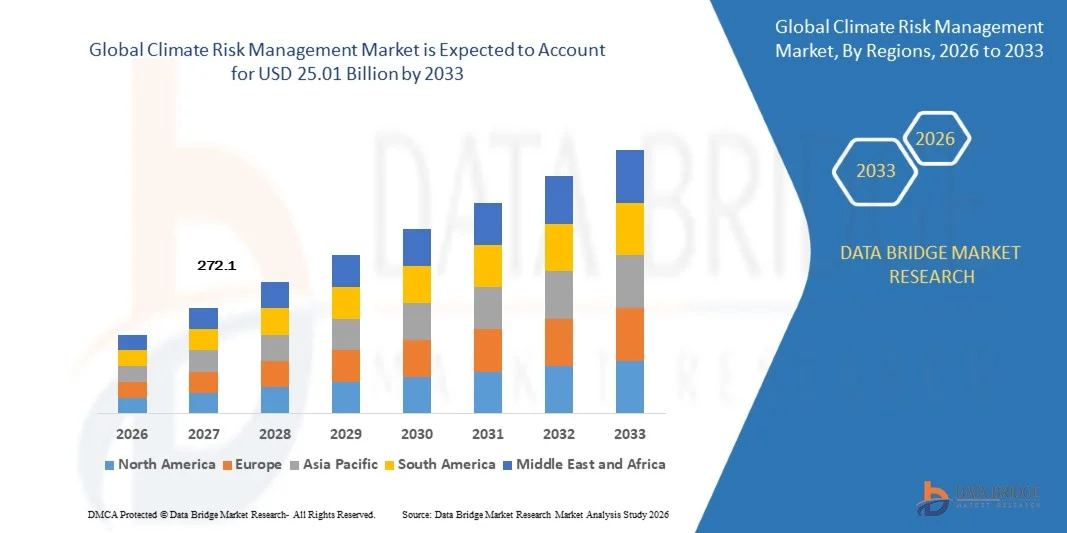
The climate risk management market was valued at USD 7.90 billion in 2025 and is projected to reach USD 25.01 billion by 2033, growing at a CAGR of 15.50% during the forecast period. The market is witnessing rapid expansion owing to the increasing frequency of climate-related disasters, rising regulatory requirements for climate risk disclosure, growing corporate commitments toward sustainability, and increasing adoption of Environmental, Social, and Governance (ESG) frameworks across industries. Governments, financial institutions, insurers, infrastructure operators, and multinational enterprises are increasingly investing in climate risk management platforms to evaluate physical and transition climate risks, strengthen operational resilience, improve business continuity planning, and support long-term sustainability objectives.
Climate Risk Management (CRM) solutions combine artificial intelligence (AI), machine learning, geospatial analytics, climate modeling, satellite imagery, big data analytics, cloud computing, and digital twin technologies to provide organizations with actionable insights into climate-related risks. These platforms enable enterprises to assess exposure to floods, hurricanes, droughts, heatwaves, wildfires, sea-level rise, and other environmental hazards while facilitating climate scenario analysis, carbon accounting, ESG reporting, portfolio risk assessment, and regulatory compliance. Increasing implementation of sustainability regulations, including the Corporate Sustainability Reporting Directive (CSRD), International Sustainability Standards Board (ISSB) standards, and mandatory climate-related financial disclosures, is significantly accelerating enterprise adoption of climate intelligence solutions.
Organizations are increasingly integrating climate risk intelligence into enterprise risk management, supply chain planning, investment strategies, infrastructure development, and financial decision-making. Financial institutions are conducting climate stress testing to evaluate portfolio exposure, while governments are utilizing predictive climate analytics to strengthen disaster preparedness and national adaptation strategies. Advances in AI-powered climate forecasting, cloud-native analytics platforms, high-resolution Earth observation data, remote sensing technologies, and real-time environmental monitoring are enabling organizations to make faster, data-driven decisions while improving resilience against both acute and chronic climate risks. Growing investments in sustainable finance, resilient infrastructure, renewable energy projects, and digital climate technologies are expected to create substantial opportunities for the climate risk management market throughout the forecast period.
Market Size & Forecast
- Market Value (2025): USD 7.90 Billion
- Expected Market Value (2033): USD 25.01 Billion
- Forecast CAGR (2026–2033): 15.50%
- Leading Region in 2025: North America
- Fastest Growing Region: Asia-Pacific
What are the Major Takeaways of Climate Risk Management Market?
- North America dominated the climate risk management market with the largest revenue share of 38.90% in 2025, driven by stringent climate disclosure regulations, mature ESG reporting practices, widespread adoption of AI-enabled climate intelligence platforms, and significant investments in digital risk management across financial services, insurance, energy, and government sectors.
- Climate Risk Analytics accounted for the largest solution segment with a market share of 34.60% in 2026, owing to increasing enterprise demand for predictive climate modeling, hazard mapping, financial exposure analysis, and AI-powered climate intelligence that supports proactive risk mitigation and strategic planning.
- Physical Climate Risk dominated the risk type segment with a market share of 61.80% in 2026, supported by increasing occurrences of floods, hurricanes, droughts, wildfires, heatwaves, and other extreme weather events that are compelling organizations to strengthen physical asset resilience and business continuity planning.
- Cloud deployment held the largest market share of 63.40% in 2025 and is projected to register the fastest CAGR of 17.20%, owing to growing adoption of cloud-native climate intelligence platforms that enable real-time data processing, satellite imagery integration, scalable analytics, and collaborative risk monitoring across geographically distributed operations.
- The BFSI segment accounted for the largest market share of 27.40% in 2026, driven by increasing regulatory requirements for climate stress testing, sustainable finance initiatives, climate-related financial disclosures, portfolio risk assessment, and ESG investment strategies.
- Asia-Pacific is expected to witness the fastest regional growth with a CAGR of 17.60%, fueled by rising government investments in climate adaptation programs, expanding sustainable infrastructure projects, increasing climate resilience initiatives, and growing adoption of digital climate intelligence platforms across China, India, Japan, Australia, and Southeast Asia.
- Large Enterprises continue to dominate organizational adoption with a market share of 71.30%, supported by higher investments in enterprise risk management, sustainability programs, regulatory compliance, and digital transformation initiatives.
- Climate Scenario Analysis & Stress Testing is anticipated to emerge as the fastest-growing solution segment, owing to increasing implementation of climate stress testing regulations by central banks, financial regulators, insurers, and institutional investors for long-term climate resilience planning.
Report Scope and Climate Risk Management Market Segmentation
|
Attributes |
Climate Risk Management Key Market Insights |
|
Segments Covered |
|
|
Countries Covered |
North America
Europe
Asia-Pacific
Middle East and Africa
South America
|
|
Key Market Players |
|
|
Market Opportunities |
|
|
Value Added Data Infosets |
In addition to the insights on market scenarios such as market value, growth rate, segmentation, geographical coverage, and major players, the market reports curated by the Data Bridge Market Research also include in-depth expert analysis, patient epidemiology, pipeline analysis, pricing analysis, and regulatory framework. |
What is the Key Trend in the Climate Risk Management Market?
Trend: Growing Adoption of AI-Powered Climate Intelligence and Climate Scenario Analysis Platforms
The increasing adoption of AI-powered climate intelligence platforms is transforming the climate risk management market. Organizations are integrating AI, machine learning, geospatial analytics, satellite imagery, remote sensing, and advanced climate models to identify and mitigate climate-related risks. These platforms combine real-time environmental data with predictive analytics to forecast climate events and evaluate their impact on business operations, supply chains, investments, and infrastructure planning.
Growing ESG reporting requirements and climate disclosure regulations are further accelerating the adoption of climate intelligence solutions across financial institutions, governments, manufacturing companies, utilities, and infrastructure operators.
For instance,
- In 2025, Google Cloud enhanced Earth Engine with AI-powered geospatial analytics and climate intelligence capabilities to support climate risk analysis and sustainability planning.
- In February 2024, Microsoft Corporation expanded Microsoft Cloud for Sustainability with enhanced environmental data intelligence and climate analytics capabilities.
The growing integration of AI and advanced analytics is enabling organizations to move from reactive climate response toward predictive risk management, making AI-driven climate intelligence a key growth trend in the market.
What are the Key Drivers of Climate Risk Management Market?
Key Market Driver: Increasing Regulatory Requirements for Climate Risk Disclosure and ESG Compliance
Increasing climate disclosure regulations and ESG reporting requirements are driving demand for climate risk management solutions. Frameworks such as ISSB, CSRD, and TCFD are encouraging organizations to assess, disclose, and manage climate-related risks as part of their corporate governance and investment strategies.
Enterprises are adopting climate risk platforms to automate climate data collection, scenario analysis, carbon accounting, sustainability reporting, and compliance activities. Financial institutions, energy companies, and infrastructure operators are increasingly using these solutions to strengthen climate resilience and improve decision-making.
For instance,
- In November 2024, ISSB continued supporting the adoption of IFRS Sustainability Disclosure Standards to enhance climate-related financial reporting.
- The European Union’s implementation of CSRD expanded sustainability reporting requirements, encouraging organizations to invest in climate risk assessment technologies.
The expansion of global climate regulations is creating a strong demand for integrated climate risk management solutions as organizations focus on transparency, compliance, and long-term operational resilience.
Key Restraint/Challenge: Limited Availability of High-Quality Climate Data and Complex Risk Modeling
Limited access to reliable climate datasets and the complexity of climate risk modeling remain significant challenges for market growth. Climate risk assessment requires integration of weather data, satellite imagery, geospatial information, emissions scenarios, and operational datasets. However, inconsistent data quality, lack of standardization, and regional data gaps can impact assessment accuracy.
Additionally, climate modeling requires specialized expertise and advanced technologies, increasing implementation costs and limiting adoption among small and medium-sized enterprises.
For instance,
-
Moody’s emphasized the importance of improving standardization of climate datasets, geospatial information, and physical risk modeling to enhance climate risk assessment capabilities.
Although data limitations and technical complexities create adoption barriers, improvements in climate data standardization and modeling technologies are expected to gradually reduce these challenges.
Key Market Opportunity: Increasing Investments in Climate Adaptation and AI-Based Climate Intelligence Platforms
Growing investments in climate adaptation initiatives and AI-powered climate intelligence platforms are creating significant opportunities for market expansion. Organizations are adopting predictive analytics, digital twins, satellite monitoring, and geospatial intelligence to improve infrastructure resilience, disaster preparedness, and operational continuity.
Rising investments in sustainable finance, renewable energy, resilient cities, and climate adaptation projects are further increasing demand for cloud-based climate risk management solutions.
For instance,
- In June 2025, Moody’s Corporation enhanced its climate risk solutions with improved climate scenario analysis and physical risk assessment capabilities.
- In October 2021, IBM Corporation introduced AI capabilities within its Environmental Intelligence Suite to improve climate forecasting and extreme weather risk assessment.
Increasing focus on climate adaptation and resilience is expected to create substantial opportunities for solution providers offering AI-powered analytics, predictive modeling, and integrated climate risk management platforms.
How is the Climate Risk Management Market Segmented?
The climate risk management market is segmented on the basis of solution, risk type, deployment, organization size, and end user.
By Solution
On the basis of solution, the market is segmented into climate risk analytics, climate risk monitoring & reporting, climate scenario analysis & stress testing, carbon accounting & ESG reporting, and disaster risk & resilience management. In 2026, the climate risk analytics segment is expected to dominate the market with a market share of 34.60%, owing to the increasing demand for predictive climate modeling, hazard mapping, geospatial intelligence, AI-driven environmental analytics, and financial impact assessment. Organizations are increasingly adopting climate risk analytics platforms to quantify physical and transition climate risks, evaluate asset vulnerability, strengthen enterprise risk management, and improve long-term strategic planning. Growing implementation of climate disclosure regulations and increasing investments in predictive climate intelligence are further accelerating adoption of advanced climate analytics solutions across both public and private sectors.
The climate scenario analysis & stress testing segment is expected to witness the fastest CAGR of 17.90% during the forecast period of 2026–2033. The growth is attributed to increasing regulatory emphasis on climate stress testing by central banks, financial regulators, insurers, and institutional investors. Enterprises are increasingly evaluating multiple climate scenarios under different greenhouse gas emission pathways to understand long-term financial exposure, improve resilience planning, support investment decisions, and comply with evolving sustainability disclosure requirements.
By Risk Type
On the basis of risk type, the market is segmented into physical climate risk and transition climate risk. In 2026, the physical climate risk segment is expected to dominate the market with a market share of 61.80%, owing to the increasing frequency and severity of floods, hurricanes, droughts, heatwaves, wildfires, storms, and rising sea levels affecting critical infrastructure and business operations worldwide. Organizations are increasingly prioritizing physical risk assessments to evaluate the vulnerability of facilities, supply chains, transportation networks, and utility infrastructure while improving disaster preparedness and operational resilience.
The transition climate risk segment is projected to register the fastest CAGR of 16.80% during the forecast period. This growth is driven by tightening climate policies, expanding carbon pricing mechanisms, stricter environmental regulations, changing investor expectations, and accelerating transition toward low-carbon economies. Organizations are increasingly investing in transition risk assessment solutions to evaluate regulatory, technological, reputational, and market risks associated with decarbonization initiatives and net-zero commitments.
By Deployment
On the basis of deployment, the market is segmented into cloud and on-premises. In 2026, the cloud segment is expected to dominate the market with a market share of 63.40%, owing to increasing enterprise adoption of cloud-native climate intelligence platforms capable of processing large-scale environmental datasets, satellite imagery, geospatial information, climate simulations, and real-time monitoring. Cloud deployment provides greater scalability, centralized data management, lower implementation costs, seamless integration with AI and machine learning technologies, and remote accessibility, making it the preferred deployment model for climate risk management solutions.
The cloud segment is also anticipated to register the fastest CAGR of 17.20% throughout the forecast period. Increasing investments in Software-as-a-Service (SaaS)-based climate platforms, digital transformation initiatives, and enterprise-wide sustainability programs continue to accelerate cloud adoption across financial institutions, governments, infrastructure operators, and multinational corporations.
By Organization Size
On the basis of organization size, the market is segmented into large enterprises and small & medium enterprises (SMEs). In 2026, the large enterprises segment is expected to dominate the market with a market share of 71.30%, owing to greater investments in enterprise risk management, ESG compliance, climate resilience strategies, and digital transformation initiatives. Large organizations typically operate geographically diversified assets and complex supply chains, making climate risk assessment an essential component of business continuity planning and regulatory compliance. Furthermore, increasing pressure from investors, shareholders, and regulatory authorities is encouraging multinational corporations to deploy enterprise-wide climate intelligence platforms.
The small & medium enterprises (SMEs) segment is expected to witness the fastest CAGR of 16.60% during 2026–2033, driven by increasing availability of affordable cloud-based climate risk management platforms, subscription-based pricing models, government sustainability initiatives, and growing awareness regarding climate-related financial risks. The emergence of AI-enabled Software-as-a-Service solutions is enabling SMEs to access sophisticated climate analytics without significant capital investments.
By End User
On the basis of end user, the market is segmented into banking, financial services & insurance (BFSI), government & public sector, energy & utilities, manufacturing, agriculture & food, real estate & infrastructure, healthcare, and others. In 2026, the banking, financial services & insurance (BFSI) segment is expected to dominate the market with a market share of 27.40%, owing to increasing implementation of climate stress testing, sustainable finance initiatives, portfolio climate risk assessment, ESG investing, and mandatory climate-related financial disclosures. Financial institutions are increasingly integrating climate risk management platforms into enterprise risk management frameworks to evaluate physical and transition risks, improve investment decision-making, strengthen regulatory compliance, and support long-term financial resilience.
The government & public sector segment is projected to register the fastest CAGR of 17.80% during the forecast period, driven by increasing investments in climate adaptation planning, disaster resilience programs, environmental monitoring systems, national climate risk assessments, and smart city initiatives. Governments worldwide are deploying AI-powered climate intelligence platforms to improve disaster preparedness, strengthen critical infrastructure resilience, optimize emergency response planning, and support evidence-based policymaking. Additionally, growing public investments in climate adaptation projects and national sustainability strategies continue to accelerate adoption of climate risk management solutions across government agencies.
Which Region Holds the Largest Share of the Climate Risk Management Market ?
North America is expected to dominate the climate risk management market with the largest market share of 38.90% in 2026, driven by stringent climate disclosure regulations, increasing adoption of Environmental, Social, and Governance (ESG) frameworks, advanced cloud infrastructure, and significant investments in artificial intelligence (AI)-based climate intelligence platforms. The region benefits from the strong presence of leading climate analytics providers, financial institutions, insurance companies, and technology vendors that are continuously investing in predictive climate modeling, geospatial intelligence, and climate scenario analysis. In addition, increasing implementation of climate stress testing, corporate sustainability reporting, and enterprise risk management strategies across asset-intensive industries is further accelerating market growth throughout North America.
U.S. Climate Risk Management Market Insight
The U.S. climate risk management market captured the largest share in North America due to the increasing adoption of climate intelligence platforms by financial institutions, government agencies, insurers, utilities, and multinational corporations. Organizations are investing significantly in AI-driven climate analytics, climate scenario modeling, physical and transition risk assessment, and ESG reporting solutions to comply with evolving sustainability regulations and strengthen enterprise resilience. Rising investments in sustainable finance, digital transformation, and disaster resilience planning are expected to continue supporting market expansion across the country.
Europe Climate Risk Management Market Insight
Europe is anticipated to account for the second-largest share of the climate risk management market owing to stringent sustainability regulations, aggressive carbon reduction targets, and widespread implementation of climate disclosure requirements. Enterprises across Germany, France, the U.K., and other European countries are increasingly integrating climate risk assessment into corporate governance, supply chain management, infrastructure planning, and financial reporting. The implementation of the Corporate Sustainability Reporting Directive (CSRD), increasing investments in green finance, and expanding climate adaptation initiatives continue to accelerate adoption of climate risk management solutions throughout the region.
U.K. Climate Risk Management Market Insight
The U.K. climate risk management market is experiencing steady growth due to increasing implementation of climate-related financial disclosure requirements, sustainable investment strategies, and enterprise-wide climate resilience programs. Financial institutions, insurance providers, infrastructure developers, and public sector organizations are increasingly deploying climate analytics platforms to strengthen portfolio risk assessment, improve climate governance, and support long-term investment planning. The country's strong focus on achieving net-zero emissions is further contributing to market growth.
Germany Climate Risk Management Market Insight
Germany continues to be one of Europe's leading markets for climate risk management owing to increasing investments in industrial sustainability, renewable energy infrastructure, and digital climate technologies. Manufacturing companies, energy providers, and financial institutions are increasingly adopting AI-powered climate analytics, carbon accounting platforms, and climate scenario analysis solutions to strengthen operational resilience while supporting regulatory compliance and sustainability objectives. Government initiatives promoting industrial decarbonization and climate adaptation are expected to further drive market growth.
Asia-Pacific Climate Risk Management Market Insight
Asia-Pacific is projected to register the fastest CAGR of 17.60% during the forecast period owing to increasing climate vulnerability, rapid urbanization, expanding infrastructure development, and growing government investments in climate adaptation programs. Countries such as China, India, Japan, Australia, and Singapore are increasingly deploying AI-enabled climate intelligence platforms, satellite-based environmental monitoring systems, and predictive analytics solutions to improve disaster preparedness, strengthen infrastructure resilience, and support sustainable economic development. Rising awareness regarding climate-related financial risks and increasing adoption of ESG frameworks are expected to create substantial growth opportunities across the region.
Japan Climate Risk Management Market Insight
Japan is expected to witness significant market growth due to increasing investments in disaster risk reduction, climate adaptation technologies, and smart infrastructure development. Frequent exposure to earthquakes, typhoons, floods, and other climate-related hazards has encouraged government agencies and private enterprises to adopt advanced climate risk assessment platforms capable of improving emergency preparedness, infrastructure resilience, and long-term sustainability planning. Growing adoption of AI, digital twins, and geospatial intelligence technologies further supports market expansion.
China Climate Risk Management Market Insight
China is expected to emerge as one of the fastest-growing national markets due to rapid investments in digital climate technologies, smart cities, renewable energy infrastructure, and environmental monitoring systems. Government initiatives supporting carbon neutrality, ecological conservation, climate adaptation planning, and digital transformation are encouraging organizations to implement climate intelligence platforms capable of monitoring environmental risks, assessing climate exposure, and supporting enterprise sustainability strategies. Increasing investments in artificial intelligence, satellite technologies, and cloud computing are expected to further strengthen market growth throughout the forecast period.
Which are the Top Companies in Climate Risk Management Market?
The climate risk management industry is primarily led by well-established companies, including:
- IBM Corporation (U.S.)
- Microsoft Corporation (U.S.)
- Google LLC (U.S.)
- Amazon Web Services, Inc. (U.S.)
- Oracle Corporation (U.S.)
- SAP SE (Germany)
- SAS Institute Inc. (U.S.)
- Moody's Corporation (U.S.)
- MSCI Inc. (U.S.)
- S&P Inc. (U.S.)
- Verisk Analytics, Inc. (U.S.)
- Munich Re AG (Germany)
- Swiss Re AG (Switzerland)
- Accenture plc (Ireland)
- Deloitte Touche Tohmatsu Limited (U.K.)
- PwC (U.K.)
- Cervest Ltd. (U.K.)
- Jupiter Intelligence, Inc. (U.S.)
- ClimateAI (U.S.)
- One Concern Inc. (U.S.)
- Esri (U.S.)
- Tomorrow.io (U.S.)
- Intercontinental Exchange (ICE) (U.S.)
- Precisely Holdings LLC (U.S.)
- Earth Blox Ltd. (U.K.)
Which Region Holds the Largest Share of the Climate Risk Management Market ?
- In June 2025, Moody's Corporation expanded its climate risk solutions by enhancing its climate scenario analysis and physical risk assessment capabilities, enabling financial institutions and enterprises to improve portfolio resilience, regulatory compliance, and long-term climate-related investment decision-making.
- In October 2021, IBM Corporation introduced new artificial intelligence capabilities within its Environmental Intelligence Suite to improve climate forecasting, geospatial analytics, and extreme weather risk assessment, helping organizations strengthen operational resilience and climate adaptation strategies.
- In 2025, Google Cloud enhanced Earth Engine with advanced AI-powered geospatial analytics and climate intelligence capabilities, enabling organizations to improve environmental monitoring, climate risk analysis, infrastructure planning, and sustainability decision-making using satellite-derived insights.
- In February 2024, Microsoft Corporation expanded Microsoft Cloud for Sustainability by introducing enhanced environmental data intelligence, carbon accounting, and climate analytics capabilities, enabling enterprises to improve ESG reporting, climate risk management, and sustainability performance.

- Interactive Data Analysis Dashboard
- Company Analysis Dashboard for high growth potential opportunities
- Research Analyst Access for customization & queries
- Competitor Analysis with Interactive dashboard
- Latest News, Updates & Trend analysis
- Harness the Power of Benchmark Analysis for Comprehensive Competitor Tracking
Data collection and base year analysis are done using data collection modules with large sample sizes. The stage includes obtaining market information or related data through various sources and strategies. It includes examining and planning all the data acquired from the past in advance. It likewise envelops the examination of information inconsistencies seen across different information sources. The market data is analysed and estimated using market statistical and coherent models. Also, market share analysis and key trend analysis are the major success factors in the market report. To know more, please request an analyst call or drop down your inquiry.
The key research methodology used by DBMR research team is data triangulation which involves data mining, analysis of the impact of data variables on the market and primary (industry expert) validation. Data models include Vendor Positioning Grid, Market Time Line Analysis, Market Overview and Guide, Company Positioning Grid, Patent Analysis, Pricing Analysis, Company Market Share Analysis, Standards of Measurement, Global versus Regional and Vendor Share Analysis. To know more about the research methodology, drop in an inquiry to speak to our industry experts.
Data Bridge Market Research is a leader in advanced formative research. We take pride in servicing our existing and new customers with data and analysis that match and suits their goal. The report can be customized to include price trend analysis of target brands understanding the market for additional countries (ask for the list of countries), clinical trial results data, literature review, refurbished market and product base analysis. Market analysis of target competitors can be analyzed from technology-based analysis to market portfolio strategies. We can add as many competitors that you require data about in the format and data style you are looking for. Our team of analysts can also provide you data in crude raw excel files pivot tables (Fact book) or can assist you in creating presentations from the data sets available in the report.













