Climate-Smart Agriculture Solutions Market Overview
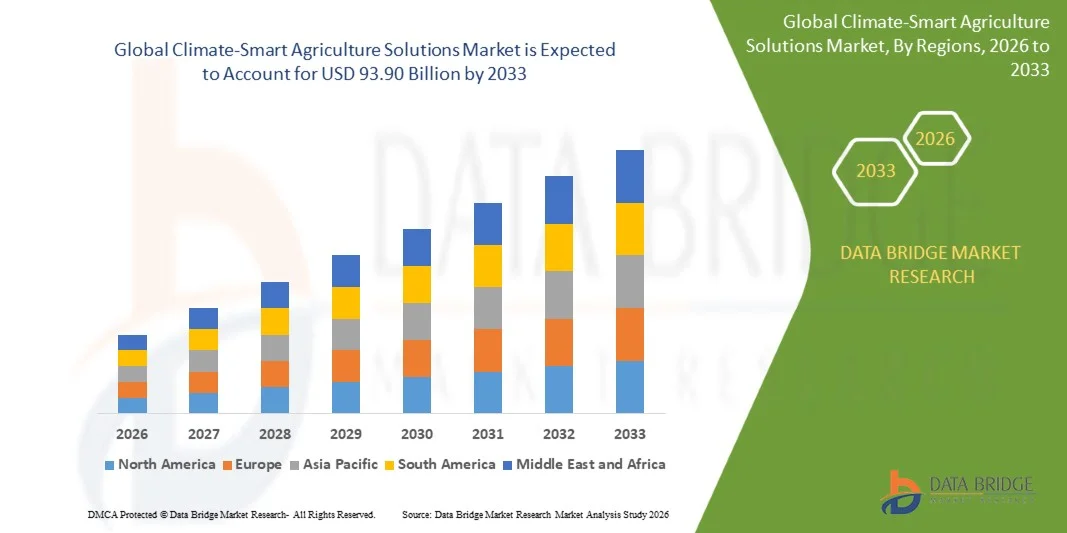
The Climate-Smart Agriculture Solutions Market was valued at USD 36.60 billion in 2025 and is projected to reach USD 93.90 billion by 2033, growing at a CAGR of 12.50% from 2026 to 2033. The market is witnessing strong expansion driven by the rising need to improve agricultural productivity while reducing environmental impact, increasing climate variability, and growing global emphasis on sustainable farming practices. Integration of digital agriculture tools such as AI-based crop monitoring, IoT-enabled smart irrigation systems, and satellite-driven farm analytics is further accelerating market adoption across both developed and emerging economies.
The increasing frequency of extreme weather events, soil degradation, and water scarcity is pushing farmers and agribusinesses to adopt climate-resilient farming practices. Governments and agricultural organizations are actively promoting carbon-efficient farming, precision agriculture, and regenerative farming techniques through subsidies and policy support. In addition, advancements in data-driven agriculture platforms are enabling real-time decision-making, improving yield optimization, and reducing resource wastage, thereby strengthening the long-term growth outlook of the market.
Key Market Trends & Insights
- North America dominated the climate-smart agriculture solutions market with the largest revenue share of 39.8% in 2025, supported by advanced agricultural infrastructure, high adoption of digital farming technologies, and strong presence of large-scale commercial farming operations.
- Asia-Pacific is expected to be the fastest-growing region, recording a CAGR of 13.4% from 2026 to 2033. Growth is driven by rapid digitalization of agriculture, rising food demand, government-backed smart farming initiatives, and increasing adoption of AI and IoT-based agricultural solutions in countries such as China, India, and Japan.
- The volumizing mascara segment held the largest market revenue share of approximately 32.6% in 2025 driven by strong consumer preference for enhanced lash volume and bold eye makeup looks supported by rising beauty trends across social media platforms and influencer-led marketing campaigns. Volumizing variants are widely used across mass and premium cosmetic brands due to their high repeat purchase rate and broad consumer acceptance.
- The waterproof mascara segment is projected to register the fastest growth at a CAGR of 7.9% from 2026 to 2033, driven by increasing demand for long-lasting and smudge-proof cosmetic products suitable for humid climates, professional use, and active lifestyles. Rising adoption of sweat-resistant and humidity-resistant formulations across Asia-Pacific and Middle Eastern markets is further accelerating segment expansion.
- The supermarkets and hypermarkets segment held the largest market revenue share of approximately 38.4% in 2025 due to strong in-store product visibility, wide brand availability, and high consumer preference for physical product testing before purchase. Large retail chains continue to dominate mass-market cosmetic sales, particularly in emerging economies.
- The online retail segment is projected to register the fastest growth at a CAGR of 10.2% from 2026 to 2033, driven by rapid e-commerce expansion, rising smartphone penetration, and increasing influence of digital beauty content and influencer marketing. Direct-to-consumer cosmetic brands and subscription-based beauty platforms are further strengthening online sales growth globally.
- The mass segment held the largest market revenue share of approximately 52.1% in 2025 driven by affordability, widespread availability, and strong demand from price-sensitive consumers across developing regions such as Asia-Pacific and Latin America. Mass-market mascaras are widely distributed through retail chains and drug stores, supporting high-volume sales.
- The premium segment is projected to register the fastest growth at a CAGR of 8.6% from 2026 to 2033, driven by increasing consumer inclination toward high-performance formulations, cruelty-free products, and brand-driven purchasing behavior. Rising disposable income and growing demand for clean beauty formulations are further accelerating premium product adoption.
- The individual consumers segment held the largest market revenue share of approximately 71.3% in 2025 driven by daily cosmetic usage, rising beauty consciousness, and expanding female workforce participation globally. Social media-driven beauty trends continue to significantly influence purchasing decisions among this segment.
- The professional makeup artists segment is projected to register the fastest growth at a CAGR of 9.1% from 2026 to 2033, driven by expanding fashion, media, and bridal makeup industries. Increasing demand for high-performance, long-wear cosmetic products in professional settings is further supporting segment growth.
- The personal use segment held the largest market revenue share of approximately 66.8% in 2025 driven by daily cosmetic application and increasing adoption of eye-enhancing makeup products among working professionals and younger consumers.
- The fashion and entertainment segment is projected to register the fastest growth at a CAGR of 8.3% from 2026 to 2033, driven by rising demand for makeup products in film, television, advertising, and social media content creation. Increasing investment in beauty-centric media production and influencer-led branding is further accelerating segment growth.
Market Size & Forecast
- Global Market Value (2025): USD 36.60 Billion
- Expected Market Value (2033): USD 93.90 Billion
- Forecast CAGR (2026–2033): 12.50%
- Leading Region in 2025: North America
- Fastest Growing Region: Asia-Pacific
Report Scope and Climate-Smart Agriculture Solutions Market Segmentation
|
Attributes |
Climate-Smart Agriculture Solutions Key Market Insights |
|
Segments Covered |
• By Solution Type: Precision Farming Solutions, Crop Monitoring Solutions, Climate-Resilient Seeds, Soil Health Management Solutions, Livestock Monitoring Solutions, and Carbon Farming Solutions • By Technology: Artificial Intelligence and Machine Learning, Iot-Based Sensors, Satellite and Remote Sensing, Blockchain Technology, Big Data Analytics, and Automation and Robotics • By Application: Crop Production, Livestock Management, Water Management, Soil Management, Weather Forecasting and Risk Mitigation • By Deployment Mode: On-Premises and Cloud-Based Solutions • By End User: Individual Farmers, Commercial Farms, Agribusiness Companies, Research Institutions, and Government and Agricultural Organizations |
|
Countries Covered |
North America
Europe
Asia-Pacific
Middle East and Africa
South America
|
|
Key Market Players |
• Deere & Company (U.S.) |
|
Market Opportunities |
• Expansion Of Precision Farming And Digital Agriculture Technologies |
|
Value Added Data Infosets |
In addition to the insights on market scenarios such as market value, growth rate, segmentation, geographical coverage, and major players, the market reports curated by the Data Bridge Market Research also include import export analysis, production capacity overview, production consumption analysis, price trend analysis, climate change scenario, supply chain analysis, value chain analysis, raw material/consumables overview, vendor selection criteria, PESTLE Analysis, Porter Analysis, and regulatory framework |
Climate-Smart Agriculture Solutions Market Trends
Trend: Growth In Digital Agriculture And Climate Resilient Farming Solutions
Increasing demand for sustainable food production systems, improved farm productivity, and efficient resource utilization is driving the adoption of climate-smart agriculture solutions across global agricultural economies. Conventional farming practices are increasingly constrained by soil degradation, water scarcity, and unpredictable weather patterns, encouraging farmers to adopt data-driven and technology-enabled agricultural practices for improved resilience and yield optimization.
In modern farming systems, agricultural stakeholders are integrating precision farming platforms, For instance satellite-based crop monitoring and AI-driven irrigation management systems, to optimize input usage, improve crop health monitoring, and reduce water consumption. Countries such as India and China are expanding digital agriculture initiatives, with India’s Digital Agriculture Mission supporting large-scale deployment of soil health cards, remote sensing tools, and farm advisory platforms to improve decision-making efficiency at the farm level.
The rapid expansion of climate variability and extreme weather events is also increasing demand for predictive weather analytics and risk mitigation tools capable of supporting early warning systems and adaptive planting strategies. In addition, agritech companies in the U.S. and Europe continue to deploy carbon farming and regenerative agriculture models, such as soil carbon sequestration programs and sustainable fertilizer management systems, to reduce greenhouse gas emissions and improve long-term soil fertility. Growing industry validation through pilot programs in 2025 integrating AI-based farm management systems in large-scale wheat and maize farms demonstrated yield improvements of nearly 8–12% while reducing irrigation demand by 10–18% under optimized field conditions.
Climate-Smart Agriculture Solutions Market Dynamics
Key Market Driver: Rising Need For Sustainable Agricultural Productivity And Climate Adaptation
Agricultural systems worldwide are facing increasing pressure from climate change impacts, population growth, and rising food demand, creating strong demand for solutions that enhance productivity while minimizing environmental degradation. Large-scale crop losses caused by droughts, floods, and temperature fluctuations are compelling farmers and governments to adopt climate-smart technologies that improve resilience and resource efficiency.
Governments and agricultural organizations are increasingly investing in digital agriculture infrastructure, For instance remote sensing systems, IoT-enabled soil monitoring, and AI-based farm advisory platforms, to support data-driven decision-making and improve yield forecasting accuracy. The European Union’s Common Agricultural Policy continues to promote sustainable farming practices through financial incentives for precision agriculture adoption and carbon reduction initiatives across member states.
Similarly, agribusiness companies and food supply chain operators are integrating climate risk analytics and sustainable sourcing platforms to improve supply chain resilience and reduce emissions across production cycles. Real-world deployments in Brazil and India during 2024 integrating precision irrigation and weather-based crop advisory systems demonstrated water savings of around 15–25% and yield stability improvements of nearly 6–10% across major crop categories such as rice and soybean.
Key Restraint/Challenge: High Initial Investment And Limited Access To Advanced Agricultural Infrastructure
Despite strong growth potential, the adoption of climate-smart agriculture solutions remains constrained by high upfront costs associated with advanced sensors, satellite systems, and digital farming platforms. Small and marginal farmers in developing regions often face financial limitations that restrict access to precision agriculture technologies and modern farm management tools.
In addition, limited digital infrastructure, lack of technical training, and fragmented landholding patterns further reduce the scalability of advanced agricultural solutions in rural areas. Integration challenges between traditional farming methods and modern data-driven systems also slow down adoption rates in several emerging economies where awareness of climate-smart practices remains relatively low.
Industry assessments indicate that adoption costs for precision agriculture systems, For instance AI-enabled farm management platforms combined with IoT sensor networks, can increase initial farm setup expenses by 20–35% depending on farm size and technology complexity, creating affordability barriers for smallholder farmers in price-sensitive markets.
Key Market Opportunity: Expansion Of Carbon Farming And AI-Enabled Agricultural Intelligence Systems
The growing focus on carbon neutrality, sustainable food supply chains, and regenerative agriculture practices is creating significant opportunities for climate-smart agriculture solution providers. Increasing corporate commitments toward net-zero emissions and sustainable sourcing are driving demand for carbon farming platforms that enable soil carbon tracking, emission reduction, and regenerative land management practices.
Agricultural technology companies are increasingly developing AI-based decision support systems, For instance predictive yield analytics, automated irrigation scheduling, and nutrient optimization platforms, to improve farm efficiency and reduce environmental impact. Large-scale agribusinesses in North America and Europe are adopting carbon credit farming programs that reward farmers for sustainable land use practices and reduced fertilizer dependency.
In addition, advancements in remote sensing technologies, drone-based crop monitoring, and machine learning-based pest detection systems are expanding applications across high-value crop production and export-oriented agriculture markets. Pilot programs conducted in 2025 across Australia and the U.S. integrating AI-driven carbon farming platforms reported emission reduction potential of around 12–20% per cultivation cycle along with improved soil organic carbon retention levels across long-term farming operations.
Climate-Smart Agriculture Solutions Market Scope
The market is segmented on the basis of product type, distribution channel, price range, end user, and application.
• By Product Type
On the basis of product type, the global mascara market is segmented into volumizing mascara, lengthening mascara, curling mascara, waterproof mascara, and conditioning mascara. The volumizing mascara segment held the largest market revenue share of approximately 32.6% in 2025 driven by strong consumer preference for enhanced lash volume and bold eye makeup looks supported by rising beauty trends across social media platforms and influencer-led marketing campaigns. Volumizing variants are widely used across mass and premium cosmetic brands due to their high repeat purchase rate and broad consumer acceptance.
The waterproof mascara segment is projected to register the fastest growth at a CAGR of 7.9% from 2026 to 2033, driven by increasing demand for long-lasting and smudge-proof cosmetic products suitable for humid climates, professional use, and active lifestyles. Rising adoption of sweat-resistant and humidity-resistant formulations across Asia-Pacific and Middle Eastern markets is further accelerating segment expansion.
• By Distribution Channel
On the basis of distribution channel, the market is segmented into supermarkets and hypermarkets, specialty stores, online retail, and pharmacy and drug stores. The supermarkets and hypermarkets segment held the largest market revenue share of approximately 38.4% in 2025 due to strong in-store product visibility, wide brand availability, and high consumer preference for physical product testing before purchase. Large retail chains continue to dominate mass-market cosmetic sales, particularly in emerging economies.
The online retail segment is projected to register the fastest growth at a CAGR of 10.2% from 2026 to 2033, driven by rapid e-commerce expansion, rising smartphone penetration, and increasing influence of digital beauty content and influencer marketing. Direct-to-consumer cosmetic brands and subscription-based beauty platforms are further strengthening online sales growth globally.
• By Price Range
On the basis of price range, the market is segmented into mass, premium, and luxury segments. The mass segment held the largest market revenue share of approximately 52.1% in 2025 driven by affordability, widespread availability, and strong demand from price-sensitive consumers across developing regions such as Asia-Pacific and Latin America. Mass-market mascaras are widely distributed through retail chains and drug stores, supporting high-volume sales.
The premium segment is projected to register the fastest growth at a CAGR of 8.6% from 2026 to 2033, driven by increasing consumer inclination toward high-performance formulations, cruelty-free products, and brand-driven purchasing behavior. Rising disposable income and growing demand for clean beauty formulations are further accelerating premium product adoption.
• By End User
On the basis of end user, the market is segmented into individual consumers, professional makeup artists, and entertainment industry users. The individual consumers segment held the largest market revenue share of approximately 71.3% in 2025 driven by daily cosmetic usage, rising beauty consciousness, and expanding female workforce participation globally. Social media-driven beauty trends continue to significantly influence purchasing decisions among this segment.
The professional makeup artists segment is projected to register the fastest growth at a CAGR of 9.1% from 2026 to 2033, driven by expanding fashion, media, and bridal makeup industries. Increasing demand for high-performance, long-wear cosmetic products in professional settings is further supporting segment growth.
• By Application
On the basis of application, the market is segmented into personal use, fashion and entertainment, and professional grooming. The personal use segment held the largest market revenue share of approximately 66.8% in 2025 driven by daily cosmetic application and increasing adoption of eye-enhancing makeup products among working professionals and younger consumers.
The fashion and entertainment segment is projected to register the fastest growth at a CAGR of 8.3% from 2026 to 2033, driven by rising demand for makeup products in film, television, advertising, and social media content creation. Increasing investment in beauty-centric media production and influencer-led branding is further accelerating segment growth.
Climate-Smart Agriculture Solutions Market Regional Analysis
North America Climate-Smart Agriculture Solutions Market Insight
North America dominated the climate-smart agriculture solutions market with the largest revenue share of 39.8% in 2025, supported by advanced agricultural infrastructure, high adoption of precision farming technologies, and strong government support for sustainable farming practices. Farmers and agribusinesses in the region are increasingly integrating AI-based crop monitoring, IoT-enabled irrigation systems, and satellite-driven farm analytics to enhance productivity while reducing environmental impact. The presence of large-scale commercial farming operations and high awareness of carbon reduction initiatives further strengthens market dominance, making climate-smart solutions a key component of modern agricultural practices across the U.S. and Canada.
U.S. Climate-Smart Agriculture Solutions Market Insight
The U.S. climate-smart agriculture solutions market captured the largest revenue share in 2025 within North America, driven by rapid adoption of digital agriculture platforms and strong investment in sustainable farming innovation. Large agribusiness firms and independent farms are increasingly using precision irrigation systems, drone-based crop monitoring, and AI-powered yield forecasting tools to improve efficiency and reduce resource wastage. Government-backed initiatives such as regenerative agriculture programs and carbon credit farming schemes are further accelerating adoption. In addition, strong participation from agritech companies and research institutions is reinforcing the expansion of climate-resilient farming technologies across major crop-producing states.
Europe Climate-Smart Agriculture Solutions Market Insight
The Europe climate-smart agriculture solutions market is expected to witness the fastest growth rate from 2026 to 2033, primarily driven by strict environmental regulations, the European Green Deal, and rising demand for sustainable food production systems. Farmers across the region are increasingly adopting carbon farming practices, precision nutrient management, and AI-based weather forecasting tools to comply with emission reduction targets. Growing investment in digital agriculture infrastructure and strong policy incentives for sustainable land use are further supporting market expansion. The region is also witnessing increased collaboration between agritech firms and research organizations to accelerate innovation in climate-resilient farming technologies.
U.K. Climate-Smart Agriculture Solutions Market Insight
The U.K. climate-smart agriculture solutions market is expected to witness the fastest growth rate from 2026 to 2033, driven by increasing focus on sustainable farming practices and net-zero emission targets in the agricultural sector. Farmers are adopting smart irrigation systems, soil health monitoring tools, and carbon tracking platforms to improve productivity while reducing environmental impact. Government-led sustainability programs and growing awareness of climate change risks are encouraging the transition toward data-driven farming. In addition, expansion of agritech startups and digital farming platforms is supporting widespread adoption of climate-smart solutions across both large and small-scale farms.
Germany Climate-Smart Agriculture Solutions Market Insight
The Germany climate-smart agriculture solutions market is expected to witness strong growth from 2026 to 2033, fueled by advanced agricultural technology adoption, sustainability-focused policies, and increasing demand for resource-efficient farming systems. German farms are increasingly integrating sensor-based soil monitoring, automated irrigation systems, and AI-driven crop management platforms to enhance efficiency and reduce chemical usage. Strong emphasis on environmental protection and precision agriculture is encouraging widespread deployment of climate-smart solutions. In addition, collaborations between research institutes and agritech companies are accelerating innovation in sustainable farming technologies across the country.
Asia-Pacific Climate-Smart Agriculture Solutions Market Insight
The Asia-Pacific climate-smart agriculture solutions market is expected to witness the fastest growth rate from 2026 to 2033, supported by rising food demand, rapid urbanization, and increasing government initiatives promoting smart agriculture. Countries such as China, India, and Japan are investing heavily in digital farming technologies, including satellite-based crop monitoring, AI-driven farm advisory systems, and IoT-enabled irrigation solutions. Expanding agritech ecosystems and improving rural connectivity are further enhancing adoption rates. The region’s large agricultural base and increasing focus on food security and climate resilience are key factors driving strong market expansion.
Japan Climate-Smart Agriculture Solutions Market Insight
The Japan climate-smart agriculture solutions market is expected to witness steady growth from 2026 to 2033 due to the country’s advanced technological ecosystem, aging farming population, and strong emphasis on efficient agricultural practices. Farmers are increasingly adopting automated farming systems, precision irrigation tools, and AI-based crop monitoring platforms to improve productivity and reduce labor dependency. Integration of robotics and IoT in agriculture is further supporting efficient resource utilization. In addition, Japan’s focus on sustainable food production and smart farming innovation is accelerating the adoption of climate-smart agriculture solutions across both traditional and modern farming systems.
China Climate-Smart Agriculture Solutions Market Insight
The China climate-smart agriculture solutions market accounted for the largest market revenue share in Asia-Pacific in 2025, driven by large-scale agricultural production, strong government support for smart farming initiatives, and rapid digital transformation in rural areas. Farmers are increasingly using satellite imagery, AI-based crop analytics, and smart irrigation systems to enhance yield efficiency and reduce environmental impact. Government-led programs promoting agricultural modernization and food security are further accelerating adoption. In addition, the presence of strong domestic agritech companies and expanding smart city-linked agricultural projects is significantly contributing to market growth across major farming regions.
Climate-Smart Agriculture Solutions Market Share
The Climate-Smart Agriculture Solutions industry is primarily led by well-established companies, including:
• Deere & Company (U.S.)
• Bayer AG (Germany)
• Corteva, Inc. (U.S.)
• Syngenta Group (Switzerland)
• Trimble Inc. (U.S.)
• Climate Corporation (Bayer) (U.S.)
• Indigo Ag Inc. (U.S.)
• Farmers Edge Inc. (Canada)
• Granular Inc. (U.S.)
• IBM Corporation (U.S.)
• Nutrien Ltd. (Canada)
• Cargill Inc. (U.S.)
• BASF SE (Germany)
• Taranis Visual Ltd. (Israel)
• CropX Technologies (Israel)

- Interactive Data Analysis Dashboard
- Company Analysis Dashboard for high growth potential opportunities
- Research Analyst Access for customization & queries
- Competitor Analysis with Interactive dashboard
- Latest News, Updates & Trend analysis
- Harness the Power of Benchmark Analysis for Comprehensive Competitor Tracking
Data collection and base year analysis are done using data collection modules with large sample sizes. The stage includes obtaining market information or related data through various sources and strategies. It includes examining and planning all the data acquired from the past in advance. It likewise envelops the examination of information inconsistencies seen across different information sources. The market data is analysed and estimated using market statistical and coherent models. Also, market share analysis and key trend analysis are the major success factors in the market report. To know more, please request an analyst call or drop down your inquiry.
The key research methodology used by DBMR research team is data triangulation which involves data mining, analysis of the impact of data variables on the market and primary (industry expert) validation. Data models include Vendor Positioning Grid, Market Time Line Analysis, Market Overview and Guide, Company Positioning Grid, Patent Analysis, Pricing Analysis, Company Market Share Analysis, Standards of Measurement, Global versus Regional and Vendor Share Analysis. To know more about the research methodology, drop in an inquiry to speak to our industry experts.
Data Bridge Market Research is a leader in advanced formative research. We take pride in servicing our existing and new customers with data and analysis that match and suits their goal. The report can be customized to include price trend analysis of target brands understanding the market for additional countries (ask for the list of countries), clinical trial results data, literature review, refurbished market and product base analysis. Market analysis of target competitors can be analyzed from technology-based analysis to market portfolio strategies. We can add as many competitors that you require data about in the format and data style you are looking for. Our team of analysts can also provide you data in crude raw excel files pivot tables (Fact book) or can assist you in creating presentations from the data sets available in the report.