


Cling Film Market Overview
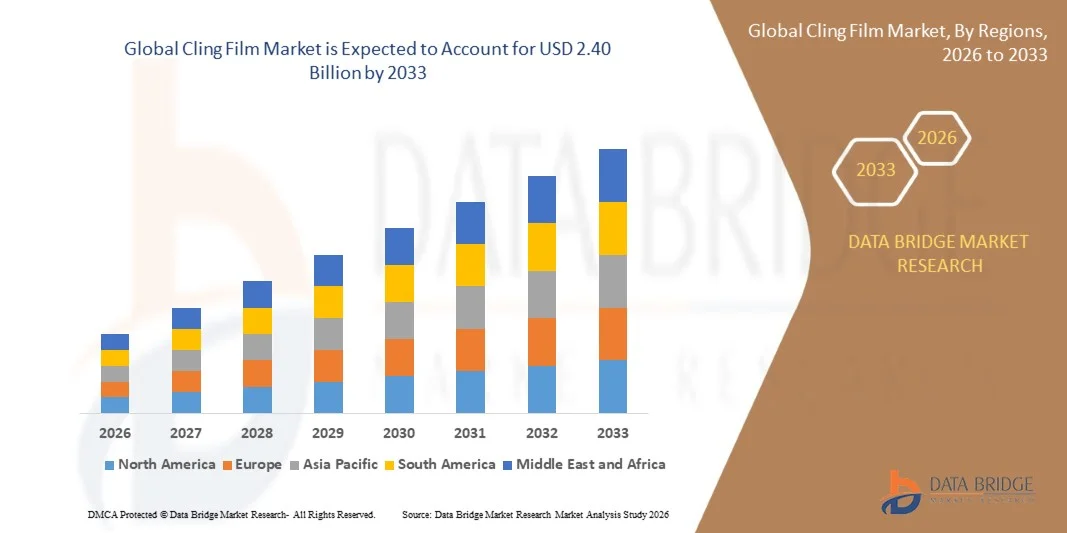
As per Data Bridge Market Research Analysis the cling film market was valued at USD 1.52 billion in 2025 and is projected to reach USD 2.40 billion by 2033, growing at a CAGR of 5.90% from 2026 to 2033. Demand is supported by the wider consumption of packaged and ready-to-eat foods, the expansion of supermarkets and food delivery services, and the practical need to protect food freshness during storage and transportation.
Cling films are thin, flexible wrapping materials that adhere closely to containers and food surfaces. Polyethylene and PVC remain widely used because they provide transparency, moisture retention, stretchability, and ease of handling. Environmental pressure is changing material selection, encouraging recyclable polyethylene structures, downgauged films, bio-based materials, and packaging formats that reduce virgin plastic use while maintaining food-contact safety, clarity, sealing performance, and compatibility with existing wrapping equipment.
Market Size & Forecast
- Market Value (2025): USD 1.52 Billion
- Expected Market Value (2033): USD 2.40 Billion
- Forecast CAGR (2026-2033): 5.90%
- Leading Region: Europe
- Fastest-Growing Region: Asia-Pacific
Key Market Trends & Insights
- Europe dominated the cling film market with the largest revenue share of 34.86% in 2025. The region benefits from established flexible-packaging infrastructure, extensive use of pre-packed food, and strict food-contact and packaging-waste requirements.
- Asia-Pacific is expected to witness the fastest growth rate from 2026 to 2033. Rapid supermarket expansion, urban food consumption, stronger cold-chain networks, and growing use of ready-to-eat and delivered foods are increasing demand across China, Japan, India, South Korea, and Southeast Asia.
- The polyethylene (PE) segment held the largest market revenue share of approximately 35.48% in 2025, driven by its flexibility, moisture resistance, clarity, durability, cost efficiency, and broad suitability for household, foodservice, retail, and automated food-packaging applications.
- The bio-based and biodegradable films segment is projected to register the fastest growth at a CAGR from 2026 to 2033, driven by plastic-reduction targets, retailer sustainability programs, demand for compostable alternatives, and continuing development of lower-impact food-contact materials.
- The manual/handheld wrap segment held the largest market revenue share in 2025, driven by widespread use in households, grocery stores, restaurants, bakeries, catering establishments, and small food businesses that require affordable wrapping without specialized equipment. The public source identifies the segment as dominant but does not disclose a separate percentage share.
- The machine wrap segment is projected to register the fastest growth at a CAGR from 2026 to 2033, driven by increasing automation in food processing, supermarkets, commercial kitchens, and high-volume retail operations requiring faster throughput, uniform wrapping, and consistent film tension.
Report Scope and Cling Film Market Segmentation
|
Attributes |
Cling Film Key Market Insights |
|
Segments Covered |
|
|
Countries Covered |
North America
Europe
Asia-Pacific
South America
Middle East and Africa
|
|
Key Market Players |
|
|
Market Opportunities |
|
|
Value Added Data Infosets |
In addition to the insights on market scenarios such as market value, growth rate, segmentation, geographical coverage, and major players, the market reports curated by the Data Bridge Market Research also include import export analysis, production capacity overview, production consumption analysis, price trend analysis, climate change scenario, supply chain analysis, value chain analysis, raw material/consumables overview, vendor selection criteria, PESTLE Analysis, Porter Analysis, and regulatory framework. |
Cling Film Market Trends
Trend: Shift Toward Recyclable, Bio-Based, and Lower-Material Cling Films
Growing regulatory and customer pressure to reduce packaging waste is moving the market away from conventional high-material wraps toward recyclable polyethylene structures, downgauged films, recycled-content options, and bio-based alternatives. Food companies and retailers still require strong clarity, stretch, moisture retention, puncture resistance, reliable cling, and compliance with food-contact requirements, so sustainability improvements must preserve the functional performance of traditional films.
Supporting demand is the expansion of ready-to-eat food, supermarket overwrap, online grocery, and automated retail packaging, all of which require films that can run efficiently on existing equipment. For instance, in February 2026, Amcor stated that its combination with Berry Global had expanded its North American polyethylene shrink and overwrap portfolio, including recycle-ready PE solutions, downgauged products, post-consumer-recycled options, and manufacturing investments intended to improve film performance and supply reliability.
The continued development of recyclable, lighter, and performance-focused polyethylene films is expected to reshape product design throughout the forecast period. Suppliers that can reduce material use and improve circularity without compromising food safety, clarity, machinability, and sealing performance are likely to secure stronger relationships with food processors, retailers, and foodservice customers.
Cling Film Market Dynamics
Key Market Driver: Expanding Consumption of Packaged and Ready-to-Eat Foods
The market is primarily driven by growing demand for convenient, hygienic, and short-term food protection. Urban lifestyles, smaller households, meal delivery, online grocery, supermarkets, restaurants, bakeries, catering businesses, and institutional kitchens rely on cling films to retain moisture, reduce contamination, improve handling, and preserve the freshness of produce, meat, bakery items, prepared meals, leftovers, and takeaway food.
Increasing commercial food production is strengthening demand for both handheld and machine-wrap formats, while improved film performance supports faster packaging and reduced material consumption. For instance, in June 2025, Amcor introduced a more sustainable Perflex shrink bag for Butterball turkey products. The company reported reduced material use and lower carbon, energy, and water impacts while maintaining packaging performance, illustrating how food brands are combining preservation requirements with operational and sustainability objectives.
As packaged-food consumption, food delivery, and organized retail continue to expand, demand for dependable food-contact films is expected to remain strong. Manufacturers that provide transparent, easy-to-handle, puncture-resistant, and lower-material solutions for household and commercial use are positioned to benefit from sustained food-packaging growth.
Key Restraint/Challenge: Plastic-Waste Regulation and Raw-Material Price Volatility
Traditional polyethylene and PVC films face increasing pressure from single-use-plastic restrictions, extended producer responsibility requirements, recycling limitations, food-contact rules, and consumer concern regarding flexible-plastic waste. At the same time, resin costs are linked to petrochemical feedstocks and can change rapidly because of crude-oil movements, energy costs, logistics disruption, supplier concentration, and geopolitical conditions.
Manufacturers must manage these cost and compliance pressures while maintaining competitive pricing, film quality, and uninterrupted supply. Amcor’s 2025 annual filing identifies raw materials and commodity-price movements as material business risks and notes that changes in resin, film, aluminium, and other inputs can affect manufacturing costs. Smaller converters may have less ability to absorb sudden price changes or fund new testing, recycling qualification, and equipment required for alternative materials.
Plastic-waste regulation and raw-material volatility are expected to remain important constraints throughout the forecast period. Companies will need stronger supplier planning, material-efficiency programs, recyclable designs, and clear food-contact compliance to protect margins and avoid disruption while transitioning away from difficult-to-recycle structures.
Key Market Opportunity: Circular Food Packaging and Automated Commercial Wrapping
A strong opportunity exists in recyclable mono-material films, certified recycled-content products, compostable wraps, and downgauged structures that provide the same clarity and cling with less material. Machine-wrap formats also offer attractive growth potential as supermarkets, food processors, meal-kit companies, and large foodservice operations automate packaging to improve speed, consistency, hygiene, and labour efficiency.
Industry collaboration is improving the supporting recovery infrastructure needed for circular flexible packaging. In May 2024, Anchor Packaging joined the Cyclyx Consortium to support the recovery and recyclability of food-grade plastics. The collaboration is intended to improve collection pathways and divert valuable post-consumer materials from landfill, demonstrating how packaging suppliers are working beyond product design to strengthen the recycling ecosystem.
As retailers and food brands increase circular-packaging commitments, suppliers that combine recyclability, food-contact compliance, anti-fog clarity, puncture resistance, lower gauge, and equipment compatibility can capture higher-value opportunities. The strongest growth is expected in solutions that reduce plastic use while improving commercial packaging productivity and end-of-life recovery.
Cling Film Market Scope
The cling film market is segmented on the basis of material type, product type, thickness, application, end user, and distribution channel
- By Material Type
On the basis of material type, the cling film market is segmented into polyethylene (PE), polyvinyl chloride (PVC), bio-based and biodegradable films, and others. The polyethylene (PE) segment held the largest market revenue share of approximately 35.48% in 2025, driven by its flexibility, moisture resistance, clarity, durability, cost efficiency, and broad suitability for household, foodservice, retail, and automated food-packaging applications.
The bio-based and biodegradable films segment is projected to register the fastest growth at a CAGR from 2026 to 2033, driven by plastic-reduction targets, retailer sustainability programs, demand for compostable alternatives, and continuing development of lower-impact food-contact materials.
- By Product Type
On the basis of product type, the cling film market is segmented into manual/handheld wrap and machine wrap. The manual/handheld wrap segment held the largest market revenue share in 2025, driven by widespread use in households, grocery stores, restaurants, bakeries, catering establishments, and small food businesses that require affordable wrapping without specialized equipment. The public source identifies the segment as dominant but does not disclose a separate percentage share.
The machine wrap segment is projected to register the fastest growth at a CAGR from 2026 to 2033, driven by increasing automation in food processing, supermarkets, commercial kitchens, and high-volume retail operations requiring faster throughput, uniform wrapping, and consistent film tension.
- By Form
On the basis of form, the cling film market is segmented into cast cling film and blow cling film. The cast cling film segment held the largest market volume share of approximately 76.17% in 2025, driven by uniform thickness, high optical clarity, efficient production, stable gauge control, and strong compatibility with automated food-packaging and grocery-fulfilment lines.
The blow cling film segment is projected to register the fastest growth at a CAGR from 2026 to 2033, driven by demand for puncture resistance, natural cling, flexible multilayer structures, and performance in handheld foodservice and specialised packaging applications.
- By Thickness
On the basis of thickness, the cling film market is segmented into below 10 microns, 10–15 microns, and above 15 microns. The 10-15 microns segment held the largest market revenue share in 2025, driven by its balanced combination of transparency, stretchability, strength, cling performance, puncture resistance, and affordability across household, retail, and foodservice applications. The public source identifies the segment as dominant but does not disclose a separate percentage share.
The below 10 microns segment is projected to register the fastest growth at a CAGR from 2026 to 2033, driven by downgauging initiatives, material-cost reduction, lower plastic use per package, and improvements in resin and film-processing technology. A separate public CAGR for this exact category is not disclosed in the cited source.
- By Application
On the basis of application, the cling film market is segmented into food packaging, household storage, industrial packaging, and others. The food packaging segment held the largest market revenue share in 2025, driven by extensive use in preserving fresh produce, meat, bakery goods, prepared meals, takeaway food, and other perishable products requiring moisture retention, hygiene, transparency, and protection from contamination. The cited public source does not disclose a separate percentage share.
The industrial packaging segment is projected to register the fastest growth at a CAGR from 2026 to 2033, driven by demand for short-term product protection, bundling, handling efficiency, and flexible wrapping across selected manufacturing and distribution applications. The source describes this category as the second-fastest-growing application.
- By End User
On the basis of end user, the cling film market is segmented into residential/households, foodservice industry, supermarkets and hypermarkets, and others. The residential/households segment held the largest market revenue share in 2025, driven by routine use for covering dishes, storing leftovers, wrapping fresh food, maintaining kitchen hygiene, and extending the usable life of fruits, vegetables, and prepared meals. The public source identifies the segment as dominant but does not disclose a separate percentage share.
The foodservice industry segment is projected to register the fastest growth at a CAGR from 2026 to 2033, driven by expansion of restaurants, cafés, cloud kitchens, catering, meal delivery, institutional kitchens, and other commercial operations requiring high-volume food preparation and storage.
- By Distribution Channel
On the basis of distribution channel, the cling film market is segmented into convenience stores, online/e-commerce, hypermarkets/supermarkets, and others. The hypermarkets/supermarkets segment held the largest market revenue share in 2025, driven by broad product availability, multiple brands and roll sizes, competitive pricing, bulk-pack options, and convenient access for household and commercial buyers. The public source identifies the segment as dominant but does not disclose a separate percentage share.
The online/e-commerce segment is projected to register the fastest growth at a CAGR from 2026 to 2033, driven by online grocery expansion, home delivery, digital business procurement, bulk ordering, and easier access to specialised sizes and sustainable film products.
Cling Film Market Regional Analysis
Europe Cling Film Market Insight
Europe dominated the cling film market with the largest revenue share of 34.86% in 2025. The region benefits from established flexible-packaging infrastructure, extensive use of pre-packed food, and strict food-contact and packaging-waste requirements. Germany and the U.K. remain important consumption centres, while recycling targets are accelerating demand for mono-material and lower-gauge film structures. Extended producer responsibility, recycled-content expectations, and circular-economy policies are also encouraging suppliers to improve film design and recovery compatibility.
Germany Cling Film Market Insight
Germany dominated the cling film market with the largest revenue share in 2025 because of its strong food-processing sector, modern supermarket network, packaging-machinery industry, and high attention to material efficiency and recycling. Demand remains steady across household storage, fresh-food overwrap, bakeries, meat packaging, foodservice, and automated retail applications. Suppliers offering food-safe, recyclable, downgauged, and high-performance films are well positioned as buyers assess both operating efficiency and environmental compliance.
U.K. Cling Film Market Insight
The U.K. is expected to witness the fastest growth rate from 2026 to 2033, is supported by supermarkets, convenience retail, takeaway food, meal delivery, catering, hospitality, household storage, and a large prepared-food sector. Retailer plastic-reduction commitments and packaging-waste requirements are encouraging the use of lighter gauges, recyclable polyethylene structures, and clearly labelled food-contact products. Demand is expected to remain strongest for films that combine transparency, ease of use, reliable cling, and lower material consumption.
Asia-Pacific Cling Film Market Insight
Asia-Pacific is expected to witness the fastest growth rate from 2026 to 2033. Rapid supermarket expansion, urban food consumption, stronger cold-chain networks, and growing use of ready-to-eat and delivered foods are increasing demand across China, Japan, India, South Korea, and Southeast Asia. New cast-film capacity is also improving local supply for automated food packaging. Rising income, convenience-store investment, and greater emphasis on food hygiene are expected to sustain regional volume growth.
China Cling Film Market Insight
China dominated the cling film market with the largest revenue share in 2025, supported by a large food-processing industry, extensive e-commerce and food-delivery activity, expanding supermarket networks, and a strong domestic plastics-conversion base. Demand is shifting toward thinner, cost-efficient, and recyclable structures as food brands and retailers seek reliable protection across long cold-chain and delivery routes. Local film and packaging producers are also increasing capability in cast-film production and automated wrapping formats.
Japan Cling Film Market Insight
Japan is expected to witness the fastest growth rate from 2026 to 2033 a quality-focused market with strong demand from convenience foods, bento meals, seafood, supermarkets, foodservice operations, and household storage. Consumers and commercial users place importance on high clarity, clean cutting, strong sealing, low odour, food-contact safety, and dependable performance with thin gauges. The country’s advanced polymer and packaging industries support continued development of premium, lightweight, and technically refined film products.
North America Cling Film Market Insight
North America is expected to witness the fastest growth rate from 2026 to 2033 supported by high consumption of processed and ready-to-eat foods, large supermarket and foodservice networks, meal-kit delivery, institutional kitchens, and widespread household use. Demand is increasingly influenced by state and provincial extended-producer-responsibility rules, retailer sustainability expectations, recyclable polyethylene structures, and automation-ready commercial wraps.
U.S. Cling Film Market Insight
The U.S. is expected to witness the fastest growth rate from 2026 to 2033 under a separate public benchmark. Growth is supported by packaged and ready-to-eat foods, restaurants, grocery retail, meal kits, food delivery, commercial kitchens, and routine household food storage. The market is also encouraging recyclable PE films, reduced-gauge products, and high-speed wrapping formats as companies seek lower material use and better operating efficiency. Strong packaging-converter and food-brand activity supports continued product innovation.
Cling Film Market share
The cling film industry is primarily led by well-established companies, including:
- Amcor plc (Switzerland)
- Mitsubishi Chemical Group Corporation (Japan)
- Inteplast Group (U.S.)
- Anchor Packaging LLC (U.S.)
- Intertape Polymer Group Inc. (U.S.)
- Paragon Films (U.S.)
- Sigma Plastics Group (U.S.)
- Nan Ya Plastics Corporation (Taiwan)
- HIPAC S.p.A. (Italy)
- Jindal Poly Films Limited (India)
Latest Developments in Cling Film Market
- In February 2026, Amcor stated that its 2025 combination with Berry Global had expanded its North American polyethylene shrink and overwrap capabilities. The combined manufacturing network and recycle-ready PE portfolio strengthen supply for food, beverage, and industrial overwrap applications and reflect ongoing consolidation in flexible films.
- In April 2025, Amcor completed its all-stock combination with Berry Global. The transaction brought together broader material-science, research, production, and global customer capabilities, creating a larger flexible packaging platform with greater ability to develop recyclable film and food packaging solutions.
- In May 2024, Anchor Packaging joined the Cyclyx Consortium to support improved recovery and recyclability of food-grade plastics. The collaboration focuses on building collection pathways and diverting valuable post-consumer materials from landfill, reflecting wider industry efforts to improve circularity across food packaging and film products.

- Interactive Data Analysis Dashboard
- Company Analysis Dashboard for high growth potential opportunities
- Research Analyst Access for customization & queries
- Competitor Analysis with Interactive dashboard
- Latest News, Updates & Trend analysis
- Harness the Power of Benchmark Analysis for Comprehensive Competitor Tracking
Global Cling Film Market, Supply Chain Analysis and Ecosystem Framework
To support market growth and help clients navigate the impact of geopolitical shifts, DBMR has integrated in-depth supply chain analysis into its Global Cling Film Market research reports. This addition empowers clients to respond effectively to global changes affecting their industries. The supply chain analysis section includes detailed insights such as Global Cling Film Market consumption and production by country, price trend analysis, the impact of tariffs and geopolitical developments, and import and export trends by country and HSN code. It also highlights major suppliers with data on production capacity and company profiles, as well as key importers and exporters. In addition to research, DBMR offers specialized supply chain consulting services backed by over a decade of experience, providing solutions like supplier discovery, supplier risk assessment, price trend analysis, impact evaluation of inflation and trade route changes, and comprehensive market trend analysis.
Data collection and base year analysis are done using data collection modules with large sample sizes. The stage includes obtaining market information or related data through various sources and strategies. It includes examining and planning all the data acquired from the past in advance. It likewise envelops the examination of information inconsistencies seen across different information sources. The market data is analysed and estimated using market statistical and coherent models. Also, market share analysis and key trend analysis are the major success factors in the market report. To know more, please request an analyst call or drop down your inquiry.
The key research methodology used by DBMR research team is data triangulation which involves data mining, analysis of the impact of data variables on the market and primary (industry expert) validation. Data models include Vendor Positioning Grid, Market Time Line Analysis, Market Overview and Guide, Company Positioning Grid, Patent Analysis, Pricing Analysis, Company Market Share Analysis, Standards of Measurement, Global versus Regional and Vendor Share Analysis. To know more about the research methodology, drop in an inquiry to speak to our industry experts.
Data Bridge Market Research is a leader in advanced formative research. We take pride in servicing our existing and new customers with data and analysis that match and suits their goal. The report can be customized to include price trend analysis of target brands understanding the market for additional countries (ask for the list of countries), clinical trial results data, literature review, refurbished market and product base analysis. Market analysis of target competitors can be analyzed from technology-based analysis to market portfolio strategies. We can add as many competitors that you require data about in the format and data style you are looking for. Our team of analysts can also provide you data in crude raw excel files pivot tables (Fact book) or can assist you in creating presentations from the data sets available in the report.













