


Clinical Alarm Management Market Overview
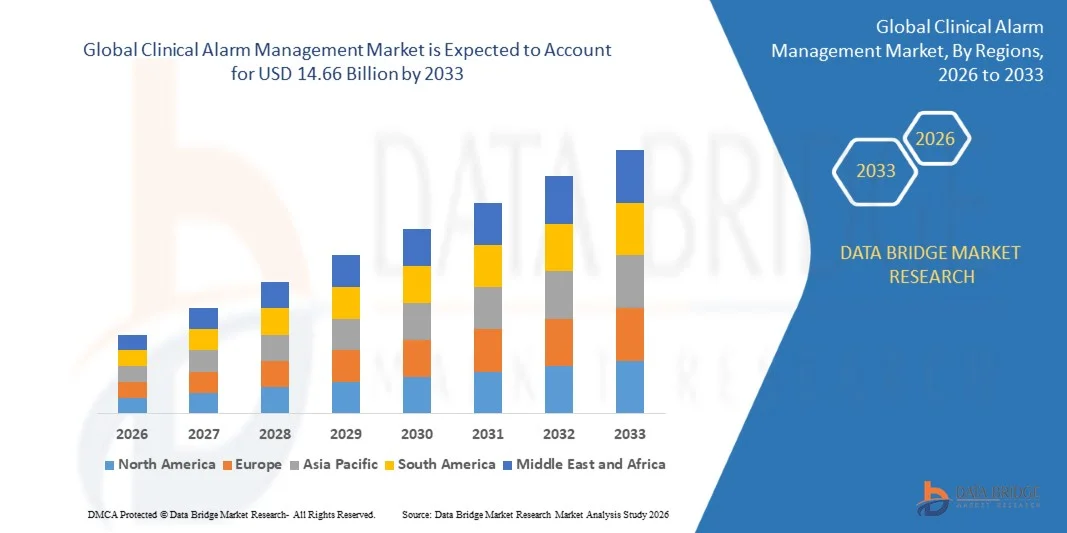
The Clinical Alarm Management Market was valued at USD 4.60 billion in 2025 and is projected to reach USD 14.66 billion by 2033, growing at a CAGR of 15.60% from 2026 to 2033. The Clinical Alarm Management Market is experiencing steady growth driven by increasing patient safety concerns, rising incidence of alarm fatigue in healthcare settings, and growing adoption of advanced hospital monitoring systems. Hospitals and healthcare providers are increasingly deploying intelligent alarm management solutions integrated with IoT-enabled medical devices, AI-driven analytics, and centralized monitoring platforms to reduce false alarms and improve clinical response times. The rising burden of chronic diseases and growing ICU admissions are further increasing reliance on continuous patient monitoring systems, thereby accelerating demand for effective alarm management solutions. In addition, technological advancements in wireless monitoring devices and interoperability solutions are improving alarm accuracy and workflow efficiency across healthcare facilities.
The increasing incidence of alarm fatigue-related medical errors, combined with stringent patient safety regulations and accreditation standards across hospitals, is compelling healthcare providers, ICU units, and emergency care centers to adopt advanced clinical alarm management systems. These solutions help prioritize critical alerts, reduce non-actionable alarms, and improve nurse response efficiency. Cloud-based monitoring platforms and AI-enabled predictive alarm systems are gradually replacing traditional standalone alarm devices in many healthcare settings, offering real-time data integration, centralized alert management, and improved patient outcomes across developed and emerging healthcare markets.
Key Market Trends & Insights
- North America dominated the Clinical Alarm Management Market with the largest revenue share of 34.18% in 2025, supported by advanced healthcare infrastructure, high adoption of hospital monitoring systems, strong presence of leading medical device companies, and stringent patient safety regulations. Widespread implementation of ICU monitoring systems, EMR-integrated alarm platforms, and IoT-enabled medical devices is further strengthening regional dominance. Increasing focus on reducing alarm fatigue and improving clinical workflow efficiency continues to drive adoption across hospitals and critical care units.
- The Solutions segment dominated the market with a 58.63% share in 2025, driven by the increasing adoption of integrated alarm management platforms, real-time patient monitoring dashboards, and AI-enabled alert prioritization systems.
- Asia-Pacific is expected to be the fastest-growing region with a CAGR of 7.6% from 2026 to 2033, fueled by rapid healthcare infrastructure development, increasing hospital digitization, rising patient population, and growing adoption of advanced patient monitoring systems in countries such as China, India, and Japan. Expanding investments in smart hospitals and increasing awareness about patient safety are accelerating regional growth.
- The Nurse Call Systems product segment dominated the market with a 27.45% revenue share in 2025, supported by their widespread use in hospitals, long-term care facilities, and emergency care units for efficient patient-to-nurse communication. Increasing deployment of smart nurse call systems integrated with mobile alerts, real-time tracking, and workflow automation is strengthening adoption. Growing demand for interoperability with hospital information systems is further supporting segment leadership.
- Hospitals dominated the end-user segment with a 61.28% revenue share in 2025, driven by high patient inflow, rising ICU admissions, and increasing need for continuous patient monitoring. Hospitals are rapidly adopting advanced clinical alarm management systems to reduce alarm fatigue, improve response efficiency, and ensure compliance with patient safety standards. Expansion of smart hospital infrastructure and digital health transformation initiatives is further reinforcing dominance.
Market Size & Forecast
- Global Market Value (2025): USD 4.60 Billion
- Expected Market Value (2033): USD 14.66 Billion
- Forecast CAGR (2026–2033): 15.60%
- Leading Region in 2025: North America
- Fastest Growing Region: Asia-Pacific
Report Scope and Clinical Alarm Management Market Segmentation
|
Attributes |
Clinical Alarm Management Key Market Insights |
|
Segments Covered |
|
|
Countries Covered |
North America · U.S. · Canada · Mexico Europe · Germany · France · U.K. · Netherlands · Switzerland · Belgium · Russia · Italy · Spain · Turkey · Rest of Europe Asia-Pacific · China · Japan · India · South Korea · Singapore · Malaysia · Australia · Thailand · Indonesia · Philippines · Rest of Asia-Pacific Middle East and Africa · Saudi Arabia · U.A.E. · South Africa · Egypt · Israel · Rest of Middle East and Africa South America · Brazil · Argentina · Rest of South America |
|
Key Market Players |
· GE HealthCare (U.S.) · Philips Healthcare (Netherlands) · Spok Inc. (U.S.) · Ascom Holding AG (Switzerland) · Hillrom (Baxter International Inc.) (U.S.) · Capsule Technologies (France/U.S.) · Cerner Corporation (Oracle Health) (U.S.) · Nihon Kohden Corporation (Japan) · Masimo Corporation (U.S.) · Drägerwerk AG & Co. KGaA (Germany) · Mindray Medical International (China) · Vocera Communications (U.S.) · Stanley Healthcare (U.S.) · Hill-Rom Service (U.S.) · Wolters Kluwer Health (U.S./Netherlands) · Stryker Corporation (U.S.) · Schiller AG (Switzerland) · Baxter International Inc. (U.S.) · CenTrak (U.S.) · Rauland-Borg Corporation (U.S.) |
|
Market Opportunities |
· Integration of AI and Predictive Alarm Intelligence Systems · Expansion of Interoperable and Integrated Hospital Monitoring Ecosystems · Growth of Remote Patient Monitoring and Home Healthcare Applications |
|
Value Added Data Infosets |
In addition to the insights on market scenarios such as market value, growth rate, segmentation, geographical coverage, and major players, the market reports curated by the Data Bridge Market Research also include in-depth expert analysis, geographically represented company-wise production and capacity, network layouts of distributors and partners, detailed and updated price trend analysis and deficit analysis of supply chain and demand. |
Clinical Alarm Management Market Trends
Trend: Growth in AI-Enabled Smart Hospital Monitoring and Predictive Alarm Systems
Healthcare providers are increasingly adopting AI-powered clinical alarm management platforms to reduce alarm fatigue and improve patient safety in ICUs and emergency departments. Studies indicate that ICU nurses are exposed to hundreds of alarms per patient per day, with up to 85–90% of them being non-actionable, driving urgent demand for intelligent filtering systems. Hospitals are integrating IoT-enabled medical devices such as physiological monitors, ventilators, and infusion pumps with centralized alarm dashboards to improve response accuracy. Companies like GE HealthCare and Philips are advancing AI-driven monitoring ecosystems that prioritize critical alerts in real time. The expansion of smart hospitals in the U.S., Germany, and Japan is accelerating adoption of interoperable alarm platforms. Increasing regulatory pressure from patient safety organizations and accreditation bodies is pushing hospitals to reduce alarm-related incidents. Cloud-based monitoring systems are also gaining traction, enabling multi-site hospital integration and remote alert management. Overall, AI-based predictive alarm systems are transforming clinical workflow efficiency and patient safety outcomes.
Clinical Alarm Management Market Dynamics
Key Market Driver: Rising Patient Safety Concerns and High ICU Alarm Burden
The growing burden of chronic diseases such as cardiovascular disorders, respiratory illnesses, and sepsis is increasing ICU admissions worldwide, significantly driving demand for clinical alarm management systems. According to healthcare safety reports, alarm-related issues are among the top 10 technology hazards in hospitals due to alarm fatigue and delayed response. Hospitals in North America alone generate millions of device alarms daily, many of which are false or clinically irrelevant. This has led to widespread adoption of centralized monitoring systems that integrate EMR platforms with medical devices. Regulatory bodies such as The Joint Commission (TJC) have issued strict guidelines requiring hospitals to implement alarm management policies. Increasing deployment of smart ICU infrastructure and real-time monitoring systems is improving patient outcomes and reducing mortality risks. Rising investments in digital health infrastructure across Europe and Asia-Pacific are further strengthening adoption. The expansion of tele-ICU and remote monitoring programs is also contributing to market growth. Overall, patient safety concerns and regulatory enforcement remain the strongest growth drivers.
Key Restraint/Challenge: High Integration Complexity and Alarm Fatigue Persistence
Despite technological advancements, a major challenge in the market is the complexity of integrating multiple medical devices into a unified alarm management system. Hospitals often operate legacy equipment that lacks interoperability, making system integration difficult and expensive. In addition, alarm fatigue remains a persistent issue, with studies showing that up to 70% of alarms in general hospital wards are false positives. The cost of deploying enterprise-level alarm management platforms, including middleware, network infrastructure, and cybersecurity systems, remains high for mid-sized hospitals. Lack of standardized global protocols for alarm prioritization further complicates implementation. Healthcare staff resistance to new workflows also slows adoption. In developing regions, limited IT infrastructure in hospitals restricts large-scale deployment. Frequent software updates and compliance requirements increase operational burden. Cybersecurity risks associated with connected medical devices also act as a concern. Overall, integration complexity and workflow adaptation challenges continue to restrain market expansion.
Key Market Opportunity: Expansion of Remote Patient Monitoring and Connected Healthcare Ecosystems
The rapid growth of remote patient monitoring (RPM) and home healthcare services is creating significant opportunities for clinical alarm management solutions. Wearable medical devices and connected biosensors are enabling continuous monitoring of patients outside hospital environments, generating real-time alerts that require centralized management platforms. The global RPM market has seen double-digit growth post-COVID-19, driven by aging populations and rising chronic disease prevalence. Companies such as Masimo and Philips are expanding cloud-connected monitoring solutions for both hospital and home care settings. Integration of 5G connectivity is improving real-time transmission of patient data with low latency. Governments in the U.S. and Europe are increasingly reimbursing telehealth and home monitoring services, boosting adoption. Hospitals are also using hybrid care models that combine in-hospital and remote monitoring systems. AI-powered predictive analytics is enabling early detection of patient deterioration, reducing emergency admissions. Expansion of smart wearable ecosystems is further enhancing continuous care capabilities. Overall, remote monitoring and digital healthcare transformation represent a major future growth opportunity for the market.
Clinical Alarm Management Market Scope
The Clinical Alarm Management market is segmented on the basis of component, product, and end-user.
- By Component
On the basis of component, the Clinical Alarm Management Market is segmented into Solutions and Services. The Solutions segment dominated the market with a 58.63% share in 2025, driven by the increasing adoption of integrated alarm management platforms, real-time patient monitoring dashboards, and AI-enabled alert prioritization systems. Hospitals and healthcare providers are rapidly deploying centralized software solutions to reduce alarm fatigue, improve response times, and enhance ICU workflow efficiency. Growing integration of solutions with EMR systems and IoT-enabled medical devices is further strengthening demand. Increasing investments in smart hospital infrastructure and digital health transformation are accelerating adoption across developed and emerging markets. Rising focus on patient safety and regulatory compliance is also supporting strong demand for advanced alarm management platforms. Cloud-based and AI-powered solutions are increasingly replacing legacy monitoring systems. Expansion of multi-hospital network integration is further boosting scalability. The growing burden of chronic diseases is increasing continuous monitoring needs. Overall, solutions remain the backbone of clinical alarm management adoption.
The Services segment is expected to witness the fastest CAGR of 6.7% from 2026 to 2033, driven by rising demand for installation, system integration, maintenance, and technical support services. Hospitals are increasingly outsourcing alarm system deployment and optimization to specialized vendors to ensure operational efficiency. Growing complexity of interoperable hospital ecosystems is increasing reliance on expert services. Training services are also gaining traction to improve clinical staff efficiency in handling alarm systems. Expansion of smart hospitals in Asia-Pacific and Latin America is creating strong service opportunities. Continuous software upgrades and cybersecurity requirements are increasing recurring service demand. Vendors offering managed services and subscription-based models are gaining traction. Increasing regulatory audits are also driving demand for compliance support services. Overall, services are becoming a critical growth enabler in the market.
- By Product
On the basis of product, the market is segmented into Nurse Call Systems, Physiological Monitors, Bed Alarms, EMR Integration Systems, Ventilators, Telemetry Monitors, Infusion Pumps, Compression Pumps, Anesthesia Machines, Feeding Pumps, and Others. The Nurse Call Systems segment dominated the market with a 27.45% revenue share in 2025, due to widespread adoption in hospitals, long-term care facilities, and emergency care units. These systems enable real-time communication between patients and healthcare staff, improving response times and patient satisfaction. Increasing integration of smart nurse call systems with mobile alerts, EMR systems, and centralized dashboards is driving adoption. Rising demand for workflow automation in hospitals is further supporting segment growth. Growing patient admissions and ICU expansion are increasing dependency on real-time communication systems. Hospitals are investing heavily in IoT-enabled nurse call solutions to reduce delays in critical care response. Integration with wearable patient monitoring devices is improving accuracy. Regulatory pressure to improve patient safety is also boosting adoption. Overall, nurse call systems remain a core component of hospital communication infrastructure.
The Physiological Monitors segment is expected to witness the fastest CAGR of 7.1% from 2026 to 2033, driven by increasing demand for continuous real-time patient monitoring in ICUs and emergency departments. Rising prevalence of cardiovascular and respiratory diseases is accelerating demand for advanced monitoring systems. Integration of AI-based predictive analytics is improving early detection of patient deterioration. Wireless and wearable monitoring devices are expanding use cases beyond hospitals into home care. Increasing adoption of smart ICU infrastructure is further driving growth. Hospitals are upgrading legacy monitoring systems with connected devices. Demand for multi-parameter monitoring systems is rising significantly. Expansion of remote patient monitoring programs is supporting segment growth. Overall, physiological monitors are becoming critical for modern healthcare delivery.
- By End-User
On the basis of end-user, the market is segmented into Hospitals, Long-Term Care, Ambulatory Care Centers, and Home Care Settings. The Hospitals segment dominated the market with a 61.28% share in 2025, driven by high patient inflow, rising ICU admissions, and increasing need for continuous monitoring systems. Hospitals are the primary users of clinical alarm management systems due to complex care environments requiring real-time alert prioritization. Growing adoption of smart hospital infrastructure and digital health systems is strengthening demand. Increasing focus on reducing alarm fatigue and improving patient outcomes is a key driver. Hospitals are rapidly integrating EMR systems with alarm platforms for centralized monitoring. Expansion of critical care units and emergency departments is further boosting adoption. Regulatory compliance requirements for patient safety are reinforcing usage. Large hospital networks are deploying enterprise-level alarm management solutions. Overall, hospitals remain the largest revenue-generating end-user segment.
The Home Care Settings segment is expected to witness the fastest CAGR of 7.4% from 2026 to 2033, driven by rising adoption of remote patient monitoring and telehealth services. Increasing prevalence of chronic diseases is pushing demand for continuous monitoring outside hospitals. Wearable devices and IoT-enabled sensors are generating real-time alerts for home-based patients. Growing aging population is significantly contributing to demand. Governments are promoting home healthcare to reduce hospital burden. Insurance reimbursement for remote monitoring is improving affordability. Cloud-based alarm systems are enabling real-time communication between patients and clinicians. Expansion of 5G networks is enhancing data transmission reliability. Overall, home care is emerging as a major growth frontier in the market.
Clinical Alarm Management Market Regional Analysis
North America dominated the Clinical Alarm Management Market and accounted for the largest revenue share of 34.18% in 2025, supported by advanced healthcare infrastructure, high adoption of hospital monitoring systems, strong presence of leading medical device companies, and stringent patient safety regulations. The region benefits from widespread deployment of ICU monitoring systems, EMR-integrated alarm platforms, and IoT-enabled medical devices across hospitals and healthcare networks. Increasing focus on reducing alarm fatigue, improving clinical workflow efficiency, and enhancing patient safety outcomes is further strengthening market growth. Rising digital transformation across healthcare facilities and strong reimbursement frameworks for advanced monitoring systems are accelerating adoption. Expansion of smart hospitals and AI-enabled patient monitoring platforms continues to enhance real-time decision-making capabilities. High prevalence of chronic diseases requiring continuous monitoring is also supporting demand. Integration of predictive analytics into alarm systems is improving early warning accuracy. Strong R&D investment by major medtech companies is further driving innovation. Overall, North America remains the most mature and technologically advanced regional market.
U.S. Clinical Alarm Management Market Insight
The U.S. Clinical Alarm Management market is witnessing strong growth due to rising hospital digitization, increasing ICU admissions, and widespread adoption of advanced patient monitoring technologies. The country’s well-established healthcare ecosystem, along with strong presence of global medical device leaders, is driving rapid deployment of intelligent alarm management systems. Hospitals are increasingly integrating AI-powered analytics, centralized monitoring dashboards, and EMR-connected alarm platforms to improve response times and reduce clinical errors. Growing emphasis on patient safety initiatives and regulatory compliance standards is further accelerating adoption. Expansion of smart hospitals and connected care infrastructure is boosting demand for interoperable alarm systems. Increasing healthcare IT investments are supporting system modernization across large hospital networks. Rising focus on reducing alarm fatigue among clinicians is driving workflow optimization solutions. Strong adoption of remote monitoring and tele-ICU systems is further expanding use cases. Overall, the U.S. remains a key innovation hub for advanced clinical alarm technologies.
Europe Clinical Alarm Management Market Insight
The Europe Clinical Alarm Management market remains a major contributor to global revenue, driven by strong regulatory frameworks, advanced healthcare systems, and high adoption of digital patient monitoring technologies. Hospitals across the region are increasingly implementing integrated alarm management platforms connected with EMR systems and centralized ICU monitoring networks. Strong government focus on patient safety and healthcare quality standards is supporting widespread adoption. Increasing investment in smart hospital infrastructure and AI-enabled healthcare systems is further enhancing market growth. The presence of leading medical technology companies and strong research capabilities is accelerating innovation in alarm optimization solutions. Rising prevalence of chronic diseases and aging population is increasing demand for continuous monitoring systems. Healthcare providers are focusing on reducing alarm fatigue and improving clinical efficiency through automation. Expansion of cross-border healthcare digitization initiatives is further strengthening adoption. Overall, Europe remains a highly regulated and technologically advanced market.
U.K. Clinical Alarm Management Market Insight
The U.K. Clinical Alarm Management market is experiencing steady growth, supported by increasing NHS digital transformation initiatives and rising adoption of connected hospital systems. Hospitals are increasingly deploying centralized alarm monitoring platforms integrated with EMR and patient tracking systems. Strong focus on improving patient safety and reducing clinical workload is driving adoption of intelligent alarm management technologies. Increasing investment in smart hospital projects and digital health infrastructure is further supporting market expansion. AI and data analytics integration is improving alarm prioritization and response efficiency. Growing demand for interoperability across healthcare systems is encouraging advanced solution deployment. Expansion of critical care facilities is increasing reliance on real-time monitoring systems. Regulatory emphasis on reducing alarm fatigue is further boosting innovation. Overall, the U.K. is emerging as a key adopter of healthcare digitalization in Europe.
Germany Clinical Alarm Management Market Insight
The Germany Clinical Alarm Management market is expanding steadily due to strong healthcare infrastructure, advanced medical device manufacturing capabilities, and increasing adoption of digital hospital systems. Hospitals are integrating AI-based alarm management platforms to improve patient monitoring efficiency and reduce false alarms. Strong government focus on healthcare innovation and patient safety is driving adoption of advanced monitoring technologies. Increasing prevalence of chronic diseases is boosting demand for continuous monitoring solutions. Germany’s strong medtech ecosystem is supporting innovation in interoperable alarm systems. Hospitals are increasingly investing in ICU automation and EMR-integrated platforms. Rising adoption of IoT-enabled medical devices is improving real-time patient tracking. Focus on clinical workflow optimization is further enhancing system deployment. Overall, Germany remains a key innovation hub within the European healthcare technology landscape.
Asia-Pacific Clinical Alarm Management Market Insight
The Asia-Pacific Clinical Alarm Management market is expected to witness the fastest growth, driven by rapid healthcare infrastructure development, increasing hospital digitization, and rising patient population across the region. Expanding adoption of advanced patient monitoring systems in countries such as China, India, and Japan is significantly boosting demand. Governments are investing heavily in smart hospital projects and digital healthcare transformation initiatives. Increasing awareness regarding patient safety and clinical efficiency is accelerating adoption of alarm management systems. Rising burden of chronic diseases is driving demand for continuous monitoring solutions. Expansion of private healthcare networks is further supporting market growth. Integration of AI and IoT-based healthcare technologies is improving monitoring accuracy and responsiveness. Growing medical tourism industry is also contributing to advanced hospital infrastructure development. Overall, Asia-Pacific is emerging as the most dynamic and high-growth regional market.
Japan Clinical Alarm Management Market Insight
The Japan Clinical Alarm Management market is witnessing consistent growth due to advanced healthcare infrastructure, strong focus on elderly care, and increasing adoption of digital hospital technologies. Hospitals are integrating smart monitoring systems with centralized alarm management platforms to improve patient safety. The country’s aging population is significantly increasing demand for continuous monitoring solutions. Strong emphasis on healthcare automation is driving adoption of AI-based alarm prioritization systems. Japanese hospitals are investing in IoT-enabled medical devices for real-time patient tracking. Integration of EMR systems with monitoring platforms is improving clinical workflow efficiency. Government initiatives supporting healthcare digitalization are further boosting adoption. Focus on reducing nurse workload is accelerating deployment of automated alert systems. Overall, Japan remains a technologically advanced and highly structured healthcare market.
China Clinical Alarm Management Market Insight
The China Clinical Alarm Management market is growing rapidly, driven by expanding healthcare infrastructure, increasing hospital digitization, and rising demand for advanced patient monitoring systems. Government initiatives supporting smart hospitals and healthcare modernization are significantly boosting adoption. Hospitals are increasingly deploying integrated alarm systems connected with EMR platforms and IoT-enabled medical devices. Rising patient population and increasing burden of chronic diseases are driving continuous monitoring needs. Strong investment in domestic medical device manufacturing is supporting market expansion. Adoption of AI-powered healthcare solutions is improving diagnostic and monitoring efficiency. Expansion of urban healthcare facilities is further accelerating demand. Increasing awareness of patient safety and workflow optimization is supporting adoption of advanced systems. Overall, China is emerging as one of the fastest-growing markets globally.
Clinical Alarm Management Market Share
The Clinical Alarm Management industry is primarily led by well-established companies, including:
- GE HealthCare (U.S.)
- Philips Healthcare (Netherlands)
- Spok Inc. (U.S.)
- Ascom Holding AG (Switzerland)
- Hillrom (Baxter International Inc.) (U.S.)
- Capsule Technologies (France/U.S.)
- Cerner Corporation (Oracle Health) (U.S.)
- Nihon Kohden Corporation (Japan)
- Masimo Corporation (U.S.)
- Drägerwerk AG & Co. KGaA (Germany)
- Mindray Medical International (China)
- Vocera Communications (U.S.)
- Stanley Healthcare (U.S.)
- Hill-Rom Service (U.S.)
- Wolters Kluwer Health (U.S./Netherlands)
- Stryker Corporation (U.S.)
- Schiller AG (Switzerland)
- Baxter International Inc. (U.S.)
- CenTrak (U.S.)
- Rauland-Borg Corporation (U.S.)
Latest Developments in Clinical Alarm Management Market
- In February 2021, Hillrom (now part of Baxter International) announced enhancements to its Voalte Nurse Call and clinical communication platform, expanding alarm routing capabilities across hospital systems. The upgrade enabled smarter alarm prioritization and mobile alert delivery to caregivers, helping reduce alarm fatigue in acute care environments. The solution strengthened interoperability between patient monitoring systems and mobile devices, improving response times and clinical workflow efficiency. This development reinforced Hillrom’s position in integrated clinical communication and alarm management technologies
- In June 2021, Koninklijke Philips N.V. expanded its IntelliVue patient monitoring ecosystem with enhanced alarm management and early warning scoring capabilities. The update focused on integrating predictive analytics to help clinicians identify patient deterioration earlier while reducing non-actionable alarms. Philips emphasized improved integration with hospital EMR systems and centralized monitoring dashboards. This launch supported the broader trend of AI-enabled patient monitoring and intelligent alarm filtering in critical care units globally
- In March 2022, GE HealthCare introduced upgrades to its CARESCAPE patient monitoring platform with advanced alarm customization and escalation workflows. The enhancements allowed hospitals to tailor alarm thresholds based on patient acuity levels, helping reduce unnecessary alerts and improve clinician response efficiency. The update also strengthened integration with hospital information systems and mobile caregiver platforms. This development reflected growing demand for personalized alarm management in intensive care environments
- In September 2022, Masimo Corporation expanded its SafetyNet remote patient monitoring platform with improved alarm notification and data integration features. The upgrade enabled continuous monitoring of oxygen saturation and other vital signs with cloud-based alert distribution to care teams. The system supported hospital-at-home and post-acute care models, improving early intervention capabilities. This development highlighted the shift toward decentralized monitoring and connected healthcare ecosystems
- In May 2023, Ascom Holding AG launched updates to its Ascom Unite Digital Health Platform, enhancing clinical alarm management and workflow orchestration. The solution enabled centralized alarm aggregation from multiple medical devices, including infusion pumps, monitors, and ventilators. The upgrade improved real-time alarm prioritization and mobile alert delivery to nurses. This development supported hospital efforts to reduce alarm fatigue and optimize care team coordination
- In November 2023, Spok Holdings, Inc. expanded its Spok Care Connect platform with enhanced alarm routing and integration capabilities for hospital environments. The update strengthened interoperability with EMR systems and clinical devices, allowing more efficient escalation of critical alerts. Hospitals using the platform benefited from improved communication workflows and reduced response delays in emergency care settings. This reinforced Spok’s role in enterprise clinical communication and alarm management solutions
- In April 2024, Drägerwerk AG & Co. KGaA introduced enhancements to its Infinity Acute Care System with improved alarm visualization and prioritization features. The update focused on reducing alarm noise in intensive care units by grouping and filtering alerts based on clinical relevance. The system also improved integration with hospital IT infrastructure and centralized monitoring stations. This development aligned with global initiatives to reduce alarm fatigue and improve patient safety outcomes
- In October 2024, Baxter International expanded its integrated hospital monitoring ecosystem following continued development of Hillrom-connected technologies, enhancing alarm interoperability across ICU devices. The system improvements enabled unified alarm streams from ventilators, monitors, and infusion pumps into centralized dashboards. This helped hospitals streamline critical care workflows and reduce missed alerts. The advancement reflected increasing consolidation of clinical communication and alarm management platforms

- Interactive Data Analysis Dashboard
- Company Analysis Dashboard for high growth potential opportunities
- Research Analyst Access for customization & queries
- Competitor Analysis with Interactive dashboard
- Latest News, Updates & Trend analysis
- Harness the Power of Benchmark Analysis for Comprehensive Competitor Tracking
Data collection and base year analysis are done using data collection modules with large sample sizes. The stage includes obtaining market information or related data through various sources and strategies. It includes examining and planning all the data acquired from the past in advance. It likewise envelops the examination of information inconsistencies seen across different information sources. The market data is analysed and estimated using market statistical and coherent models. Also, market share analysis and key trend analysis are the major success factors in the market report. To know more, please request an analyst call or drop down your inquiry.
The key research methodology used by DBMR research team is data triangulation which involves data mining, analysis of the impact of data variables on the market and primary (industry expert) validation. Data models include Vendor Positioning Grid, Market Time Line Analysis, Market Overview and Guide, Company Positioning Grid, Patent Analysis, Pricing Analysis, Company Market Share Analysis, Standards of Measurement, Global versus Regional and Vendor Share Analysis. To know more about the research methodology, drop in an inquiry to speak to our industry experts.
Data Bridge Market Research is a leader in advanced formative research. We take pride in servicing our existing and new customers with data and analysis that match and suits their goal. The report can be customized to include price trend analysis of target brands understanding the market for additional countries (ask for the list of countries), clinical trial results data, literature review, refurbished market and product base analysis. Market analysis of target competitors can be analyzed from technology-based analysis to market portfolio strategies. We can add as many competitors that you require data about in the format and data style you are looking for. Our team of analysts can also provide you data in crude raw excel files pivot tables (Fact book) or can assist you in creating presentations from the data sets available in the report.













