


What is the Clot Retrievers Market Size and Growth Rate?
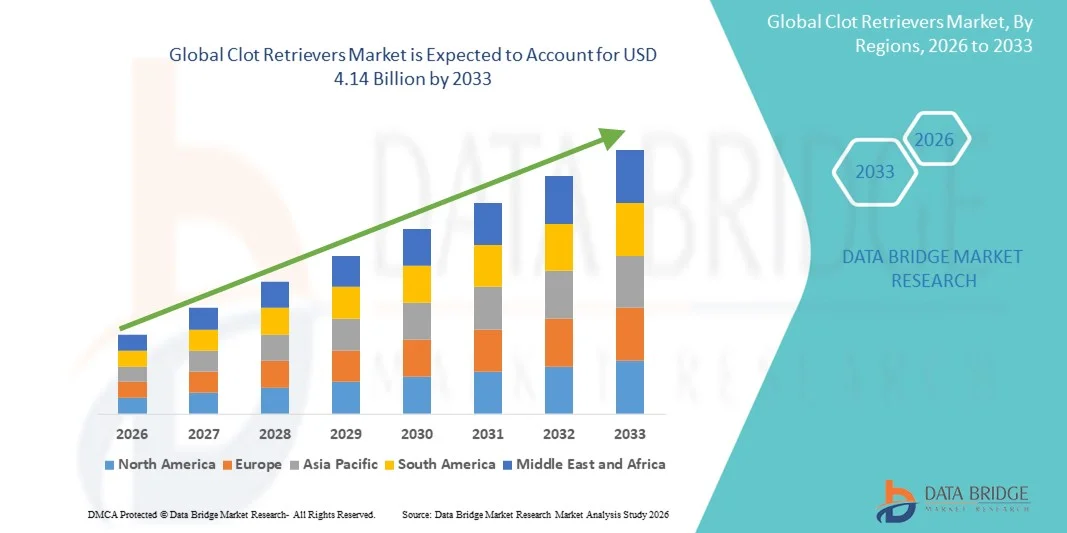
- The global clot retrievers market size was valued at USD 2.10 Billion in 2025 and is expected to reach USD 4.14 Billion by 2033, at a CAGR of 8.86% during the forecast period
- The market growth is largely driven by the increasing incidence of acute ischemic stroke, rising awareness about the benefits of mechanical thrombectomy, and continuous technological advancements in minimally invasive neurointerventional devices. The growing adoption of advanced endovascular procedures across hospitals and specialized stroke treatment centers is contributing to faster diagnosis and effective clot removal, thereby improving patient outcomes in both emergency and elective care settings
- Furthermore, the rising demand for efficient, safe, and easy-to-use stroke intervention solutions, along with increased investment in healthcare infrastructure and trained neurointerventional specialists, is establishing clot retrievers as a preferred treatment option for large vessel occlusions. These converging factors are accelerating the uptake of Clot Retrievers solutions globally, significantly boosting overall market growth
What are the Major Takeaways of Clot Retrievers Market?
- Clot retrievers, used in mechanical thrombectomy procedures to remove blood clots from blocked vessels, are becoming critical tools in the treatment of acute ischemic stroke due to their ability to restore blood flow quickly, minimize brain damage, and improve patient survival and functional outcomes in emergency care settings
- The increasing demand for clot retrievers is primarily driven by the rising global incidence of stroke, growing awareness of early stroke intervention, advancements in minimally invasive neurovascular devices, and the expanding adoption of endovascular procedures across hospitals and specialized stroke centers
- North America dominated the clot retrievers market with the largest revenue share of approximately 41.5% in 2025, supported by advanced healthcare infrastructure, high adoption of mechanical thrombectomy procedures, strong reimbursement frameworks, and the presence of leading medical device manufacturers, with the U.S. witnessing significant growth in Clot Retrievers usage due to well-established stroke networks and increasing investments in comprehensive stroke care programs
- Asia-Pacific is expected to be the fastest-growing region in the clot retrievers market during the forecast period, registering a CAGR driven by improving healthcare infrastructure, rising stroke prevalence, increasing awareness of advanced stroke treatments, and growing access to specialized neurointerventional facilities in countries such as China, India, and Japan
- The ischemic stroke segment dominated the largest market revenue share of approximately 78% in 2025, driven by the significantly higher incidence of ischemic strokes compared to other stroke types across global populations
Report Scope and Clot Retrievers Market Segmentation
|
Attributes |
Clot Retrievers Key Market Insights |
|
Segments Covered |
|
|
Countries Covered |
North America
Europe
Asia-Pacific
Middle East and Africa
South America
|
|
Key Market Players |
• Stryker Corporation (U.S.) |
|
Market Opportunities |
|
|
Value Added Data Infosets |
In addition to the insights on market scenarios such as market value, growth rate, segmentation, geographical coverage, and major players, the market reports curated by the Data Bridge Market Research also include in-depth expert analysis, patient epidemiology, pipeline analysis, pricing analysis, and regulatory framework. |
What is the Key Trend in the Clot Retrievers Market?
Technological Advancements in Mechanical Thrombectomy Devices
- A significant and rapidly advancing trend in the global clot retrievers market is the continuous innovation in device design aimed at improving clot retrieval efficiency and patient outcomes in acute ischemic stroke treatment. Manufacturers are focusing on developing next-generation stent retrievers with enhanced radial force, optimized mesh structures, and improved flexibility to navigate complex cerebral vasculature
- For instance, newer clot retrievers are designed to achieve higher first-pass effect rates, reducing the need for multiple retrieval attempts and minimizing procedure time. These advancements help lower the risk of vessel injury and distal embolization during thrombectomy procedures
- Ongoing improvements in material engineering, such as the use of nitinol alloys and advanced coatings, are enhancing device durability and ensuring better clot integration and retrieval success. These innovations allow clinicians to treat a wider range of clot compositions, including firm and fibrin-rich thrombi
- In addition, catheter compatibility and delivery system refinements are supporting smoother deployment and retrieval, making procedures more predictable and efficient for neurointerventionalists
- The integration of better radiopacity markers is also improving visualization under fluoroscopy, enabling precise positioning during critical interventions
- This trend toward technologically advanced, safer, and more effective clot retrievers is reshaping clinical expectations in stroke care and driving procurement decisions among hospitals and stroke centers worldwide
- Consequently, leading players are heavily investing in R&D to expand their product portfolios and gain competitive advantage in the evolving Clot Retrievers market
Clot Retrievers Market Dynamics
Driver
Rising Burden of Ischemic Stroke and Expanding Adoption of Mechanical Thrombectomy
- The increasing global incidence of ischemic stroke is a major driver fueling demand in the Clot Retrievers market, particularly as stroke remains a leading cause of mortality and long-term disability worldwide
- Growing clinical evidence supporting the effectiveness of mechanical thrombectomy for large vessel occlusion (LVO) strokes has strengthened treatment guidelines and accelerated adoption across developed and emerging healthcare systems
- For instance, the expansion of comprehensive stroke centers and improved emergency stroke care pathways are enabling faster patient access to thrombectomy procedures, thereby boosting utilization of clot retrievers
- Advancements in imaging technologies and better pre-hospital stroke identification are also increasing the number of eligible patients for endovascular intervention
- Favorable reimbursement policies in regions such as North America and parts of Europe further encourage hospitals to invest in advanced neurointerventional devices
- In addition, rising awareness among clinicians regarding early intervention and improved clinical outcomes is contributing to steady market growth
- The unmet need for effective acute stroke treatment in aging populations continues to create sustained demand for clot retrievers globally
Restraint/Challenge
High Procedure Costs and Limited Access in Developing Regions
- The high overall cost associated with mechanical thrombectomy procedures remains a major restraint for the Clot Retrievers market, particularly in cost-sensitive regions
- Clot retrievers are premium, single-use devices, and their cost is compounded by expenses related to imaging systems, catheter labs, and specialized neurointerventional expertise
- For instance, in many low- and middle-income countries, public hospitals often limit thrombectomy procedures due to budget constraints and lack of reimbursement coverage
- Even within developed regions, smaller hospitals may refrain from offering thrombectomy services due to high capital investment requirements
- Shortages of trained neurointerventional specialists further limit procedural availability, especially in rural or underserved areas
- Delayed patient arrival and lack of comprehensive stroke networks also reduce effective device utilization
- Overcoming these challenges will require improved reimbursement frameworks, wider training programs, and development of cost-efficient clot retriever solutions to ensure broader market penetration
How is the Clot Retrievers Market Segmented?
The market is segmented on the basis of stroke type, device, end user, and distribution channel.
- By Stroke Type
On the basis of stroke type, the Global Clot Retrievers market is segmented into ischemic stroke, haemorrhagic stroke, and transient ischemic attack. The ischemic stroke segment dominated the largest market revenue share of approximately 78% in 2025, driven by the significantly higher incidence of ischemic strokes compared to other stroke types across global populations. Ischemic stroke remains the most common form of stroke, accounting for the majority of acute cerebrovascular events that require rapid mechanical intervention. The increasing adoption of mechanical thrombectomy as a first-line treatment for large vessel occlusions strongly supports segment dominance. Favorable clinical guidelines recommending clot retrievers for ischemic stroke management further boost demand. Improved access to advanced imaging technologies enables early diagnosis and timely intervention. Rising public awareness of stroke symptoms and emergency response has accelerated treatment rates. Strong reimbursement frameworks in developed markets further facilitate widespread adoption. Technological advancements improving procedural success and reducing complication rates reinforce leadership. Expansion of certified stroke centers globally also contributes to higher procedural volumes.
The transient ischemic attack segment is expected to be the fastest growing, registering a CAGR of around 13.2% from 2026 to 2033, driven by growing awareness of TIAs as critical warning events for major strokes. Healthcare systems are increasingly emphasizing early intervention to prevent severe ischemic episodes. Advancements in diagnostic tools enable faster identification of clot-related TIAs. Increasing focus on preventive neurology and risk mitigation drives demand. Rising investments in stroke prevention programs further support growth. Expansion of neurovascular care facilities in emerging markets accelerates adoption.
- By Device
On the basis of device, the Global Clot Retrievers market is segmented into mechanical embolus removal devices, penumbra blood clot retrieval devices, stent retrievers, and ultrasound-assisted devices. The stent retrievers segment dominated the global market with a revenue share of approximately 45% in 2025, owing to their proven clinical efficacy and widespread physician acceptance. Stent retrievers demonstrate high recanalization rates and improved functional outcomes, making them the preferred option in acute ischemic stroke treatment. Strong backing from international clinical trials and guideline endorsements supports widespread use. Their flexibility, ease of deployment, and compatibility with complex vascular anatomy further strengthen adoption. The availability of next-generation stent designs improves clot engagement and first-pass success. High procedural success rates reduce treatment time and complications. Robust distribution networks ensure broad global availability. Favorable reimbursement policies enhance accessibility. Continuous product innovation by key manufacturers reinforces dominance.
The ultrasound-assisted devices segment is anticipated to be the fastest growing, registering a CAGR of nearly 14.0% from 2026 to 2033, driven by increasing interest in adjunctive technologies that enhance clot disruption. These devices support improved thrombolysis in challenging cases. Growing clinical research and product development encourage adoption. Rising preference for combination therapies supports demand. Expanding clinical evidence and physician familiarity further accelerate growth. Advancements in device portability and ease of integration with existing interventional systems aid wider acceptance. In addition, increasing adoption in tertiary care and advanced stroke centers contributes to sustained segment expansion.
- By End User
On the basis of end user, the Global Clot Retrievers market is segmented into diagnostic centres, ambulatory surgical centres, hospitals, clinics, and others. The hospitals segment dominated the market with a revenue share of approximately 62% in 2025, driven by the concentration of advanced neurointerventional infrastructure within hospital settings. Hospitals serve as primary centers for emergency stroke management and mechanical thrombectomy procedures. Availability of specialized neurologists, interventional radiologists, and trained staff supports dominance. Round-the-clock emergency care capabilities ensure timely intervention. Comprehensive stroke centers continue to expand globally, increasing procedure volumes. Hospitals also benefit from strong reimbursement support. Growing investments in neurovascular departments further strengthen leadership. High patient inflow from emergency admissions supports sustained dominance.
The ambulatory surgical centres segment is expected to witness the fastest growth, registering a CAGR of around 12.8% from 2026 to 2033, driven by the shift toward cost-effective and specialized care facilities. Improvements in minimally invasive techniques make outpatient procedures more viable. Shorter recovery times and reduced hospital stays fuel adoption. Growing investments in ambulatory neurointerventional infrastructure support growth. Favorable reimbursement policies for outpatient stroke interventions further encourage adoption. Increasing patient preference for same-day procedures enhances procedural volumes in ambulatory settings. In addition, reduced operation costs compared to hospitals attract healthcare providers to expand services through ambulatory surgical centres.
- By Distribution Channel
On the basis of distribution channel, the Global Clot Retrievers market is segmented into direct and retail channels. The direct distribution segment dominated the market with a share of approximately 70% in 2025, as manufacturers prefer direct engagement with large hospitals and stroke centers. Direct channels enable better training, technical support, and relationship management. Customized pricing agreements and long-term supply contracts support dominance. Direct sales ensure quality control and post-procedure support. Strong hospital-manufacturer partnerships reinforce adoption. Efficient logistics and inventory management further strengthen this segment’s leadership.
The retail distribution channel is projected to be the fastest growing, registering a CAGR of about 11.9% from 2026 to 2033, driven by increased penetration in emerging markets. Expansion of regional distributors improves accessibility. Growth of private healthcare facilities supports demand. Improved supply chain networks and competitive pricing accelerate adoption. Rising preference among smaller hospitals and clinics for readily available products further supports segment growth. Increasing government initiatives to strengthen medical device distribution in rural and semi-urban areas also contribute to higher adoption. In addition, partnerships between manufacturers and local distributors help ensure faster delivery and consistent product availability.
Which Region Holds the Largest Share of the Clot Retrievers Market?
- North America dominated the clot retrievers market with the largest revenue share of approximately 41.5% in 2025, supported by advanced healthcare infrastructure, high adoption of mechanical thrombectomy procedures, strong reimbursement frameworks, and the presence of leading medical device manufacturers focused on neurointerventional therapies
- Healthcare providers in the region emphasize rapid stroke intervention, clinical efficacy, and improved patient outcomes, which has accelerated the adoption of advanced clot retriever devices across hospitals and comprehensive stroke centers
- This widespread adoption is further reinforced by well-established stroke networks, increasing incidence of acute ischemic stroke, favorable regulatory support, and continuous investments in emergency neurovascular care, positioning North America as the leading market for clot retrievers globally
U.S. Clot Retrievers Market Insight
The U.S. clot retrievers market captured the largest revenue share within North America in 2025, driven by a high volume of mechanical thrombectomy procedures and early adoption of next-generation clot retrieval technologies. Hospitals and stroke centers in the U.S. increasingly prioritize rapid recanalization and minimally invasive treatment approaches to reduce stroke-related morbidity and mortality. Strong reimbursement coverage, the presence of key industry players, and investments in comprehensive stroke care programs further support market growth. Additionally, ongoing clinical research and expanding training programs for neurointerventional specialists continue to propel the adoption of clot retrievers across the country.
Europe Clot Retrievers Market Insight
The Europe clot retrievers market is projected to expand at a substantial CAGR during the forecast period, driven by increasing prevalence of ischemic stroke, supportive government healthcare initiatives, and growing adoption of mechanical thrombectomy as a standard of care. Improvements in emergency stroke pathways and the expansion of certified stroke centers are facilitating higher usage of clot retriever devices. Countries across Western and Northern Europe are witnessing steady growth due to strong public healthcare funding and rising awareness of advanced stroke treatment options.
U.K. Clot Retrievers Market Insight
The U.K. clot retrievers market is anticipated to grow at a noteworthy CAGR over the forecast period, supported by National Health Service (NHS) initiatives aimed at improving stroke outcomes. Increasing investments in hyper-acute stroke units, along with growing emphasis on early diagnosis and rapid intervention, are driving demand for clot retrievers. The expansion of thrombectomy-capable centers and favorable clinical guidelines are further enhancing market adoption across the UK.
Germany Clot Retrievers Market Insight
The Germany clot retrievers market is expected to expand at a considerable CAGR, fueled by the country’s advanced medical infrastructure and strong focus on technological innovation in healthcare. Germany has a high concentration of specialized neurology and neurointerventional centers, which supports the growing use of clot retrievers. Additionally, strong clinical research activity and favorable reimbursement policies encourage the adoption of advanced thrombectomy devices in both public and private hospitals.
Asia-Pacific Clot Retrievers Market Insight
The Asia-Pacific clot retrievers market is expected to be the fastest-growing region during the forecast period, registering a strong CAGR driven by improving healthcare infrastructure, rising stroke prevalence, increasing awareness of advanced stroke treatments, and expanding access to specialized neurointerventional facilities. Governments across the region are investing heavily in emergency care and stroke management programs, accelerating the adoption of clot retrievers in emerging economies.
Japan Clot Retrievers Market Insight
The Japan clot retrievers market is gaining steady momentum due to the country’s aging population and high incidence of stroke-related conditions. Japan’s well-developed healthcare system and early adoption of advanced medical technologies support the growing use of mechanical thrombectomy procedures. Increasing availability of trained neurointerventional specialists and the integration of clot retrievers into standardized stroke treatment protocols are key factors driving market growth.
China Clot Retrievers Market Insight
The China clot retrievers market accounted for the largest revenue share in Asia-Pacific in 2025, driven by rapid expansion of hospital infrastructure, increasing stroke burden, and rising adoption of advanced neurovascular interventions. Government initiatives aimed at strengthening stroke care networks, combined with growing availability of cost-effective clot retriever devices from domestic manufacturers, are significantly boosting market growth in China.
Clot Retrievers Market Share
The Clot Retrievers industry is primarily led by well-established companies, including:
• Stryker Corporation (U.S.)
• Medtronic (Ireland)
• Penumbra, Inc. (U.S.)
• Boston Scientific Corporation (U.S.)
• Johnson & Johnson (U.S.)
• Terumo Corporation (Japan)
• Merit Medical Systems, Inc. (U.S.)
• MicroPort Scientific Corporation (China)
• Balt Extrusion (France)
• MicroVention, Inc. – Terumo Group (U.S.)
• iVascular S.L.U. (Spain)
• Evasc Medical Systems (Canada)
• Sophysa (France)
• Phenox GmbH (Germany)
• Vesalio, LLC (U.S.)
What are Latest Developments in Global Clot Retrievers Market?
- In April 2024, Cerenovus (Johnson & Johnson MedTech) launched the CEREGLIDE 71 Aspiration Catheter with TruCourse technology in Europe — a next-generation aspiration catheter optimized for direct clot aspiration as well as delivery of compatible stent retrievers into the neurovasculature for acute ischemic stroke treatment
- In 7 March 2025, a major thrombectomy platform (from a leading global device manufacturer) was launched featuring a next-generation stent retriever with optimized radial force and a low-profile aspiration catheter aimed at improved first-pass success and reduced procedure times. The launch included physician training modules and bundled support services for stroke centers
- In April 2025, Surmodics commercially introduced its Pounce XL Thrombectomy System for clot removal, expanding the company’s thrombectomy portfolio to address both acute and chronic clots in peripheral arteries

- Interactive Data Analysis Dashboard
- Company Analysis Dashboard for high growth potential opportunities
- Research Analyst Access for customization & queries
- Competitor Analysis with Interactive dashboard
- Latest News, Updates & Trend analysis
- Harness the Power of Benchmark Analysis for Comprehensive Competitor Tracking
Data collection and base year analysis are done using data collection modules with large sample sizes. The stage includes obtaining market information or related data through various sources and strategies. It includes examining and planning all the data acquired from the past in advance. It likewise envelops the examination of information inconsistencies seen across different information sources. The market data is analysed and estimated using market statistical and coherent models. Also, market share analysis and key trend analysis are the major success factors in the market report. To know more, please request an analyst call or drop down your inquiry.
The key research methodology used by DBMR research team is data triangulation which involves data mining, analysis of the impact of data variables on the market and primary (industry expert) validation. Data models include Vendor Positioning Grid, Market Time Line Analysis, Market Overview and Guide, Company Positioning Grid, Patent Analysis, Pricing Analysis, Company Market Share Analysis, Standards of Measurement, Global versus Regional and Vendor Share Analysis. To know more about the research methodology, drop in an inquiry to speak to our industry experts.
Data Bridge Market Research is a leader in advanced formative research. We take pride in servicing our existing and new customers with data and analysis that match and suits their goal. The report can be customized to include price trend analysis of target brands understanding the market for additional countries (ask for the list of countries), clinical trial results data, literature review, refurbished market and product base analysis. Market analysis of target competitors can be analyzed from technology-based analysis to market portfolio strategies. We can add as many competitors that you require data about in the format and data style you are looking for. Our team of analysts can also provide you data in crude raw excel files pivot tables (Fact book) or can assist you in creating presentations from the data sets available in the report.













