


Cloud-based Quantum Computing Market Size
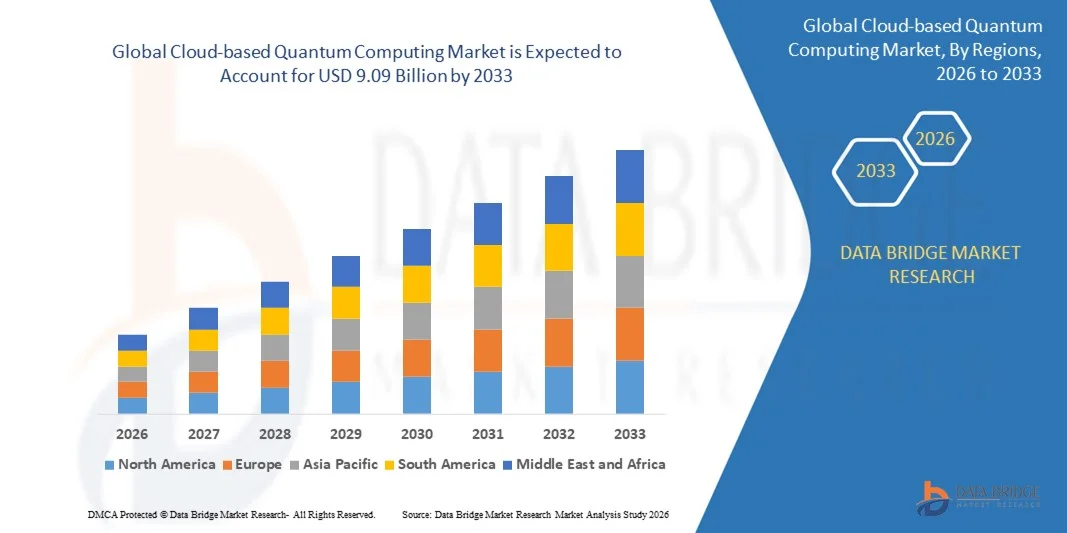
- The global cloud-based quantum computing market size was valued at USD 1.12 billion in 2025 and is expected to reach USD 9.09 billion by 2033, at a CAGR of 29.81% during the forecast period
- The market growth is largely fueled by rapid advancements in quantum hardware, cloud infrastructure, and quantum-as-a-service platforms, which are making quantum computing more accessible to enterprises, research institutions, and developers without the need for on-site hardware investments
- Furthermore, increasing demand for solving complex optimization, simulation, and computational problems across industries such as BFSI, healthcare, and energy is accelerating adoption of cloud-based quantum computing, thereby significantly supporting overall market expansion
Cloud-based Quantum Computing Market Analysis
- Cloud-based quantum computing, which enables remote access to quantum processors through cloud platforms, is emerging as a critical technology for next-generation computing due to its ability to handle problems beyond the practical limits of classical systems
- The growing adoption of cloud-based quantum solutions is primarily driven by strong R&D investments, rising enterprise experimentation, government-backed quantum initiatives, and the flexibility of integrating quantum computing with existing classical cloud environments
- North America dominated the cloud-based quantum computing market with a share of 26.2% in 2025, due to strong investments in quantum research, early commercialization of quantum cloud platforms, and the presence of major technology providers
- Asia-Pacific is expected to be the fastest growing region in the cloud-based quantum computing market during the forecast period due to rising investments in advanced computing technologies and rapid digital transformation
- Software segment dominated the market with a market share of 52.4% in 2025, due to increasing adoption of quantum software platforms, development kits, and cloud-accessible quantum programming environments. Enterprises and research institutions primarily invest in software to design, test, and simulate quantum algorithms without owning physical quantum hardware. The availability of quantum-as-a-service platforms from leading providers has further strengthened software adoption across academic and commercial users. Continuous advancements in quantum development frameworks and integration with classical cloud infrastructure also support sustained dominance of this segment
Report Scope and Cloud-based Quantum Computing Market Segmentation
|
Attributes |
Cloud-based Quantum Computing Key Market Insights |
|
Segments Covered |
|
|
Countries Covered |
North America
Europe
Asia-Pacific
Middle East and Africa
South America
|
|
Key Market Players |
|
|
Market Opportunities |
|
|
Value Added Data Infosets |
In addition to the market insights such as market value, growth rate, market segments, geographical coverage, market players, and market scenario, the market report curated by the Data Bridge Market Research team includes in-depth expert analysis, import/export analysis, pricing analysis, production consumption analysis, and pestle analysis. |
Cloud-based Quantum Computing Market Trends
Increasing Adoption of Quantum-as-a-Service Platforms
- A prominent trend in the cloud-based quantum computing market is the increasing adoption of quantum-as-a-service platforms, driven by the need to provide scalable and cost-efficient access to quantum capabilities without requiring direct ownership of quantum hardware. Cloud-based delivery models are enabling enterprises, research institutions, and developers to experiment with quantum algorithms while leveraging existing cloud infrastructure
- For instance, Amazon Web Services offers Amazon Braket, which provides managed access to quantum devices from providers such as IonQ, Rigetti, and D-Wave, allowing users to test and run quantum workloads through a unified cloud interface. This approach lowers entry barriers and accelerates hands-on adoption across academic and commercial users
- Major technology companies are integrating quantum services into broader cloud ecosystems, enabling hybrid quantum–classical workflows that improve usability and flexibility. Platforms from IBM and Microsoft allow developers to combine classical computing resources with quantum processors, strengthening practical experimentation and early-stage deployment
- The growing availability of multiple quantum hardware technologies through cloud platforms is expanding user choice and application diversity. Access to superconducting qubits, trapped ions, and quantum annealers through cloud environments is supporting broader exploration of use cases
- Research organizations and universities are increasingly relying on cloud-based quantum access to support education, training, and collaborative research initiatives. This trend is helping build a skilled quantum workforce and fostering innovation across global research networks
- The rising adoption of quantum-as-a-service platforms is reinforcing cloud-based quantum computing as the preferred pathway for early commercialization. This trend is shaping a scalable ecosystem that supports experimentation, collaboration, and gradual transition toward enterprise-grade quantum solutions
Cloud-based Quantum Computing Market Dynamics
Driver
Rising Demand for Complex Computation
- The demand for cloud-based quantum computing is strongly driven by the need to solve highly complex computational problems that are inefficient or impractical for classical computing systems. Industries such as finance, healthcare, chemicals, and logistics increasingly require advanced computing methods to address optimization, simulation, and modeling challenges
- For instance, IBM collaborates with financial institutions and research organizations to apply quantum algorithms for portfolio optimization and risk analysis through its IBM Quantum cloud platform. These applications demonstrate the potential of quantum computing to enhance decision-making in data-intensive environments
- In life sciences, organizations are exploring quantum computing to model molecular interactions and accelerate drug discovery processes. Cloud-based access enables pharmaceutical companies and research institutes to experiment with quantum simulations without investing in proprietary quantum hardware
- The growing complexity of supply chain networks and energy systems is driving interest in quantum optimization solutions delivered via the cloud. Enterprises are seeking computational advantages to improve efficiency, reduce costs, and manage large-scale variables
- This rising need for advanced computation is reinforcing cloud-based quantum computing as a strategic technology. The ability to access quantum power on demand through cloud platforms is directly supporting sustained market growth
Restraint/Challenge
Limited quantum expertise
- The cloud-based quantum computing market faces a significant challenge due to the limited availability of skilled professionals with expertise in quantum algorithms, hardware, and software development. Quantum computing requires specialized knowledge that combines physics, mathematics, and computer science, which restricts widespread adoption
- For instance, despite offering cloud-based quantum platforms, companies such as Microsoft and IBM continue to highlight the shortage of trained quantum developers as a key barrier to enterprise-scale implementation. Organizations often struggle to translate theoretical quantum capabilities into practical business use cases
- The complexity of quantum programming languages and frameworks increases the learning curve for developers transitioning from classical computing backgrounds. This slows down experimentation and reduces the pace of commercial deployment
- Educational and training initiatives are expanding, but the current talent pipeline remains insufficient to meet growing market demand. Enterprises often rely heavily on academic partnerships or external consultants to bridge skill gaps
- This challenge continues to constrain the pace of adoption despite growing technological readiness. Addressing the quantum skills gap remains critical for unlocking the full potential of cloud-based quantum computing across industries
Cloud-based Quantum Computing Market Scope
The market is segmented on the basis of solution, technology, application, and vertical.
- By Solution
On the basis of solution, the cloud-based quantum computing market is segmented into software and services. The software segment dominated the market with the largest revenue share of 52.4% in 2025, driven by increasing adoption of quantum software platforms, development kits, and cloud-accessible quantum programming environments. Enterprises and research institutions primarily invest in software to design, test, and simulate quantum algorithms without owning physical quantum hardware. The availability of quantum-as-a-service platforms from leading providers has further strengthened software adoption across academic and commercial users. Continuous advancements in quantum development frameworks and integration with classical cloud infrastructure also support sustained dominance of this segment.
The services segment is anticipated to witness the fastest growth from 2026 to 2033, fueled by rising demand for consulting, system integration, training, and managed quantum services. Organizations entering early-stage quantum adoption increasingly rely on service providers to bridge skill gaps and optimize use cases. Growing enterprise experimentation and pilot projects are expected to accelerate demand for specialized quantum services.
- By Technology
On the basis of technology, the cloud-based quantum computing market is segmented into trapped ions, quantum annealing, superconducting qubits, and others. The superconducting qubits segment held the largest market revenue share in 2025, supported by strong investments from major cloud and technology companies and its scalability advantages. This technology benefits from faster gate operations and compatibility with existing semiconductor fabrication processes, enabling rapid commercialization. Its availability through cloud platforms has made it widely accessible to enterprises and researchers.
The trapped ions segment is expected to register the fastest growth rate over the forecast period, driven by its high qubit coherence times and superior accuracy for complex quantum computations. Increasing research focus and successful demonstrations of error reduction are encouraging cloud providers to expand trapped-ion offerings. These factors position trapped ions as a key growth technology in cloud-based quantum ecosystems.
- By Application
On the basis of application, the market is segmented into optimization, simulation and modelling, sampling, and others. The optimization segment dominated the market in 2025, driven by its strong relevance across logistics, finance, manufacturing, and energy use cases. Cloud-based quantum optimization enables organizations to address complex combinatorial problems that are difficult for classical systems. Early commercial pilots and proof-of-concept projects have largely focused on optimization workloads.
The simulation and modelling segment is projected to witness the fastest growth from 2026 to 2033, fueled by increasing use in material science, drug discovery, and chemical modelling. Quantum simulations offer significant advantages in accurately modelling molecular and atomic interactions. Growing collaboration between cloud providers and research institutions is accelerating adoption of simulation-focused quantum applications.
- By Vertical
On the basis of vertical, the cloud-based quantum computing market is segmented into aerospace & defense, BFSI, healthcare, automotive, energy & power, chemical, government, and others. The BFSI segment accounted for the largest revenue share in 2025, driven by early adoption of quantum computing for portfolio optimization, risk analysis, and fraud detection. Financial institutions actively leverage cloud-based access to experiment with quantum algorithms while minimizing infrastructure investments. Strong R&D spending and partnerships with quantum technology providers support this dominance.
The healthcare segment is expected to experience the fastest growth during the forecast period, driven by rising interest in quantum-enabled drug discovery, genomics, and personalized medicine. Cloud-based quantum platforms allow healthcare organizations to conduct advanced simulations without owning quantum hardware. Increasing focus on reducing drug development timelines and improving diagnostic accuracy is accelerating adoption in this vertical.
Cloud-based Quantum Computing Market Regional Analysis
- North America dominated the cloud-based quantum computing market with the largest revenue share of 26.2% in 2025, driven by strong investments in quantum research, early commercialization of quantum cloud platforms, and the presence of major technology providers
- Enterprises and research institutions in the region actively leverage cloud-based quantum computing for experimentation, algorithm development, and proof-of-concept deployments across multiple industries
- This dominance is further supported by robust digital infrastructure, high R&D spending, government-backed quantum initiatives, and strong collaboration between academia and private players, positioning North America as a global leader in cloud-based quantum adoption
U.S. Cloud-based Quantum Computing Market Insight
The U.S. cloud-based quantum computing market captured the largest revenue share within North America in 2025, fueled by the strong presence of leading cloud service providers and quantum hardware developers. Organizations across BFSI, aerospace, and healthcare are increasingly accessing quantum capabilities through cloud platforms to accelerate innovation while avoiding high infrastructure costs. Substantial federal funding, national quantum programs, and active participation from universities and startups continue to drive market expansion.
Europe Cloud-based Quantum Computing Market Insight
The Europe cloud-based quantum computing market is projected to grow at a steady CAGR during the forecast period, driven by coordinated regional initiatives and increasing focus on technological sovereignty. Strong emphasis on collaborative research, public–private partnerships, and cross-border quantum projects is supporting cloud-based adoption. European enterprises are gradually integrating quantum computing into optimization, simulation, and industrial research workflows.
U.K. Cloud-based Quantum Computing Market Insight
The U.K. cloud-based quantum computing market is anticipated to grow at a notable CAGR over the forecast period, supported by government-led quantum programs and a strong academic research base. The country’s focus on commercializing quantum technologies through cloud access is enabling wider enterprise experimentation. Increasing collaboration between startups, universities, and cloud providers is further strengthening market growth.
Germany Cloud-based Quantum Computing Market Insight
The Germany cloud-based quantum computing market is expected to expand at a considerable CAGR, driven by strong industrial demand and leadership in advanced manufacturing and engineering. German enterprises are exploring cloud-based quantum solutions for optimization, material science, and chemical simulations. Supportive government funding and emphasis on applied research are accelerating adoption across industrial and research sectors.
Asia-Pacific Cloud-based Quantum Computing Market Insight
The Asia-Pacific cloud-based quantum computing market is poised to grow at the fastest CAGR during the forecast period, driven by rising investments in advanced computing technologies and rapid digital transformation. Governments and enterprises across the region are increasingly focusing on cloud-accessible quantum platforms to build domestic capabilities. Expanding research ecosystems and growing collaboration with global cloud providers are accelerating adoption across APAC.
Japan Cloud-based Quantum Computing Market Insight
The Japan cloud-based quantum computing market is gaining momentum due to strong emphasis on high-performance computing and next-generation technologies. Japanese organizations are increasingly adopting cloud-based quantum access for research in materials science, optimization, and industrial applications. Government-backed initiatives and close industry–academia collaboration continue to support market growth.
China Cloud-based Quantum Computing Market Insight
The China cloud-based quantum computing market accounted for the largest revenue share in Asia Pacific in 2025, driven by substantial government investment and rapid advancement in quantum research. The country’s focus on cloud platforms enables broader access to quantum capabilities across enterprises and research institutions. Strong domestic technology players and national strategies aimed at leadership in quantum technologies are key factors propelling market growth.
Cloud-based Quantum Computing Market Share
The cloud-based quantum computing industry is primarily led by well-established companies, including:
- Baidu, Inc. (China)
- Rigetti & Co, LLC (U.S.)
- Fujitsu Limited (Japan)
- Quantum Computing Inc. (U.S.)
- Pasqal S.A. (France)
- Amazon Web Services, Inc. (U.S.)
- Xanadu Quantum Technologies Inc. (Canada)
- Atos SE (France)
- IonQ, Inc. (U.S.)
- Alibaba Group Holding Limited (China)
- QC Ware Corp. (U.S.)
- Oxford Quantum Circuits Ltd (U.K.)
- International Business Machines Corporation (U.S.)
- QuEra Computing Inc. (U.S.)
- D-Wave Quantum Inc. (Canada)
- Microsoft Corporation (U.S.)
- Zapata Computing, Inc. (U.S.)
- Quantinuum Ltd. (U.K.)
- Alphabet Inc. (U.S.)
- PsiQuantum Corp. (U.S.)
Latest Developments in Global Cloud-based Quantum Computing Market
- In February 2025, Google announced significant progress with its Willow quantum chip by reducing logical error rates below physical error rates, marking a critical threshold for building fault-tolerant quantum systems. This achievement addresses one of the biggest barriers to scalable quantum computing and enhances market confidence in the feasibility of long-term commercial quantum deployments. As a result, cloud-based quantum computing platforms are expected to see increased enterprise experimentation and stronger government and academic investment
- In January 2025, NVIDIA committed USD 750 million to PsiQuantum to accelerate the development of large-scale photonic quantum hardware manufacturing lines. This investment supports the transition of quantum computing from laboratory-scale systems to industrial production, which is essential for wider cloud deployment. The move strengthens the overall cloud-based quantum ecosystem by ensuring a future supply of scalable, energy-efficient quantum processors
- In December 2024, IonQ finalized its USD 250 million acquisition of ID Quantique, bringing quantum key distribution capabilities into its cloud-based quantum offerings. This development significantly enhances data security and trust in cloud-delivered quantum services, particularly for government, defense, and financial applications. By integrating quantum-safe communication technologies, IonQ improves its competitive positioning in secure cloud quantum solutions
- In November 2023, Amazon Braket introduced Braket Direct, allowing users to reserve dedicated quantum hardware capacity and interact directly with quantum experts. This initiative lowers barriers to advanced quantum research by providing predictable access and early exposure to next-generation devices such as IonQ’s Forte trapped-ion system. The program is expected to accelerate innovation, reduce experimentation timelines, and strengthen AWS’s role in the cloud-based quantum computing market
- In April 2023, Moderna announced a strategic collaboration with IBM to explore the combined use of quantum computing and artificial intelligence for mRNA research and development. This partnership demonstrates the growing relevance of cloud-based quantum computing in pharmaceutical innovation by enabling complex molecular simulations and optimization tasks. The collaboration highlights how quantum technologies can potentially shorten drug discovery cycles and improve research efficiency across the life sciences sector

- Interactive Data Analysis Dashboard
- Company Analysis Dashboard for high growth potential opportunities
- Research Analyst Access for customization & queries
- Competitor Analysis with Interactive dashboard
- Latest News, Updates & Trend analysis
- Harness the Power of Benchmark Analysis for Comprehensive Competitor Tracking
Data collection and base year analysis are done using data collection modules with large sample sizes. The stage includes obtaining market information or related data through various sources and strategies. It includes examining and planning all the data acquired from the past in advance. It likewise envelops the examination of information inconsistencies seen across different information sources. The market data is analysed and estimated using market statistical and coherent models. Also, market share analysis and key trend analysis are the major success factors in the market report. To know more, please request an analyst call or drop down your inquiry.
The key research methodology used by DBMR research team is data triangulation which involves data mining, analysis of the impact of data variables on the market and primary (industry expert) validation. Data models include Vendor Positioning Grid, Market Time Line Analysis, Market Overview and Guide, Company Positioning Grid, Patent Analysis, Pricing Analysis, Company Market Share Analysis, Standards of Measurement, Global versus Regional and Vendor Share Analysis. To know more about the research methodology, drop in an inquiry to speak to our industry experts.
Data Bridge Market Research is a leader in advanced formative research. We take pride in servicing our existing and new customers with data and analysis that match and suits their goal. The report can be customized to include price trend analysis of target brands understanding the market for additional countries (ask for the list of countries), clinical trial results data, literature review, refurbished market and product base analysis. Market analysis of target competitors can be analyzed from technology-based analysis to market portfolio strategies. We can add as many competitors that you require data about in the format and data style you are looking for. Our team of analysts can also provide you data in crude raw excel files pivot tables (Fact book) or can assist you in creating presentations from the data sets available in the report.













