


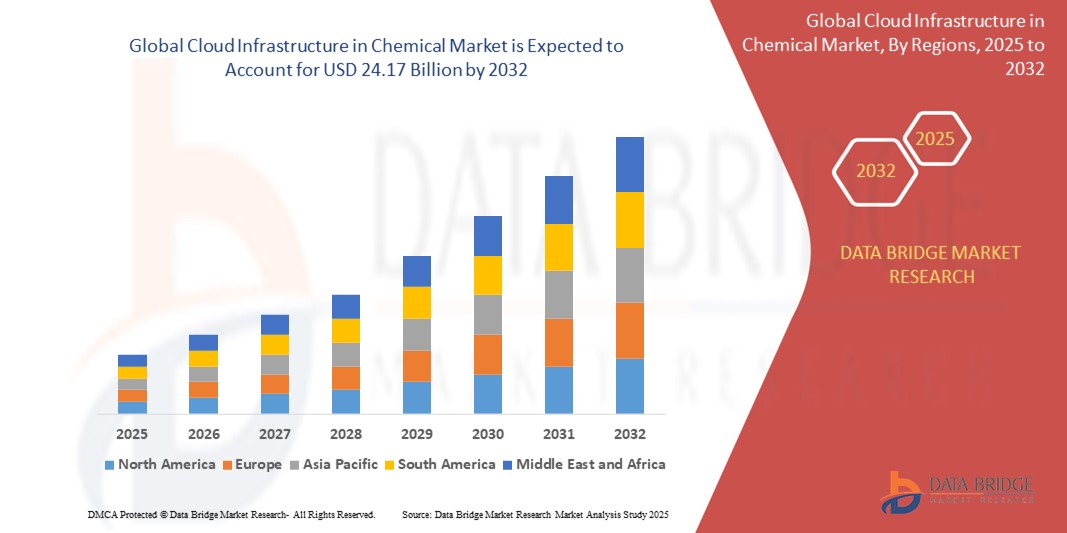
Cloud Infrastructure in Chemical Market Size
- The Global Cloud Infrastructure in Chemical Market size was valued at USD 11.10 billion in 2024 and is expected to reach USD 24.17 billion by 2032, at a CAGR of 13.2% during the forecast period
- Growth is driven by increasing adoption in healthcare and electronics, where its computational capabilities support innovation and efficiency.
- Rising demand for cloud-enabled analytics, simulation, and smart manufacturing is transforming chemical production processes.
Cloud Infrastructure in Chemical Market Analysis
- Healthcare Sector: Adoption of cloud infrastructure enables real-time data access, patient monitoring, and R&D in biochemistry and pharmaceuticals, fueled by rising chronic illness rates and aging populations demanding advanced diagnostics, treatment personalization, and better interoperability between health systems.
- Electronics & Automotive: Cloud solutions support the design and development of advanced materials and electric vehicle components, enhancing safety and performance through better thermal management, materials testing, simulation-driven design, and supply chain coordination.
- North America dominates the Global Cloud Infrastructure in Chemical Market with 35% market share in 2024, led by the U.S. due to strong cloud adoption in medical and chemical R&D, advanced IT infrastructure, strong investment in Industry 4.0, and supportive government policies enhancing digital innovation.
- Asia Pacific is the Fastest-growing region with a projected CAGR of over 8%. driven by rapid digitization in China, India, and Southeast Asia, along with expanding chemical sectors, favorable regulatory environments, and smart manufacturing initiatives.
- In 2025, hardware dominates the cloud infrastructure in chemical market with over 60% market share due to increased demand for high-performance servers, storage systems, and switches essential for data processing, simulation, and real-time analytics in chemical manufacturing.
Report Scope and Cloud Infrastructure in Chemical Market Segmentation
|
Attributes |
Cloud Infrastructure in Chemical Key Market Insights |
|
Segments Covered |
|
|
Countries Covered |
North America
Europe
Asia-Pacific
Middle East and Africa
South America
|
|
Key Market Players |
|
|
Market Opportunities |
|
|
Value Added Data Infosets |
In addition to the insights on market scenarios such as market value, growth rate, segmentation, geographical coverage, and major players, the market reports curated by the Data Bridge Market Research also include in-depth expert analysis, pricing analysis, brand share analysis, consumer survey, demography analysis, supply chain analysis, value chain analysis, raw material/consumables overview, vendor selection criteria, PESTLE Analysis, Porter Analysis, and regulatory framework. |
Cloud Infrastructure in Chemical Market Trends
“Shift towards sustainable practices”
- The market is increasingly focusing on eco-friendly Cloud Infrastructure in Chemical solutions, driven by sustainability goals and regulatory pressure. Development of recyclable and biodegradable formulations is gaining traction.
- Customized Cloud Infrastructure in Chemical products are rising in demand, tailored to specific industry needs such as electronics, healthcare, and cosmetics, offering specialty grades with enhanced performance characteristics.
- In the electronics sector, Cloud Infrastructure in Chemicals are favored for thermal management, UV resistance, and corrosion protection in solar panels and semiconductors, supporting the renewable energy transition.
- Healthcare applications continue to expand, with Cloud Infrastructure in Chemicals playing a vital role in medical devices, implants, and advanced wound care products due to their biocompatibility and durability.
For instance,
- in March 2025, IBM Cloud partnered with BASF to deploy AI-driven chemical process management solutions, aiming to reduce emissions and enhance sustainability in global chemical manufacturing.
Cloud Infrastructure in Chemical Market Dynamics
Driver
“Growing Adoption of Cloud Infrastructure Solutions in Chemical Industry”
- The chemical industry is increasingly adopting cloud infrastructure to enhance data management, operational efficiency, and real-time analytics across manufacturing and R&D processes. Cloud platforms offer scalable storage, advanced computing power, and integrated software solutions that streamline complex chemical production workflows globally.
- Rising digitization initiatives and Industry 4.0 transformations drive demand for cloud-based services to optimize supply chains, reduce downtime, and improve quality control. Cloud infrastructure supports advanced simulation, predictive maintenance, and regulatory compliance, enabling faster innovation cycles and cost savings.
- The surge in chemical manufacturing in emerging economies, coupled with growing investments in smart factories, encourages the adoption of cloud infrastructure for better connectivity and collaboration among global stakeholders. Additionally, the shift towards sustainable practices relies on cloud data analytics for monitoring emissions and waste management.
- Increased cybersecurity measures and hybrid cloud models provide enhanced data protection and flexible deployment options, reassuring chemical companies about data privacy and operational resilience. Cloud adoption thus fosters innovation and competitive advantage across the global chemical sector.
For Instance
- In March 2024, BASF announced the integration of a new cloud-based digital platform across its global manufacturing sites to improve real-time process monitoring and supply chain transparency, marking a significant step in their digital transformation journey.
Restraint/Challenge
“Data Security Concerns and Infrastructure Costs”
- Despite benefits, concerns over data breaches, intellectual property protection, and regulatory compliance slow cloud infrastructure adoption in the chemical industry. Sensitive R&D and production data require robust cybersecurity frameworks, which increase operational complexity and costs.
- Small and medium chemical enterprises face challenges in funding cloud migration and upgrading legacy IT systems, limiting their ability to leverage advanced cloud technologies fully. High initial investments and ongoing service fees can deter widespread adoption, especially in developing markets.
- Connectivity issues in remote chemical plants and regions with inadequate internet infrastructure hinder seamless cloud integration, affecting real-time data access and system reliability. These limitations restrict cloud-based innovation and operational efficiency gains.
- Furthermore, evolving regulations around data sovereignty and cross-border data flows impose compliance burdens, requiring continuous adaptation and legal oversight for cloud deployments.
For Instance,
- In November 2023, a mid-sized chemical manufacturer in Latin America postponed its cloud migration project due to rising cybersecurity insurance costs and concerns over compliance with new data protection laws, demonstrating the practical barriers to cloud adoption in the region.
Cloud Infrastructure in Chemical Market Scope
The market is segmented on the basis of type and deployment.
- By type
On the basis of type, the cloud infrastructure in chemical market is segmented into hardware and services. Hardware is further sub-segmented into server, storage and Ethernet switches. Server is further bifurcated into tower server, rack server, blade server and density-optimized server. Services are further bifurcated into platform as a service (PaaS), infrastructure as a service (IaaS), content delivery network (CDN)/application delivery network (AND), managed hosting and colocation services. In 2025, hardware dominates the cloud infrastructure in chemical market with over 60% market share due to increased demand for high-performance servers, storage systems, and switches essential for data processing, simulation, and real-time analytics in chemical manufacturing.
In 2025, Services are the fastest-growing segment, projected to grow at a CAGR of 8.1% in 2025, driven by rising adoption of cloud-based platforms like IaaS and PaaS for scalable computing, cost efficiency, and enhanced collaboration in chemical research and operations.
- By deployment
On the basis of deployment, the cloud infrastructure in chemical market is segmented into public cloud, private cloud and hybrid cloud. In 2025, the private cloud segment dominates the cloud infrastructure in chemical market due to its enhanced data security, customization, and regulatory compliance, making it the preferred choice for chemical companies handling sensitive intellectual property and proprietary process data.
The hybrid cloud segment is the fastest-growing in 2025, driven by its flexibility, scalability, and ability to integrate on-premise infrastructure with public cloud services, enabling chemical firms to optimize workloads while maintaining control over critical operations and data privacy.
Cloud Infrastructure in Chemical Market Regional Analysis
- North America dominates the Global Cloud Infrastructure in Chemical Market with 35% market share in 2024, led by the U.S. due to strong cloud adoption in medical and chemical R&D, advanced IT infrastructure, strong investment in Industry 4.0, and supportive government policies enhancing digital innovation.
- The advanced IT infrastructure, strong cloud adoption in chemical and medical R&D, and heavy investments in Industry 4.0, fostering efficient, data-driven chemical manufacturing processes.
- Supportive government policies, robust healthcare and electronics sectors, and high R&D spending drive innovation. The presence of major cloud service providers further accelerates digital transformation across the chemical value chain.
U.S. Cloud Infrastructure in Chemical Market Insight
In 2025, The U.S. dominates the market with a 35% share in 2025, supported by world-class healthcare systems, cutting-edge R&D in medical and specialty chemicals, and strong digital infrastructure. The country’s leadership in cloud innovation, favorable regulatory landscape, and widespread use across cosmetics, automotive, and pharmaceutical sectors further enhance demand.
Europe Cloud Infrastructure in Chemical Market Insight
Europe’s market is driven by a highly regulated chemical industry, rising demand for eco-friendly solutions, and strong digital adoption in manufacturing processes. Countries like Germany, France, and the U.K. lead the way through large-scale digitization of industrial operations, circular economy initiatives, and integration of AI-powered cloud platforms.
U.K. Cloud Infrastructure in Chemical Market Insight
The U.K. market sees robust growth supported by expanding healthcare infrastructure, growing cosmetic surgery demand, and significant government investment in innovation ecosystems. Increasing reliance on cloud-based platforms for medical device development, regulatory compliance, and secure data storage supports diversification.
Germany Cloud Infrastructure in Chemical Market Insight
Germany’s Cloud Infrastructure in Chemical Market is bolstered by its world-leading automotive and manufacturing sectors, emphasis on precision engineering, and advanced sustainability standards. Strong investments in R&D, a highly skilled workforce, and digitized supply chains promote adoption of cloud systems.
Asia-Pacific Cloud Infrastructure in Chemical Market Insight
Asia Pacific is the Fastest-growing region with a projected CAGR of over 8%. driven by rapid digitization in China, India, and Southeast Asia, along with expanding chemical sectors, favorable regulatory environments, and smart manufacturing initiatives.
Japan Cloud Infrastructure in Chemical Market Insight
Japan’s advanced electronics, automotive, and healthcare industries drive consistent demand for cloud-integrated chemical infrastructure. The country benefits from a mature R&D ecosystem, high technological literacy, and government support for digital transformation.
China Cloud Infrastructure in Chemical Market Insight
China’s Cloud Infrastructure in Chemical Market is expanding rapidly due to industrial digitization, rising healthcare demands, and renewable energy development. Government incentives for smart manufacturing, investment in cloud and AI technologies, and growing consumer markets create ideal conditions for adoption.
Cloud Infrastructure in Chemical Market Share
The Cloud Infrastructure in Chemical industry is primarily led by well-established companies, including:
- Hewlett Packard Enterprise Development LP (U.S.)
- Dell (U.S.)
- Cisco Systems, Inc. (U.S.)
- IBM (U.S.)
- Amazon Web Services, Inc. or its affiliates (U.S.)
- Salesforce.com, Inc. (U.S.)
- NetApp (U.S.)
- Intel Corporation (U.S.)
- Lenovo (China)
- AT&T Intellectual Property (U.S.)
- RACKSPACE TECHNOLOGY (U.S.)
- Oracle (U.S.)
- Quanta Computer Inc. (Taiwan)
- Foxconn Technology Group (Taiwan)
- Alibaba Cloud (China)
- SAP SE (Germany)
- MongoDB, Inc. (U.S.)
- EDB (EnterpriseDB) (U.S.)
- Redis Labs (U.S.)
- DataStax (U.S.)
Latest Developments in Global Cloud Infrastructure in Chemical Market
- In January 2023, EY introduced the Intelligent Chemicals Solution (ICS), aiming to assist chemical companies in optimizing costs and enhancing operations through innovative technologies. This platform leverages cloud computing to streamline processes, improve data analytics, and support digital transformation initiatives within the chemical industry.
- In November 2021, IBM expanded its RoboRXN platform, an AI-driven, cloud-based laboratory designed to facilitate remote discovery and synthesis of chemical compounds. This advancement enables researchers to conduct experiments virtually, accelerating the development of new materials and molecules while reducing the need for physical lab resources.
- In August 2021, Mitsui Chemicals Inc. announced the implementation of the Nutanix Cloud Platform to build a private cloud infrastructure. This move aims to digitize factory operations, enhance data management, and transition towards a data-driven business model, thereby improving efficiency and fostering innovation within the company.

- Interactive Data Analysis Dashboard
- Company Analysis Dashboard for high growth potential opportunities
- Research Analyst Access for customization & queries
- Competitor Analysis with Interactive dashboard
- Latest News, Updates & Trend analysis
- Harness the Power of Benchmark Analysis for Comprehensive Competitor Tracking
Global Cloud Infrastructure In Chemical Market, Supply Chain Analysis and Ecosystem Framework
To support market growth and help clients navigate the impact of geopolitical shifts, DBMR has integrated in-depth supply chain analysis into its Global Cloud Infrastructure In Chemical Market research reports. This addition empowers clients to respond effectively to global changes affecting their industries. The supply chain analysis section includes detailed insights such as Global Cloud Infrastructure In Chemical Market consumption and production by country, price trend analysis, the impact of tariffs and geopolitical developments, and import and export trends by country and HSN code. It also highlights major suppliers with data on production capacity and company profiles, as well as key importers and exporters. In addition to research, DBMR offers specialized supply chain consulting services backed by over a decade of experience, providing solutions like supplier discovery, supplier risk assessment, price trend analysis, impact evaluation of inflation and trade route changes, and comprehensive market trend analysis.
Data collection and base year analysis are done using data collection modules with large sample sizes. The stage includes obtaining market information or related data through various sources and strategies. It includes examining and planning all the data acquired from the past in advance. It likewise envelops the examination of information inconsistencies seen across different information sources. The market data is analysed and estimated using market statistical and coherent models. Also, market share analysis and key trend analysis are the major success factors in the market report. To know more, please request an analyst call or drop down your inquiry.
The key research methodology used by DBMR research team is data triangulation which involves data mining, analysis of the impact of data variables on the market and primary (industry expert) validation. Data models include Vendor Positioning Grid, Market Time Line Analysis, Market Overview and Guide, Company Positioning Grid, Patent Analysis, Pricing Analysis, Company Market Share Analysis, Standards of Measurement, Global versus Regional and Vendor Share Analysis. To know more about the research methodology, drop in an inquiry to speak to our industry experts.
Data Bridge Market Research is a leader in advanced formative research. We take pride in servicing our existing and new customers with data and analysis that match and suits their goal. The report can be customized to include price trend analysis of target brands understanding the market for additional countries (ask for the list of countries), clinical trial results data, literature review, refurbished market and product base analysis. Market analysis of target competitors can be analyzed from technology-based analysis to market portfolio strategies. We can add as many competitors that you require data about in the format and data style you are looking for. Our team of analysts can also provide you data in crude raw excel files pivot tables (Fact book) or can assist you in creating presentations from the data sets available in the report.













