What is the Cloud Kitchen Market Size and Growth Rate?
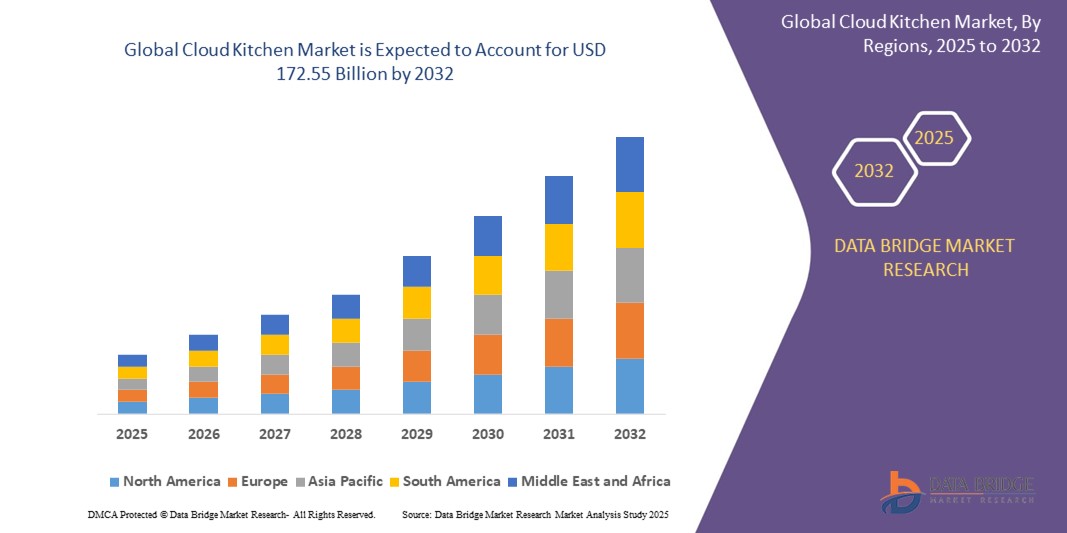
- As per Data Bridge Market Research Analysis the global cloud kitchen market size was valued at USD 80.49 billion in 2024 and is expected to reach USD 172.55 billion by 2032, at a CAGR of 10.00% during the forecast period
- The market growth is largely fuelled by the increasing demand for food delivery services, rising adoption of digital ordering platforms, and lower overhead costs compared to traditional dine-in restaurants
- The proliferation of online food aggregators and third-party delivery services such as Uber Eats, DoorDash, and Grubhub has significantly supported the expansion of the cloud kitchen model across urban centers
Market Size & Forecast
- Global Market Value (2024): USD 80.49 Billion
- Expected Market Value (2032): USD 172.55 Billion
- Forecast CAGR (2025–2032): 10.00%
What are the Major Takeaways of Cloud Kitchen Market?
- The market is witnessing strong growth due to the shift in consumer behavior toward convenient, on-demand dining experiences facilitated by online food aggregators
- Startups and established food brands are increasingly investing in cloud kitchen models to expand their delivery reach without incurring the high operational costs of physical outlets
- Asia-Pacific dominated the cloud kitchen market with the largest revenue share of 48.3% in 2024, driven by rapid urbanization, increasing smartphone and internet penetration, and a rising preference for online food delivery services
- North America region is expected to witness the highest growth rate in the global cloud kitchen market, driven by growing preference for convenience-based dining, strong digital ordering ecosystems, and the emergence of scalable, delivery-focused kitchen models
- The independent cloud kitchen segment dominated the market with the largest revenue share of 62.6% in 2024, primarily due to its ability to operate with lower overhead costs and higher menu flexibility. These kitchens are typically single-brand operations that cater to specific cuisines or food categories, making them agile in responding to consumer preferences. Their focused model allows operators to maintain quality control and brand identity, attracting both startup ventures and established food chains
Report Scope and Cloud Kitchen Market Segmentation
|
Attributes |
Cloud Kitchen Key Market Insights |
|
Segments Covered |
|
|
Countries Covered |
North America
Europe
Asia-Pacific
Middle East and Africa
South America
|
|
Key Market Players |
|
|
Market Opportunities |
• Rising Demand for Contactless Food Delivery Services • Expansion of Cloud Kitchens into Tier 2 and Tier 3 Cities |
|
Value Added Data Infosets |
In addition to the insights on market scenarios such as market value, growth rate, segmentation, geographical coverage, and major players, the market reports curated by the Data Bridge Market Research also include in-depth expert analysis, pricing analysis, brand share analysis, consumer survey, demography analysis, supply chain analysis, value chain analysis, raw material/consumables overview, vendor selection criteria, PESTLE Analysis, Porter Analysis, and regulatory framework. |
What is the Key Trend in the Cloud Kitchen Market?
“Growing Integration of AI and Automation in Kitchen Operations”
- Growing Reliance on Data-Driven Menu Engineering Is Optimizing Profitability and Enhancing Customer Retention Rates Across Cloud Kitchen Networks, as Operators Leverage Sales Analytics, Customer Feedback, and Localized Demand Patterns to Curate High-Performing Menus That Align With Specific Consumer Preferences and Ordering Behaviors
- Advanced analytics platforms are helping brands identify best-selling dishes, eliminate underperformers, and personalize offerings based on region, season, and demographics, thereby reducing food waste and maximizing margins per square foot of kitchen space
- For instance, Rebel Foods uses an AI-powered system to test and adapt menus across its brands such as Faasos and Behrouz Biryani, while U.S.-based ClusterTruck integrates customer data to tailor real-time offerings and dynamically adjust kitchen workflows
- Data-driven decision-making is also enabling micro-segmentation of delivery zones, influencing kitchen site selection, marketing efforts, and real-time inventory stocking to reduce turnaround times and increase order frequency
- As competition intensifies, cloud kitchen operators are increasingly prioritizing menu optimization through deep data insights as a core strategy for driving repeat orders, improving unit economics, and sustaining long-term brand loyalty
Cloud Kitchen Market Dynamics
Driver
“Surge In Online Food Delivery Demand Due To Lifestyle Changes”
• Rapid Urbanization and Changing Consumer Habits Are Fueling the Growth of the Cloud Kitchen Market, as Tech-Savvy Urban Consumers Seek Convenient, Quick-Service Meal Options That Fit Into Busy Work Schedules and Digital Lifestyles Across Major Metropolitan Areas
• The growing prevalence of dual-income households, rising single-person residences, and increased smartphone penetration are prompting a surge in app-based food ordering, which cloud kitchens are uniquely positioned to serve due to their delivery-only model and flexible operational setups
• For instance, in cities such as New York and Bengaluru, over 60% of food orders are now routed through aggregators and direct-to-consumer apps, with cloud kitchen formats offering faster preparation times and broader menu variety than many traditional dine-in restaurants
• The model’s ability to rapidly launch multiple cuisines from a single centralized location appeals to a generation that values customization, affordability, and digital convenience over physical ambience, further supporting demand among millennial and Gen Z consumers
• As urban density rises and real estate prices soar, the low footprint and high output nature of cloud kitchens is expected to remain a compelling operational model, driving further growth and innovation in the sector through 2032
Which Factor is Challenging the Growth of the Cloud Kitchen Market?
“High Dependency on Delivery Aggregators and Commission Fees”
• Intensifying Competition and Lack of Brand Differentiation Are Posing Long-Term Sustainability Risks for Smaller Cloud Kitchen Operators, as Market Saturation in High-Demand Urban Centers Leads to Margin Erosion and High Customer Acquisition Costs
• The influx of numerous independent operators, franchise models, and aggregator-backed kitchen brands has led to overfragmentation, with many players offering similar cuisines and pricing structures without distinctive value propositions or brand loyalty
• For instance, in highly competitive zones of Los Angeles and Mumbai, newer cloud kitchens struggle to gain visibility and retain users as they are overshadowed by better-funded players with advanced tech stacks, aggressive marketing budgets, and existing customer bases
• The dominance of aggregator platforms also limits smaller operators’ ability to own customer relationships, further compounding the challenge of repeat order generation and brand awareness, particularly in crowded food categories such as burgers, pizza, and biryani
• Without clear differentiation through culinary innovation, hyper-local branding, or unique customer engagement models, many smaller cloud kitchens face stagnation or exit from the market, creating a long-term hurdle for inclusive growth across the global cloud kitchen ecosystem
How is the Cloud Kitchen Market Segmented?
The market is segmented on the basis of type, product type, and nature.
- By Type
On the basis of type, the cloud kitchen market is segmented into independent cloud kitchen, commissary/shared kitchen, and kitchen pods. The independent cloud kitchen segment dominated the market with the largest revenue share of 62.6% in 2024, primarily due to its ability to operate with lower overhead costs and higher menu flexibility. These kitchens are typically single-brand operations that cater to specific cuisines or food categories, making them agile in responding to consumer preferences. Their focused model allows operators to maintain quality control and brand identity, attracting both startup ventures and established food chains.
The kitchen pods segment is expected to witness the fastest growth rate from 2025 to 2032, driven by the increasing popularity of modular, plug-and-play kitchen units that can be installed in high-demand urban areas. These pods offer fast deployment, minimal real estate usage, and are well-suited for brands looking to test new markets or scale rapidly without investing heavily in infrastructure.
- By Product Type
On the basis of product type, the cloud kitchen market is segmented into burger/sandwich, pizza/pasta, chicken, seafood, Mexican/Asian food, and others. The burger/sandwich segment accounted for the largest market revenue share in 2024, owing to the high volume of consumer demand for quick, customizable, and delivery-friendly fast food items. Their ease of packaging and consistent preparation standards make them ideal for delivery-based models.
The Mexican/Asian food segment is expected to witness the fastest growth rate from 2025 to 2032, propelled by growing consumer interest in bold, flavorful cuisines and a shift toward healthier, authentic international meals. Cloud kitchen operators are increasingly introducing diverse menu options in this category to cater to multicultural urban demographics and evolving taste preferences.
- By Nature
On the basis of nature, the cloud kitchen market is segmented into franchised and standalone. The franchised segment held the largest market share in 2024, supported by the expansion strategies of major food chains and delivery-focused brands that leverage standardized operations and centralized marketing. Franchising provides faster brand scalability, especially in competitive urban environments where consumer trust and recognition are key to retention.
The standalone segment is expected to witness the fastest growth rate from 2025 to 2032, as many independent entrepreneurs and chefs are adopting cloud kitchen models to experiment with new concepts and establish niche offerings. This segment benefits from operational freedom and the ability to quickly adapt to market trends and consumer feedback.
Which Region Holds the Largest Share of the Cloud Kitchen Market?
• Asia-Pacific dominated the cloud kitchen market with the largest revenue share of 48.3% in 2024, driven by rapid urbanization, increasing smartphone and internet penetration, and a rising preference for online food delivery services
• The region benefits from a large, young, and digitally engaged population, particularly in countries such as China, India, and Indonesia, where food delivery has become a lifestyle choice
• Favorable economic conditions, cost-effective labor, and strong investments in cloud kitchen infrastructure are encouraging both local operators and international brands to expand across urban centers
China Cloud Kitchen Market Insight
The China cloud kitchen market held the largest revenue share within Asia-Pacific in 2024, attributed to the country’s mature online food delivery ecosystem, dense urban population, and high mobile payment adoption. Delivery giants such as Meituan and Ele.me are accelerating the growth of virtual kitchens by optimizing last-mile logistics and supporting local food businesses with digital tools. The availability of scalable real estate and automation technology further supports rapid expansion and cost efficiency, making China a key growth driver in the region.
Japan Cloud Kitchen Market Insight
The Japan cloud kitchen market is expected to witness the fastest growth rate from 2025 to 2032, supported by rising urban lifestyles, growing demand for convenience, and increased digital food ordering habits. The country's well-established logistics infrastructure, combined with high smartphone penetration and widespread use of cashless payments, supports the smooth operation of cloud kitchens. In addition, consumers in Japan are increasingly drawn to specialized and health-oriented food offerings, encouraging the rise of niche virtual brands. As dining habits shift toward on-demand and contactless solutions, cloud kitchens are becoming an integral part of the evolving food service landscape in Japan.
North America Cloud Kitchen Market Insight
The North America cloud kitchen market is expected to witness the fastest growth rate from 2025 to 2032, fueled by shifting consumer behavior toward off-premise dining and the rising number of delivery-first restaurant brands. Major players are investing in ghost kitchen facilities to streamline operations and meet the demand for convenience and speed. In addition, innovations in kitchen automation and data-driven menu optimization are helping operators maximize profitability and efficiency across the region.
U.S. Cloud Kitchen Market Insight
The U.S. cloud kitchen market is expected to witness the fastest growth rate from 2025 to 2032, driven by evolving consumer preferences, strong digital infrastructure, and growing partnerships with third-party delivery apps such as DoorDash and Uber Eats. The trend toward contactless dining, coupled with the demand for customized and quick-service meals, is encouraging restaurants to adopt the cloud kitchen model. Furthermore, the rise of virtual brands and increased venture capital funding are accelerating market growth across metropolitan areas.
Europe Cloud Kitchen Market Insight
The Europe cloud kitchen market is expected to witness the fastest growth rate from 2025 to 2032, supported by increasing demand for food delivery, especially in urban and tech-forward cities. Consumer preference for convenience, a wide range of cuisine options, and affordable meals is driving cloud kitchen expansion in countries such as Germany, the U.K., and France. Regulatory support for small business models and the continued growth of aggregator platforms are also enabling regional market penetration.
U.K. Cloud Kitchen Market Insight
The U.K. cloud kitchen market is expected to witness the fastest growth rate from 2025 to 2032, underpinned by rising consumer expectations for high-quality food delivered quickly and affordably. With increasing real estate and operational costs, many restaurant brands are shifting to virtual kitchen models to stay competitive. The growth of app-based ordering, along with the flexibility to launch multiple brands from a single kitchen space, is making the U.K. one of the leading markets in Europe for cloud kitchens.
Germany Cloud Kitchen Market Insight
The Germany cloud kitchen market is expected to witness the fastest growth rate from 2025 to 2032, due to the growing popularity of online food delivery and a strong culture of food innovation. High urban density, efficient delivery logistics, and increased consumer focus on sustainability are fostering the growth of cloud kitchens. Operators are leveraging technology to streamline kitchen operations, manage order volumes, and offer tailored menus, meeting the needs of convenience-seeking and health-conscious consumers across the country.
Cloud Kitchen Market Share
The cloud kitchen industry is primarily led by well-established companies, including:
- Dahmakan (Malaysia)
- Kitchen United (U.S.)
- Kitopi (U.A.E.)
- Rebel Foods (India)
- Zuul (U.S.)
- Ghost Kitchen Orlando (U.S.)
- CloudKitchens (U.S.)
- Franklin Junction (U.S.)
- Nextbite Brands LLC (U.S.)
- REEF TECHNOLOGY INC. (U.S.)
- Virturant Brands (U.S.)
What are Latest Developments in Cloud Kitchen Market?
- In January 2024, ITC announced its plans to extend its cloud kitchen operations into key Indian markets, including Mumbai, Delhi, and Kolkata. The company's new business model involves establishing a central kitchen that supports multiple satellite kitchens strategically located to optimize delivery efficiency. This approach aligns with the operational preferences of major food delivery platforms such as Swiggy and Zomato, which favor kitchens situated every 2.5 to 3 kilometers to ensure prompt and effective service
- In July 2023, Rebel Foods made a significant entry into the Saudi Arabian market by launching two cloud kitchens in Riyadh. This expansion marks a strategic move to tap into the growing demand for online food services in the region. Rebel Foods plans to further establish its presence by setting up 60 internet restaurants across Riyadh within the next year. This ambitious growth strategy aims to cater to the increasing preference for food delivery services, leveraging the efficiency of cloud kitchens to meet local consumer needs and preferences
- In March 2022, Eat Takeaway, Europe's leading online food ordering and delivery platform, announced a strategic partnership with McDonald's to broaden its delivery capabilities. This collaboration is set to enhance the convenience of food delivery services across Europe by integrating McDonald's extensive menu with Eat Takeaway efficient delivery network. The partnership aims to leverage Eat Takeaway robust technological infrastructure and McDonald’s established brand presence to offer a seamless and expanded delivery experience to customers

- Interactive Data Analysis Dashboard
- Company Analysis Dashboard for high growth potential opportunities
- Research Analyst Access for customization & queries
- Competitor Analysis with Interactive dashboard
- Latest News, Updates & Trend analysis
- Harness the Power of Benchmark Analysis for Comprehensive Competitor Tracking
Data collection and base year analysis are done using data collection modules with large sample sizes. The stage includes obtaining market information or related data through various sources and strategies. It includes examining and planning all the data acquired from the past in advance. It likewise envelops the examination of information inconsistencies seen across different information sources. The market data is analysed and estimated using market statistical and coherent models. Also, market share analysis and key trend analysis are the major success factors in the market report. To know more, please request an analyst call or drop down your inquiry.
The key research methodology used by DBMR research team is data triangulation which involves data mining, analysis of the impact of data variables on the market and primary (industry expert) validation. Data models include Vendor Positioning Grid, Market Time Line Analysis, Market Overview and Guide, Company Positioning Grid, Patent Analysis, Pricing Analysis, Company Market Share Analysis, Standards of Measurement, Global versus Regional and Vendor Share Analysis. To know more about the research methodology, drop in an inquiry to speak to our industry experts.
Data Bridge Market Research is a leader in advanced formative research. We take pride in servicing our existing and new customers with data and analysis that match and suits their goal. The report can be customized to include price trend analysis of target brands understanding the market for additional countries (ask for the list of countries), clinical trial results data, literature review, refurbished market and product base analysis. Market analysis of target competitors can be analyzed from technology-based analysis to market portfolio strategies. We can add as many competitors that you require data about in the format and data style you are looking for. Our team of analysts can also provide you data in crude raw excel files pivot tables (Fact book) or can assist you in creating presentations from the data sets available in the report.