


What is the Cloud Logistics Market Size and Growth Rate?
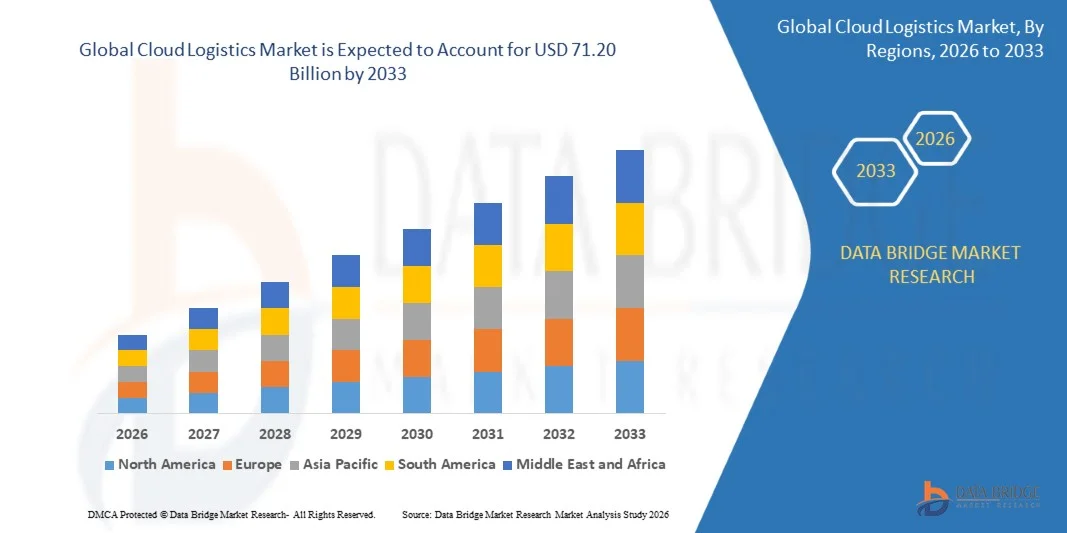
- As per Data Bridge Market Research analysis, the cloud logistics market was valued at USD 24.10 billion in 2025 and is projected to reach USD 71.20 billion by 2033, growing at a CAGR of 14.50% from 2026 to 2033.
- The market is experiencing strong growth driven by the increasing adoption of cloud-based logistics solutions, rising demand for real-time shipment visibility and supply chain optimization, and the growing need for flexible, scalable, and cost-effective logistics management across retail and e-commerce, manufacturing, automotive, food and beverages, healthcare, and other industries.
- The increasing need to improve logistics efficiency without high upfront infrastructure expenditure, combined with advancements in cloud computing, artificial intelligence, machine learning, Internet of Things (IoT), automation, and real-time data analytics, is encouraging businesses to adopt Cloud Logistics solutions. Cloud-based platforms are improving access to advanced logistics management capabilities, enabling businesses to optimize transportation and warehouse operations, enhance shipment visibility, reduce operational costs, improve resource utilization, and support flexible deployment across increasingly complex supply chains.
Market Size & Forecast
- Global Market Value (2025): USD 24.10 Billion
- Expected Market Value (2033): USD 71.20 Billion
- Forecast CAGR (2026–2033): 14.50%
- Leading Region in 2025: North America
- Fastest Growing Region: Asia Pacific
What are the Major Takeaways of the Cloud Logistics Market?
- North America dominated the cloud logistics market with a revenue share of 30.8% in 2025, supported by the early adoption of cloud-based supply chain technologies, strong investments in digital logistics infrastructure, increasing demand for real-time shipment visibility, and the presence of major technology and logistics solution providers.
- Asia-Pacific is projected to be the fastest-growing region during the forecast period from 2026 to 2033, driven by rapid digitalization of logistics operations, expansion of e-commerce, increasing adoption of cloud-based supply chain platforms, growing demand for real-time tracking, and rising investments in logistics automation across China, India, Japan, and South Korea.
- The large enterprises segment dominated the enterprise size category with a revenue share of 66.6% in 2025, supported by higher technology investment capabilities, established IT infrastructure, complex global supply chains, and increasing adoption of cloud logistics platforms for transportation management, warehouse management, inventory optimization, order fulfillment, and supply chain visibility.
- The small and medium enterprises segment is projected to be the fastest-growing enterprise-size category during the forecast period, as cloud-based deployment reduces infrastructure requirements, lowers upfront technology investment, and enables smaller businesses to access scalable logistics management, transportation, inventory, and supply chain optimization capabilities.
- The public segment accounted for the largest type share at 30.1% in 2025, driven by the increasing preference for scalable and cost-effective cloud infrastructure, pay-as-you-go deployment models, reduced IT maintenance requirements, and growing demand for flexible logistics management solutions. The private segment is projected to register strong growth during the forecast period as enterprises increasingly seek enhanced security, customization, and control over logistics data.
- The retail segment dominated the industry vertical category with a revenue share of 23.2% in 2025, supported by the rapid expansion of e-commerce, increasing demand for faster order fulfillment, real-time inventory visibility, omnichannel distribution, last-mile delivery optimization, and the need to manage increasingly complex retail supply chains.
- The automotive segment is projected to register strong growth during the forecast period, driven by increasing adoption of digital supply chain management, complex multi-tier supplier networks, demand for real-time inventory and shipment visibility, and the growing use of cloud platforms for transportation, warehouse, order, and inventory management. The automotive cloud logistics segment generated USD 2.59 billion in 2025 and is projected to grow at a 14.5% CAGR through 2033.
Report Scope and Cloud Logistics Market Segmentation
|
Attributes |
Cloud Logistics Key Market Insights |
|
Segments Covered |
|
|
Countries Covered |
North America
Europe
Asia-Pacific
Middle East and Africa
South America
|
|
Key Market Players |
|
|
Market Opportunities |
|
|
Value Added Data Infosets |
In addition to the market insights such as market value, growth rate, market segments, geographical coverage, market players, and market scenario, the market report curated by the Data Bridge Market Research team includes in-depth expert analysis, import/export analysis, pricing analysis, production consumption analysis, and pestle analysis. |
What is the Key Trend in the Cloud Logistics Market?
- Cloud Logistics is increasingly shifting toward AI-enabled and cloud-connected platforms, allowing businesses to improve real-time visibility, optimize transportation and inventory, and manage logistics activities through centralized digital systems.
- For instance, in May 2025, Blue Yonder and GXO Logistics announced a multi-year strategic agreement to deploy end-to-end logistics software solutions, including warehouse management capabilities, to improve speed, flexibility, and predictability across logistics operations.
- The integration of artificial intelligence, machine learning, IoT, and real-time analytics is improving demand forecasting, route optimization, shipment tracking, inventory planning, and supply chain decision-making. Cloud-based platforms are increasingly enabling businesses to access real-time data and analytics across distributed logistics networks.
- For instance, in May 2025, Blue Yonder introduced AI agents and cognitive supply chain solutions designed to support faster decision-making, improve resilience, and respond to supply chain disruptions.
- Cloud-based transportation management, warehouse management, and order management solutions are gaining importance as businesses seek scalable logistics capabilities without extensive on-premises infrastructure investment.
- For instance, in February 2025, Oracle announced that Allcargo Gati had migrated its mission-critical ERP system to Oracle Cloud Infrastructure, resulting in a 20% improvement in system performance and operational efficiency.
- Cloud Logistics is expanding across retail and e-commerce, manufacturing, automotive, healthcare, food and beverage, and other industries as businesses seek greater supply chain visibility, flexible operations, and faster decision-making.
- As businesses increasingly seek scalable logistics solutions with lower infrastructure requirements, the combination of cloud computing, AI, IoT, real-time visibility, and predictive analytics is expected to accelerate the adoption of Cloud Logistics across global supply chains.
What are the Key Drivers of the Cloud Logistics Market?
- The growing demand for real-time supply chain visibility is increasing the adoption of cloud-based logistics platforms because businesses can monitor shipments, inventory, transportation activities, and delivery performance through centralized systems.
- For instance, in March 2025, Gartner highlighted transportation visibility as a key priority for shippers, logistics providers, and supply chain technology leaders, supporting demand for real-time transportation visibility platforms.
- The rapid expansion of e-commerce and omnichannel fulfillment is creating strong demand for cloud-based transportation, warehouse, inventory, and order management solutions to improve delivery speed and fulfillment efficiency.
- Increasing adoption of artificial intelligence, machine learning, IoT, and predictive analytics is encouraging businesses to use cloud logistics platforms for route optimization, demand forecasting, inventory planning, and operational decision-making.
- For instance, in May 2025, Blue Yonder launched AI-powered cognitive supply chain solutions and AI agents to help businesses improve supply chain decision-making, resilience, and profitability.
- The increasing need to reduce infrastructure costs and improve scalability is supporting the adoption of cloud logistics because businesses can access logistics applications through flexible cloud and SaaS-based models without maintaining extensive on-premises systems.
- The growing need for integrated transportation, warehouse, inventory, and order management is further supporting market growth as businesses seek connected platforms that reduce fragmented logistics processes and improve data sharing across supply chain stakeholders.
Which Factors are Challenging the Growth of the Cloud Logistics Market?
- Data security, cybersecurity, and privacy concerns remain significant challenges because cloud logistics platforms manage sensitive shipment, customer, inventory, transportation, and supply chain information.
- For instance, Maersk's 2025 logistics trend analysis highlighted cybersecurity as an important logistics concern, noting that reliance on third-party cloud providers and vulnerabilities across supply chain partners can increase cybersecurity risks.
- Integration of cloud logistics platforms with existing enterprise resource planning, warehouse management, transportation management, and legacy systems can increase deployment complexity, particularly for businesses operating fragmented infrastructure.
- For instance, in February 2025, Allcargo Gati's migration of its mission-critical ERP system to Oracle Cloud Infrastructure demonstrated the increasing need to integrate core enterprise systems with cloud infrastructure while maintaining operational performance.
- Dependence on reliable internet connectivity, cloud infrastructure, APIs, and third-party technology providers can create operational risks for businesses operating across locations with limited digital infrastructure.
- High implementation costs related to customization, data migration, system integration, employee training, and cybersecurity can limit adoption among small and medium-sized businesses.
- Interoperability challenges between different logistics platforms, IoT devices, enterprise applications, carriers, and third-party logistics providers can restrict seamless data exchange and create additional integration requirements.
- The increasing volume of real-time logistics data also requires strong data governance, analytics capabilities, cybersecurity controls, and technical expertise, increasing the complexity of managing cloud-based logistics environments.
- The combination of cybersecurity requirements, integration complexity, infrastructure dependency, implementation costs, and the need for skilled technical resources continues to challenge the adoption of Cloud Logistics, particularly among businesses transitioning from traditional and fragmented logistics systems.
How is the Cloud Logistics Market Segmented?
The cloud logistics market is segmented on the basis of type, operating system type, enterprise size, and industry vertical.
- By Type
On the basis of type, the cloud logistics market is segmented into public, private, hybrid, and multi. The public segment dominated the market with a 30.1% share in 2025, supported by the increasing adoption of scalable and cost-efficient cloud infrastructure across logistics and supply chain operations. Public cloud logistics solutions enable businesses to access transportation management, warehouse management, inventory management, shipment tracking, and analytics through flexible cloud-based platforms without requiring extensive on-premises infrastructure. The lower infrastructure costs, flexible subscription models, rapid deployment, and scalability of public cloud platforms are encouraging logistics providers, retailers, manufacturers, and other businesses to adopt these solutions. Public cloud platforms also support real-time data sharing and collaboration across geographically distributed supply chain networks. Current market analysis identifies public cloud as the dominant type segment.
The private segment is projected to register the fastest growth during the forecast period, driven by increasing demand for enhanced data security, customization, regulatory compliance, and greater control over logistics information. Private cloud logistics solutions are particularly suitable for large enterprises handling sensitive transportation, inventory, customer, and supply chain data. Growing cybersecurity requirements and the need to integrate cloud logistics platforms with enterprise systems are encouraging organizations to adopt private cloud environments. The increasing demand for secure and customized logistics infrastructure is expected to create additional opportunities for this segment.
- By Operating System Type
On the basis of operating system type, the cloud logistics market is segmented into native and web-based. The web-based segment dominated the market with a 52.3% share in 2025, supported by the increasing use of browser-accessible logistics platforms for transportation management, inventory control, order monitoring, shipment tracking, and supply chain coordination. Web-based cloud logistics solutions allow users to access logistics information from different locations without requiring dedicated software installation, supporting distributed operations and collaboration among shippers, carriers, suppliers, and logistics providers. Real-time tracking, centralized data access, flexible deployment, and integration with enterprise applications are further supporting adoption of web-based platforms.
The native segment is projected to register the fastest growth during the forecast period, driven by increasing demand for cloud-native logistics applications designed to fully utilize cloud scalability, flexibility, and computing capabilities. Native cloud logistics applications can dynamically respond to changing workloads and support real-time analytics, automation, artificial intelligence, and large-scale data processing. The growing adoption of cloud-native architectures and the need for high-performance logistics platforms are expected to accelerate demand for native solutions.
- By Enterprise Size
On the basis of enterprise size, the cloud logistics market is segmented into large enterprises and small and medium enterprises. The large enterprises segment dominated the market with a 66.6% share in 2025, owing to the extensive logistics networks, higher technology budgets, and complex supply chain requirements of large organizations. Large enterprises are increasingly adopting cloud logistics platforms to integrate transportation, warehouse, inventory, order management, and analytics across multiple facilities and geographic locations. Cloud-based platforms provide scalability during demand fluctuations, improve supply chain visibility, and support advanced analytics and predictive decision-making. The ability to integrate logistics operations across global supply chains further supports adoption among large enterprises.
The small and medium enterprises segment is projected to register the fastest growth during the forecast period, driven by the increasing availability of subscription-based and scalable cloud logistics solutions. SMEs can access transportation management, inventory visibility, shipment tracking, and analytics capabilities without making substantial investments in on-premises infrastructure. Growing digitalization, expanding e-commerce activities, lower deployment requirements, and increasing competition are encouraging SMEs to adopt cloud logistics platforms to improve operational efficiency and compete with larger organizations.
- By Industry Vertical
On the basis of industry vertical, the cloud logistics market is segmented into retail and e-commerce, consumer electronics, healthcare, automotive, food and beverage, and others. The retail and e-commerce segment dominated the market with a 23.2% share in 2025, supported by the rapid expansion of online commerce, high order volumes, omnichannel fulfillment, and increasing demand for real-time inventory and shipment visibility. Cloud logistics platforms enable retailers and e-commerce companies to coordinate inventory, order fulfillment, transportation, last-mile delivery, and returns through centralized digital systems. The ability to scale logistics operations during seasonal demand peaks and promotional periods further supports adoption of cloud-based logistics solutions in retail and e-commerce.
The healthcare segment is projected to register the fastest growth during the forecast period, driven by increasing demand for real-time visibility of medical supplies, pharmaceuticals, equipment, and temperature-sensitive products. Cloud logistics platforms enable healthcare organizations to improve inventory management, monitor shipments, reduce stockout risks, and coordinate complex healthcare supply chains. Growing adoption of digital supply chain technologies, increasing requirements for traceability, and the need for efficient pharmaceutical and cold-chain logistics are expected to further accelerate cloud logistics adoption in the healthcare sector.
Which Region Holds the Largest Share of the Cloud Logistics Market?
- North America dominated the cloud logistics market with the largest revenue share of 30.8% in 2025, supported by the presence of established cloud technology providers, advanced logistics infrastructure, high digitalization, and strong adoption of transportation and supply chain management technologies. The region benefits from increasing investments in cloud computing, artificial intelligence, real-time shipment visibility, warehouse automation, and predictive analytics across logistics and supply chain operations.
- The region also benefits from the strong presence of e-commerce, complex distribution networks, and increasing demand for scalable logistics platforms that improve operational visibility and reduce infrastructure requirements. The growing adoption of cloud-based transportation management systems, warehouse management systems, inventory management, and real-time tracking solutions is further strengthening North America's leadership position. Increasing integration of AI, IoT, analytics, and cloud-native technologies is expected to support continued market expansion.
U.S. Cloud Logistics Market Insight
The U.S. cloud logistics market is witnessing strong growth due to rising investments in cloud computing, transportation management, warehouse automation, artificial intelligence, and real-time supply chain visibility. The country's mature technology ecosystem and presence of major cloud and logistics technology providers are supporting the deployment of cloud-based logistics platforms across retail, e-commerce, manufacturing, healthcare, automotive, and other industries. Increasing demand for real-time shipment tracking, inventory visibility, route optimization, and predictive analytics is encouraging businesses to shift toward cloud-based logistics solutions. In addition, the growing integration of AI, IoT, machine learning, and advanced analytics is improving the scalability and operational efficiency of logistics operations in the U.S.
Asia-Pacific Cloud Logistics Market Insight
The Asia-Pacific cloud logistics market is expected to witness rapid growth during the forecast period, driven by expanding e-commerce activities, increasing digitalization, growing manufacturing and logistics operations, and rising investments in cloud computing and supply chain technologies. Countries such as China, Japan, South Korea, and India are witnessing increasing adoption of cloud-based transportation management, warehouse management, inventory tracking, and logistics analytics solutions. The region's large and increasingly complex supply chains are creating strong demand for real-time visibility, automated logistics processes, and scalable cloud platforms. In addition, growing adoption of artificial intelligence, IoT, predictive analytics, and digital supply chain technologies is accelerating cloud logistics adoption across industrial and commercial sectors.
Japan Cloud Logistics Market Insight
The Japan cloud logistics market is witnessing consistent growth due to the country's advanced technology infrastructure, highly developed logistics industry, and increasing adoption of digital supply chain solutions. Logistics operators, manufacturers, retailers, and automotive companies are increasingly adopting cloud-based platforms to improve transportation planning, inventory management, warehouse operations, and shipment visibility. The need to address labor shortages and improve operational efficiency is further encouraging the adoption of automation, AI, IoT, and cloud-based logistics technologies. Moreover, Japan's focus on digital transformation, smart manufacturing, and advanced supply chain management is creating favorable conditions for the expansion of cloud logistics solutions.
China Cloud Logistics Market Insight
The China cloud logistics market is growing rapidly, driven by expanding e-commerce, large-scale manufacturing activities, increasing warehouse automation, and strong investments in cloud computing and artificial intelligence. Growing demand for transportation management, inventory optimization, shipment tracking, and automated fulfillment is boosting cloud logistics adoption across retail, manufacturing, automotive, electronics, and logistics industries. The increasing complexity of domestic and cross-border supply chains is encouraging businesses to deploy centralized cloud platforms for real-time visibility and data-driven decision-making. In addition, rapid advancements in AI, IoT, big data analytics, and digital logistics infrastructure are further positioning China as one of the fastest-growing cloud logistics markets globally.
U.K. Cloud Logistics Market Insight
The U.K. cloud logistics market is experiencing steady growth, supported by increasing adoption of e-commerce, digital supply chain technologies, warehouse automation, and real-time logistics management. Retailers, logistics providers, manufacturers, and other businesses are increasingly using cloud-based platforms for transportation planning, inventory management, order fulfillment, and shipment tracking. Growing demand for faster deliveries, omnichannel fulfillment, and improved supply chain visibility is encouraging organizations to adopt scalable cloud logistics solutions. Furthermore, increasing integration of artificial intelligence, predictive analytics, IoT, and cloud-based transportation and warehouse management platforms is improving the efficiency and flexibility of logistics operations across the U.K.
Germany Cloud Logistics Market Insight
The Germany cloud logistics market is expanding steadily due to the country's strong industrial manufacturing base, advanced logistics infrastructure, and increasing adoption of Industry 4.0 and digital supply chain technologies. Automotive manufacturers, logistics operators, retailers, and industrial companies are increasingly utilizing cloud-based solutions for transportation management, warehouse operations, inventory optimization, and supply chain visibility. The growing need to integrate complex manufacturing and logistics networks is creating additional opportunities for cloud logistics providers. Continuous advancements in artificial intelligence, IoT, predictive analytics, automation, and cloud-native platforms, combined with Germany's strong focus on smart manufacturing and digitalization, are further driving the adoption of cloud logistics solutions.
Which are the Top Companies in Cloud Logistics Market?
The Cloud Logistics industry is primarily led by well-established companies, including:
- SAP SE (Germany)
- Oracle Corporation (U.S.)
- Blue Yonder Group, Inc. (U.S.)
- Manhattan Associates, Inc. (U.S.)
- The Descartes Systems Group Inc. (Canada)
- Infor (U.S.)
- Kinaxis Inc. (Canada)
- E2open Parent Holdings, Inc. (U.S.)
- project44 (U.S.)
- FourKites, Inc. (U.S.)
- WiseTech Global Limited (Australia)
- Trimble Inc. (U.S.)
- MercuryGate International, Inc. (U.S.)
- C.H. Robinson Worldwide, Inc. (U.S.)
- Shippeo SAS (France)
- Körber AG (Germany)
- IBM Corporation (U.S.)
- Microsoft Corporation (U.S.)
- Flexport, Inc. (U.S.)
- Transporeon GmbH (Germany)
- Coupa Software Inc. (U.S.)
- Logility, Inc. (U.S.)
- o9 Solutions, Inc. (U.S.)
- Honeywell International Inc. (U.S.)
- Amazon Web Services, Inc. (U.S.)
What are Latest Developments in Cloud Logistics Market?
- In June 2025, according to GXO Logistics, the company launched GXO IQ, an AI-powered, cloud-native operating system designed specifically for logistics operations. The platform was developed to orchestrate activities across warehousing, transportation, and workforce management while using artificial intelligence to improve operational productivity and decision-making. The development highlights the increasing integration of cloud-native platforms and AI technologies into logistics operations to improve visibility, scalability, and supply chain performance.
- In May 2025, according to GXO Logistics and Blue Yonder, the companies announced a multi-year strategic agreement to deploy end-to-end logistics software solutions across GXO's operations. Blue Yonder was selected as a preferred provider of warehouse management system solutions, supporting real-time data forecasting, inventory flexibility, and improved visibility across warehouse operations. The development demonstrates the growing adoption of cloud-based logistics software to enhance speed, flexibility, scalability, and operational predictability.
- In February 2025, according to Oracle and Allcargo Gati, Allcargo Gati migrated its mission-critical enterprise resource planning system from on-premises infrastructure to Oracle Base Database Service on Oracle Cloud Infrastructure. The migration improved system performance and operational efficiency by 20% while supporting greater scalability and modernization of the company's logistics technology infrastructure. The development demonstrates how logistics companies are increasingly adopting cloud infrastructure to improve operational efficiency and support digital transformation.
- In May 2025, according to PepsiCo and Amazon Web Services, the companies announced a strategic multi-year agreement under which PepsiCo selected AWS as a strategic cloud provider for artificial intelligence, supply chain, and consumer experience initiatives. The collaboration supports PepsiCo's cloud-first digital transformation strategy and aims to improve agility, intelligence, and scalability across its supply chain operations. The development reflects the increasing use of cloud infrastructure and AI capabilities to transform supply chain and logistics processes.
- In August 2025, according to Salesforce and Jeena & Company, the companies announced a strategic collaboration to accelerate the digital transformation of the logistics and freight forwarding company. Jeena & Company began deploying Salesforce Sales Cloud to improve sales visibility, customer intelligence, and data-driven decision-making across its logistics network. The development highlights the expanding use of cloud-based platforms to centralize information, improve visibility, and support data-driven operations across logistics networks.

- Interactive Data Analysis Dashboard
- Company Analysis Dashboard for high growth potential opportunities
- Research Analyst Access for customization & queries
- Competitor Analysis with Interactive dashboard
- Latest News, Updates & Trend analysis
- Harness the Power of Benchmark Analysis for Comprehensive Competitor Tracking
Data collection and base year analysis are done using data collection modules with large sample sizes. The stage includes obtaining market information or related data through various sources and strategies. It includes examining and planning all the data acquired from the past in advance. It likewise envelops the examination of information inconsistencies seen across different information sources. The market data is analysed and estimated using market statistical and coherent models. Also, market share analysis and key trend analysis are the major success factors in the market report. To know more, please request an analyst call or drop down your inquiry.
The key research methodology used by DBMR research team is data triangulation which involves data mining, analysis of the impact of data variables on the market and primary (industry expert) validation. Data models include Vendor Positioning Grid, Market Time Line Analysis, Market Overview and Guide, Company Positioning Grid, Patent Analysis, Pricing Analysis, Company Market Share Analysis, Standards of Measurement, Global versus Regional and Vendor Share Analysis. To know more about the research methodology, drop in an inquiry to speak to our industry experts.
Data Bridge Market Research is a leader in advanced formative research. We take pride in servicing our existing and new customers with data and analysis that match and suits their goal. The report can be customized to include price trend analysis of target brands understanding the market for additional countries (ask for the list of countries), clinical trial results data, literature review, refurbished market and product base analysis. Market analysis of target competitors can be analyzed from technology-based analysis to market portfolio strategies. We can add as many competitors that you require data about in the format and data style you are looking for. Our team of analysts can also provide you data in crude raw excel files pivot tables (Fact book) or can assist you in creating presentations from the data sets available in the report.













