Cloud Sandboxing Market Size
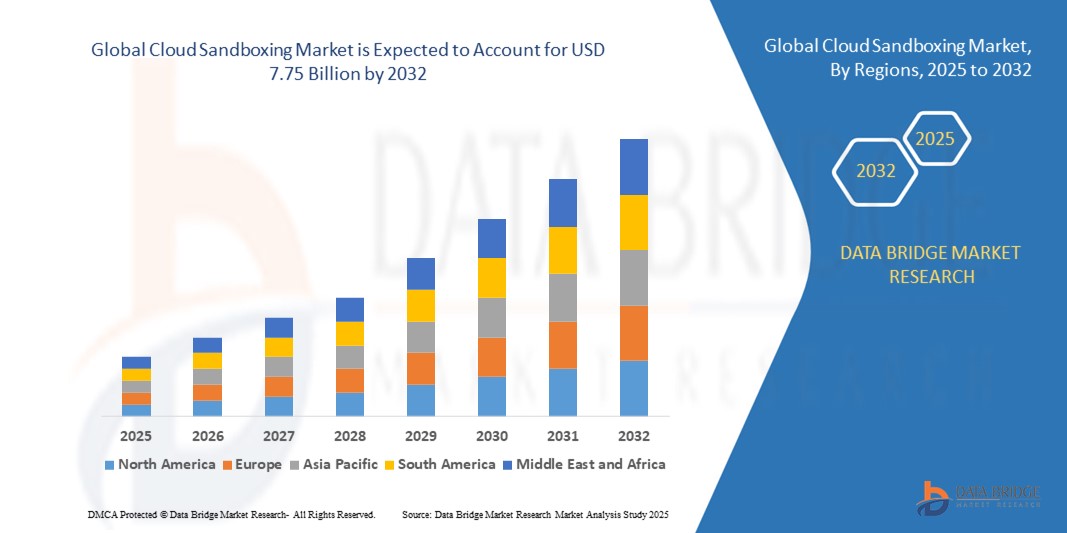
- The global cloud sandboxing market size was valued at USD 2.44 billion in 2024 and is expected to reach USD 7.75 billion by 2032, at a CAGR of 15.50% during the forecast period
- The market growth is largely fuelled by the increasing frequency of cyberattacks, growing adoption of cloud computing, and rising demand for advanced threat detection and malware analysis solutions
- Rapid digital transformation across industries and the need for secure application development further drive market expansion
Cloud Sandboxing Market Analysis
- The global cloud sandboxing market is witnessing rapid growth due to the increasing frequency and sophistication of cyberattacks, prompting organizations to adopt advanced threat detection solutions
- Growing adoption of cloud computing and digital transformation across industries is driving the demand for secure application testing and malware analysis
- North America dominated the cloud sandboxing market with the largest revenue share of 38.5% in 2024, driven by the presence of major cybersecurity vendors, high adoption of cloud technologies, and stringent regulatory requirements
- Asia-Pacific region is expected to witness the highest growth rate in the global cloud sandboxing market, driven by rising cybersecurity investments, expanding IT infrastructure, and increasing cloud adoption in countries such as China, Japan, and India
- The Integrated Sandbox segment held the largest market revenue share in 2024, driven by its seamless integration with existing security solutions and enterprise IT infrastructures. Integrated sandboxes often offer automated threat analysis, real-time monitoring, and centralized management, making them a preferred choice for large organizations and cybersecurity-focused enterprises
Report Scope and Cloud Sandboxing Market Segmentation
|
Attributes |
Cloud Sandboxing Key Market Insights |
|
Segments Covered |
|
|
Countries Covered |
North America
Europe
Asia-Pacific
Middle East and Africa
South America
|
|
Key Market Players |
|
|
Market Opportunities |
|
|
Value Added Data Infosets |
In addition to the market insights such as market value, growth rate, market segments, geographical coverage, market players, and market scenario, the market report curated by the Data Bridge Market Research team includes in-depth expert analysis, import/export analysis, pricing analysis, production consumption analysis, and pestle analysis. |
Cloud Sandboxing Market Trends
Rise of Advanced Threat Detection and Real-Time Malware Analysis
- The growing adoption of advanced cloud sandboxing solutions is transforming cybersecurity operations by enabling real-time detection and isolation of malicious files. The cloud-based architecture allows enterprises to analyze threats without affecting their on-premises infrastructure, resulting in improved threat mitigation and reduced operational disruptions
- The increasing need for rapid threat intelligence in distributed IT environments is accelerating the deployment of cloud sandboxing platforms. These solutions are particularly effective for organizations with remote or hybrid workforces, where centralized malware analysis can significantly reduce response times. The trend is further supported by regulatory mandates emphasizing proactive cybersecurity measures
- The scalability and ease of integration of modern cloud sandboxing platforms are making them attractive for continuous threat monitoring, leading to more robust security postures. Enterprises benefit from automated analysis and frequent updates without substantial infrastructure investments, which ultimately strengthens overall cybersecurity resilience
- For instance, in 2023, several multinational IT firms reported a significant reduction in malware-related incidents after implementing cloud-based sandboxing solutions. These platforms allowed early threat detection and automated containment, improving overall system security while reducing response costs
- While cloud sandboxing accelerates threat detection and enhances enterprise security, its impact depends on ongoing technological innovation, skilled personnel, and seamless integration with existing security frameworks. Vendors must focus on AI-powered analytics and customizable deployment strategies to fully capitalize on growing demand
Cloud Sandboxing Market Dynamics
Driver
Rising Cybersecurity Threats And Increasing Adoption Of Cloud-Based Security Solutions
- The surge in sophisticated cyberattacks is pushing enterprises and government organizations to prioritize cloud sandboxing as a frontline defense. Threats such as ransomware, zero-day exploits, and advanced persistent threats have significant operational and financial implications, prompting strong adoption of sandboxing solutions
- Organizations are increasingly aware of the financial and reputational risks associated with delayed threat detection, including data breaches, regulatory penalties, and service disruptions. This awareness has led to widespread deployment of cloud sandboxing platforms, even among small and medium-sized enterprises
- Public sector initiatives and industry alliances have strengthened cybersecurity frameworks and promoted threat intelligence sharing. From compliance mandates to national cybersecurity programs, supportive measures are helping enterprises implement sandboxing solutions proactively
- For instance, in 2022, several European governments issued cybersecurity guidelines mandating advanced malware analysis protocols, boosting demand for cloud sandboxing services across commercial and public sectors
- While rising threats and regulatory support are driving the market, there remains a need to enhance integration with existing security systems, ensure cost-effective solutions, and continuously update threat databases to sustain long-term adoption
Restraint/Challenge
High Implementation Costs And Integration Complexity
- The high cost of advanced cloud sandboxing platforms, including licensing and subscription fees, limits adoption among small enterprises and resource-constrained organizations. These solutions are often deployed primarily by large enterprises or cybersecurity-focused firms. The upfront investment, ongoing maintenance costs, and need for regular updates make it difficult for smaller players to justify deployment, restricting market penetration
- Many organizations face challenges in deploying and managing cloud sandboxing solutions due to a lack of trained personnel and integration expertise. Without proper staff and workflows, the effectiveness of sandboxing platforms is reduced. In addition, insufficient in-house cybersecurity skills can lead to misconfigurations, delayed threat responses, and underutilization of advanced features, impacting ROI and security outcomes
- Market expansion is also restricted by compatibility and interoperability issues with legacy IT systems, which can delay deployment and limit functionality. Organizations may rely on partial security measures instead, reducing the effectiveness of threat mitigation. The challenge of integrating cloud-based solutions with older on-premises applications often requires additional investment in middleware or system upgrades, further slowing adoption
- For instance, in 2023, several SMEs in Southeast Asia reported difficulty integrating cloud sandboxing solutions into existing IT environments, citing cost and technical barriers as primary constraints. Many of these organizations struggled with workflow disruptions during initial deployment. Lack of localized support and limited access to expert consultants further compounded the challenge, delaying full adoption and measurable security improvements
- While cloud sandboxing technologies continue to evolve, addressing cost, usability, and integration challenges is crucial. Market stakeholders must focus on scalable, user-friendly platforms, AI-assisted deployment, and flexible pricing models to unlock widespread adoption and long-term growth. Ensuring seamless integration with existing cybersecurity frameworks, providing robust training programs, and offering subscription-based pricing options can help overcome adoption barriers and expand market reach
Cloud Sandboxing Market Scope
The market is segmented on the basis of type and application.
- By Type
On the basis of type, the cloud sandboxing market is segmented into Standalone Sandbox and Integrated Sandbox. The Integrated Sandbox segment held the largest market revenue share in 2024, driven by its seamless integration with existing security solutions and enterprise IT infrastructures. Integrated sandboxes often offer automated threat analysis, real-time monitoring, and centralized management, making them a preferred choice for large organizations and cybersecurity-focused enterprises.
The Standalone Sandbox segment is expected to witness the fastest growth rate from 2025 to 2032, driven by its flexibility, ease of deployment, and cost-effectiveness. Standalone sandboxes are particularly popular among SMEs and organizations with limited IT infrastructure, offering isolated testing environments and rapid threat detection without the need for extensive integration.
- By Application
On the basis of application, the cloud sandboxing market is segmented into Government and Defense, BFSI, IT and Telecom, Healthcare, Retail, Education, and Others. The BFSI segment held the largest market share in 2024, fueled by the need for secure financial transactions, fraud prevention, and protection against malware targeting critical banking and insurance systems.
The IT and Telecom segment is expected to witness the fastest growth rate from 2025 to 2032, driven by rising cyber threats, cloud adoption, and the critical need for real-time malware detection in data centers, network operations, and cloud-based services. Organizations in this segment increasingly rely on cloud sandboxing to ensure business continuity and protect sensitive customer data.
Cloud Sandboxing Market Regional Analysis
- North America dominated the cloud sandboxing market with the largest revenue share of 38.5% in 2024, driven by the presence of major cybersecurity vendors, high adoption of cloud technologies, and stringent regulatory requirements
- Enterprises in the region highly value real-time threat detection, automated malware analysis, and seamless integration with existing security frameworks
- This widespread adoption is further supported by high IT spending, advanced cybersecurity infrastructure, and growing demand for cloud-based security solutions, establishing cloud sandboxing as a preferred choice for both private and public sector organizations
U.S. Cloud Sandboxing Market Insight
The U.S. cloud sandboxing market captured the largest revenue share in 2024 within North America, fueled by the rapid adoption of advanced cybersecurity technologies and increasing sophistication of cyber threats. Organizations are prioritizing real-time malware detection and proactive threat mitigation. The growing preference for AI-driven security analytics and automated sandboxing, combined with strong investments in cloud infrastructure, further propels market growth. Moreover, government cybersecurity initiatives and industry compliance requirements are significantly contributing to the market's expansion.
Europe Cloud Sandboxing Market Insight
The Europe cloud sandboxing market is expected to witness the fastest growth rate from 2025 to 2032, primarily driven by strict data protection regulations and the rising need for proactive cybersecurity. Increasing adoption of cloud services among enterprises, coupled with rising cyberattacks, is fostering demand for sandboxing solutions. European organizations are also drawn to solutions that offer seamless integration, centralized management, and threat intelligence sharing. The region is witnessing growth across BFSI, IT & Telecom, and government sectors.
U.K. Cloud Sandboxing Market Insight
The U.K. cloud sandboxing market is expected to witness the fastest growth rate from 2025 to 2032, driven by increasing cyber threats and a growing emphasis on data security and regulatory compliance. Enterprises are adopting cloud sandboxing solutions to enhance real-time threat detection and malware analysis. In addition, the U.K.’s strong IT infrastructure and high cloud adoption rates are expected to continue stimulating market growth.
Germany Cloud Sandboxing Market Insight
The Germany cloud sandboxing market is expected to witness the fastest growth rate from 2025 to 2032, fueled by increasing awareness of cyber risks and the adoption of advanced security solutions. Germany’s well-developed IT ecosystem, combined with strong cybersecurity policies, promotes the adoption of cloud sandboxing, particularly in large enterprises and government institutions. Integration with AI-based threat detection and centralized monitoring systems is becoming increasingly prevalent.
Asia-Pacific Cloud Sandboxing Market Insight
The Asia-Pacific cloud sandboxing market is expected to witness the fastest growth rate from 2025 to 2032, driven by increasing digitalization, rising IT infrastructure investments, and growing cyber threats in countries such as China, Japan, and India. The region's expanding enterprise cloud adoption, supported by government initiatives promoting cybersecurity, is driving sandboxing solution adoption. Furthermore, as APAC emerges as a hub for IT services and security solutions, affordability and accessibility of cloud sandboxing are expanding to a wider consumer base.
Japan Cloud Sandboxing Market Insight
The Japan cloud sandboxing market is expected to witness the fastest growth rate from 2025 to 2032 due to the country’s high-tech ecosystem, rapid digital transformation, and emphasis on cybersecurity. Enterprises are increasingly deploying sandboxing solutions integrated with AI-based threat analytics. The adoption of cloud-based security platforms is also driven by the need for real-time threat mitigation and compliance with stringent data protection laws.
China Cloud Sandboxing Market Insight
The China cloud sandboxing market accounted for the largest market revenue share in Asia Pacific in 2024, attributed to rapid digital transformation, increasing cyberattacks, and strong investments in IT security infrastructure. China is one of the largest adopters of cloud security solutions, with enterprises across BFSI, IT, and government sectors deploying sandboxing solutions to ensure proactive threat detection. Government initiatives to strengthen cybersecurity frameworks and the availability of cost-effective cloud solutions are key factors propelling market growth.
Cloud Sandboxing Market Share
The Cloud Sandboxing industry is primarily led by well-established companies, including:
- Forcepoint LLC (U.S.)
- McAfee (U.S.)
- Juniper Networks (U.S.)
- Cisco Systems (U.S.)
- Symantec Corp (U.S.)
- Zscaler (U.S.)
- Palo Alto Networks (U.S.)
- Check Point Software Technologies (Israel)
- Sophos Group (U.K.)
- Sonicwall (U.S.)
- Fortinet, Inc. (U.S.)
Latest Developments in Global Cloud Sandboxing Market
- In April 2022, Fortinet released FortiOS 7.2, an enhanced version of its flagship operating system, strengthening the Fortinet Security Fabric. The update integrates advanced FortiGuard security services powered by AI, improving threat detection and response capabilities. This development enables enterprises to secure their networks more efficiently, streamline operations, and reduce cybersecurity risks. The update is expected to reinforce Fortinet’s market position by offering more comprehensive, AI-driven protection across hybrid IT environments
- In March 2022, Palo Alto Networks collaborated with Amazon Web Services (AWS) to launch the Palo Alto Networks Cloud Next-Generation Firewall (NGFW) specifically for AWS. This solution streamlines security for AWS deployments, with Palo Alto Networks managing scaling, availability, maintenance, and deployment. The service provides businesses with robust cloud security while accelerating innovation and minimizing operational complexity. By offering exclusive NGFW capabilities on AWS, the launch strengthens Palo Alto Networks’ presence in the cloud security market

- Interactive Data Analysis Dashboard
- Company Analysis Dashboard for high growth potential opportunities
- Research Analyst Access for customization & queries
- Competitor Analysis with Interactive dashboard
- Latest News, Updates & Trend analysis
- Harness the Power of Benchmark Analysis for Comprehensive Competitor Tracking
Data collection and base year analysis are done using data collection modules with large sample sizes. The stage includes obtaining market information or related data through various sources and strategies. It includes examining and planning all the data acquired from the past in advance. It likewise envelops the examination of information inconsistencies seen across different information sources. The market data is analysed and estimated using market statistical and coherent models. Also, market share analysis and key trend analysis are the major success factors in the market report. To know more, please request an analyst call or drop down your inquiry.
The key research methodology used by DBMR research team is data triangulation which involves data mining, analysis of the impact of data variables on the market and primary (industry expert) validation. Data models include Vendor Positioning Grid, Market Time Line Analysis, Market Overview and Guide, Company Positioning Grid, Patent Analysis, Pricing Analysis, Company Market Share Analysis, Standards of Measurement, Global versus Regional and Vendor Share Analysis. To know more about the research methodology, drop in an inquiry to speak to our industry experts.
Data Bridge Market Research is a leader in advanced formative research. We take pride in servicing our existing and new customers with data and analysis that match and suits their goal. The report can be customized to include price trend analysis of target brands understanding the market for additional countries (ask for the list of countries), clinical trial results data, literature review, refurbished market and product base analysis. Market analysis of target competitors can be analyzed from technology-based analysis to market portfolio strategies. We can add as many competitors that you require data about in the format and data style you are looking for. Our team of analysts can also provide you data in crude raw excel files pivot tables (Fact book) or can assist you in creating presentations from the data sets available in the report.