


What is the Cloud Security Posture Management Market Size and Overview?
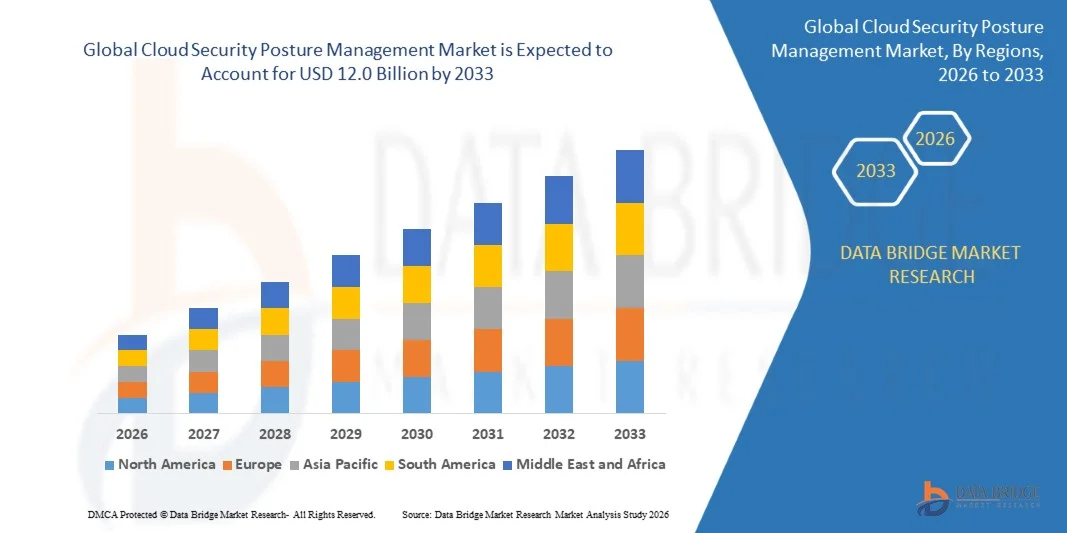
As per Data Bridge Market Research Analysis the cloud security posture management market was valued t USD 5.53 billion in 2025 and is projected to reach USD 12.0 billion by 2033, growing at a CAGR of 10.17% from 2026 to 2033. The market is experiencing robust growth driven by the accelerating shift toward cloud platforms across all industries, the increasing complexity of multi-cloud environments, and stringent regulatory requirements for data protection and compliance.
CSPM solutions provide automated capabilities that uncover configuration errors, validate compliance requirements, and maintain unified oversight across hybrid or multi-cloud setups. With enterprises scaling their cloud workloads, CSPM is now vital for strengthening governance, preventing unauthorized access, and supporting adherence to industry and regulatory standards.
Market Size & Forecast
- Global Market Value (2025): USD 5.53 billion
- Expected Market Value (2033): USD 12.0 billion
- Forecast CAGR (2026–2033): 10.17%
What are the Major Takeaways of Cloud Security Posture Management Market?
- North America dominated the global CSPM market with the largest revenue share of 36.10% in 2025, reaching USD 1.13 billion, supported by the highest enterprise cloud adoption rate and stringent regulatory enforcement.
- Asia-Pacific is expected to be the fastest-growing region, fueled by rapid cloud adoption, increasing investments in digital infrastructure, and growing cybersecurity awareness across countries such as China, India, and Southeast Asian nations.
- The solutions segment held the dominant share of 62.5% in the CSPM market in 2025, as organizations continue to implement advanced solutions for continuous monitoring, compliance management, and automated threat detection.
- The services segment is projected to experience robust growth, with the services segment expected to register the highest CAGR of 13.7%, driven by the need for solution integrations, setup, and maintenance for businesses lacking in-house cloud security expertise.
- The bfsi vertical currently holds the largest market share due to stringent regulatory measures, high data sensitivity, and the increasing shift toward cloud-based digital banking and fintech services.
- The healthcare vertical is expected to witness significant growth, driven by the increasing use of cloud-based electronic health records (EHRs), telemedicine, and growing demands to protect patient data amid rising cybersecurity risks and regulatory requirements such as HIPAA.
Report Scope and Cloud Security Posture Management Market Segmentation
|
Attributes |
Cloud Security Posture Management Key Market Insights |
|
Segments Covered |
|
|
Countries Covered |
North America
Europe
Asia-Pacific
Middle East and Africa
South America
|
|
Key Market Players |
|
|
Market Opportunities |
|
|
Value Added Data Infosets |
In addition to the market insights such as market value, growth rate, market segments, geographical coverage, market players, and market scenario, the market report curated by the Data Bridge Market Research team includes in-depth expert analysis, import/export analysis, pricing analysis, production consumption analysis, and pestle analysis. |
What is the Key Trend in the Cloud Security Posture Management Market?
Trend: Integration with CNAPP and Unified Cloud Security Platforms
The CSPM market is witnessing a significant trend toward integration with Cloud-Native Application Protection Platforms (CNAPP) and broader cloud security solutions. CSPM is increasingly converging into CNAPP platforms, serving as a foundational capability alongside Cloud Workload Protection Platform (CWPP) and Cloud Infrastructure Entitlement Management (CIEM). This integration aims to combine posture management, workload protection, and identity governance across AWS, Azure, and GCP. As enterprises seek to streamline security operations, reduce tool redundancy, and enhance contextual risk prioritization, the demand for integrated platforms is growing. The increasing complexity of cloud environments is driving organizations to correlate misconfigurations with potential attack pathways, creating new business opportunities and promoting a holistic approach to cloud security.
Cloud Security Posture Management Market Dynamics
Key Market Driver: Regulatory Compliance and Data Protection Requirements
Growing regulatory pressures are major drivers of CSPM adoption. Enterprises must comply with frameworks such as GDPR (European Union), HIPAA (United States), PCI DSS, SOX, and GLBA. The EU Cloud Code of Conduct (CoC) further strengthens compliance mandates under GDPR Article 28. CSPM platforms automate compliance monitoring across SOC 2, GDPR, HIPAA, and PCI DSS requirements, providing continuous audit evidence and mapping security controls to multiple frameworks simultaneously. CSPM platforms provide continuous monitoring, automated compliance checks, and audit-ready reporting, helping organizations avoid penalties and reputational risks. According to the Cloud Security Alliance (CSA), the Cloud Controls Matrix (CCM) provides 197 control objectives across 17 domains, explicitly designed to help organizations systematically assess cloud implementations and align with industry-accepted security standards.
Key Restraint/Challenge: Cybersecurity Skills Shortage
A critical skills shortage hampers organizations' ability to effectively implement and manage CSPM solutions. Companies frequently find it difficult to hire staff with the specific technical skills required to manage complex cloud environments. The severe scarcity of skilled cybersecurity professionals acts as a significant barrier to the expansion of the CSPM market. According to ISC² Cybersecurity Workforce Study, the cybersecurity profession is evolving rapidly, presenting both significant challenges and career opportunities, with organizations facing persistent skills gaps across cloud security roles.
Key Market Opportunity: Growing Adoption of DevSecOps and Shift-Left Security
The rising focus on DevSecOps and shift-left methodologies opens strong opportunities for CSPM growth as companies work to integrate security earlier in development cycles. CSPM tools can connect with CI/CD frameworks to identify risks before deployment, apply security policies automatically, and support consistent configuration management. This approach reduces exposure, improves release speed, and ensures security is built into cloud-native applications. Vendors can benefit by offering advanced integrations, developer-oriented tools, and instant visibility. This synergy between CSPM and DevSecOps significantly accelerates market expansion.
How is the Cloud Security Posture Management Market Segmented?
The cloud security posture management market is segmented on the basis of component, deployment model, service type, end-user sector, technology focus, compliance standards, and enterprise size.
- By Component
On the basis of component, the CSPM market is segmented into solutions and services. The solutions segment held the dominant share of the CSPM market in 2025, confirming that detection and reporting remain the entry point for most buyers. Organizations continue to implement advanced solutions for continuous monitoring, compliance management, and automated threat detection across sophisticated cloud environments. These solutions offer automated remediation and real-time visibility, making them critical to cloud security. The solutions segment includes cloud security posture management platforms, vulnerability assessment tools, compliance management solutions, and threat detection systems that provide comprehensive security coverage across multi-cloud and hybrid environments.
- By Service Type
On the basis of service type, the CSPM market is segmented into professional services and managed services. The services segment is projected to experience robust growth, as enterprises seek specialized support to navigate the complexities of multi-cloud security deployments and maintain continuous compliance across evolving regulatory landscapes. Professional services include consulting, integration, training, and support services that help organizations design, implement, and optimize their CSPM strategies. Managed services involve outsourced security operations where third-party providers manage CSPM deployments, offering continuous monitoring, compliance management, and remediation services for organizations lacking in-house cloud security expertise.
- By Deployment Model
On the basis of deployment model, the CSPM market is segmented into public cloud, private cloud, and hybrid cloud. The hybrid cloud segment is projected to experience strong growth, as CSPM solutions are well-suited for hybrid cloud environments, offering continuous monitoring and analysis of resources across all infrastructure types. Organizations are increasingly adopting hybrid and multi-cloud strategies, creating a pressing need for CSPM solutions that can provide unified visibility and consistent policy enforcement across diverse cloud environments. CSPM solutions address these challenges by ensuring that security policies remain consistent across multi-cloud and hybrid cloud architectures.
- By End-User Sector
On the basis of end-user sector, the CSPM market is segmented into BFSI, healthcare, IT & telecom, retail & e-commerce, government & defense, and energy & utilities. The BFSI sector currently holds the largest market share because of its stringent regulatory measures, high data sensitivity, and the increasing shift toward cloud-based digital banking and fintech services. Financial institutions prioritize robust security measures for critical data housed in cloud environments, driving high interest in CSPM solutions to avoid data breaches, ensure compliance, and protect customer information. The healthcare industry is expected to witness significant growth, driven by the increasing use of cloud-based electronic health records (EHRs), telemedicine, and growing demands to protect patient data amid rising cybersecurity risks and regulatory requirements such as HIPAA.
- By Technology Focus
On the basis of technology focus, the CSPM market is segmented into misconfiguration management, compliance management, vulnerability management, and threat detection & response. Misconfiguration management remains a core focus area, as misconfigurations are a primary cause of cloud breaches. Modern CSPM requirements have evolved far beyond simple vulnerability scanning and compliance checking; organizations now demand real-time threat detection, automated remediation capabilities, and integration with DevOps workflows. The focus has shifted toward comprehensive risk management that includes attack path analysis, runtime visibility, and identity-centric security controls. Advanced capabilities now include continuous asset discovery, dynamic configuration monitoring, and intelligent risk prioritization using AI and machine learning technologies.
- By Compliance Standards
On the basis of compliance standards, the CSPM market is segmented into GDPR, HIPAA, PCI DSS, ISO 27001, NIST, and SOC 2. The growing regulatory pressures are major drivers of CSPM adoption, as enterprises must comply with frameworks such as GDPR (European Union), HIPAA (United States), PCI DSS, SOX, and GLBA. CSPM platforms automate compliance monitoring across SOC 2, GDPR, HIPAA, and PCI DSS requirements, providing continuous audit evidence and mapping security controls to multiple frameworks simultaneously. CSPM platforms provide continuous monitoring, automated compliance checks, and audit-ready reporting, helping organizations avoid penalties and reputational risks. The NIST Cybersecurity Framework (CSF) provides organizations with a structured approach to managing and reducing cybersecurity risk, offering guidance that is widely adopted across cloud security implementations.
- By Enterprise Size
On the basis of enterprise size, the CSPM market is segmented into large enterprises and small & medium enterprises (SMEs). Large enterprises currently dominate the market, holding a significant majority of the market share, as they operate vast and complex cloud infrastructures, often using multiple cloud providers and handling large volumes of sensitive data. Large enterprises have extensive cloud footprints, complex multi-cloud environments, and substantial cybersecurity budgets, making them the primary adopters of advanced CSPM solutions. However, SMEs are increasingly adopting CSPM solutions as cloud-based deployment models make these technologies more accessible and cost-effective. The small and medium enterprises segment is expected to witness significant growth during the forecast period, driven by increasing awareness of cloud security risks and the availability of scalable, subscription-based CSPM offerings tailored to smaller organizations.
Which Region Holds the Largest Share of the Cloud Security Posture Management Market?
North America CSPM Market Insight
North America dominated the CSPM market in 2025, holding the largest revenue share. The U.S. holds the largest share of the CSPM market, driven by the highest enterprise cloud adoption rate, the most active cybersecurity regulatory enforcement environment, and the commercial concentration of leading CSPM platform providers. Organizations in North America are at the forefront of adopting advanced CSPM capabilities, including AI-powered threat detection, automated remediation, and integration with DevSecOps workflows. The region's stringent data protection regulations, including HIPAA, GLBA, and state-level privacy laws, further drive CSPM adoption across healthcare, financial services, and government sectors.
Europe CSPM Market Insight
Europe represents a significant market for CSPM solutions, supported by strong regulatory frameworks, advanced digital infrastructure, and growing demand from the BFSI, healthcare, and government sectors. The European Union's General Data Protection Regulation (GDPR) has been a primary driver of CSPM adoption, as organizations seek automated solutions to ensure continuous compliance and avoid substantial penalties. The EU Cloud Code of Conduct (CoC) further strengthens compliance mandates under GDPR Article 28. Countries such as Germany, the United Kingdom, and France are leading CSPM adoption in Europe, driven by their strong financial services sectors, advanced healthcare infrastructure, and increasing government investments in cloud security.
Asia-Pacific CSPM Market Insight
Asia-Pacific is expected to witness the fastest growth in the CSPM market, driven by rapid digital transformation, strong cloud adoption, and the increasing scale of cyber threats. Countries such as China, India, Japan, and Southeast Asian nations are leading this growth. China represents one of the fastest-growing CSPM markets in the region, driven by the country's massive cloud migration initiatives, government investments in digital infrastructure, and increasing cybersecurity regulations. India's CSPM market is evolving in response to the rapid adoption of cloud computing services, with organizations increasingly recognizing the need for robust security measures as they move their operations to the cloud.
Middle East & Africa CSPM Market Insight
The Middle East and Africa region represents an emerging market for CSPM solutions, with demand primarily concentrated in the Gulf Cooperation Council (GCC) countries and South Africa. Governments across the region are increasing investments in digital infrastructure and technology sectors to diversify their economies. The UAE and Saudi Arabia are investing in smart city initiatives and digital transformation programs, creating opportunities for CSPM applications in government, financial services, and energy sectors. However, relatively low adoption of advanced security technologies and limited cybersecurity expertise continue to restrain market growth in certain parts of the region.
South America CSPM Market Insight
South America represents an emerging market for CSPM solutions, with growing demand influenced by increasing digitalization of business operations, rising e-commerce penetration, and expanding cloud adoption. Brazil is a key market in South America, driven by the country's large economy, growing financial services sector, and increasing government focus on cybersecurity. However, market growth is currently constrained by limited digital infrastructure, budget constraints, and a shortage of skilled cybersecurity professionals compared to more developed regions.
Which are the Top Companies in Cloud Security Posture Management Market?
The cloud security posture management industry is primarily led by well-established companies, including:
- Wiz (U.S.)
- Orca Security (U.S.)
- Lacework (Fortinet) (U.S.)
- Sysdig (U.S.)
- Upwind Security (U.S.)
- Tenable Cloud Security (formerly Ermetic) (U.S.)
- Palo Alto Networks (U.S.)
- Microsoft Corporation (U.S.)
- CrowdStrike Holdings, Inc. (U.S.)
- SentinelOne (U.S.)
- Check Point Software Technologies (Israel)
- Fortinet (U.S.)
- Trend Micro (Japan)
- Tenable (U.S.)
- Qualys (U.S.)
- Aqua Security (Israel)
- Rapid7 (U.S.)
- Forcepoint (U.S.)
- Netskope (U.S.)
- Sophos (U.K.)
- Datadog (U.S.)
- IBM Corporation (U.S.)
- Snyk (U.S.)
- Amazon Web Services (U.S.)
- Google Cloud (U.S.)
- VMware by Broadcom (U.S.)
- Cisco Systems (U.S.)
- AlgoSec (U.S.)
- NSFOCUS (China)
What are Latest Developments in Cloud Security Posture Management Market?
- In April 2025, Gomboc.ai announced industry-first direct integrations with Wiz, Orca Security, and Prisma Cloud by Palo Alto Networks, enabling organizations to instantly transform critical cloud security alerts into code fixes. The solution links alerts from these CSPM platforms directly to Infrastructure-as-Code (IaC) resources and generates a secure, context-aware fix with one click, ready for review in GitHub or GitLab. This reduces remediation time from days to seconds and eliminates manual work.
- In July 2025, CardinalOps launched Cardinal AI, a new suite of artificial intelligence capabilities designed to accelerate effective exposure management with agentic, risk-reducing workflows. The launch reflects the broader industry trend toward AI-driven security automation and the growing demand for intelligent, autonomous security solutions.
- In December 2025, CrowdStrike unveiled new Cloud Detection and Response (CDR) innovations, including a real-time detection engine, cloud Indicators of Attack, and automated response actions. Powered by a new real-time detection engine built on streaming technology, the enhanced CDR eliminates detection delays, surfacing high-fidelity alerts in seconds. The new capabilities reduce response time to seconds, stopping cloud threats before they spread. The CrowdStrike 2025 Threat Hunting Report revealed a 40% increase in cloud intrusions attributed to China-nexus adversaries.
- In November 2025, Palo Alto Networks announced it has entered into a definitive agreement to acquire Chronosphere for a total consideration of $3.35 billion**. Chronosphere, a next-generation observability platform, is recognized as a Leader in the 2025 Gartner® Magic Quadrant™ for Observability Platforms. The deal represents approximately 21 times Chronosphere's annual recurring revenue, which exceeded $160 million as of September 2025. The acquisition strengthens Palo Alto Networks' cloud-native application protection and observability capabilities.
- In October 2025, Versa Networks announced a new CSPM capability extending the VersaONE Universal SASE Platform with continuous monitoring and risk assessment for cloud infrastructure spanning AWS, Microsoft Azure, GCP, and OCI. The CSPM capability brings cloud risk visibility into the same view as access security, giving security teams a unified operational view of both access risk and cloud posture risk. Versa CSPM continuously evaluates cloud configurations against common security and compliance frameworks and prioritizes risks based on severity and exposure.

- Interactive Data Analysis Dashboard
- Company Analysis Dashboard for high growth potential opportunities
- Research Analyst Access for customization & queries
- Competitor Analysis with Interactive dashboard
- Latest News, Updates & Trend analysis
- Harness the Power of Benchmark Analysis for Comprehensive Competitor Tracking
Data collection and base year analysis are done using data collection modules with large sample sizes. The stage includes obtaining market information or related data through various sources and strategies. It includes examining and planning all the data acquired from the past in advance. It likewise envelops the examination of information inconsistencies seen across different information sources. The market data is analysed and estimated using market statistical and coherent models. Also, market share analysis and key trend analysis are the major success factors in the market report. To know more, please request an analyst call or drop down your inquiry.
The key research methodology used by DBMR research team is data triangulation which involves data mining, analysis of the impact of data variables on the market and primary (industry expert) validation. Data models include Vendor Positioning Grid, Market Time Line Analysis, Market Overview and Guide, Company Positioning Grid, Patent Analysis, Pricing Analysis, Company Market Share Analysis, Standards of Measurement, Global versus Regional and Vendor Share Analysis. To know more about the research methodology, drop in an inquiry to speak to our industry experts.
Data Bridge Market Research is a leader in advanced formative research. We take pride in servicing our existing and new customers with data and analysis that match and suits their goal. The report can be customized to include price trend analysis of target brands understanding the market for additional countries (ask for the list of countries), clinical trial results data, literature review, refurbished market and product base analysis. Market analysis of target competitors can be analyzed from technology-based analysis to market portfolio strategies. We can add as many competitors that you require data about in the format and data style you are looking for. Our team of analysts can also provide you data in crude raw excel files pivot tables (Fact book) or can assist you in creating presentations from the data sets available in the report.













