


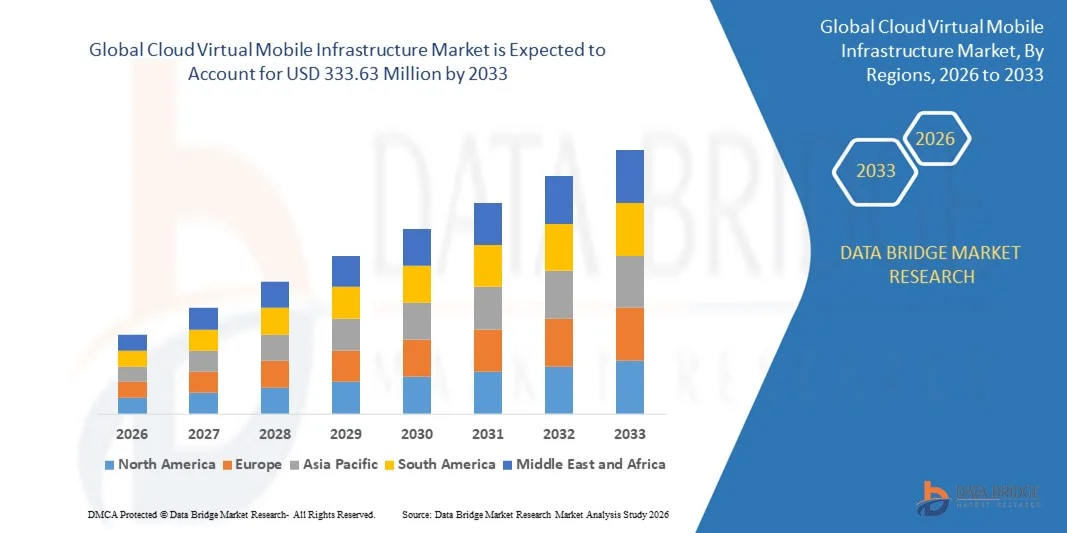
Cloud Virtual Mobile Infrastructure Market Size
- The global cloud virtual mobile infrastructure market size was valued at USD 165.00 million in 2025 and is expected to reach USD 333.63 million by 2033, at a CAGR of 9.20% during the forecast period
- The market growth is largely fueled by the growing adoption of mobile-first enterprise strategies and the increasing reliance on cloud-based solutions for secure mobile device management, leading to enhanced digitalization and workforce mobility across both SMEs and large enterprises
- Furthermore, rising enterprise demand for secure, scalable, and easily manageable mobile infrastructure solutions is establishing CVMI platforms as the preferred choice for centralized mobile application management and endpoint security. These converging factors are accelerating the adoption of CVMI solutions, thereby significantly boosting the market’s growth
Cloud Virtual Mobile Infrastructure Market Analysis
- Cloud Virtual Mobile Infrastructure platforms, enabling secure access, remote workforce management, and centralized monitoring of mobile endpoints, are increasingly critical components of modern enterprise IT environments in both corporate and public-sector settings due to their efficiency, security, and flexibility
- The escalating demand for CVMI solutions is primarily driven by the widespread adoption of BYOD policies, growing mobile workforce requirements, and enterprises’ increasing need for secure application delivery and compliance with data protection regulations
- North America dominated the cloud virtual mobile infrastructure market in 2025, due to the rapid adoption of mobile-first enterprise strategies and increasing reliance on cloud-based solutions for secure device management
- Asia-Pacific is expected to be the fastest growing region in the cloud virtual mobile infrastructure market during the forecast period due to increasing mobile workforce adoption, rising cloud computing penetration, and technological advancements in countries such as China, Japan, and India
- Platforms segment dominated the market with a market share of 63% in 2025, due to the increasing demand for centralized management of mobile devices and applications across enterprise environments. Organizations prioritize platforms for their ability to streamline app deployment, enhance security protocols, and provide robust analytics for mobile device usage. The market growth is also supported by platforms offering multi-OS support and seamless integration with existing IT infrastructure, ensuring operational efficiency. Platforms further gain traction due to their role in supporting enterprise mobility strategies, enabling remote workforce management, and reducing IT overhead. Advanced platform solutions with automated policy enforcement and real-time monitoring capabilities strengthen their adoption across sectors
Report Scope and Cloud Virtual Mobile Infrastructure Market Segmentation
|
Attributes |
Cloud Virtual Mobile Infrastructure Key Market Insights |
|
Segments Covered |
|
|
Countries Covered |
North America
Europe
Asia-Pacific
Middle East and Africa
South America
|
|
Key Market Players |
|
|
Market Opportunities |
|
|
Value Added Data Infosets |
In addition to the market insights such as market value, growth rate, market segments, geographical coverage, market players, and market scenario, the market report curated by the Data Bridge Market Research team includes in-depth expert analysis, import/export analysis, pricing analysis, production consumption analysis, and pestle analysis. |
Cloud Virtual Mobile Infrastructure Market Trends
Rise of Cloud-Based Mobile Infrastructure for Enterprise Mobility
- Cloud Virtual Mobile Infrastructure (VMI) is gaining momentum due to enterprises’ growing need to enable secure remote access to mobile applications and data from any device and location. This trend supports workforce mobility and enhances business agility through cloud-hosted virtual mobile environments that deliver applications without data leaving secure servers.
- For instance, VMware’s Workspace ONE platform combines cloud VMI with unified endpoint management to provide seamless and secure mobile experiences across varied devices, facilitating remote work and BYOD policies
- The adoption of cloud VMI solutions is accelerated by increasing concerns around data security and governance, as these platforms ensure sensitive corporate data remains within controlled cloud environments rather than on physical mobile devices
- Cloud VMI also enables rapid deployment and scaling of mobile services, allowing enterprises to quickly onboard users and support fluctuating workforce sizes without the constraints of traditional device management
- Integration with emerging technologies such as 5G and edge computing further enhances the performance, latency, and accessibility of virtual mobile environments, broadening their applicability across industries
- The collective effect of these trends is transforming enterprise mobility strategies, pushing organizations toward centralized, cloud-delivered mobile infrastructures that balance security, flexibility, and ease of management
Cloud Virtual Mobile Infrastructure Market Dynamics
Driver
Rising Demand for Secure, Centralized Mobile Endpoint Management
- Secure and centralized management of mobile endpoints is becoming a critical requirement as enterprises face increasing cybersecurity threats and regulatory pressures concerning mobile data protection. This drives the adoption of cloud VMI platforms that offer unified control without compromising user experience or security
- For instance, Citrix Systems has enhanced its Citrix Endpoint Management with cloud VMI capabilities, allowing IT administrators to remotely manage mobile device access and applications while maintaining strict security policies. Such advancements propel growth by addressing the security needs of a mobile workforce
- The cloud-based nature of VMI solutions also supports distributed workforces by enabling IT teams to maintain visibility and control over mobile endpoints from anywhere, reducing risks of data leakage or unauthorized access
- Enterprises benefit from simplified compliance with industry regulations as cloud VMI platforms often include audit trails and policy enforcement features that ensure mobile usage aligns with corporate standards
- The growing requirement for timely updates and patches to mobile applications and operating systems is efficiently met through cloud VMI, supporting ongoing endpoint security and performance in dynamic enterprise environments
Restraint/Challenge
Integration with Legacy IT Systems
- Integrating cloud VMI with existing legacy IT infrastructure remains a significant challenge as many enterprises still rely on traditional on-premises systems that are not natively compatible with cloud-native virtual mobile solutions. This complicates seamless deployment and interoperability
- For instance, IBM has worked on hybrid solutions that attempt to bridge legacy systems with modern cloud VMI platforms; however, customization and extensive testing are often needed to ensure smooth integration, which can delay adoption and increase costs
- Legacy infrastructure often lacks the APIs or flexible architecture necessary for real-time data exchange with cloud VMI, limiting the potential for full automation or unified endpoint management across all enterprise devices
- In addition, legacy systems may have outdated security protocols, which complicate enforcing consistent security policies across cloud VMI and traditional IT environments, increasing the risk of vulnerabilities
- Overcoming these integration hurdles requires strategic IT modernization initiatives and vendor collaboration to create adaptable solutions that facilitate coexistence between legacy and cloud virtual infrastructures, enabling broader enterprise adoption
Cloud Virtual Mobile Infrastructure Market Scope
The market is segmented on the basis of component, enterprise size, and vertical.
- By Component
On the basis of component, the Cloud Virtual Mobile Infrastructure market is segmented into platforms and services. The platforms segment dominated the market with the largest revenue share of 63% in 2025, driven by the increasing demand for centralized management of mobile devices and applications across enterprise environments. Organizations prioritize platforms for their ability to streamline app deployment, enhance security protocols, and provide robust analytics for mobile device usage. The market growth is also supported by platforms offering multi-OS support and seamless integration with existing IT infrastructure, ensuring operational efficiency. Platforms further gain traction due to their role in supporting enterprise mobility strategies, enabling remote workforce management, and reducing IT overhead. Advanced platform solutions with automated policy enforcement and real-time monitoring capabilities strengthen their adoption across sectors.
The services segment is expected to witness the fastest growth rate from 2026 to 2033, fueled by increasing reliance on managed services for mobile device management and application lifecycle support. For instance, companies such as VMware provide subscription-based CVMI services that help enterprises minimize upfront IT costs while ensuring continuous updates, security patches, and technical support. The growing complexity of mobile environments and the need for specialized expertise to maintain secure infrastructure drives demand for professional and managed services. In addition, service offerings such as consulting, integration, and 24/7 monitoring enable enterprises to focus on core operations while ensuring mobile security compliance.
- By Enterprise Size
On the basis of enterprise size, the Cloud Virtual Mobile Infrastructure market is segmented into SMEs and large enterprises. The large enterprises segment dominated the market with the largest revenue share in 2025, driven by their extensive mobile workforce and the need to maintain standardized security protocols across multiple geographies. Large enterprises prioritize CVMI solutions to enable secure access to corporate applications and data from any location, ensuring productivity and regulatory compliance. The market is further supported by the increasing adoption of bring-your-own-device (BYOD) policies, which require scalable infrastructure capable of handling diverse devices. Enterprises benefit from CVMI platforms that facilitate centralized monitoring, threat detection, and remote management of mobile endpoints. Large organizations also seek integration of CVMI solutions with other enterprise IT systems such as identity management and cloud security services, enhancing overall operational efficiency.
The SMEs segment is anticipated to witness the fastest growth from 2026 to 2033, fueled by growing digitalization and increasing awareness of mobile security solutions among smaller enterprises. For instance, startups and mid-sized firms are adopting cloud-based CVMI solutions from providers such as Citrix to reduce IT costs while ensuring secure mobile operations. SMEs find CVMI attractive for its pay-as-you-go models, simplified deployment, and minimal infrastructure requirements. The flexibility to scale services according to business needs, coupled with the ability to secure sensitive customer and business data, drives adoption in this segment. In addition, CVMI services allow SMEs to implement enterprise-grade security without significant in-house IT investment, leveling the technological playing field with larger competitors.
- By Vertical
On the basis of vertical, the Cloud Virtual Mobile Infrastructure market is segmented into BFSI, healthcare, manufacturing, IT & telecom, government, and others. The BFSI vertical dominated the market with the largest revenue share in 2025, driven by stringent regulatory requirements and the critical need to secure sensitive financial data across mobile endpoints. Financial institutions increasingly adopt CVMI solutions to enable secure mobile banking, remote workforce management, and real-time access to enterprise applications. The market growth is supported by platforms offering robust encryption, multi-factor authentication, and compliance with standards such as PCI DSS and GDPR. BFSI organizations prioritize CVMI solutions that reduce risk, prevent data breaches, and ensure seamless access for employees and partners. Advanced analytics and centralized management offered by CVMI platforms further enhance operational efficiency and decision-making capabilities within financial enterprises.
The IT & telecom vertical is expected to witness the fastest growth rate from 2026 to 2033, fueled by the increasing proliferation of mobile applications and demand for remote device management. For instance, telecom providers are implementing CVMI solutions from vendors such as VMware to ensure secure app distribution and consistent service delivery to mobile users. The growth is driven by enterprises requiring scalable, cloud-based solutions to manage a rapidly expanding mobile ecosystem. CVMI adoption in IT & telecom helps streamline device provisioning, enforce corporate policies, and monitor security incidents in real time. In addition, the vertical benefits from the flexibility of cloud deployment models, enabling faster innovation cycles and reduced infrastructure investment.
Cloud Virtual Mobile Infrastructure Market Regional Analysis
- North America dominated the cloud virtual mobile infrastructure market with the largest revenue share in 2025, driven by the rapid adoption of mobile-first enterprise strategies and increasing reliance on cloud-based solutions for secure device management
- Enterprises in the region prioritize centralized mobile application management, real-time monitoring, and secure access to corporate data, facilitating the adoption of CVMI solutions across both SMEs and large organizations
- This widespread adoption is further supported by high cloud penetration, a technologically advanced workforce, and strong regulatory compliance requirements, establishing CVMI as a preferred solution for managing enterprise mobility and mobile security
U.S. Cloud Virtual Mobile Infrastructure Market Insight
The U.S. CVMI market captured the largest revenue share in 2025 within North America, fueled by the swift adoption of cloud-based enterprise mobility solutions and increasing demand for secure remote access. Organizations are increasingly focusing on managing a growing number of mobile endpoints, ensuring data protection and compliance with industry regulations. The growing trend of BYOD policies, combined with robust demand for seamless integration with enterprise applications and cloud platforms, further propels the CVMI market. In addition, the integration of advanced analytics, AI-based monitoring, and multi-factor authentication is significantly contributing to the market's expansion.
Europe Cloud Virtual Mobile Infrastructure Market Insight
The Europe CVMI market is projected to expand at a substantial CAGR throughout the forecast period, primarily driven by stringent data security regulations and the need for secure mobile workforce management. Growing digital transformation initiatives across enterprises are fostering CVMI adoption. Enterprises in Europe prioritize platforms and services that ensure secure mobile access, centralized device management, and compliance with GDPR and other local regulations. The market is witnessing significant growth in BFSI, healthcare, and government verticals, with organizations leveraging CVMI for both new deployments and modernization of existing infrastructure.
U.K. Cloud Virtual Mobile Infrastructure Market Insight
The U.K. CVMI market is expected to grow at a noteworthy CAGR during the forecast period, driven by increasing digitalization, demand for secure mobile access, and enterprise mobility initiatives. Organizations are adopting CVMI solutions to streamline mobile application management and ensure compliance with local cybersecurity policies. The U.K.’s strong IT infrastructure and growing reliance on cloud-based services further fuel market expansion. Moreover, demand for scalable and cost-effective CVMI solutions is rising among SMEs and large enterprises alike, promoting growth in both private and public sectors.
Germany Cloud Virtual Mobile Infrastructure Market Insight
The Germany CVMI market is expected to expand at a considerable CAGR during the forecast period, fueled by increasing awareness of mobile security and enterprise mobility solutions. Organizations in Germany prioritize CVMI platforms for secure management of mobile endpoints and compliance with strict data protection laws. The country’s focus on innovation, digital transformation, and sustainability encourages enterprises to integrate cloud-based mobile infrastructure. In addition, Germany’s well-developed IT and telecom ecosystem supports rapid deployment and adoption of CVMI solutions across BFSI, healthcare, and manufacturing verticals.
Asia-Pacific Cloud Virtual Mobile Infrastructure Market Insight
The Asia-Pacific CVMI market is poised to grow at the fastest CAGR during the forecast period of 2026 to 2033, driven by increasing mobile workforce adoption, rising cloud computing penetration, and technological advancements in countries such as China, Japan, and India. Enterprises in the region are increasingly investing in cloud-based mobile infrastructure to support remote work and enhance data security. Government initiatives promoting digitalization, along with the growing SME sector, are further driving market growth. The availability of cost-effective solutions and local vendors in APAC is expanding CVMI accessibility across enterprises of all sizes.
Japan Cloud Virtual Mobile Infrastructure Market Insight
The Japan CVMI market is gaining momentum due to the country’s technology-driven enterprises, high mobile device adoption, and focus on secure remote workforce solutions. Japanese organizations emphasize centralized mobile application management and secure access to sensitive enterprise data. Integration of CVMI solutions with existing IT systems, IoT devices, and cloud platforms is driving adoption. Moreover, Japan’s aging workforce and demand for user-friendly, efficient mobile solutions are supporting growth in both SMEs and large enterprises.
China Cloud Virtual Mobile Infrastructure Market Insight
The China CVMI market accounted for the largest market revenue share in Asia-Pacific in 2025, attributed to rapid enterprise digitalization, increasing mobile device penetration, and strong IT infrastructure. Chinese enterprises are adopting CVMI solutions to manage growing mobile endpoints, secure sensitive data, and enable remote workforce management. The push towards smart enterprises, combined with availability of affordable cloud-based CVMI platforms and strong domestic vendors, is propelling market growth. CVMI adoption spans multiple verticals including BFSI, IT & telecom, and manufacturing, reinforcing China’s position as a key contributor to the Asia-Pacific market.
Cloud Virtual Mobile Infrastructure Market Share
The cloud virtual mobile infrastructure industry is primarily led by well-established companies, including:
- Trend Micro Incorporated (U.S.)
- Avast Software s.r.o. (Czech Republic)
- Sierraware (U.S.)
- Nubo Software Ltd. (U.K.)
- Intelligent Waves LLC (U.S.)
- Pulse Secure, LLC (U.S.)
- Raytheon Technologies Corporation (U.S.)
- Prescient Solutions (U.S.)
- Fortinet, Inc. (U.S.)
- Space-O Technologies (India)
- JFG Inc (U.S.)
- Forcepoint (U.S.)
- Workspot, Inc. (U.S.)
Latest Developments in Global Cloud Virtual Mobile Infrastructure Market
- In September 2025, VMware showcased VCF 9.0 with AI-native features, upgraded GPU monitoring, and extended platform lifecycle support. This innovation impacts the CVMI market by embedding virtual mobile infrastructure within broader enterprise cloud ecosystems, reducing adoption friction, enhancing appeal to large enterprises, and improving integration of mobile security, access control, and virtualization capabilities with existing cloud infrastructure
- In August 2025, Broadcom Inc. expanded integration of the VMware Cloud Foundation platform with next-generation GPUs, enabling enterprises and cloud providers to deploy and scale AI workloads alongside mobile infrastructure services. This development strengthens the CVMI market by positioning virtual mobile infrastructure as part of advanced enterprise workloads, boosting demand for platforms that manage mobile endpoints, application delivery, and virtual mobile environments within cloud and edge infrastructures
- In March 2025, market research highlighted strong projected growth for the global CVMI market, reflecting increasing enterprise focus on secure mobile access and virtualized mobile environments. This market attention encourages vendors to accelerate product development, partnerships, and service offerings, indirectly driving adoption of CVMI solutions for remote work, mobile application management, and secure enterprise mobility
- In February 2025, Arrcus Inc. announced support for the VMware Telco Cloud Platform to enhance distributed data-center and edge infrastructure capabilities. The impact on the CVMI market is significant as it enables deployment of mobile application streaming and virtual mobile endpoints across distributed environments, expanding the addressable market beyond traditional centralized deployments and supporting telco and edge use cases
- In February 2025, following Broadcom’s acquisition of VMware, strategic consolidation around enterprise cloud and virtualization offerings gained momentum. This shift impacts the CVMI market by integrating mobile infrastructure capabilities into broader platform suites, increasing competition, fostering bundled enterprise solutions, and accelerating adoption of CVMI platforms within large-scale enterprise environments

- Interactive Data Analysis Dashboard
- Company Analysis Dashboard for high growth potential opportunities
- Research Analyst Access for customization & queries
- Competitor Analysis with Interactive dashboard
- Latest News, Updates & Trend analysis
- Harness the Power of Benchmark Analysis for Comprehensive Competitor Tracking
Data collection and base year analysis are done using data collection modules with large sample sizes. The stage includes obtaining market information or related data through various sources and strategies. It includes examining and planning all the data acquired from the past in advance. It likewise envelops the examination of information inconsistencies seen across different information sources. The market data is analysed and estimated using market statistical and coherent models. Also, market share analysis and key trend analysis are the major success factors in the market report. To know more, please request an analyst call or drop down your inquiry.
The key research methodology used by DBMR research team is data triangulation which involves data mining, analysis of the impact of data variables on the market and primary (industry expert) validation. Data models include Vendor Positioning Grid, Market Time Line Analysis, Market Overview and Guide, Company Positioning Grid, Patent Analysis, Pricing Analysis, Company Market Share Analysis, Standards of Measurement, Global versus Regional and Vendor Share Analysis. To know more about the research methodology, drop in an inquiry to speak to our industry experts.
Data Bridge Market Research is a leader in advanced formative research. We take pride in servicing our existing and new customers with data and analysis that match and suits their goal. The report can be customized to include price trend analysis of target brands understanding the market for additional countries (ask for the list of countries), clinical trial results data, literature review, refurbished market and product base analysis. Market analysis of target competitors can be analyzed from technology-based analysis to market portfolio strategies. We can add as many competitors that you require data about in the format and data style you are looking for. Our team of analysts can also provide you data in crude raw excel files pivot tables (Fact book) or can assist you in creating presentations from the data sets available in the report.













