


What is the CNG, RNG, and Hydrogen Tanks Market Size and Growth Rate?
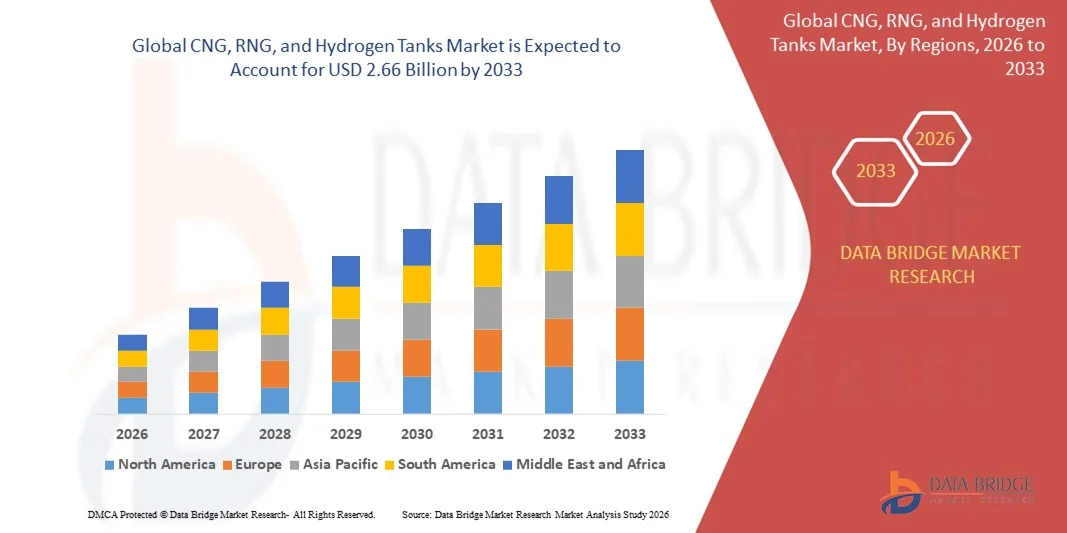
- As per Data Bridge Market Research Analysis the global CNG, RNG, and Hydrogen Tanks Market size was valued at USD 1.42 billion in 2025 and is expected to reach USD 2.66 billion by 2033, at a CAGR of 8.20% during the forecast period.
- The market growth is primarily driven by increasing adoption of alternative fuels and the shift towards decarbonization in the transportation and industrial sectors, promoting cleaner and more sustainable energy storage solutions.
- Additionally, rising government initiatives and incentives supporting green energy infrastructure, along with advancements in high-pressure tank technologies, are encouraging wider deployment of CNG, RNG, and hydrogen storage systems, further propelling the market expansion.
Market Size & Forecast
Global Market Value (2025): USD 1.42 billion
Expected Market Value (2033): USD 2.66 billion
Forecast CAGR (2026–2033): 8.20%
What are the Major Takeaways of CNG, RNG, and Hydrogen Tanks Market?
- CNG, RNG, and hydrogen tanks, providing high-pressure storage solutions for alternative fuels, are becoming essential components in the transition to cleaner energy across transportation, industrial, and commercial sectors due to their safety, efficiency, and compatibility with emerging fuel technologies.
- The rising demand for these tanks is primarily driven by increasing adoption of alternative fuel vehicles, government regulations promoting decarbonization, and growing emphasis on reducing greenhouse gas emissions in energy-intensive industries.
- Asia-Pacific dominated the Global CNG, RNG, and Hydrogen Tanks Market with the largest revenue share of 34.3% in 2025, supported by strong government incentives, established fueling infrastructure, and the presence of key industry players, with the U.S. witnessing significant growth in hydrogen and RNG storage deployments, particularly in commercial fleets and industrial applications.
- Europe is expected to be the fastest-growing region in the Global CNG, RNG, and Hydrogen Tanks Market during the forecast period due to rapid industrialization, increasing adoption of alternative fuel vehicles, and expanding investments in clean energy infrastructure.
- The CNG segment dominated the market with the largest revenue share of 45.5% in 2025, driven by its widespread adoption in light and heavy-duty vehicles, established fueling infrastructure, and proven safety record.
Report Scope and Global CNG, RNG, and Hydrogen Tanks Market Segmentation
|
Attributes |
CNG, RNG, and Hydrogen Tanks Key Market Insights |
|
Segments Covered |
|
|
Countries Covered |
North America
Europe
Asia-Pacific
Middle East and Africa
South America
|
|
Key Market Players |
|
|
Market Opportunities |
|
|
Value Added Data Infosets |
In addition to the insights on market scenarios such as market value, growth rate, segmentation, geographical coverage, and major players, the market reports curated by the Data Bridge Market Research also include import export analysis, production capacity overview, production consumption analysis, price trend analysis, climate change scenario, supply chain analysis, value chain analysis, raw material/consumables overview, vendor selection criteria, PESTLE Analysis, Porter Analysis, and regulatory framework. |
What is the Key Trend in the CNG, RNG, and Hydrogen Tanks Market?
Enhanced Efficiency Through IoT and Smart Monitoring
- A significant and accelerating trend in the global CNG, RNG, and Hydrogen Tanks Market is the deepening integration of advanced IoT-enabled monitoring systems and digital platforms. This fusion of technologies is significantly improving operational efficiency, safety, and remote management of fuel storage and distribution systems.
- For instance, smart hydrogen storage tanks equipped with IoT sensors allow operators to remotely monitor pressure, temperature, and gas levels in real time, ensuring optimal performance and early detection of potential issues. Similarly, composite CNG tanks with embedded digital monitoring systems can provide predictive maintenance alerts to reduce downtime.
- AI and IoT integration in fuel storage systems enables features such as predictive leak detection, automated reporting, and optimized fuel dispensing schedules. Some advanced systems can analyze historical usage patterns to improve operational efficiency and enhance safety, sending intelligent alerts in case of irregular pressure fluctuations or potential hazards.
- The seamless integration of tanks with centralized digital management platforms facilitates unified control over multiple storage units across fleets or industrial facilities. Through a single interface, operators can monitor fuel levels, track maintenance schedules, and manage refueling operations, creating a more efficient and automated energy management ecosystem.
- This trend towards more intelligent, connected, and data-driven storage systems is fundamentally reshaping operational standards in the alternative fuels sector. Consequently, companies such as Hexagon Composites and Linde are developing IoT-enabled storage solutions with predictive analytics, remote monitoring, and automated safety protocols.
- The demand for CNG, RNG, and hydrogen tanks with integrated IoT and AI capabilities is growing rapidly across transportation, industrial, and commercial sectors, as operators increasingly prioritize safety, efficiency, and real-time visibility into fuel storage and management operations.
CNG, RNG, and Hydrogen Tanks Market Dynamics
Driver
Growing Need Due to Environmental Regulations and Alternative Fuel Adoption
- The increasing global emphasis on reducing carbon emissions, coupled with the accelerating adoption of alternative fuels, is a significant driver for the heightened demand for CNG, RNG, and hydrogen tanks.
- For instance, in 2025, the U.S. Department of Energy and the European Union announced initiatives to expand hydrogen and renewable natural gas infrastructure, encouraging the deployment of advanced high-pressure storage solutions. Such regulatory and policy-driven strategies by governments and key industry players are expected to propel market growth during the forecast period.
- As industries and transportation sectors aim to comply with stringent emissions regulations, CNG, RNG, and hydrogen tanks offer safe, efficient, and reliable storage solutions for alternative fuels, providing a compelling upgrade over conventional fossil fuel systems.
- Furthermore, the growing adoption of fuel cell vehicles, commercial fleets, and industrial applications is increasing the need for robust and technologically advanced tanks, ensuring seamless integration into broader clean energy systems.
- The rising emphasis on operational efficiency, safety, and sustainability—combined with government incentives, grants, and subsidies—are key factors driving the adoption of advanced storage tanks in both transportation and industrial sectors. The trend towards expanding clean energy infrastructure and increasing availability of user-friendly, modular tank solutions further contributes to market growth.
Restraint/Challenge
Concerns Regarding Safety Standards and High Initial Costs
- Concerns surrounding safety standards and handling of high-pressure alternative fuel storage tanks pose significant challenges to broader market penetration. As CNG, RNG, and hydrogen tanks operate under high pressure, improper installation or maintenance can lead to accidents, raising apprehensions among potential buyers.
- For instance, stringent regulatory requirements for hydrogen storage and transportation in Europe and North America require rigorous certification, which can delay deployment and add complexity to adoption.
- Addressing these safety concerns through robust tank design, rigorous testing, compliance with international standards, and clear user guidelines is crucial for building confidence among operators. Companies such as Hexagon Composites and Linde emphasize advanced composite materials and certified safety protocols in their product offerings to reassure clients. Additionally, the relatively high initial cost of advanced CNG, RNG, and hydrogen tanks compared to conventional storage solutions can be a barrier to adoption for price-sensitive customers, particularly in developing regions or smaller commercial operations.
- While costs are gradually decreasing with technological advancements and economies of scale, the perceived premium for high-performance, safety-certified tanks can still hinder widespread adoption.
- Overcoming these challenges through enhanced safety features, adherence to global standards, government incentives, and the development of more cost-effective solutions will be vital for sustained market growth.
How is the CNG, RNG, and Hydrogen Tanks Market Segmented?
CNG, RNG, and hydrogen tanks market is segmented on the basis of gas type, material, tank type and application.
- By Gas Type
On the basis of gas type, the Global CNG, RNG, and Hydrogen Tanks Market is segmented into Compressed Natural Gas (CNG), Renewable Natural Gas (RNG), and Hydrogen. The CNG segment dominated the market with the largest revenue share of 45.5% in 2025, driven by its widespread adoption in light and heavy-duty vehicles, established fueling infrastructure, and proven safety record. CNG tanks are favored for commercial fleets and public transportation due to operational efficiency and lower emissions compared to conventional fuels.
The Hydrogen segment is expected to witness the fastest CAGR of 22.3% from 2026 to 2033, fueled by the growing adoption of fuel cell vehicles, government incentives for green hydrogen infrastructure, and rising industrial demand. Technological advancements in high-pressure hydrogen storage and expanding refueling networks are further accelerating market growth for hydrogen tanks.
- By Material
On the basis of material, the Global CNG, RNG, and Hydrogen Tanks Market is segmented into Metal, Glass Fiber, and Carbon Fiber. The Metal segment accounted for the largest market revenue share of 42.7% in 2025, due to its durability, established manufacturing processes, and cost-effectiveness. Metal tanks are widely used in commercial and residential fuel storage applications where safety and long service life are prioritized.
The Carbon Fiber segment is anticipated to witness the fastest CAGR of 24.1% from 2026 to 2033, driven by increasing demand for lightweight, high-strength tanks in transportation and industrial applications. Carbon fiber tanks offer superior performance for hydrogen and high-pressure CNG storage, enabling higher fuel efficiency and improved vehicle payload capacity.
- By Tank Type
On the basis of tank type, the Global CNG, RNG, and Hydrogen Tanks Market is segmented into Type 1, Type 2, Type 3, and Type 4 tanks. The Type 1 segment dominated the market with the largest revenue share of 39.6% in 2025, owing to its all-metal construction, robustness, and cost-efficiency for conventional CNG and RNG storage. Type 1 tanks remain widely adopted in existing vehicle fleets and stationary storage applications.
The Type 4 segment is expected to witness the fastest CAGR of 23.7% from 2026 to 2033, supported by its fully composite design, lightweight structure, and high-pressure capability, making it ideal for hydrogen storage and next-generation fuel cell vehicles. Increasing investments in clean energy transport solutions are boosting the adoption of Type 4 tanks globally.
- By Application
On the basis of application, the Global CNG, RNG, and Hydrogen Tanks Market is segmented into Fuel Tank and Transportation Tank. The Fuel Tank segment held the largest market revenue share of 47.2% in 2025, driven by the extensive use of tanks in stationary fuel storage for commercial, industrial, and residential purposes. Fuel tanks are essential for fleet management, gas refueling stations, and backup energy systems, providing reliable storage and safety.
The Transportation Tank segment is expected to witness the fastest CAGR of 21.9% from 2026 to 2033, fueled by the increasing adoption of CNG, RNG, and hydrogen-powered vehicles in passenger, commercial, and public transport sectors. Rising environmental regulations and technological advancements in lightweight, high-pressure tanks are further accelerating market expansion for transportation applications.
Which Region Holds the Largest Share of the CNG, RNG, and Hydrogen Tanks Market?
- Asia-Pacific dominated the Global CNG, RNG, and Hydrogen Tanks Market with the largest revenue share of 34.3% in 2025, driven by the early adoption of alternative fuel technologies, well-established CNG and hydrogen infrastructure, and supportive government policies promoting clean energy.
- Consumers and industries in the region prioritize reliable, high-performance fuel storage solutions for commercial fleets, public transportation, and industrial applications, leading to widespread deployment of CNG, RNG, and hydrogen tanks.
- This strong market position is further supported by high disposable incomes, advanced technological infrastructure, and growing environmental awareness, encouraging both private and public sectors to adopt sustainable fuel solutions. The presence of key global players and ongoing R&D initiatives in the region are also accelerating the uptake of advanced storage technologies, establishing North America as a critical hub for the CNG, RNG, and hydrogen tanks market.
U.S. CNG, RNG, and Hydrogen Tanks Market Insight
The U.S. CNG, RNG, and Hydrogen Tanks Market captured the largest revenue share of 38% in 2025 within North America, driven by the rapid adoption of alternative fuel vehicles, expanding fleet electrification initiatives, and supportive federal and state-level clean energy policies. Increasing demand for low-emission commercial and public transport vehicles, combined with investments in refueling infrastructure and high-pressure tank technologies, is accelerating market growth. Moreover, ongoing technological advancements in lightweight, high-strength storage solutions are further contributing to the market’s expansion.
Europe CNG, RNG, and Hydrogen Tanks Market Insight
The Europe market is projected to grow at a substantial CAGR during the forecast period, primarily fueled by stringent emission regulations, the European Green Deal, and increasing adoption of clean transportation solutions. Countries such as Germany, France, and the Netherlands are witnessing rising demand for CNG, RNG, and hydrogen tanks in commercial fleets, public transport, and industrial applications. Government incentives and investments in renewable fuel infrastructure are significantly driving the market, particularly in urban and eco-sensitive regions.
U.K. CNG, RNG, and Hydrogen Tanks Market Insight
The U.K. market is anticipated to expand at a noteworthy CAGR during the forecast period, supported by initiatives to decarbonize transport and promote sustainable energy adoption. The country’s growing fleet of alternative fuel vehicles, increasing investments in CNG and hydrogen refueling stations, and favorable policy frameworks are encouraging adoption. Rising environmental awareness among consumers and commercial operators is also boosting demand for advanced fuel storage solutions.
Germany CNG, RNG, and Hydrogen Tanks Market Insight
Germany’s market is expected to grow at a considerable CAGR, driven by strong industrial demand, adoption of hydrogen-powered transport, and government-backed clean mobility programs. The country’s focus on sustainability, combined with a well-developed manufacturing and logistics infrastructure, supports the deployment of high-pressure CNG and hydrogen tanks. Germany is also witnessing rising integration of storage technologies in fleet vehicles, public transportation, and industrial applications.
Asia-Pacific CNG, RNG, and Hydrogen Tanks Market Insight
The Asia-Pacific market is poised to grow at the fastest CAGR of 23% during 2026–2033, fueled by rapid urbanization, rising disposable incomes, and increasing government initiatives for clean energy adoption. Countries such as China, Japan, and India are witnessing growing investments in alternative fuel infrastructure and fleet electrification. Technological advancements in lightweight composite tanks and the presence of domestic manufacturers are enhancing affordability and accessibility, accelerating adoption across both transportation and industrial sectors.
Japan CNG, RNG, and Hydrogen Tanks Market Insight
The Japan market is gaining momentum due to the country’s emphasis on technological innovation, environmental sustainability, and high adoption of fuel cell vehicles. The increasing number of hydrogen-powered vehicles and expanding refueling networks are driving demand for high-pressure hydrogen tanks. Japan’s aging population and urban concentration further highlight the need for safe, reliable, and easy-to-use storage solutions in residential, commercial, and public transportation sectors.
China CNG, RNG, and Hydrogen Tanks Market Insight
The China market accounted for the largest revenue share in Asia-Pacific in 2025, attributed to the country’s massive fleet of commercial vehicles, rapid urbanization, and strong government push towards clean transportation. Investments in hydrogen refueling stations, CNG infrastructure, and domestic manufacturing capabilities are key growth drivers. The widespread availability of cost-effective tanks, coupled with China’s position as a global production hub for advanced fuel storage solutions, is propelling market expansion across residential, industrial, and transportation applications.
Which are the Top Companies in CNG, RNG, and Hydrogen Tanks Market?
The CNG, RNG, and Hydrogen Tanks industry is primarily led by well-established companies, including:
- Hexagon Purus (Norway)
- Worthington Industries (U.S.)
- Air Liquide (France)
- Chart Industries (U.S.)
- Ballard Power Systems (Canada)
- Mahle GmbH (Germany)
- Luxfer Gas Cylinders (U.K.)
- Quantum Fuel Systems Technologies Worldwide (U.S.)
- CMC Composites (U.S.)
- Faber Industrie (Italy)
- Lincoln Composites (U.S.)
- Greenkraft (U.S.)
- NPROXX (Netherlands)
- Ardebar (U.K.)
- Tata Steel (India)
- Reliance Industries Limited (India)
- Haskel (U.S.)
- Linde plc (Germany)
- Faurecia (France)
- Hyundai Mobis (South Korea)
What are the Recent Developments in CNG, RNG, and Hydrogen Tanks Market?
- In April 2024, Hexagon Purus, a global leader in high-pressure gas storage solutions, launched a strategic initiative in South Africa aimed at expanding the deployment of CNG and hydrogen tanks for commercial and public transportation fleets. This initiative highlights the company’s commitment to delivering advanced, reliable fuel storage solutions tailored to regional infrastructure and environmental needs, strengthening its position in the growing global CNG, RNG, and Hydrogen Tanks Market.
- In March 2024, Worthington Industries, a U.S.-based industrial gas company, introduced its next-generation Type 4 hydrogen tank system designed for heavy-duty trucks and industrial vehicles. The new tanks feature enhanced safety, lightweight construction, and higher energy density, demonstrating the company’s dedication to advancing fuel storage technology and supporting the global transition to clean energy.
- In March 2024, Air Liquide successfully deployed a hydrogen refueling and storage infrastructure project in Bengaluru, India, aimed at supporting public transportation and industrial fleets. The project underscores Air Liquide’s focus on sustainable mobility solutions and highlights the growing importance of reliable, high-performance hydrogen tanks in urban clean energy initiatives.
- In February 2024, Chart Industries, a leading global manufacturer of cryogenic and compressed gas tanks, announced a strategic partnership with a major European public transit operator to supply CNG and hydrogen storage tanks for buses and fleet vehicles. This collaboration is designed to improve operational efficiency, enhance energy storage reliability, and accelerate the adoption of low-emission transport solutions.
- In January 2024, Ballard Power Systems introduced an advanced Type 3 composite hydrogen tank for fuel cell vehicles at the Hannover Messe 2024 industrial trade show. The tank features improved weight reduction, higher pressure tolerance, and enhanced durability, reflecting Ballard’s commitment to integrating cutting-edge materials and technology into fuel storage systems, supporting the global clean mobility transition.

- Interactive Data Analysis Dashboard
- Company Analysis Dashboard for high growth potential opportunities
- Research Analyst Access for customization & queries
- Competitor Analysis with Interactive dashboard
- Latest News, Updates & Trend analysis
- Harness the Power of Benchmark Analysis for Comprehensive Competitor Tracking
Global Cng Rng And Hydrogen Tanks Market, Supply Chain Analysis and Ecosystem Framework
To support market growth and help clients navigate the impact of geopolitical shifts, DBMR has integrated in-depth supply chain analysis into its Global Cng Rng And Hydrogen Tanks Market research reports. This addition empowers clients to respond effectively to global changes affecting their industries. The supply chain analysis section includes detailed insights such as Global Cng Rng And Hydrogen Tanks Market consumption and production by country, price trend analysis, the impact of tariffs and geopolitical developments, and import and export trends by country and HSN code. It also highlights major suppliers with data on production capacity and company profiles, as well as key importers and exporters. In addition to research, DBMR offers specialized supply chain consulting services backed by over a decade of experience, providing solutions like supplier discovery, supplier risk assessment, price trend analysis, impact evaluation of inflation and trade route changes, and comprehensive market trend analysis.
Data collection and base year analysis are done using data collection modules with large sample sizes. The stage includes obtaining market information or related data through various sources and strategies. It includes examining and planning all the data acquired from the past in advance. It likewise envelops the examination of information inconsistencies seen across different information sources. The market data is analysed and estimated using market statistical and coherent models. Also, market share analysis and key trend analysis are the major success factors in the market report. To know more, please request an analyst call or drop down your inquiry.
The key research methodology used by DBMR research team is data triangulation which involves data mining, analysis of the impact of data variables on the market and primary (industry expert) validation. Data models include Vendor Positioning Grid, Market Time Line Analysis, Market Overview and Guide, Company Positioning Grid, Patent Analysis, Pricing Analysis, Company Market Share Analysis, Standards of Measurement, Global versus Regional and Vendor Share Analysis. To know more about the research methodology, drop in an inquiry to speak to our industry experts.
Data Bridge Market Research is a leader in advanced formative research. We take pride in servicing our existing and new customers with data and analysis that match and suits their goal. The report can be customized to include price trend analysis of target brands understanding the market for additional countries (ask for the list of countries), clinical trial results data, literature review, refurbished market and product base analysis. Market analysis of target competitors can be analyzed from technology-based analysis to market portfolio strategies. We can add as many competitors that you require data about in the format and data style you are looking for. Our team of analysts can also provide you data in crude raw excel files pivot tables (Fact book) or can assist you in creating presentations from the data sets available in the report.













