CNG Tanks Cylinders Market Size
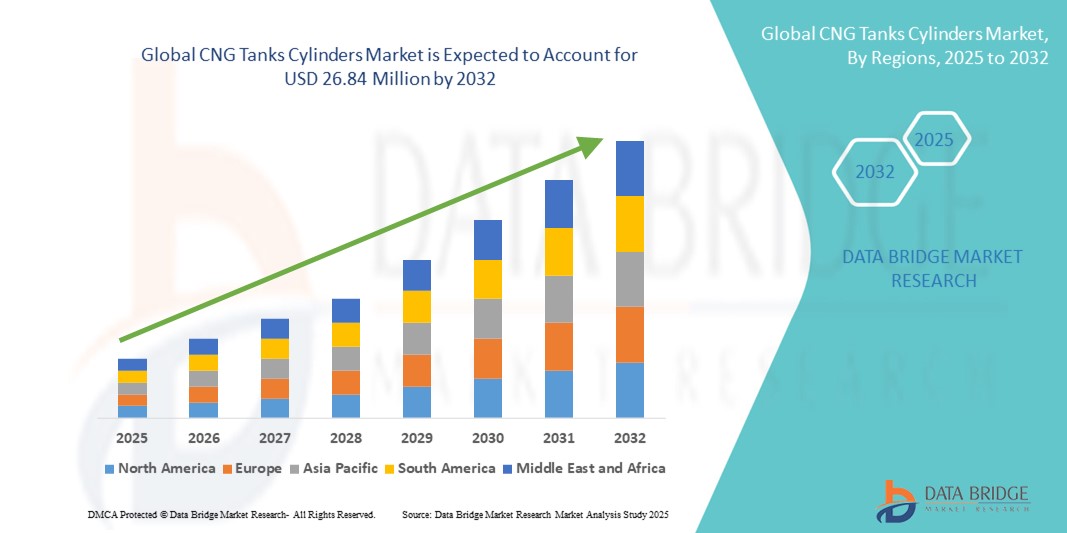
- The global CNG tanks cylinders market size was valued at USD 19.76 Million in 2024 and is expected to reach USD 26.84 Million by 2032, at a CAGR of 3.90% during the forecast period
- The market growth is largely fueled by the growing adoption and technological progress within clean energy storage systems and alternative fuel infrastructure, leading to increased deployment of CNG tanks and cylinders across automotive and industrial applications
- Furthermore, rising consumer demand for cost-effective, environmentally friendly, and high-efficiency fuel solutions is establishing CNG tanks and cylinders as a preferred storage option for compressed natural gas. These converging factors are accelerating the uptake of CNG tanks and cylinder solutions, thereby significantly boosting the industry's growth
CNG Tanks Cylinders Market Analysis
- CNG (Compressed Natural Gas) tanks and cylinders, used primarily for storing natural gas in vehicles and industrial applications, are increasingly vital in supporting the global shift toward cleaner alternative fuels and reducing dependence on conventional fossil fuels
- The growing adoption of CNG vehicles in both public and private transportation sectors, combined with supportive government initiatives to curb emissions, is significantly accelerating the demand for high-pressure, lightweight, and durable CNG tanks and cylinders
- North America dominated the CNG tanks cylinders market with the largest revenue share of 36.5% in 2024, driven by strong adoption of natural gas vehicles (NGVs), favorable emission regulations, and the presence of a well-developed CNG refueling infrastructure
- Asia-Pacific is expected to be the fastest-growing region in the CNG tanks cylinders market during the forecast period, fueled by rapid urbanization, rising environmental awareness, and growing demand for cost-effective transportation alternatives. Countries like India, China, and Pakistan are witnessing substantial adoption of CNG vehicles due to government subsidies, rising fuel prices, and air pollution concerns
- The On-board CNG tanks segment dominated the CNG tanks cylinders market with a market share of 72.4% in 2024, fueled by rising adoption of CNG-powered vehicles across various transportation sectors. These tanks are increasingly integrated into both OEM-installed systems and retrofitted solutions in light and heavy-duty vehicles. Their wide usage is driven by growing environmental concerns, government incentives for clean fuel adoption, and the need for cost-effective alternatives to diesel and petrol
Report Scope and CNG Tanks Cylinders Market Segmentation
|
Attributes |
CNG Tanks Cylinders Key Market Insights |
|
Segments Covered |
|
|
Countries Covered |
North America
Europe
Asia-Pacific
Middle East and Africa
South America
|
|
Key Market Players |
|
|
Market Opportunities |
|
|
Value Added Data Infosets |
In addition to the insights on market scenarios such as market value, growth rate, segmentation, geographical coverage, and major players, the market reports curated by the Data Bridge Market Research also include in-depth expert analysis, pricing analysis, brand share analysis, consumer survey, demography analysis, supply chain analysis, value chain analysis, raw material/consumables overview, vendor selection criteria, PESTLE Analysis, Porter Analysis, and regulatory framework. |
CNG Tanks Cylinders Market Trends
Enhanced Efficiency and Sustainability in Clean Fuel Storage
- A significant and accelerating trend in the global CNG tanks cylinders market is the rising demand for lightweight, high-strength cylinders that offer enhanced storage capacity and longer service life. These advancements are enabling greater fuel efficiency, vehicle performance, and reduced carbon emissions, particularly in the transportation and logistics sectors
- For instance, manufacturers are increasingly focusing on the development of Type III and Type IV composite cylinders, which combine durability with reduced weight. This makes them ideal for applications in commercial vehicles, buses, and long-haul transport, where weight reduction translates directly into better mileage and reduced operational costs
- In addition, increasing government support in the form of emission regulations, subsidies for alternative fuel vehicles, and investments in CNG infrastructure is playing a key role in boosting the market. Public transit agencies across North America, Europe, and Asia-Pacific are rapidly adopting CNG buses and fleet vehicles, creating strong demand for safe, efficient, and pressure-resistant cylinder systems
- The market is also witnessing growing adoption in stationary and industrial applications, such as power generation, backup energy systems, and remote fueling stations. In these sectors, CNG tanks offer a reliable and cleaner alternative to diesel or LPG-based systems
- With increasing focus on sustainability and energy diversification, industries are turning to composite CNG tanks that reduce lifecycle emissions and align with global decarbonization goals. Additionally, improvements in valve technologies, leak-proof designs, and better inspection protocols are enhancing product reliability and safety
- The trend toward higher-capacity, longer-lasting, and safer CNG tanks is fundamentally transforming how natural gas is stored and transported. As nations look for alternatives to petroleum-based fuels, CNG tank solutions are becoming central to clean energy mobility and industrial operations
CNG Tanks Cylinders Market Dynamics
Driver
Transition Toward Lightweight and High-Performance CNG Storage Solutions
- The global CNG tanks cylinders market is undergoing a shift toward lightweight, high-pressure storage technologies, driven by the rising need for fuel-efficient, low-emission transportation. As both developed and developing nations push toward greener energy solutions, CNG is gaining traction as a reliable and cost-effective fuel alternative, especially in public transit and logistics fleets
- In response to this growing demand, leading manufacturers are advancing the development of Type IV composite cylinders, which offer superior pressure resistance, corrosion resistance, and weight reduction. These next-generation cylinders improve vehicle range and payload capacity, making them ideal for long-haul transport and heavy-duty commercial applications
- Government policies aimed at curbing vehicle emissions—such as tax incentives, infrastructure development, and fleet conversion subsidies—are further reinforcing adoption. Regions like North America, Europe, and Asia-Pacific are witnessing robust investments in CNG fueling networks, supporting the expansion of this cleaner fuel option
- In parallel, escalating diesel prices and mounting environmental concerns are encouraging fleet operators and urban transport providers to transition to CNG-powered vehicles. As a result, the need for durable and safe storage systems is propelling innovation in cylinder materials and manufacturing processes, marking a pivotal trend in the industry's evolution toward sustainable fuel technologies
Restraint/Challenge
High Initial Costs and Infrastructure Limitations
- Despite its growing popularity, the CNG tanks cylinders market faces certain challenges, particularly the high initial cost associated with composite cylinder manufacturing and vehicle conversion
- Type III and Type IV cylinders, while offering superior performance, often come with higher upfront costs, making adoption slower in price-sensitive or developing markets
- Another significant constraint is the limited availability of refueling infrastructure, especially in rural or underdeveloped areas
- In regions where CNG filling stations are sparse, consumers and businesses remain hesitant to switch from conventional fuels, slowing market penetration
- Moreover, maintenance, inspection protocols, and regulatory compliance for high-pressure gas cylinders require trained personnel and investment in safety, which can be a deterrent for smaller fleet operators or independent users
- Overcoming these challenges requires strategic government-private partnerships, localized manufacturing efforts, and the development of lightweight, cost-effective tank technologies
- In addition, expanding the CNG station network and offering financial incentives for vehicle conversion will play a critical role in driving broader market adoption
CNG Tanks Cylinders Market Scope
The market is segmented on the basis of material type, vehicle type, application, end-use, composite type, and distribution channel.
- By Material Type
On the basis of material type, the CNG tanks cylinders market is segmented into Type I (Metal), Type II (Metal Liner with Hoop-Wrapped Composite), Type III (Metal Liner with Fully Wrapped Composite), and Type IV (Full Composite). Type I cylinders held the largest market share of 38.5% in 2024, due to their low cost, mechanical durability, and ease of production. These all-metal cylinders are predominantly used in stationary and industrial systems where vehicle weight is not a primary concern. Their affordability makes them a practical solution for regions with cost-sensitive industries and limited access to composites.
Type IV cylinders are projected to grow at the fastest CAGR of 10.2% from 2025 to 2032, owing to their lightweight structure and high-pressure tolerance. Constructed entirely from advanced composites, they drastically reduce vehicle weight, improving both range and fuel efficiency. These tanks are favored by automakers seeking to comply with emission standards while optimizing performance. Their corrosion resistance, safety at extreme pressures, and suitability for demanding transport operations are fueling their rapid adoption in light- and heavy-duty CNG vehicles.
- By Vehicle Type
On the basis of vehicle type, the market is segmented into Light-Duty Vehicles, Medium-Duty Vehicles, and Heavy-Duty Vehicles. Light-duty vehicles accounted for the largest revenue share of 45.8% in 2024, driven by surging demand for economical and environmentally-friendly urban transport. Increasing fuel prices and supportive government incentives have encouraged individual car owners and taxi operators to shift toward CNG-powered vehicles. Automakers are now offering factory-fitted CNG variants, especially in countries like India, Brazil, and Iran.
Heavy-duty vehicles are expected to record the fastest CAGR of 9.8% during 2025–2032, due to the growing preference for clean and efficient logistics and transit solutions. CNG trucks and buses equipped with larger, high-capacity cylinders are becoming integral to public and commercial fleets. With regulatory bodies enforcing stricter emission controls, the cost-effectiveness and long-range capabilities of CNG systems are propelling adoption in long-haul transport and city bus networks.
- By Application
On the basis of application, the market is segmented into On-board CNG Tanks and Stationary CNG Tanks. On-board CNG tanks dominated the market with a 72.4% share in 2024, driven by increasing adoption of CNG-powered passenger cars, trucks, and buses. These tanks are installed directly into vehicles and are critical to efficient fuel storage and delivery. As global emission standards tighten, OEMs and consumers alike are favoring CNG systems for both economic and environmental benefits.
Stationary CNG tanks are projected to grow at a CAGR of 7.1% from 2025 to 2032, largely due to their vital role in CNG refueling stations and storage hubs. These tanks store high-pressure gas and ensure consistent supply to vehicles and industrial equipment. With growing investment in alternative fuel infrastructure and government-backed initiatives to expand refueling networks, especially in Asia and Africa, this segment is witnessing accelerated development.
- By End-Use
On the basis of end-use, the market is segmented into transportation and industrial. Transportation emerged as the leading end-use segment with a market share of 81.6% in 2024, propelled by the widespread transition to clean fuels across both public and private sectors. The deployment of CNG tanks in taxis, buses, company fleets, and private vehicles is surging, supported by favorable regulations and subsidies. As cities seek to decarbonize mobility, CNG presents a low-cost, low-emission alternative to traditional fuels. The growing availability of CNG models and infrastructure further cements this segment’s dominance.
The industrial segment is forecasted to grow at a CAGR of 6.4% from 2025 to 2032, as industries integrate cleaner energy solutions into operations. CNG cylinders are increasingly being utilized in backup power systems, heating equipment, and remote industrial facilities. With global pressure to reduce emissions from heavy industries, CNG is gaining popularity as a sustainable and cost-effective fuel source for off-grid energy and machinery use.
- By Composite Type
On the basis of composite type, the market is segmented into Carbon Fiber Reinforced Composite and Glass Fiber Reinforced Composite. Carbon fiber reinforced composites held the largest market share of 66.1% in 2024, owing to their exceptional strength-to-weight ratio and durability under high-pressure environments. These composites are particularly useful in mobile applications where vehicle performance and fuel efficiency are critical. Carbon fiber cylinders are widely adopted in both OEM and aftermarket segments for passenger and commercial vehicles.
Glass fiber composites are anticipated to grow at a CAGR of 6.9% from 2025 to 2032, due to their cost-effectiveness and sufficient durability for lower-pressure applications. These cylinders are commonly deployed in less demanding environments, such as short-range vehicles or aftermarket retrofits. In developing countries where cost is a decisive factor, glass fiber tanks provide an accessible solution for CNG adoption in basic transport and industrial settings.
- By Distribution Channel
On the basis of distribution channel, the market is segmented into OEM (Original Equipment Manufacturer) and Aftermarket. OEM channels accounted for the largest share of 69.7% in 2024, driven by the proactive integration of CNG systems into newly manufactured vehicles. Automakers are increasingly aligning with environmental mandates and consumer preferences by offering factory-fitted CNG variants. This trend ensures better performance, system compatibility, and compliance with safety norms. OEM-fitted cylinders also appeal to customers due to warranty coverage, reliability, and regulatory approval.
The aftermarket segment is expected to grow at a CAGR of 7.8% from 2025 to 2032, thanks to the growing demand for retrofitting existing gasoline and diesel vehicles. Budget-conscious individuals and fleet operators are switching to CNG to cut fuel costs while minimizing their carbon footprint. The expanding availability of certified conversion kits and trained service providers is making the retrofit process more efficient and attractive, especially in emerging economies.
CNG Tanks Cylinders Market Regional Analysis
- North America held the largest revenue share of 36.5% in 2024 in the global CNG tanks cylinders market, reflecting the region’s strong commitment to decarbonizing the transport sector. The presence of vast natural gas reserves in the U.S. and Canada makes CNG a domestically sourced, cost-efficient fuel alternative
- The region has seen increasing adoption of CNG-powered heavy-duty trucks, school buses, waste management fleets, and public transit vehicles, driven by the dual advantages of lower operating costs and reduced emissions
- Key state-level initiatives, such as the California Low Carbon Fuel Standard and federal clean energy tax credits, continue to stimulate demand for advanced, lightweight composite CNG cylinders
U.S. CNG Tanks Cylinders Market Insight
The U.S. CNG tanks cylinders market accounts for 55% of North America’s market in 2024, largely due to aggressive decarbonization goals, government funding for cleaner fleets, and the presence of major tank and cylinder manufacturers. Local gas utilities are partnering with commercial fleet operators to transition to renewable natural gas (RNG), further enhancing the sustainability profile of CNG systems. Demand for Type IV composite cylinders, which are lightweight and corrosion-resistant, is growing in the U.S. due to their enhanced safety and performance in long-haul and high-pressure applications.
Europe CNG Tanks Cylinders Market Insight
The Europe CNG tanks cylinders market is projected to grow at a robust CAGR over the forecast period, backed by stringent climate regulations such as the European Green Deal, EU Clean Vehicles Directive, and Euro 6 emission standards. The multi-modal adoption of CNG—including buses, delivery vans, taxis, and waste collection vehicles—is a major growth lever in countries like Germany, Italy, and Spain. EU-funded initiatives aimed at cross-border CNG refueling corridors are strengthening the infrastructure backbone necessary to support regional transportation. Environmental awareness among consumers and logistics providers, combined with attractive subsidies for vehicle conversion, is further accelerating CNG vehicle and tank cylinder adoption.
Germany CNG Tanks Cylinders Market Insight
The Germany CNG tanks cylinders market is at the forefront of Europe’s clean fuel movement and offers incentives on CNG vehicle purchases and fuel prices. The government also supports infrastructure expansion through the Clean Vehicle Directive, mandating public transport operators to include low- or zero-emission vehicles in their fleets. German engineering firms are focusing on developing hybrid metal-composite CNG tanks that provide a balance of cost-efficiency and structural integrity. There's a growing inclination toward dual-fuel (CNG-diesel) systems in logistics fleets, opening up new opportunities for modular and customizable CNG tank solutions.
Asia-Pacific CNG Tanks Cylinders Market Insight
The Asia-Pacific CNG tanks cylinders market is forecasted to grow at the fastest CAGR from 2025 to 2032, driven by rising urban populations, economic expansion, and energy security goals. Countries such as India, China, Pakistan, and Bangladesh are embracing CNG as a cleaner and more affordable alternative to diesel and petrol for three-wheelers, public buses, and freight transport. Government-led efforts like India's SATAT initiative (Sustainable Alternative Towards Affordable Transportation) are stimulating biogas and CNG adoption, directly impacting cylinder demand.
India CNG Tanks Cylinders Market Insight
The India CNG tanks cylinders market is one of the fastest-growing markets globally for CNG vehicles, supported by an expanding network of over 6,000 CNG stations expected by 2030. The government's "Make in India" initiative has led to an increase in domestic production of CNG tanks and composite cylinders, reducing reliance on imports and promoting affordability. Lightweight composite cylinders are gaining popularity among auto rickshaws and last-mile delivery vehicles due to ease of handling, fuel efficiency, and safety.
China CNG Tanks Cylinders Market Insight
The China CNG tanks cylinders market held the largest revenue share in the Asia-Pacific CNG tanks cylinders market in 2024, primarily due to its vast vehicle fleet, strong industrial base, and environmental focus. Provinces with high pollution levels are mandating a shift from diesel to CNG for public buses, taxis, and delivery trucks, thereby stimulating market demand. China's rapid advancements in automation and high-speed manufacturing have enabled large-scale, cost-effective production of CNG composite cylinders, helping meet domestic and export demand.
Japan CNG Tanks Cylinders Market Insight
The Japan CNG tanks cylinders market while traditionally focused on hydrogen and electric vehicles, is increasingly investing in CNG solutions for municipal services and logistics sectors, especially in cities with tight emission control zones. The demand for compact, lightweight CNG tanks is rising in urban delivery vehicles, and the country is exploring dual-energy vehicle systems (CNG-electric hybrids) for efficiency and range extension. Japan’s precision manufacturing and materials innovation also position it as a key contributor to next-generation cylinder design and testing.
CNG Tanks Cylinders Market Share
The CNG tanks cylinders industry is primarily led by well-established companies, including:
- Worthington Industries, Inc. (U.S.)
- Hexagon Composites ASA (Norway)
- Luxfer Gas Cylinders (U.K.)
- INOXCVA (India)
- NGV Technologies Inc (Belgium)
- Cobham Mission Systems (U.S.)
- Beijing Tianhai Industry Co., Ltd. (China)
- Lianyungang Zhongfu Lianzhong Composites Group Co., Ltd. (China)
- Sinomatech Wind Power Blade Co., Ltd. (China)
- CNG United (U.S.)
- North American Cylinders Inc. (U.S.)
- Everest Kanto Cylinder Ltd. (India)
- Navdeep Industries (India)
- Maven Composite Materials Co., Ltd. (Taiwan)
- Quantum Fuel Systems Technologies Worldwide, Inc. (U.S.)
- Shaanxi Tianren Organic Co., Ltd. (China)
- AVANCO GmbH (Germany)
- Faber Industrie S.p.A. (Italy)
Latest Developments in Global CNG Tanks Cylinders Market
- In July 2024, Bengal Gas Company Ltd (BGCL) announced plans to expand CNG infrastructure in Kolkata, India. The company aims to increase the number of CNG stations from 18 to 30 by the end of 2025 and connect 25,000 households with piped natural gas. This development supports the growing adoption of clean fuel alternatives in Eastern India
- In June 2024, the Metropolitan Transport Corporation (MTC) in Chennai, India, signed an agreement with Torrent Gas and THINK Gas to convert 240 diesel buses to CNG-powered vehicles. As part of the initiative, two new CNG fueling stations will be established at major depots to meet rising demand for eco-friendly public transportation
- In August 2023, The Tiago and Tigor iCNG have been altered by Tata Motors with its dual-cylinder CNG tank technology. Tata incorporated two smaller cylinders that fit beneath the baggage are instead of a single giant CNG cylinder that takes up space in the boot. As a result, Tigor ICNG has a 70-liter CNG tank capacity
- In April 2023, The Altroz iCNG, Tata Motors' much-anticipated premium hatchback, made its formal debut. This design now boasts a new twin-cylinder CNG tank technology, making it the first vehicle in India
- In March 2021, Hexagon Composites business company Hexagon Ability has bagged an order of CNG trucks from global logistics deliver company Ups. This order will lead to establishment of sustainable fleets in environmental and economic sense

- Interactive Data Analysis Dashboard
- Company Analysis Dashboard for high growth potential opportunities
- Research Analyst Access for customization & queries
- Competitor Analysis with Interactive dashboard
- Latest News, Updates & Trend analysis
- Harness the Power of Benchmark Analysis for Comprehensive Competitor Tracking
Data collection and base year analysis are done using data collection modules with large sample sizes. The stage includes obtaining market information or related data through various sources and strategies. It includes examining and planning all the data acquired from the past in advance. It likewise envelops the examination of information inconsistencies seen across different information sources. The market data is analysed and estimated using market statistical and coherent models. Also, market share analysis and key trend analysis are the major success factors in the market report. To know more, please request an analyst call or drop down your inquiry.
The key research methodology used by DBMR research team is data triangulation which involves data mining, analysis of the impact of data variables on the market and primary (industry expert) validation. Data models include Vendor Positioning Grid, Market Time Line Analysis, Market Overview and Guide, Company Positioning Grid, Patent Analysis, Pricing Analysis, Company Market Share Analysis, Standards of Measurement, Global versus Regional and Vendor Share Analysis. To know more about the research methodology, drop in an inquiry to speak to our industry experts.
Data Bridge Market Research is a leader in advanced formative research. We take pride in servicing our existing and new customers with data and analysis that match and suits their goal. The report can be customized to include price trend analysis of target brands understanding the market for additional countries (ask for the list of countries), clinical trial results data, literature review, refurbished market and product base analysis. Market analysis of target competitors can be analyzed from technology-based analysis to market portfolio strategies. We can add as many competitors that you require data about in the format and data style you are looking for. Our team of analysts can also provide you data in crude raw excel files pivot tables (Fact book) or can assist you in creating presentations from the data sets available in the report.