


What is the Co-Robots Robotics Market Size and Growth Rate?
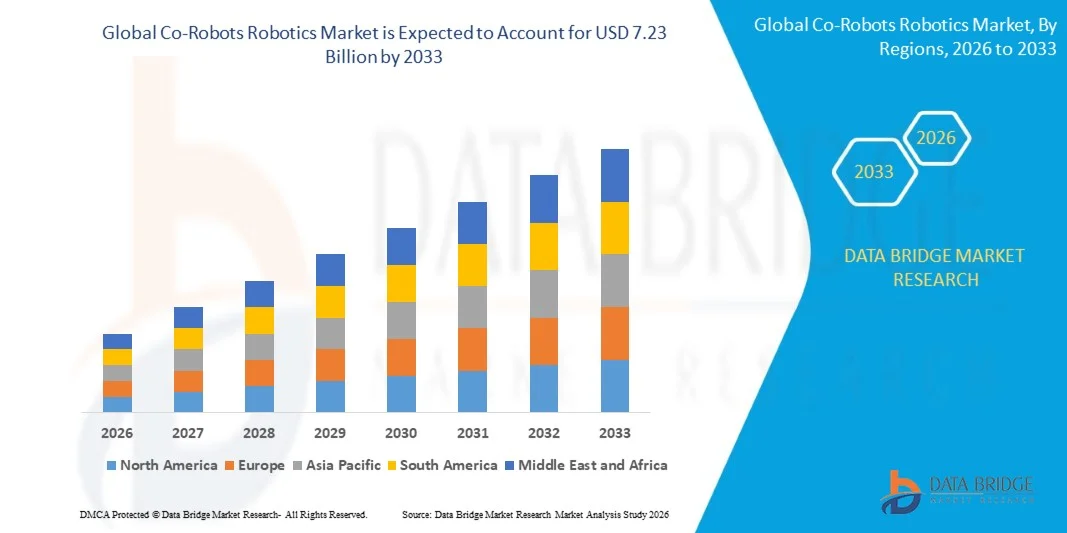
- As per market analysis, the Global Co-Robots Robotics Market was valued at approximately USD 2.95 billion in 2025 and is projected to reach USD 7.23 billion by 2033, growing at a CAGR of 23.1% from 2026 to 2033.
- The market is witnessing strong growth driven by the increasing adoption of automation across manufacturing industries, rising labor shortages, growing operational costs, and the need for flexible and cost-effective robotic solutions. The ability of collaborative robots to work safely alongside human operators, improve productivity, reduce repetitive manual tasks, and enhance workplace efficiency is further supporting market expansion.
- Increasing demand for Industry 4.0 technologies, smart manufacturing, precision assembly, machine tending, material handling, packaging, and automated quality inspection is encouraging manufacturers to deploy collaborative robots across automotive, electronics, food and beverage, pharmaceuticals, logistics, and other industrial applications. Advances in lightweight robotic arms, force and torque sensing, artificial intelligence, and easy-to-program robotic systems are further creating opportunities for market growth.
Market Size & Forecast
- Market Value (2025): USD 2.95 billion
- Expected Market Value (2033): USD 7.23 billion
- Forecast CAGR (2026–2033): 23.1%
- Leading Region in 2025: Asia-Pacific
- Fastest Growing Region: Asia-Pacific
What are the Major Takeaways of the Co-Robots Robotics Market?
- Asia-Pacific dominated the Co-Robots Robotics Market, accounting for a 51.0% revenue share in 2025, supported by rapid industrialization, expanding electronics and automotive manufacturing, increasing labor costs, rising automation investments, and growing adoption of smart manufacturing technologies. The region is expected to maintain its leading position during the forecast period.
- Asia-Pacific is also expected to witness the fastest growth, registering a CAGR of 22.1% from 2025 to 2030, supported by increasing deployment of collaborative robots across electronics, automotive, semiconductor, logistics, and manufacturing applications. China, Japan, South Korea, and India are contributing significantly to regional adoption through expanding automation and Industry 4.0 investments.
- Up to 5 kg payload capacity dominated the market, accounting for a 44.0% market share in 2025, supported by strong demand for lightweight, flexible, and easily deployable collaborative robots across assembly, pick-and-place, handling, inspection, and other applications.
- Assembly dominated the market by application, accounting for a 23.0% market share in 2025, driven by increasing demand for precision automation, flexible production systems, human-robot collaboration, and automated component handling across automotive, electronics, and industrial manufacturing. The processing segment is expected to witness strong growth at a CAGR of 20.0%, supported by increasing use of cobots for grinding, milling, cutting, and other force-sensitive operations.
- Automotive dominated the market by industry vertical, accounting for a 22.6% market share in 2025, supported by increasing adoption of cobots for assembly, machine tending, welding, painting, inspection, and material handling applications. The growing use of collaborative robots to improve productivity, address labor shortages, and enhance manufacturing flexibility is expected to further support demand across the automotive industry.
Report Scope and Co-Robots Robotics Market Segmentation
|
Attributes |
Co-Robots Robotics Key Market Insights |
|
Segments Covered |
|
|
Countries Covered |
North America
Europe
Asia-Pacific
Middle East and Africa
South America
|
|
Key Market Players |
|
|
Market Opportunities |
|
|
Value Added Data Infosets |
In addition to the insights on market scenarios such as market value, growth rate, segmentation, geographical coverage, and major players, the market reports curated by the Data Bridge Market Research also include in-depth expert analysis, geographically represented company-wise production and capacity, network layouts of distributors and partners, detailed and updated price trend analysis and deficit analysis of supply chain and demand. |
What is the Key Trend in the Co-Robots Robotics Market?
- Co-robots manufacturers are increasingly focusing on AI-enabled collaborative robotics, integrating machine vision, advanced perception, force sensing, adaptive motion control, and edge AI to enable robots to understand their surroundings, adjust movements, and perform more complex tasks while working alongside human operators.
- The development of faster, higher-payload, and more flexible co-robots is gaining traction, as manufacturers seek to extend collaborative automation from lightweight repetitive tasks toward industrial applications such as assembly, machine tending, dispensing, inspection, welding, and material handling.
- For instance, in May 2025, Universal Robots launched the UR15, its fastest collaborative robot at the time, with a maximum TCP speed of 5 m/s and a 15 kg payload. The company highlighted up to 30% cycle-time improvements for pick-and-place applications, while the UR15 was also designed to support AI-powered applications through the UR AI Accelerator developed with NVIDIA.
- Manufacturers are also expanding co-robot applications beyond conventional factory automation, with increasing adoption across healthcare, pharmaceutical workflows, laboratories, hospitality, logistics, and other environments. At the same time, mobile manipulation, natural-language interaction, no-code programming, and AI-based autonomous task execution are encouraging the transition of co-robots from programmable automation tools toward more intelligent and adaptable robotic systems.
What are the Key Drivers of the Co-Robots Robotics Market?
- Co-Robots Robotics manufacturers are increasingly focusing on AI-enabled, sensor-driven, and flexible collaborative robots to improve automation efficiency, precision, adaptability, and human-robot interaction across manufacturing environments. The integration of machine vision, force sensing, artificial intelligence, and advanced software is enabling cobots to perform increasingly complex tasks while supporting safer collaboration with human workers.
- Labor shortages and rising operational costs are encouraging manufacturers to deploy collaborative robots for repetitive, physically demanding, and precision-intensive activities. Cobots are increasingly being used for assembly, machine tending, material handling, packaging, welding, inspection, and finishing, allowing manufacturers to augment human workers while improving productivity and operational consistency.
- For instance, in May 2025, Universal Robots introduced the UR15 collaborative robot, its fastest cobot at the time, with a maximum TCP speed of 5 meters per second and up to 30% cycle-time improvement for pick-and-place applications. The launch highlighted the industry's increasing focus on higher-speed, flexible, and AI-ready collaborative robots for demanding production environments.
- Manufacturers are also increasingly integrating artificial intelligence, machine vision, and autonomous capabilities into collaborative robotics to support more flexible and less programming-intensive automation.
Which Factors are Challenging the Growth of the Co-Robots Robotics Market?
- Safety requirements and regulatory compliance are creating challenges for collaborative robot manufacturers, as cobots operating alongside humans require application-specific risk assessments, safety-rated monitoring, force and power limitation, and appropriate safeguarding. Recent revisions to ISO 10218 and ANSI/A3 R15.06 have further emphasized that collaborative safety depends on the complete application rather than the robot alone.
- High integration and implementation complexity is limiting the adoption of co-robots, particularly among small and medium-sized manufacturers. Programming, end-effector selection, safety integration, manufacturing-system connectivity, and application engineering can require specialized technical expertise, increasing the overall deployment burden. Research published in 2025 identified the extensive domain knowledge required for programming advanced human-robot collaboration systems as a key implementation challenge.
- For instance, in June 2025, Comau launched its MyCo family of six collaborative robots at Automatica 2025, highlighting quick installation, easy programming, and rapid redeployment to reduce integration complexity. The launch demonstrates how manufacturers are increasingly addressing programming and deployment barriers through lightweight designs and simplified programming capabilities.
- High total deployment costs and the need for specialized components are also challenging market expansion, as the cost of end-effectors, safety systems, software, integration, and programming can increase the overall investment beyond the initial robot purchase price. These costs can be particularly restrictive for smaller manufacturers with limited automation budgets, despite the availability of more compact and flexible cobot solutions.
How is the Co-Robots Robotics Market Segmented?
The market is segmented on the basis of Payload Capacity, Application, and Industry Vertical.
- By Payload Capacity
On the basis of payload capacity, the Co-Robots Robotics Market is segmented into Up to 5kg, Up to 10kg, and Above 10kg. The Up to 5kg segment held the largest market revenue share of 44.0% in 2025, supported by increasing demand for compact, lightweight, flexible, and cost-efficient collaborative robots for precision handling, assembly, pick-and-place, packaging, and quality inspection operations. The segment is further supported by increasing adoption among small and medium-sized enterprises seeking easily deployable automation solutions.
The Above 10kg segment is expected to witness the fastest growth during the forecast period, driven by increasing demand for heavy-duty material handling, palletizing, machine tending, and other physically demanding industrial applications. The segment is projected to register a CAGR 24% from 2026 to 2033, supported by the growing adoption of high-payload collaborative robots in large-scale manufacturing and warehouse automation.
- By Application
On the basis of application, the Co-Robots Robotics Market is segmented into Assembly, Pick & Place, Handling, Packaging, Quality Testing, Machine Tending, Gluing & Welding, and Others. The Assembly segment held the largest market revenue share of 23.0% in 2025, supported by increasing demand for high-precision component alignment, consistent production quality, flexible automation, and reduced human error across manufacturing operations.
The Gluing & Welding segment is expected to witness the fastest growth during the forecast period, driven by increasing demand for precise material bonding, uniform welding quality, automated process control, and reduced material waste. The adoption of sensor-enabled collaborative robots and advanced motion-control technologies is further supporting the use of cobots in these specialized manufacturing applications.
- By Industry Vertical
On the basis of industry vertical, the Co-Robots Robotics Market is segmented into Automotive, Food & Beverage, Furniture & Equipment, Plastic & Polymers, Metal & Machinery, Electronics, Pharma, and Others. The Automotive segment held the largest market revenue share of 25.0% in 2025, supported by increasing deployment of collaborative robots for component assembly, machine tending, welding assistance, material handling, and quality inspection.
The Electronics segment is expected to witness the fastest growth during the forecast period, driven by increasing demand for precision assembly, component handling, inspection, and flexible automation across electronics manufacturing. The growing adoption of smart manufacturing technologies and the need for high-precision repetitive operations are further supporting the deployment of collaborative robots in electronics production environments.
Which Region Holds the Largest Share of the Co-Robots Robotics Market?
- Asia-Pacific dominated the Co-Robots Robotics Market with the largest revenue share of 51.0% in 2025, supported by rapid industrialization, expansion of manufacturing hubs, increasing adoption of Industry 4.0 technologies, rising labor costs, workforce shortages, and growing deployment of collaborative robots across electronics, automotive, semiconductor, and e-commerce logistics operations. The region is further supported by increasing investments in smart factories, robotics infrastructure, and cost-efficient automation technologies across China, Japan, South Korea, and other Asian manufacturing economies.
- Asia-Pacific is expected to witness the fastest growth at a CAGR of 22.1% from 2025 to 2030, supported by rapid automation adoption across electronics, semiconductor, automotive, and manufacturing industries, increasing labor costs, government support for industrial automation, expansion of smart manufacturing, and growing demand for precision and flexible production systems. China, Japan, South Korea, Taiwan, and India are contributing to regional growth through investments in advanced manufacturing, electronics production, and Industry 4.0 technologies.
U.S. Co-Robots Robotics Insight
The U.S. Co-Robots Robotics Market is experiencing strong adoption, supported by increasing automation across automotive, electronics, semiconductor, logistics, and consumer goods manufacturing. Persistent labor shortages, rising operational costs, and the need for flexible production are encouraging manufacturers to deploy collaborative robots for assembly, pick-and-place, packaging, machine tending, and quality testing. The integration of artificial intelligence, machine vision, and intuitive programming is further improving cobot adaptability and enabling closer human-robot collaboration. Growing reshoring activities and investments in advanced manufacturing are also creating favorable opportunities for collaborative robotics adoption across the country.
Europe Co-Robots Robotics Insight
Europe is witnessing increasing adoption of Co-Robots Robotics, supported by the region’s advanced manufacturing infrastructure, strong focus on industrial automation, labor shortages, and demand for flexible and precision-oriented production solutions. Germany remains a key market, driven by its established automotive, electronics, machinery, and Industry 4.0 ecosystem. The adoption of collaborative robots is also expanding across logistics, food and beverage, healthcare, and electronics applications. Increasing integration of artificial intelligence, machine vision, and intuitive programming is further enhancing cobot capabilities and supporting their deployment among both large manufacturers and small and medium-sized enterprises.
U.K. Co-Robots Robotics Insight
The U.K. Co-Robots Robotics Market is witnessing increasing adoption, supported by advanced manufacturing infrastructure, rising labor costs, workforce shortages, and growing demand for flexible automation across semiconductor, electronics, precision engineering, and manufacturing applications. Government initiatives supporting robotics adoption and Industry 4.0 are further strengthening market development. The increasing need to improve productivity, operational efficiency, and manufacturing competitiveness is encouraging businesses to integrate collaborative robots into production environments. In addition, efforts to provide clearer workplace safety guidance for cobots are expected to improve adoption confidence among manufacturers and SMEs.
Germany Co-Robots Robotics Insight
Germany represents a strong market for Co-Robots Robotics, supported by its advanced manufacturing base, strong automotive and electronics industries, and established Industry 4.0 ecosystem. Collaborative robots are increasingly being adopted to improve production flexibility, support workers, and automate repetitive and physically demanding tasks. Growing labor shortages, demand for precision manufacturing, and the expansion of smart factories are further encouraging cobot deployment. Germany’s strong engineering capabilities and increasing use of artificial intelligence, machine vision, and digital manufacturing technologies are creating additional opportunities for collaborative robotics across manufacturing and industrial applications.
Asia-Pacific Co-Robots Robotics Insight
Asia-Pacific Co-Robots Robotics Market is experiencing strong growth, supported by rapid industrial automation, expanding electronics and semiconductor manufacturing, increasing automotive production, and rising labor costs. The region benefits from established manufacturing ecosystems and growing investments in Industry 4.0, smart factories, and advanced robotics technologies. China, Japan, South Korea, Taiwan, and India are emerging as important adoption centers, with manufacturers increasingly deploying collaborative robots for assembly, handling, inspection, machine tending, and precision manufacturing. Government support for automation and growing demand for flexible production systems are further strengthening regional market opportunities.
Japan Co-Robots Robotics Insight
Japan's Co-Robots Robotics Market is supported by its advanced manufacturing ecosystem, strong robotics expertise, and increasing demand for automation amid labor shortages and an aging workforce. Adoption is expanding across automotive, electronics, semiconductor, precision manufacturing, assembly, inspection, and material-handling applications. The country's established robotics supply chain and focus on precision engineering are encouraging manufacturers to integrate collaborative robots into existing production environments. Increasing investments in smart factories, AI-enabled robotics, and human-robot collaboration are further supporting market development, while growing adoption among small and medium-sized manufacturers is creating additional opportunities for flexible automation solutions.
China Co-Robots Robotics Insight
China represents a significant market for co-robots, supported by rapid manufacturing automation, increasing adoption of Industry 4.0 technologies, and strong demand from electronics, automotive, semiconductor, and logistics industries. Manufacturers are increasingly deploying collaborative robots for assembly, handling, testing, packaging, and other precision-intensive operations to improve productivity and address rising labor costs. Government-backed robotics initiatives, expanding domestic robotics capabilities, and investments in smart manufacturing are further supporting adoption. The growing presence of small and medium-sized manufacturers is also creating opportunities for flexible, easy-to-deploy cobot solutions across diverse industrial applications.
Which are the Top Companies in Co-Robots Robotics Market?
The Co-Robots Robotics industry is primarily led by well-established companies, including:
- Universal Robots A/S (Denmark)
- FANUC Corporation (Japan)
- ABB Ltd. (Switzerland)
- Techman Robot Inc. (Taiwan)
- KUKA AG (Germany)
- Yaskawa Electric Corporation (Japan)
- Doosan Robotics Inc. (South Korea)
- DENSO Corporation (Japan)
- AUBO Robotics (China)
- Kawasaki Heavy Industries, Ltd. (Japan)
- OMRON Corporation (Japan)
- Stäubli International AG (Switzerland)
- Mitsubishi Electric Corporation (Japan)
- Siasun Robot & Automation Co., Ltd. (China)
- Franka Robotics (Germany)
What are Latest Developments in Co-Robots Robotics Market?
- In July 2026, Yaskawa Electric Corporation launched the MOTOMAN-HC35 collaborative robot with a 35 kg payload capacity and 2,030 mm reach, expanding cobot capabilities for heavier workpieces and applications such as palletizing and screwdriving. The robot incorporates newly developed torque sensors, improved collision detection, and a compact design to support safer and more flexible factory automation.
- In April 2026, ABB Robotics launched its new PoWa collaborative robot family, designed to combine collaborative operation with higher speed and payload performance. The portfolio covers payloads from 7 kg to 30 kg and is powered by ABB’s OmniCore controller platform, targeting automation requirements across both small and medium-sized enterprises and larger industrial operations.
- In March 2026, ABB Robotics and NVIDIA announced a strategic partnership to develop AI-enabled autonomous industrial robots by integrating ABB’s robot training software with NVIDIA’s Omniverse simulation platform. The technology is being trialed by Foxconn and is intended to enable robots to learn in virtual environments, reducing deployment time and supporting more autonomous manufacturing and logistics operations.
- In August 2025, OPTEL Group acquired Vanguard Robotics, a specialist in end-of-line collaborative robot automation for pharmaceutical applications. The acquisition was aimed at strengthening OPTEL’s pharmaceutical automation capabilities by combining Vanguard Robotics’ cobot-based packaging solutions with OPTEL’s traceability and vision technologies for regulated manufacturing environments.
- In February 2025, Doosan Robotics signed an MOU with Thailand-based VRNJ for the supply of 300 collaborative robots across Southeast Asia. The partnership covers manufacturing applications including parts finishing, palletizing, inspection, and pick-and-place automation, while also supporting expansion across Thailand, Indonesia, the Philippines, and Vietnam.

- Interactive Data Analysis Dashboard
- Company Analysis Dashboard for high growth potential opportunities
- Research Analyst Access for customization & queries
- Competitor Analysis with Interactive dashboard
- Latest News, Updates & Trend analysis
- Harness the Power of Benchmark Analysis for Comprehensive Competitor Tracking
Global Co Robots Robotics Market, Supply Chain Analysis and Ecosystem Framework
To support market growth and help clients navigate the impact of geopolitical shifts, DBMR has integrated in-depth supply chain analysis into its Global Co Robots Robotics Market research reports. This addition empowers clients to respond effectively to global changes affecting their industries. The supply chain analysis section includes detailed insights such as Global Co Robots Robotics Market consumption and production by country, price trend analysis, the impact of tariffs and geopolitical developments, and import and export trends by country and HSN code. It also highlights major suppliers with data on production capacity and company profiles, as well as key importers and exporters. In addition to research, DBMR offers specialized supply chain consulting services backed by over a decade of experience, providing solutions like supplier discovery, supplier risk assessment, price trend analysis, impact evaluation of inflation and trade route changes, and comprehensive market trend analysis.
Data collection and base year analysis are done using data collection modules with large sample sizes. The stage includes obtaining market information or related data through various sources and strategies. It includes examining and planning all the data acquired from the past in advance. It likewise envelops the examination of information inconsistencies seen across different information sources. The market data is analysed and estimated using market statistical and coherent models. Also, market share analysis and key trend analysis are the major success factors in the market report. To know more, please request an analyst call or drop down your inquiry.
The key research methodology used by DBMR research team is data triangulation which involves data mining, analysis of the impact of data variables on the market and primary (industry expert) validation. Data models include Vendor Positioning Grid, Market Time Line Analysis, Market Overview and Guide, Company Positioning Grid, Patent Analysis, Pricing Analysis, Company Market Share Analysis, Standards of Measurement, Global versus Regional and Vendor Share Analysis. To know more about the research methodology, drop in an inquiry to speak to our industry experts.
Data Bridge Market Research is a leader in advanced formative research. We take pride in servicing our existing and new customers with data and analysis that match and suits their goal. The report can be customized to include price trend analysis of target brands understanding the market for additional countries (ask for the list of countries), clinical trial results data, literature review, refurbished market and product base analysis. Market analysis of target competitors can be analyzed from technology-based analysis to market portfolio strategies. We can add as many competitors that you require data about in the format and data style you are looking for. Our team of analysts can also provide you data in crude raw excel files pivot tables (Fact book) or can assist you in creating presentations from the data sets available in the report.













