


What is the Coated Steel Market Size and Growth Rate?
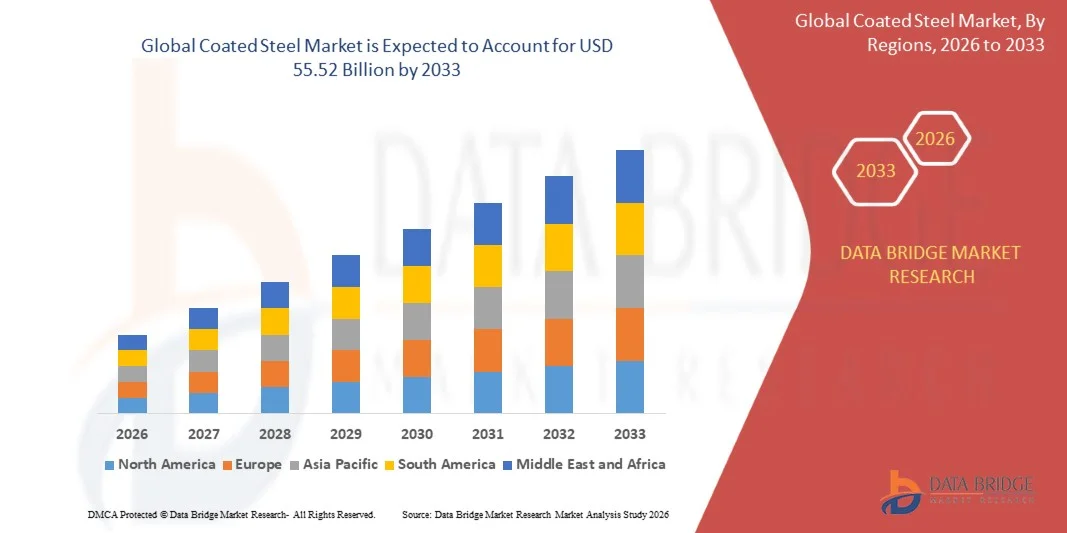
- As per Data Bridge Market Research analysis, the coated steel market was valued at USD 35.37 billion in 2025 and is projected to reach USD 55.52 billion by 2033, growing at a CAGR of 5.80% from 2026 to 2033.
- The market is experiencing steady growth driven by rising construction and infrastructure investment, increasing automotive and appliance production, and growing demand for corrosion-resistant, durable, and low-maintenance steel products across building, mobility, and energy applications.
- The increasing shift toward value-added galvanized, galvalume, and pre-painted products, combined with growing adoption of zinc-aluminum-magnesium alloy coatings and advanced high-strength coated grades, is supporting market adoption. Coated steel is being applied across roofing and wall cladding, automotive body panels, appliance housings, and renewable energy structures, offering longer service life and lower lifecycle cost for end users.
Market Size & Forecast
- Global Market Value (2025): USD 35.37 Billion
- Expected Market Value (2033): USD 55.52 Billion
- Forecast CAGR (2026–2033): 5.80%
- Leading Region in 2025: Asia-Pacific
- Fastest Growing Region: Middle East and Africa
What are the Major Takeaways of the Coated Steel Market?
- Asia-Pacific dominated the coated steel market with the largest revenue share of 54.35% in 2025, supported by the region's large steel production base, extensive construction and infrastructure activity, and strong automotive and appliance manufacturing.
- Middle East and Africa is expected to be the fastest-growing region at a CAGR of 7.85% from 2026 to 2033, fueled by rapid urbanization, expanding housing and infrastructure programs, and rising industrial and energy investments.
- The galvanized steel segment led the market with a 48.60% share in 2025, driven by its cost-effective corrosion protection, long service life, and wide use across construction, automotive, and appliance applications.
- Zinc-aluminum-magnesium coated steel is the fastest-growing product type, projected to register a CAGR of 8.35%, reflecting the surge in demand for superior cut-edge protection and longer service life at lower coating weights.
- The hot-dip coating segment dominated the process category with a 71.25% revenue share in 2025, led by extensive continuous galvanizing capacity and its suitability for high-volume production.
- Roofing & wall cladding accounted for 34.55% of the market share in 2025, preferred by increasing use of coated steel in industrial, commercial, and residential building envelopes.
- The renewable energy structures segment is the fastest-growing application category, with a CAGR of 9.40%, driven by increasing installation of solar mounting systems and other energy infrastructure requiring corrosion-resistant steel.
Report Scope and Coated Steel Market Segmentation
|
Attributes |
Coated Steel Key Market Insights |
|
Segments Covered |
|
|
Countries Covered |
North America
Europe
Asia-Pacific
Middle East and Africa
South America
|
|
Key Market Players |
|
|
Market Opportunities |
|
|
Value Added Data Infosets |
In addition to the insights on market scenarios such as market value, growth rate, segmentation, geographical coverage, and major players, the market reports curated by the Data Bridge Market Research also include in-depth expert analysis, geographically represented company-wise production and capacity, network layouts of distributors and partners, detailed and updated price trend analysis and deficit analysis of supply chain and demand. |
What is the Key Trend in the Coated Steel Market?
- Coated steel producers are steadily moving from commodity galvanized grades toward value-added products, including zinc-aluminum-magnesium alloy coatings, advanced high-strength automotive grades, and pre-painted steel that offer longer service life, better cut-edge protection, and lower lifecycle maintenance.
- For instance, in February 2026, according to The Korea Herald, POSCO set up a dedicated “One Team” structure for eight strategic steel products, including PosMAC, its corrosion-resistant alloy-coated steel sheet used extensively in renewable energy structures, and GigaSteel, an ultra-high-strength lightweight automotive steel, highlighting the growing commercial priority of premium coated and high-strength grades.
- New continuous galvanizing lines are being designed around automotive-grade surface quality, tighter coating-weight control, and the ability to process advanced high-strength substrates, reflecting the sector's shift toward exposed-panel and safety-critical applications.
- Sustainability requirements are also shaping product development, as steelmakers and building-product manufacturers seek coatings that extend asset life, reduce repainting and replacement cycles, and support lower-carbon construction and mobility.
- For instance, in June 2025, according to John Cockerill and Tata Steel, the first coil was produced on Continuous Galvanizing Line 1 at Tata Steel's Kalinganagar plant, a line equipped with a third-generation air-knife with magnetic stabiliser and an oxidation chamber and designed for coated automotive and appliance steels, illustrating the expansion of advanced galvanizing capacity in India.
- As automotive electrification, renewable energy installation, and prefabricated construction continue to advance, coated steel is expected to evolve from a basic corrosion-protection material into an engineered, application-specific product across construction, mobility, and energy infrastructure.
What are the Key Drivers of the Coated Steel Market?
- Growing construction, infrastructure, and automotive activity is increasing demand for coated steel, which combines the strength and formability of steel with corrosion resistance, durability, and low maintenance requirements.
- For instance, in April 2026, according to the World Steel Association (worldsteel), steel demand in India is forecast to grow by 7.4% in 2026 and 9.2% in 2027, supported by infrastructure-led construction, a strong automotive sector, and rail network expansion, highlighting the pull from large emerging-market end-use sectors.
- Building-product manufacturers, appliance producers, and automotive OEMs are increasingly specifying galvanized, galvalume, and pre-painted steel to extend product life, lower repair and repainting costs, and meet durability and sustainability requirements.
- For instance, in January 2022, according to Nucor Corporation, the company selected West Virginia for a new sheet mill costing approximately USD 2.7 billion, with capacity of three million tons per year and two galvanizing lines, one for advanced automotive steel and one for construction-grade steel; in July 2026, company officials said construction was about 85% complete with sheet production planned for 2027, demonstrating continued producer investment in coated flat steel capacity.
- With infrastructure renewal, energy-transition projects, and vehicle production continuing to expand across regions, coated steel is expected to remain an essential material for durable, corrosion-resistant, and cost-efficient engineering solutions.
What Factors Are Challenging the Growth of the Coated Steel Market?
- Trade barriers, import tariffs, and shifting trade flows are increasing procurement costs and pricing uncertainty for coated steel producers, importers, and downstream fabricators, particularly in markets that rely on imported coil.
- For instance, in June 2025, according to The White House, the United States raised Section 232 tariffs on steel and aluminum imports from 25% to 50%, effective June 4, 2025, while retaining a 25% rate for imports from the United Kingdom, materially changing the cost structure and sourcing decisions for imported coated steel products.
- Volatility in the prices of steel substrate, zinc, aluminum, and energy raises production costs and squeezes margins, as coating lines are capital- and energy-intensive and require continuous, high-utilization operation to remain competitive.
- Competition from alternative materials such as aluminum, engineered plastics, and composites, together with tightening carbon-emission and environmental compliance requirements for coating and pretreatment operations, can further constrain growth in price-sensitive applications.
- For instance, in April 2026, according to worldsteel, global steel demand is forecast to grow by just 0.3% in 2026 to 1,724 million tonnes, with demand in China expected to decline by 1.5% as its housing market correction approaches a bottom, highlighting the soft demand backdrop that can limit volume growth in construction-linked coated steel products.
- The combination of trade uncertainty, input-cost volatility, capital intensity, and uneven construction demand can constrain adoption and profitability, particularly among smaller mills and in price-sensitive regions where uncoated or lower-specification steel already meets basic requirements.
How is the Coated Steel Market Segmented?
The coated steel market is segmented on the basis of product type, process, application, and end-use industry.
- By Product Type
On the basis of product type, the coated steel market is segmented into galvanized steel, galvalume steel, zinc-aluminum-magnesium coated steel, pre-painted steel, and others. The galvanized steel segment dominated the market with 48.60% share in 2025, supported by its cost-effective corrosion protection, long service life, and extensive use across construction, automotive, and appliance applications. The sacrificial zinc layer protects the base steel even where the surface is scratched or cut, making the product suitable for roofing, structural sections, ducting, and general fabrication. Established continuous galvanizing capacity across major steel-producing regions supports reliable supply and competitive pricing. Its compatibility with downstream painting, forming, and joining processes further strengthens demand. Broad acceptance in building codes and OEM specifications continues to reinforce its leading position.
The zinc-aluminum-magnesium coated steel segment is projected to register the fastest growth at a CAGR of 8.35% from 2026 to 2033, driven by increasing demand for coatings that deliver superior cut-edge protection and longer service life at lower coating weights. These coatings are increasingly specified for solar mounting structures, agricultural buildings, coastal infrastructure, and exposed automotive components. Steelmakers are upgrading continuous galvanizing lines to handle alloy baths, widening product availability. Reduced maintenance and lifecycle cost advantages are encouraging specifiers to shift from conventional galvanizing. Growth in renewable energy installations is creating additional demand for corrosion-resistant structural steel. Ongoing product development is also improving formability and surface quality for a wider range of applications.
- By Process
On the basis of process, the coated steel market is segmented into hot-dip coating, electro-galvanizing, and coil coating. The hot-dip coating segment dominated the market with 71.25% share in 2025, supported by its ability to deposit thick, durable zinc and zinc-alloy layers at high line speeds. Continuous hot-dip lines offer economies of scale for coil products used in construction, automotive, and appliance manufacturing. The process is compatible with a range of coating chemistries, including galvanized, galvannealed, and aluminum-zinc alloys. Large installed capacity in Asia-Pacific, North America, and Europe supports consistent availability. Continuous investment in new and upgraded lines continues to strengthen the segment's position.
The coil coating segment is projected to register the fastest growth at a CAGR of 6.90% from 2026 to 2033, driven by increasing demand for pre-painted steel that arrives ready to fabricate and install. Factory-applied organic coatings eliminate post-fabrication painting, reduce on-site labor, and provide consistent color and finish. Solar-reflective and cool-roof coatings are gaining traction in hot climates. Prefabricated and modular construction is creating additional volume for pre-painted panels. Tighter emissions rules on solvent-based painting are also favoring controlled coil coating operations. Product innovation in polyester, silicone-modified polyester, and fluoropolymer systems is expanding the range of applications.
- By Application
On the basis of application, the coated steel market is segmented into roofing & wall cladding, body panels & components, structural & framing, appliance housings, renewable energy structures, and others. The roofing & wall cladding segment dominated the application category with 34.55% share in 2025, supported by extensive use of coated steel in industrial, commercial, and residential building envelopes. Coated steel offers light weight, fast installation, weather resistance, and low maintenance compared with alternative roofing materials. Growing urbanization and warehouse and logistics construction continue to support demand. Government spending on public buildings and infrastructure is also contributing to volume. Its versatility across climates and budgets continues to reinforce its leading position.
The renewable energy structures segment is projected to register the fastest growth at a CAGR of 9.40% from 2026 to 2033, driven by increasing installation of solar mounting systems, transmission structures, and other energy infrastructure that requires long-life corrosion protection. These structures are exposed to weather, humidity, and coastal or agricultural environments for decades. Alloy-coated grades reduce maintenance and replacement needs over the project life. Expanding utility-scale solar and grid investment is creating additional demand. Producers are developing dedicated coated products for energy applications. Government support for renewable capacity is expected to sustain segment momentum.
- By End-Use Industry
On the basis of end-use industry, the coated steel market is segmented into building & construction, automotive & transportation, appliances & consumer durables, industrial machinery, and energy & utilities. The building & construction segment dominated the end-use category with 44.30% share in 2025, supported by extensive use in roofing, cladding, framing, ducting, and prefabricated structures. Coated steel provides durability and corrosion resistance with lower lifecycle maintenance than uncoated alternatives. Rising residential, commercial, and industrial construction activity in emerging economies continues to underpin demand. Infrastructure renewal programs in developed markets are creating additional requirements. Growing focus on energy-efficient and sustainable buildings further strengthens adoption.
The automotive & transportation segment is projected to register the fastest growth at a CAGR of 7.20% from 2026 to 2033, driven by increasing vehicle production and rising demand for corrosion-resistant, high-strength, and lightweight materials. Automakers use galvanized and galvannealed grades for body panels, closures, and structural parts to meet long corrosion warranties. Electric vehicle platforms are increasing demand for high-formability coated grades for battery enclosures and structural components. Steelmakers are commissioning new automotive-grade galvanizing lines to serve exposed-panel requirements. Localization of vehicle production in emerging markets is also supporting regional demand. Continuous improvement in coating adhesion and surface quality is expanding usage in premium applications.
Which Region Holds the Largest Share of the Coated Steel Market?
- Asia-Pacific dominated the coated steel market with the largest revenue share of 54.35% in 2025, supported by the region's large steel production base, extensive construction and infrastructure activity, and strong automotive and appliance manufacturing.
- The region also benefits from continuous investment in new galvanizing and coil coating lines, rapid urbanization, and the presence of leading steel producers in China, Japan, South Korea, and India. According to worldsteel, India's crude steel output rose 10.4% to 164.9 million tonnes in 2025, reinforcing the region's leadership in steel production and downstream coated steel consumption.
China Coated Steel Market Insight
The China coated steel market is evolving toward higher-value products, supported by large-scale manufacturing, automotive and appliance output, and export demand, even as domestic construction demand moderates. According to worldsteel, China produced approximately 1,005 million tonnes of crude steel in 2024, accounting for more than half of global output, giving domestic coaters scale and close proximity to downstream users. In addition, continued investment in automotive-grade galvanizing capacity, including the new 400,000-tonne line at Angang Guangzhou, is upgrading the product mix toward exposed-panel and high-surface-quality grades.
India Coated Steel Market Insight
The India coated steel market is witnessing rapid growth due to infrastructure-led construction, expanding automotive production, and rising consumer durables demand. According to worldsteel, India is the world's fastest-growing major steel market. Moreover, new galvanizing lines commissioned by Tata Steel, Jindal Steel & Power, and AM/NS India are broadening domestic availability of galvanized, galvalume, and automotive-grade coated products.
Japan Coated Steel Market Insight
The Japan coated steel market is witnessing consistent growth due to demand for high-corrosion-resistant, formable, and lightweight-compatible coated steels from automotive, appliance, and building applications. Domestic producers, including Nippon Steel and JFE Steel, continue to refine alloy-coated and pre-painted products for durability, low maintenance, and coastal and industrial environments. Furthermore, strong emphasis on quality, precision, and lower-carbon steelmaking is supporting continued product upgrades in the country.
U.S. Coated Steel Market Insight
The U.S. coated steel market is witnessing steady growth due to sustained investment in domestic galvanizing capacity, infrastructure spending, and demand from construction, automotive, and appliance manufacturers. Producers such as Nucor are adding galvanizing lines, including a USD 425 million line at Nucor Steel Berkeley in South Carolina and two galvanizing lines at its new West Virginia sheet mill. In addition, Section 232 tariffs of 50% on steel imports are shifting sourcing toward domestic supply and supporting capacity additions by U.S. mills.
Germany Coated Steel Market Insight
The Germany coated steel market is expanding steadily due to the country's strong automotive and machinery base, advanced engineering capabilities, and role as the European Union's largest steel producer. Demand for high-quality galvanized and pre-painted steel continues across vehicle manufacturing, appliances, building envelopes, and industrial equipment. Moreover, producers such as thyssenkrupp and Salzgitter are investing in lower-carbon steelmaking routes, which is shaping product portfolios and customer requirements.
Which are the Top Companies in Coated Steel Market?
The coated steel industry is primarily led by well-established companies, including:
- ArcelorMittal S.A. (Luxembourg)
- Nippon Steel Corporation (Japan)
- China Baowu Steel Group Corporation Limited (China)
- POSCO Holdings Inc. (South Korea)
- JFE Steel Corporation (Japan)
- Tata Steel Limited (India)
- JSW Steel Limited (India)
- Nucor Corporation (U.S.)
- Dongkuk Steel Mill Co., Ltd. (South Korea)
- Cleveland-Cliffs Inc. (U.S.)
- BlueScope Steel Limited (Australia)
- thyssenkrupp AG (Germany)
- voestalpine AG (Austria)
- SSAB AB (Sweden)
- Salzgitter AG (Germany)
- Hyundai Steel Company (South Korea)
- China Steel Corporation (Taiwan)
- Jindal Steel & Power Limited (India)
- Ansteel Group Corporation Limited (China)
- Steel Dynamics, Inc. (U.S.)
What are Latest Developments in Coated Steel Market?
- In June 2026, Angang Guangzhou produced the first coil on its new No. 2 galvanizing line, which has an annual capacity of 400,000 metric tons and is designed for exposed automotive steel grades requiring high surface quality. SMS group supplied the project on a full-line basis, including mechanical equipment, furnace and process equipment, and electrical and automation systems.
- In May 2026, AM/NS India started its pickling line and tandem cold mill for automotive sheet, about a year after commissioning a 500,000 tonnes-per-year continuous galvanizing line and a 1 million tonnes-per-year continuous galvanizing and annealing line that require cold-rolled substrate. The company said India's automotive flat steel demand stands at 7.8 million tonnes per annum and is projected to grow by 6–7% annually.
- In June 2025, Jindal Steel & Power commissioned its first continuous galvanizing line (CGL 1) at the Angul Integrated Steel Complex in Odisha, India. The line processes thicknesses from 0.15 mm to 1.50 mm and widths from 700 mm to 1,400 mm, and produces galvanized and galvalume products under the Jindal Panther and ZINKALUME brands for appliance, automotive, infrastructure, and construction applications.
- In May 2025, ANDRITZ announced an upgrade of the No. 5 continuous galvanizing line at China's Tangsteel to cover a wider production range and higher steel grades for automotive applications, with commissioning scheduled for the fourth quarter of 2025. The line, originally commissioned in 2017, primarily supplies material for high-end automotive and home appliance applications.
- In September 2022, Nucor's Board of Directors approved a USD 425 million galvanizing line at Nucor Steel Berkeley in South Carolina to grow the company's participation in the automotive and consumer durables markets. The line, described as Nucor's eighth wholly owned galvanizing line, was initially expected to start up in mid-2025, and trade press has since reported a mid-2026 start-up.

- Interactive Data Analysis Dashboard
- Company Analysis Dashboard for high growth potential opportunities
- Research Analyst Access for customization & queries
- Competitor Analysis with Interactive dashboard
- Latest News, Updates & Trend analysis
- Harness the Power of Benchmark Analysis for Comprehensive Competitor Tracking
Global Coated Steel Market, Supply Chain Analysis and Ecosystem Framework
To support market growth and help clients navigate the impact of geopolitical shifts, DBMR has integrated in-depth supply chain analysis into its Global Coated Steel Market research reports. This addition empowers clients to respond effectively to global changes affecting their industries. The supply chain analysis section includes detailed insights such as Global Coated Steel Market consumption and production by country, price trend analysis, the impact of tariffs and geopolitical developments, and import and export trends by country and HSN code. It also highlights major suppliers with data on production capacity and company profiles, as well as key importers and exporters. In addition to research, DBMR offers specialized supply chain consulting services backed by over a decade of experience, providing solutions like supplier discovery, supplier risk assessment, price trend analysis, impact evaluation of inflation and trade route changes, and comprehensive market trend analysis.
Data collection and base year analysis are done using data collection modules with large sample sizes. The stage includes obtaining market information or related data through various sources and strategies. It includes examining and planning all the data acquired from the past in advance. It likewise envelops the examination of information inconsistencies seen across different information sources. The market data is analysed and estimated using market statistical and coherent models. Also, market share analysis and key trend analysis are the major success factors in the market report. To know more, please request an analyst call or drop down your inquiry.
The key research methodology used by DBMR research team is data triangulation which involves data mining, analysis of the impact of data variables on the market and primary (industry expert) validation. Data models include Vendor Positioning Grid, Market Time Line Analysis, Market Overview and Guide, Company Positioning Grid, Patent Analysis, Pricing Analysis, Company Market Share Analysis, Standards of Measurement, Global versus Regional and Vendor Share Analysis. To know more about the research methodology, drop in an inquiry to speak to our industry experts.
Data Bridge Market Research is a leader in advanced formative research. We take pride in servicing our existing and new customers with data and analysis that match and suits their goal. The report can be customized to include price trend analysis of target brands understanding the market for additional countries (ask for the list of countries), clinical trial results data, literature review, refurbished market and product base analysis. Market analysis of target competitors can be analyzed from technology-based analysis to market portfolio strategies. We can add as many competitors that you require data about in the format and data style you are looking for. Our team of analysts can also provide you data in crude raw excel files pivot tables (Fact book) or can assist you in creating presentations from the data sets available in the report.













