


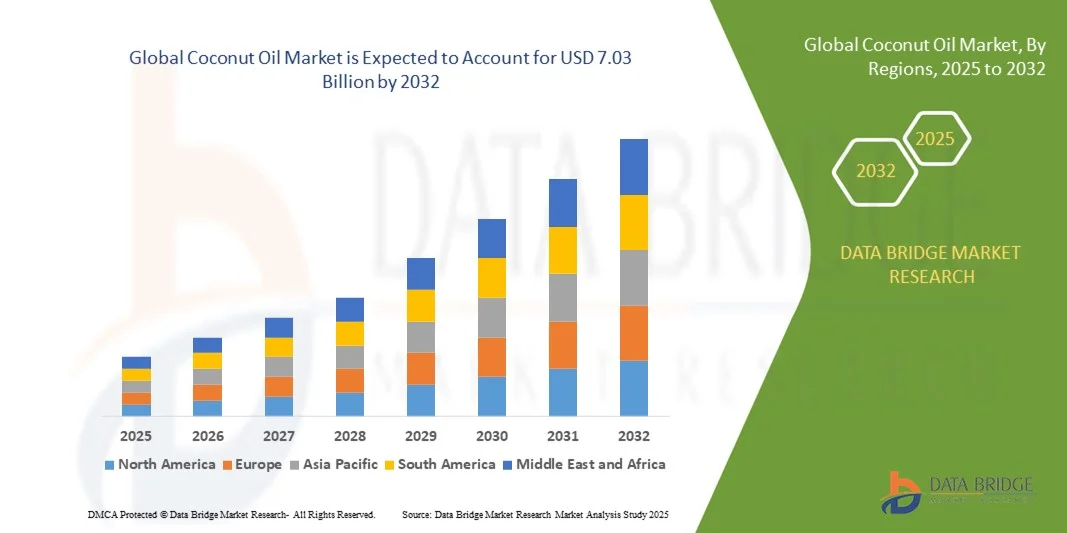
Coconut Oil Market Size
- The global coconut oil market size was valued at USD 4.91 billion in 2024 and is expected to reach USD 7.03 billion by 2032, at a CAGR of 4.60% during the forecast period
- The market growth is largely fuelled by the increasing demand for natural and plant-based oils across food, cosmetics, and pharmaceutical applications
- Rising consumer awareness regarding the health benefits of coconut oil, such as improved heart health and skin nourishment, is further supporting market expansion
Coconut Oil Market Analysis
- The market is witnessing consistent growth due to the versatility of coconut oil across multiple industries, from cooking and baking to skincare and haircare formulations
- Manufacturers are investing in product innovation, including flavored, refined, and virgin variants, to meet evolving consumer demands
- North America dominated the coconut oil market with the largest revenue share in 2024, driven by increasing consumer preference for organic and natural oils, rising health awareness, and expanding applications across food, cosmetics, and personal care sectors
- Asia-Pacific region is expected to witness the highest growth rate in the global coconut oil market, driven by increasing production capacity, rising health-conscious consumer base, government initiatives supporting sustainable agriculture, and expanding exports to North America and Europe
Report Scope and Coconut Oil Market Segmentation
|
Attributes |
Coconut Oil Key Market Insights |
|
Segments Covered |
|
|
Countries Covered |
North America
Europe
Asia-Pacific
Middle East and Africa
South America
|
|
Key Market Players |
|
|
Market Opportunities |
|
|
Value Added Data Infosets |
In addition to the insights on market scenarios such as market value, growth rate, segmentation, geographical coverage, and major players, the market reports curated by the Data Bridge Market Research also include in-depth expert analysis, pricing analysis, brand share analysis, consumer survey, demography analysis, supply chain analysis, value chain analysis, raw material/consumables overview, vendor selection criteria, PESTLE Analysis, Porter Analysis, and regulatory framework. |
Coconut Oil Market Trends
Rising Demand For Organic And Cold-Pressed Coconut Oil
- The global market is witnessing a growing shift toward organic and cold-pressed coconut oil as consumers increasingly prefer natural and minimally processed products. These oils are perceived as healthier alternatives, retaining more nutrients and antioxidants due to their gentle extraction methods. The surge in health-conscious lifestyles is reinforcing demand across food, cosmetic, and nutraceutical industries. Moreover, the preference for natural fats over refined alternatives is driving strong market momentum in both developed and emerging economies
- The trend is especially prominent among consumers seeking plant-based and chemical-free alternatives. As a result, producers are expanding their product portfolios to include certified organic and virgin coconut oils, emphasizing purity and transparency in labeling to appeal to premium and eco-conscious buyers. Growing awareness of ethical sourcing and sustainable farming has also influenced purchasing behavior, encouraging brands to obtain fair-trade and organic certifications to build consumer trust
- Increasing adoption of cold-pressed extraction technologies is further improving oil quality and extending shelf life, which enhances market competitiveness. Manufacturers are leveraging advanced filtration systems and sustainable sourcing practices to meet growing global standards. The use of modern processing facilities and quality assurance systems ensures consistency, flavor retention, and nutrient preservation, aligning with global quality benchmarks and food safety regulations
- For instance, in 2024, several leading Asian producers launched new cold-pressed coconut oil lines targeting export markets in the U.S. and Europe, supportedby rising interest in natural functional foods and clean beauty formulations. These launches helped boost exports and reinforce the region’s position as a key supplier. Such innovations are also creating new opportunities for small and medium enterprises (SMEs) to enter high-value markets through private-label and online distribution partnerships
- While the demand for premium coconut oil continues to expand, manufacturers must balance production costs, certification standards, and scalability to sustain growth and maintain competitive pricing in both developed and emerging markets. Strengthening agricultural value chains, investing in technology, and diversifying product applications will be essential strategies to address supply-demand imbalances and ensure long-term profitability
Coconut Oil Market Dynamics
Driver
Expanding Applications In Food, Cosmetic, And Pharmaceutical Industries
- The diverse applications of coconut oil across food, personal care, and pharmaceutical sectors are significantly driving market growth. In the food industry, it is increasingly used as a healthy cooking medium, flavor enhancer, and functional ingredient in vegan and gluten-free products, owing to its rich lauric acid content and antimicrobial properties. The oil’s versatility has made it a preferred choice for both household and industrial food preparations, particularly in Asian and Western cuisines
- The cosmetic sector has embraced coconut oil as a key ingredient in moisturizers, hair treatments, and organic skincare formulations due to its natural conditioning and anti-inflammatory benefits. The rise of clean beauty trends and consumer preference for plant-based ingredients have accelerated this adoption globally. Companies are also utilizing coconut oil in innovative product categories such as solid shampoos, lip balms, and eco-friendly packaging to enhance sustainability credentials
- In the pharmaceutical and nutraceutical fields, coconut oil is utilized in supplements and medicinal formulations due to its immunity-boosting and energy-enhancing properties. Manufacturers are increasingly focusing on value-added variants, such as MCT oil, to meet growing health demands. The product’s proven benefits for cognitive health and metabolism are further driving its adoption among fitness enthusiasts and aging populations worldwide
- For instance, in 2023, major personal care brands in the U.S. and U.K. launched coconut oil-based skincare and haircare products to cater to clean-label and organic product demand. These initiatives significantly strengthened the presence of coconut oil across beauty and wellness categories. The introduction of eco-certified and dermatologically tested formulations further elevated consumer confidence, stimulating retail and e-commerce sales globally
- As product diversification continues, the multifunctional nature of coconut oil is expected to sustain strong growth across industries, reinforcing its global market appeal and value creation potential. Expanding its role in plant-based food innovation, sustainable cosmetics, and holistic health solutions will further strengthen its long-term commercial significance
Restraint/Challenge
Price Volatility And Climatic Dependency Of Coconut Production
- The market faces challenges due to the fluctuating prices of raw coconuts, largely influenced by climatic variations, pest infestations, and inconsistent yield patterns in major producing countries such as the Philippines, Indonesia, and India. These factors directly impact production costs and profit margins for manufacturers. The reliance on traditional cultivation systems without yield-optimizing interventions further limits production efficiency and consistency
- Natural calamities such as typhoons and droughts can disrupt supply chains and lead to price instability, affecting export volumes and trade balances in key coconut-producing regions. This volatility often makes it difficult for small and medium producers to maintain consistent production levels. The resulting unpredictability in raw material costs also hinders long-term planning for manufacturers and traders
- In addition, dependence on traditional farming methods and limited access to high-yield coconut varieties hinder production efficiency. The lack of technological advancement and insufficient replanting initiatives further exacerbate supply constraints, particularly in developing regions. Inadequate infrastructure, poor irrigation facilities, and limited farmer training programs intensify these challenges, affecting both quantity and quality of output
- For instance, in 2023, extreme weather conditions in Southeast Asia led to a temporary shortage of raw coconuts, causing a spike in coconut oil prices by over 15%, which affected both domestic consumption and export performance. The disruption prompted governments and private players to explore sustainable replanting initiatives and climate-resilient cultivation models to prevent future shortages
- While global demand remains high, stabilizing supply through sustainable farming practices, improved crop management, and government-led support programs is essential to mitigate volatility and ensure long-term industry resilience. Strengthening producer cooperatives, enhancing logistics networks, and investing in climate-adaptive research will play key roles in maintaining steady supply and price equilibrium
Coconut Oil Market Scope
The coconut oil market is segmented on the basis of source, type, distribution channel, application, packaging, and product type
- By Source
On the basis of source, the coconut oil market is segmented into organic and conventional. The organic segment held the largest market revenue share in 2024 driven by growing consumer preference for natural and chemical-free products, rising awareness of health benefits, and increasing use across food, cosmetic, and pharmaceutical applications. Organic coconut oil is highly valued for nutrient retention, purity, and sustainable sourcing, making it a preferred choice for premium and eco-conscious buyers.
The conventional segment is expected to witness the fastest growth rate from 2025 to 2032, driven by its widespread availability, affordability, and suitability for large-scale culinary, industrial, and personal care applications. Conventional coconut oil continues to serve as a cost-effective alternative for mass-market consumers while maintaining consistent quality for industrial purposes.
- By Type
On the basis of type, the coconut oil market is segmented into refined and unrefined. The unrefined segment held the largest revenue share in 2024 due to its rich nutritional profile, natural aroma, and growing demand for virgin and cold-pressed oils across food, cosmetics, and nutraceutical industries.
The refined segment is expected to witness the fastest growth rate from 2025 to 2032, driven by its neutral flavor, extended shelf life, and industrial applicability. Refined coconut oil is widely adopted in processed foods, bakery products, and commercial cosmetic formulations where stability and consistency are critical.
- By Distribution Channel
On the basis of distribution channel, the coconut oil market is segmented into direct and indirect sales. Direct sales held the largest market revenue share in 2024 due to the growth of e-commerce platforms, brand-owned stores, and subscription models that offer certified organic and premium coconut oil products directly to consumers.
Indirect sales are expected to witness significant growth from 2025 to 2032, driven by supermarket expansion, hypermarkets, and retail chains providing convenient access to a wide range of coconut oil products. The growth in indirect channels is further supported by partnerships with distributors and wholesalers catering to both domestic and international markets.
- By Application
On the basis of application, the coconut oil market is segmented into food, household detergents, metalworking fluids, paints and coatings, soaps, textile chemicals, plastic industry, pharmaceuticals, and cosmetic industry. The food segment held the largest revenue share in 2024, driven by increasing use in cooking, baking, and functional foods due to its rich lauric acid content and health benefits.
The cosmetic and pharmaceutical segment is expected to witness the fastest growth rate from 2025 to 2032, driven by rising demand for clean-label skincare, haircare, and nutraceutical products that utilize coconut oil as a natural and multifunctional ingredient.
- By Packaging
On the basis of packaging, the coconut oil market is segmented into steel drums, flexi tanks/iso tanks, carboys, plastic bottles, squeeze tubes, glass jars, and pails. Plastic bottles and glass jars held the largest market revenue share in 2024 due to convenience for household consumers and small-scale buyers.
Industrial packaging formats is expected to witness the fastest growth rate from 2025 to 2032, driven by bulk requirements in cosmetic, pharmaceutical, and food processing industries. These formats offer efficiency, cost-effectiveness, and ease of storage for large-scale production and export.
- By Product Type
On the basis of product type, the coconut oil market is segmented into distilled, partially hydrogenated, fully hydrogenated, and low white or low whole products. The distilled segment held the largest revenue share in 2024, driven by its purity, long shelf life, and versatility across food, cosmetic, and industrial applications.
Partially hydrogenated is expected to witness the fastest growth rate from 2025 to 2032, driven by demand in specialty food products, industrial formulations, and commercial applications requiring customized coconut oil derivatives.
Coconut Oil Market Regional Analysis
- North America dominated the coconut oil market with the largest revenue share in 2024, driven by increasing consumer preference for organic and natural oils, rising health awareness, and expanding applications across food, cosmetics, and personal care sectors
- Consumers in the region highly value the nutritional benefits, purity, and multifunctional uses of coconut oil in cooking, skincare, and wellness products, boosting demand for premium and cold-pressed variants
- This widespread adoption is further supported by higher disposable incomes, established distribution networks, and strong e-commerce penetration, establishing North America as a key revenue contributor in the global coconut oil market
U.S. Coconut Oil Market Insight
The U.S. coconut oil market captured the largest revenue share in 2024 within North America, fueled by growing consumer inclination toward healthy cooking oils, organic ingredients, and plant-based personal care products. Rising awareness about natural skincare and clean-label food products has driven adoption across retail and online channels. Moreover, increasing product innovation in cold-pressed, virgin, and fortified coconut oils is significantly expanding market presence and consumer engagement.
Europe Coconut Oil Market Insight
The Europe coconut oil market is expected to witness the fastest growth rate from 2025 to 2032, primarily driven by rising health consciousness, vegan and clean-label trends, and increasing use of coconut oil in cosmetics and functional foods. The region’s strict regulatory standards and focus on sustainable sourcing are fostering higher adoption of certified organic products. Coconut oil is gaining traction in both household and industrial applications, supporting steady market expansion.
U.K. Coconut Oil Market Insight
The U.K. coconut oil market is expected to witness strong growth from 2025 to 2032, driven by increased demand for natural cooking oils, organic beauty products, and dietary supplements. Consumers’ preference for plant-based and chemical-free products is encouraging manufacturers to expand organic and cold-pressed product lines. The country’s robust retail infrastructure and growing e-commerce adoption further support market development and availability.
Germany Coconut Oil Market Insight
The Germany coconut oil market is expected to witness notable growth from 2025 to 2032, fueled by rising health awareness, demand for natural cosmetics, and preference for organic cooking oils. German consumers emphasize sustainability and high-quality certifications, driving manufacturers to ensure eco-friendly sourcing and processing. The integration of coconut oil in personal care and functional food applications enhances its appeal, particularly among premium buyers.
Asia-Pacific Coconut Oil Market Insight
The Asia-Pacific coconut oil market is expected to witness the fastest growth rate from 2025 to 2032, driven by high coconut production in countries such as the Philippines, Indonesia, and India, along with growing domestic and export demand. Rising health awareness, urbanization, and disposable incomes are encouraging consumption in food, cosmetic, and pharmaceutical applications. In addition, APAC’s position as a leading supplier of coconut oil supports competitive pricing and wider accessibility across global markets.
Japan Coconut Oil Market Insight
The Japan coconut oil market is expected to witness significant growth from 2025 to 2032 due to strong consumer preference for functional foods, clean-label personal care, and plant-based ingredients. Adoption is fueled by increasing awareness of health benefits, rising disposable income, and innovative product offerings. Coconut oil’s use in cooking, skincare, and nutraceuticals is expanding, while retail and online channels facilitate convenient access to premium and specialty products.
China Coconut Oil Market Insight
The China coconut oil market accounted for the largest market revenue share in Asia-Pacific in 2024, attributed to the country’s growing middle class, health-conscious consumers, and increasing awareness of natural cooking oils. Rising applications in cosmetics, personal care, and processed foods are driving demand. Moreover, domestic production and exports of high-quality organic and cold-pressed coconut oils are reinforcing China’s position as a significant player in the global coconut oil industry.
Coconut Oil Market Share
The Coconut Oil industry is primarily led by well-established companies, including:
- Windy City Organics, LLC (U.S.)
- Premier Organics (U.S.)
- Hain Celestial (U.S.)
- Windmill Organics Ltd (U.K.)
- Wichy Plantation Company (Pvt) Ltd (Sri Lanka)
- ANDY ALBAO CORPORATION - CocoWonder Organic Coconut & Cacao Products (Philippines)
- Hallstar (U.S.)
- Marico (India)
- A.B. Enterprises (U.S.)
- Mangga Dua (Indonesia)
- Flower's Song (U.K.)
- EPS Impex Co. (U.S.)
- JK International (India)
- PT. General Laju (Indonesia)
- LibraBioScience (U.S.)
- Adani Group (India)
- Cargill, Incorporated (U.S.)
- ADM (U.S.)
- Bunge Limited (U.S.)
- Greenville Agro Corporation (U.S.)
Latest Developments in Global Coconut Oil Market
- In November 2021, Bunge, announced the development of a state-of-the-art sustainable production facility in the Port of Amsterdam. The facility is designed to expand the company’s portfolio of innovative, plant-based oils and fats, focusing on sustainability and eco-friendly manufacturing. This initiative aims to meet the growing global demand for healthier and environmentally conscious products, strengthen Bunge’s market presence in Europe, and support long-term growth in the plant-based oils sector. The new facility is expected to enhance operational efficiency, drive product innovation, and reinforce the company’s commitment to sustainable food solutions

- Interactive Data Analysis Dashboard
- Company Analysis Dashboard for high growth potential opportunities
- Research Analyst Access for customization & queries
- Competitor Analysis with Interactive dashboard
- Latest News, Updates & Trend analysis
- Harness the Power of Benchmark Analysis for Comprehensive Competitor Tracking
Global Coconut Oil Market, Supply Chain Analysis and Ecosystem Framework
To support market growth and help clients navigate the impact of geopolitical shifts, DBMR has integrated in-depth supply chain analysis into its Global Coconut Oil Market research reports. This addition empowers clients to respond effectively to global changes affecting their industries. The supply chain analysis section includes detailed insights such as Global Coconut Oil Market consumption and production by country, price trend analysis, the impact of tariffs and geopolitical developments, and import and export trends by country and HSN code. It also highlights major suppliers with data on production capacity and company profiles, as well as key importers and exporters. In addition to research, DBMR offers specialized supply chain consulting services backed by over a decade of experience, providing solutions like supplier discovery, supplier risk assessment, price trend analysis, impact evaluation of inflation and trade route changes, and comprehensive market trend analysis.
Data collection and base year analysis are done using data collection modules with large sample sizes. The stage includes obtaining market information or related data through various sources and strategies. It includes examining and planning all the data acquired from the past in advance. It likewise envelops the examination of information inconsistencies seen across different information sources. The market data is analysed and estimated using market statistical and coherent models. Also, market share analysis and key trend analysis are the major success factors in the market report. To know more, please request an analyst call or drop down your inquiry.
The key research methodology used by DBMR research team is data triangulation which involves data mining, analysis of the impact of data variables on the market and primary (industry expert) validation. Data models include Vendor Positioning Grid, Market Time Line Analysis, Market Overview and Guide, Company Positioning Grid, Patent Analysis, Pricing Analysis, Company Market Share Analysis, Standards of Measurement, Global versus Regional and Vendor Share Analysis. To know more about the research methodology, drop in an inquiry to speak to our industry experts.
Data Bridge Market Research is a leader in advanced formative research. We take pride in servicing our existing and new customers with data and analysis that match and suits their goal. The report can be customized to include price trend analysis of target brands understanding the market for additional countries (ask for the list of countries), clinical trial results data, literature review, refurbished market and product base analysis. Market analysis of target competitors can be analyzed from technology-based analysis to market portfolio strategies. We can add as many competitors that you require data about in the format and data style you are looking for. Our team of analysts can also provide you data in crude raw excel files pivot tables (Fact book) or can assist you in creating presentations from the data sets available in the report.













