


What is the Coconut Syrup Market Size and Growth Rate?
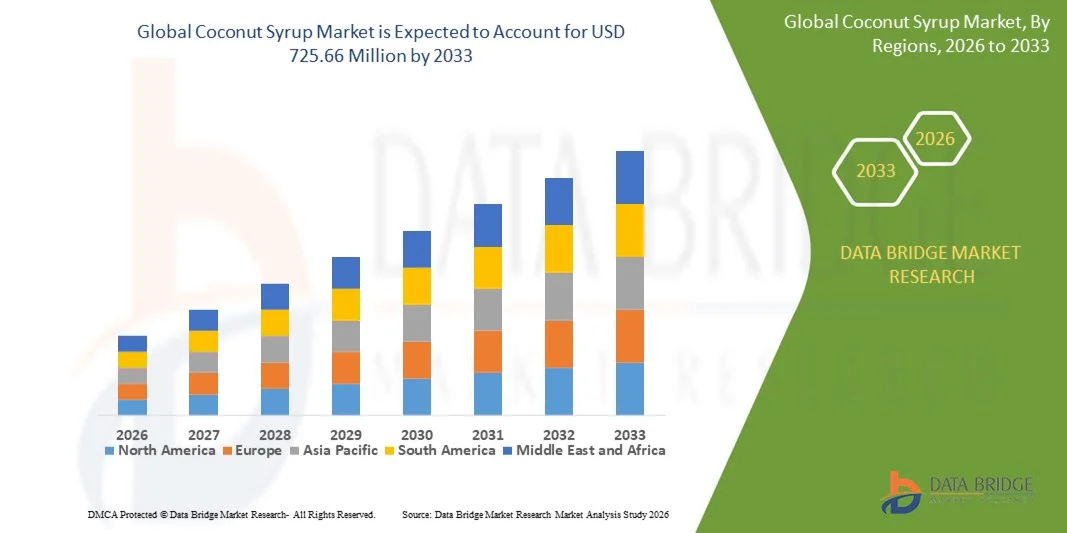
- As per Data Bridge Market Research Analysis the global coconut syrup market size was valued at USD 465.73 million in 2025 and is expected to reach USD 725.66 million by 2033, at a CAGR of 5.70% during the forecast period
- The market growth is largely fuelled by rising consumer preference for natural and plant-based sweeteners as alternatives to refined sugar and artificial syrups
- Increasing awareness regarding the low glycaemic index of coconut syrup, along with its perceived health benefits such as mineral content and suitability for diabetic-friendly diets, is further supporting market expansion
Market Size & Forecast
- Global Market Value (2025): USD 465.73 million
- Expected Market Value (2033): USD 725.66 million
- Forecast CAGR (2026–2033): 5.70%
What are the Major Takeaways of Coconut Syrup Market?
- The market is witnessing steady demand driven by clean-label trends and the growing use of coconut syrup in beverages, bakery products, confectionery, and functional foods
- In addition, expanding adoption across foodservice and specialty food manufacturers, combined with premium positioning and organic product offerings, is positively influencing overall market development
- Asia-Pacific coconut syrup market dominated the global coconut syrup market with the largest revenue share of 47.68% in 2025, driven by rising urbanization, increasing disposable incomes, and growing awareness of health and wellness
- North America region is expected to witness the highest growth rate in the global coconut syrup market, driven by clean-label ingredients, expanding organic food sectors, and increasing use of coconut syrup in beverages, bakery, and dietary supplements
- The liquid segment accounted for the largest market revenue share in 2025 driven by its wide usage across food and beverage applications and its ease of incorporation into recipes and formulations. Liquid coconut syrup is widely preferred in beverages, bakery products, and confectionery due to its smooth consistency and natural sweetness, supporting its strong adoption among manufacturers and consumers
Report Scope and Coconut Syrup Market Segmentation
|
Attributes |
Coconut Syrup Key Market Insights |
|
Segments Covered |
|
|
Countries Covered |
North America
Europe
Asia-Pacific
Middle East and Africa
South America
|
|
Key Market Players |
|
|
Market Opportunities |
|
|
Value Added Data Infosets |
In addition to the insights on market scenarios such as market value, growth rate, segmentation, geographical coverage, and major players, the market reports curated by the Data Bridge Market Research also include in-depth expert analysis, pricing analysis, brand share analysis, consumer survey, demography analysis, supply chain analysis, value chain analysis, raw material/consumables overview, vendor selection criteria, PESTLE Analysis, Porter Analysis, and regulatory framework. |
What is the Key Trend in the Coconut Syrup Market?
Rising Demand for Natural and Low-Glycaemic Sweeteners
- The increasing consumer shift toward natural, minimally processed, and plant-based sweeteners is significantly shaping the global coconut syrup market, as buyers seek alternatives to refined sugar and artificial sweeteners. Coconut syrup is gaining traction due to its low glycaemic index, mineral content, and natural origin, making it suitable for health-conscious and diabetic-friendly diets. This trend is strengthening its adoption across food, beverage, and wellness product categories, encouraging manufacturers to expand clean-label product lines
- Growing awareness of health, wellness, and balanced nutrition is accelerating the use of coconut syrup in bakery, confectionery, beverages, breakfast foods, and functional products. Consumers focused on weight management, blood sugar control, and natural nutrition are increasingly opting for products formulated with coconut-based sweeteners. This has encouraged brands to highlight nutritional benefits and natural sourcing in product development strategies
- Clean-label, organic, and sustainability trends are influencing purchasing decisions, with manufacturers emphasizing transparent sourcing, ethical farming practices, and organic certifications. These factors are helping brands differentiate products, enhance consumer trust, and justify premium pricing, while also encouraging the adoption of fair-trade and sustainability labels across packaging and marketing campaigns
- For instance, in 2024, food and beverage brands in the U.S. and Europe expanded their natural sweetener portfolios by introducing coconut syrup-based beverages, baking syrups, and breakfast toppings. These products were launched to meet rising demand for low-glycaemic and plant-based sweeteners, with strong traction across retail, specialty stores, and e-commerce platforms
- While demand for coconut syrup continues to rise, sustained market growth depends on consistent raw material supply, quality standardization, and maintaining competitive pricing. Producers are focusing on improving production efficiency, enhancing shelf stability, and investing in product innovation to expand applications while balancing cost and nutritional value
Coconut Syrup Market Dynamics
Driver
Growing Preference for Natural And Low-Glycaemic Sweeteners
- Rising consumer demand for natural, plant-derived, and low-glycaemic sweeteners is a major driver for the coconut syrup market. Manufacturers are increasingly replacing refined sugar and artificial syrups with coconut syrup to meet clean-label requirements and align with health-focused consumer expectations. This shift is also encouraging innovation in coconut-based sweetener formulations and blends
- Expanding applications across bakery, confectionery, beverages, sauces, and health foods are supporting market growth. Coconut syrup enhances flavour, sweetness, and nutritional appeal while maintaining a natural positioning, enabling manufacturers to cater to consumers seeking healthier indulgence and functional benefits. The global rise in plant-based and vegan diets further supports this trend
- Food and beverage manufacturers are actively promoting coconut syrup-based products through product launches, clean-label claims, and wellness-oriented marketing campaigns. These efforts are reinforced by consumer interest in sustainable and ethically sourced ingredients, driving partnerships between coconut farmers, processors, and branded product companies
- For instance, in 2023, natural food brands in the U.S. and Australia increased the use of coconut syrup in organic snacks, energy bars, and beverages in response to growing demand for low-glycaemic and plant-based sweeteners. These launches helped improve product differentiation and repeat purchases among health-focused consumers
- Although natural sweetener trends support market expansion, long-term growth relies on supply chain efficiency, price stability, and scalable production. Investment in sustainable coconut farming, processing technology, and quality control will be critical to meeting rising global demand and maintaining market competitiveness
Restraint/Challenge
Higher Cost And Limited Awareness Compared To Conventional Sweeteners
- The relatively higher cost of coconut syrup compared to refined sugar and conventional sweeteners remains a key challenge, restricting adoption among price-sensitive manufacturers and consumers. Premium pricing is driven by labor-intensive production processes, limited raw material availability, and certification requirements, which can impact mass-market penetration
- Consumer awareness regarding the functional and health benefits of coconut syrup remains uneven, particularly in developing markets where price sensitivity is high and refined sugar dominates consumption. Limited understanding of its low-glycaemic and nutritional advantages slows adoption across mainstream food and beverage categories
- Supply chain constraints and dependency on coconut harvest cycles also pose challenges, as fluctuations in yield and climate conditions can affect raw material availability and pricing. Inconsistent supply can create volatility for manufacturers relying on coconut syrup as a core ingredient
- For instance, in 2024, foodservice distributors and packaged food manufacturers in Southeast Asia reported slower adoption of coconut syrup due to higher costs and limited consumer familiarity compared to traditional sweeteners. Retailers also faced challenges in allocating shelf space to premium coconut syrup products with slower turnover rates
- Addressing these challenges will require improved consumer education, cost-efficient processing methods, and stronger distribution networks. In addition, strategic marketing, product blending, and collaboration with retailers can help improve affordability, visibility, and long-term growth potential of the global coconut syrup market
How is the Coconut Syrup Market Segmented?
The market is segmented on the basis of form, flavor, nature, application, end user, and distribution channel.
- By Form
On the basis of form, the global coconut syrup market is segmented into liquid and powder. The liquid segment accounted for the largest market revenue share in 2025 driven by its wide usage across food and beverage applications and its ease of incorporation into recipes and formulations. Liquid coconut syrup is widely preferred in beverages, bakery products, and confectionery due to its smooth consistency and natural sweetness, supporting its strong adoption among manufacturers and consumers.
The powder segment is expected to register the fastest growth rate from 2026 to 2033 supported by its longer shelf life, ease of storage, and convenience in transportation. Powdered coconut syrup is increasingly used in dietary supplements and instant food products, particularly in regions with growing demand for clean-label and plant-based ingredients.
- By Flavor
On the basis of flavor, the market is segmented into plain and flavored. The plain segment dominated the market revenue share in 2025 due to its versatility and widespread use as a natural sweetener across multiple applications such as beverages, bakery, and pharmaceuticals. Plain coconut syrup is favored for its neutral taste profile, allowing it to be easily blended with other ingredients without altering the original flavor.
The flavored segment is expected to register the fastest growth rate from 2026 to 2033 driven by rising consumer preference for innovative and value-added food products. Flavored coconut syrups are gaining traction in specialty beverages and confectionery products, supported by increasing experimentation by manufacturers to enhance taste and product differentiation.
- By Nature
On the basis of nature, the global coconut syrup market is segmented into organic and conventional. The conventional segment held the largest market share in 2025 attributed to its wider availability and relatively lower cost compared to organic variants. Conventional coconut syrup continues to be widely adopted by large-scale food processors due to established supply chains and consistent production volumes.
The organic segment is expected to grow at the fastest pace from 2026 to 2033 driven by increasing consumer awareness regarding health, sustainability, and clean-label products. Rising demand for organic food ingredients in developed and emerging markets is further supporting the growth of organic coconut syrup.
- By Application
On the basis of application, the market is segmented into sweetening, texturizing, flavoring, and preservative. The sweetening segment accounted for the largest revenue share in 2025 driven by the extensive use of coconut syrup as a natural alternative to refined sugar in food and beverage products. Its low glycemic index and natural origin continue to support its strong demand in health-conscious consumer segments.
The flavoring segment is expected to register the fastest growth rate from 2026 to 2033 supported by the expanding use of coconut syrup in premium and specialty food products. Increasing demand for natural flavor enhancers in bakery, confectionery, and beverages is contributing to the rapid adoption of coconut syrup for flavoring applications.
- By End User
On the basis of end user, the market is segmented into bakery, beverages, dietary supplements, pharmaceutical, and confectionary. The bakery segment dominated the market revenue share in 2025 driven by the rising use of coconut syrup in cakes, cookies, and bread products as a natural sweetening ingredient. Its ability to enhance taste and texture has made it a preferred choice among bakery manufacturers.
The beverages segment is expected to register the fastest growth rate from 2026 to 2033 supported by increasing consumption of functional drinks, smoothies, and plant-based beverages. Growing consumer inclination toward natural sweeteners in ready-to-drink products is further accelerating the adoption of coconut syrup in the beverage industry.
- By Distribution Channel
On the basis of distribution channel, the global coconut syrup market is segmented into direct sales and indirect sales. The indirect sales segment held the largest market share in 2025 attributed to the strong presence of distributors, wholesalers, and retail networks that enable wider product reach. Indirect channels support easy accessibility of coconut syrup across both developed and emerging markets.
The direct sales segment is projected to witness notable growth from 2026 to 2033 driven by increasing adoption of direct-to-consumer models by manufacturers. Rising use of online platforms and direct partnerships with food processors is supporting the expansion of direct sales channels in the global coconut syrup market.
Which Region Holds the Largest Share of the Coconut Syrup Market?
- Asia-Pacific coconut syrup market dominated the global coconut syrup market with the largest revenue share of 47.68% in 2025, driven by rising urbanization, increasing disposable incomes, and growing awareness of health and wellness
- The region benefits from abundant coconut production, particularly in Southeast Asian countries, supporting easy availability of raw materials
- Expanding food and beverage industries and increasing exports of coconut-based products are further accelerating market growth in the region
Japan Coconut Syrup Market Insight
The Japan coconut syrup market is expected to witness the fastest growth rate from 2026 to 2033 due to increasing consumer interest in natural and functional food ingredients. Japanese consumers place strong emphasis on quality, health benefits, and product authenticity, supporting the adoption of coconut syrup. Its use in premium beverages, desserts, and health-oriented food products is steadily increasing, contributing to market expansion.
China Coconut Syrup Market Insight
The China coconut syrup market accounted for the largest revenue share in Asia Pacific in 2025, attributed to rapid urbanization, a growing middle-class population, and increasing demand for healthier food ingredients. Coconut syrup is gaining popularity in beverages, bakery, and confectionery applications, supported by expanding domestic food processing industries. Rising awareness of natural sweeteners and increasing availability through both offline and online channels are key factors driving market growth in China.
North America Coconut Syrup Market Insight
North America is expected to witness the fastest growth rate from 2026 to 2033, driven by strong demand for natural and plant-based sweeteners and the growing preference for clean-label food products. Consumers in the region increasingly value coconut syrup for its low glycemic index, natural origin, and suitability for health-focused diets such as vegan, paleo, and gluten-free. This widespread adoption is further supported by high disposable incomes, well-established health food retail channels, and rising usage of coconut syrup across bakery, beverages, and dietary supplements, positioning it as a preferred alternative sweetener in both household and industrial applications
U.S. Coconut Syrup Market Insight
The U.S. coconut syrup market is expected to witness the fastest growth rate from 2026 to 2033, driven by rising health consciousness and increasing demand for natural sugar substitutes. Consumers are actively shifting away from refined sugar toward plant-based sweeteners, supporting strong adoption of coconut syrup. The expansion of organic food stores, online retail platforms, and the growing popularity of functional foods and beverages are further contributing to market growth in the country.
Europe Coconut Syrup Market Insight
The Europe coconut syrup market is expected to witness the fastest growth rate from 2026 to 2033, primarily driven by increasing consumer awareness regarding sugar reduction and sustainable food sourcing. The region’s strong focus on organic and natural food products is accelerating the adoption of coconut syrup across food and beverage applications. Growing demand from bakery, confectionery, and specialty beverage manufacturers is further supporting market expansion across Europe.
U.K. Coconut Syrup Market Insight
The U.K. coconut syrup market is expected to witness the fastest growth rate from 2026 to 2033, supported by rising demand for healthier sweetening alternatives and the growing popularity of plant-based diets. Increasing concerns related to obesity and diabetes are encouraging consumers to opt for low-glycemic sweeteners. The strong presence of health-focused retailers and e-commerce platforms is further boosting coconut syrup adoption across the country.
Germany Coconut Syrup Market Insight
The Germany coconut syrup market is expected to witness the fastest growth rate from 2026 to 2033, driven by the country’s emphasis on organic food consumption and sustainable ingredients. German consumers show strong preference for natural, ethically sourced sweeteners, supporting demand for coconut syrup in bakery, beverages, and dietary supplements. The country’s well-developed food processing industry is also contributing to increased usage of coconut syrup as a functional ingredient
Which are the Top Companies in Coconut Syrup Market?
The Coconut Syrup industry is primarily led by well-established companies, including:
• Wichy Plantation Company (Pvt) Ltd (Sri Lanka)
• Bali Nutra Ltd (Indonesia)
• TRADIN ORGANIC AGRICULTURE B.V. (Netherlands)
• Holos Integra (India)
• Wholesome Sweeteners Inc. (U.S.)
• Benevelle Corporation (U.S.)
• Coconut Secret (U.S.)
• Coconut Merchant (U.K.)
• Treelife (Thailand)
• SINGABERA (Indonesia)
• rockwellswholefoods (U.K.)
• Wuhu Deli Foods Co., Ltd. (China)
What are Latest Developments in Coconut Syrup Market?
- In July 2025, Monin Americas announced a new product development with the launch of its Sugar Free Coconut syrup, designed to deliver the rich, creamy taste of coconut without added sugar. The product targets both beverage and dessert applications, catering to growing consumer demand for low-sugar and wellness-oriented offerings. This launch strengthens Monin’s portfolio in the natural and functional syrup segment and supports broader adoption of coconut-based flavors in health-conscious markets
- In April 2025, the Government of the Philippines, led by President Ferdinand R. Marcos Jr., initiated an industry development project with the inauguration of the PHP350-million SUnRISE-ICPF facility in Misamis Oriental. The public-private partnership aims to diversify coconut processing by producing high-value coconut products beyond traditional copra. The facility is expected to directly benefit more than 66,000 coconut farmers while enhancing value addition, improving supply chain efficiency, and supporting long-term growth of the coconut products market

- Interactive Data Analysis Dashboard
- Company Analysis Dashboard for high growth potential opportunities
- Research Analyst Access for customization & queries
- Competitor Analysis with Interactive dashboard
- Latest News, Updates & Trend analysis
- Harness the Power of Benchmark Analysis for Comprehensive Competitor Tracking
Global Coconut Syrup Market, Supply Chain Analysis and Ecosystem Framework
To support market growth and help clients navigate the impact of geopolitical shifts, DBMR has integrated in-depth supply chain analysis into its Global Coconut Syrup Market research reports. This addition empowers clients to respond effectively to global changes affecting their industries. The supply chain analysis section includes detailed insights such as Global Coconut Syrup Market consumption and production by country, price trend analysis, the impact of tariffs and geopolitical developments, and import and export trends by country and HSN code. It also highlights major suppliers with data on production capacity and company profiles, as well as key importers and exporters. In addition to research, DBMR offers specialized supply chain consulting services backed by over a decade of experience, providing solutions like supplier discovery, supplier risk assessment, price trend analysis, impact evaluation of inflation and trade route changes, and comprehensive market trend analysis.
Data collection and base year analysis are done using data collection modules with large sample sizes. The stage includes obtaining market information or related data through various sources and strategies. It includes examining and planning all the data acquired from the past in advance. It likewise envelops the examination of information inconsistencies seen across different information sources. The market data is analysed and estimated using market statistical and coherent models. Also, market share analysis and key trend analysis are the major success factors in the market report. To know more, please request an analyst call or drop down your inquiry.
The key research methodology used by DBMR research team is data triangulation which involves data mining, analysis of the impact of data variables on the market and primary (industry expert) validation. Data models include Vendor Positioning Grid, Market Time Line Analysis, Market Overview and Guide, Company Positioning Grid, Patent Analysis, Pricing Analysis, Company Market Share Analysis, Standards of Measurement, Global versus Regional and Vendor Share Analysis. To know more about the research methodology, drop in an inquiry to speak to our industry experts.
Data Bridge Market Research is a leader in advanced formative research. We take pride in servicing our existing and new customers with data and analysis that match and suits their goal. The report can be customized to include price trend analysis of target brands understanding the market for additional countries (ask for the list of countries), clinical trial results data, literature review, refurbished market and product base analysis. Market analysis of target competitors can be analyzed from technology-based analysis to market portfolio strategies. We can add as many competitors that you require data about in the format and data style you are looking for. Our team of analysts can also provide you data in crude raw excel files pivot tables (Fact book) or can assist you in creating presentations from the data sets available in the report.













