


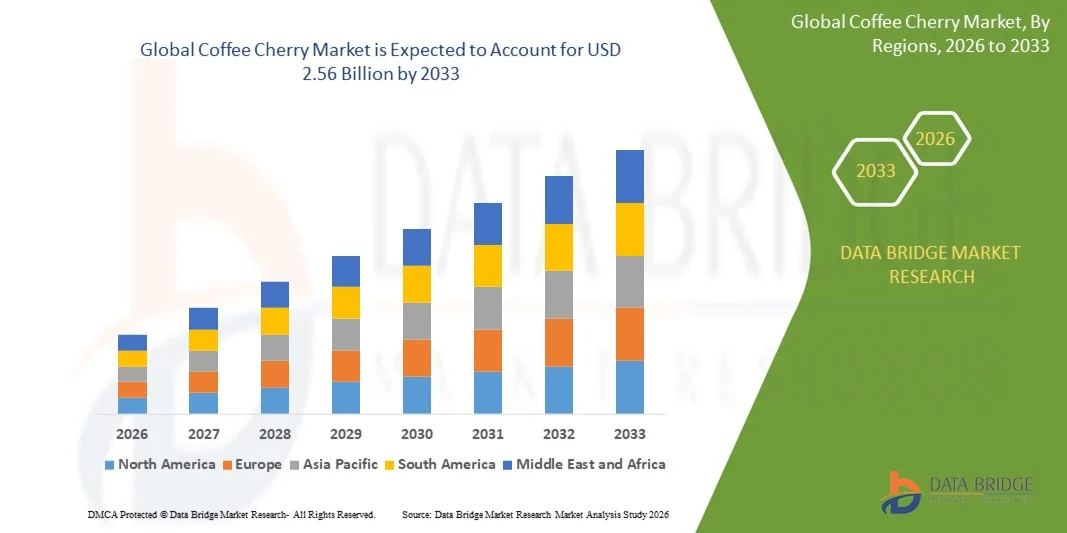
Coffee Cherry Market Size
- The global coffee cherry market size was valued at USD 1.76 billion in 2025 and is expected to reach USD 2.56 billion by 2033, at a CAGR of 4.80% during the forecast period
- The market growth is largely fueled by the rising utilization of coffee cherry as a value-added ingredient across food and beverages, dietary supplements, and personal care products, driven by increasing focus on natural antioxidants, functional nutrition, and sustainable ingredient sourcing
- Furthermore, growing emphasis on waste reduction and circular economy practices within the coffee industry is encouraging the conversion of coffee cherries from by-products into commercially viable ingredients. These converging factors are accelerating the adoption of coffee cherry derivatives, thereby significantly supporting overall market growth
Coffee Cherry Market Analysis
- Coffee cherry, encompassing the pulp and skin surrounding the coffee bean, is emerging as an important functional ingredient across food, beverage, nutraceutical, and cosmetic applications due to its antioxidant content, natural energy properties, and sustainability benefits
- The increasing demand for coffee cherry products is primarily driven by rising consumer preference for plant-based, clean-label ingredients, growing awareness of functional health benefits, and expanding innovation by food and beverage manufacturers seeking differentiated and sustainable formulations
- Europe dominated the coffee cherry market with a share of 33.5% in 2025, due to strong demand for natural, antioxidant-rich ingredients across food, beverages, cosmetics, and dietary supplements, supported by strict quality standards and sustainability-focused sourcing practices
- Asia-Pacific is expected to be the fastest growing region in the coffee cherry market during the forecast period due to rising health awareness, expanding middle-class population, and growing demand for functional food and beverage products
- Arabica segment dominated the market with a market share of 55.5% in 2025, due to its superior flavor profile, higher antioxidant content, and widespread use in premium food and beverage formulations. Arabica coffee cherries are preferred by manufacturers producing specialty coffee extracts, nutraceutical ingredients, and high-end dietary supplements due to their balanced acidity and aromatic compounds. The strong global demand for premium and functional coffee-based products further supports the dominance of this segment
Report Scope and Coffee Cherry Market Segmentation
|
Attributes |
Coffee Cherry Key Market Insights |
|
Segments Covered |
|
|
Countries Covered |
North America
Europe
Asia-Pacific
Middle East and Africa
South America
|
|
Key Market Players |
|
|
Market Opportunities |
|
|
Value Added Data Infosets |
In addition to the insights on market scenarios such as market value, growth rate, segmentation, geographical coverage, and major players, the market reports curated by the Data Bridge Market Research also include in-depth expert analysis, pricing analysis, brand share analysis, consumer survey, demography analysis, supply chain analysis, value chain analysis, raw material/consumables overview, vendor selection criteria, PESTLE Analysis, Porter Analysis, and regulatory framework. |
Coffee Cherry Market Trends
Rising Adoption of Coffee Cherry Upcycling in Functional Beverages
- A prominent trend in the coffee cherry market is the increasing upcycling of coffee cherries into functional beverage ingredients, driven by growing demand for sustainable, antioxidant-rich, and naturally energizing products. Beverage manufacturers are recognizing coffee cherry pulp and skin as valuable raw materials that enhance flavor complexity while supporting circular economy practices
- For instance, Kirin Holdings Co., Ltd. developed a fermented ingredient derived from coffee cherries to improve body and aroma in non-alcoholic and low-alcohol beverages, demonstrating commercial viability beyond traditional coffee uses. Such innovations elevate coffee cherry from an agricultural by-product to a differentiated functional beverage component
- The ready-to-drink and wellness beverage segment is increasingly incorporating coffee cherry extracts to meet consumer expectations for clean-label and plant-based formulations. This trend aligns with shifting preferences toward natural energy sources and reduced synthetic additives
- Brands focused on sustainability are leveraging coffee cherry upcycling to communicate reduced waste and positive environmental impact. This approach strengthens brand positioning while supporting higher-value utilization of coffee supply chains
- Specialty beverage developers are exploring coffee cherry syrups, concentrates, and fermented bases to create novel taste profiles. This experimentation is expanding application diversity and supporting premiumization within functional drinks
- Overall, the rising adoption of coffee cherry upcycling in beverages is reshaping its market perception and reinforcing long-term growth through sustainability-led product innovation
Coffee Cherry Market Dynamics
Driver
Growing Demand for Natural Antioxidant-Rich and Clean-Label Ingredients
- The coffee cherry market is strongly driven by increasing demand for natural ingredients with antioxidant and functional health benefits across food, beverage, and nutraceutical industries. Consumers are actively shifting toward clean-label products that offer wellness benefits without artificial additives
- For instance, Nestlé has advanced research into coffee cherry extracts for use in functional beverages and nutrition products, focusing on antioxidant properties and flavor enhancement. This involvement from major food and beverage players validates coffee cherry as a scalable and credible ingredient
- Dietary supplement manufacturers are adopting coffee cherry due to its polyphenol content and natural energy support, aligning with preventive health and lifestyle nutrition trends. This demand supports higher utilization rates across multiple end-use segments
- The cosmetics and personal care sector is also incorporating coffee cherry derivatives for antioxidant and skin-conditioning benefits. Such cross-industry adoption strengthens demand stability and market diversification
- As awareness of functional nutrition grows, coffee cherry ingredients are increasingly positioned as premium, plant-based solutions. This sustained preference for natural and transparent formulations continues to accelerate market growth
Restraint/Challenge
Limited Large-Scale Processing Infrastructure and Supply Chain Standardization
- The coffee cherry market faces challenges due to limited large-scale processing infrastructure capable of handling fresh cherries before spoilage. Coffee cherries require timely processing, which restricts scalability in regions lacking advanced post-harvest facilities
- For instance, KonaRed Corporation has invested heavily in proprietary processing systems to stabilize coffee fruit immediately after harvest, highlighting the high capital and technical requirements involved. Such infrastructure is not widely accessible to smaller producers
- Inconsistent supply chain standardization across coffee-growing regions affects quality uniformity and ingredient consistency. This creates challenges for large manufacturers that require reliable specifications for mass production
- Logistical constraints, including transportation and cold-chain requirements, further complicate commercialization in emerging markets. These issues limit broader participation and slow capacity expansion
- Overall, overcoming infrastructure and standardization challenges remains critical for scaling coffee cherry adoption while maintaining quality, cost efficiency, and global market competitiveness
Coffee Cherry Market Scope
The market is segmented on the basis of product type, application, nature, and distribution channel.
- By Product Type
On the basis of product type, the coffee cherry market is segmented into Arabica (Coffea Arabica), Robusta (Coffea Canephora), and Liberica (Coffea liberica Bull). The Arabica segment dominated the market with the largest share of 55.5% in 2025, driven by its superior flavor profile, higher antioxidant content, and widespread use in premium food and beverage formulations. Arabica coffee cherries are preferred by manufacturers producing specialty coffee extracts, nutraceutical ingredients, and high-end dietary supplements due to their balanced acidity and aromatic compounds. The strong global demand for premium and functional coffee-based products further supports the dominance of this segment.
The Robusta segment is expected to witness the fastest growth from 2026 to 2033, supported by its higher caffeine content, cost efficiency, and increasing utilization in functional beverages and pharmaceutical formulations. Robusta coffee cherries are gaining traction among manufacturers seeking higher yield and stronger bioactive concentration for energy-focused products. Expanding use in emerging markets and industrial-scale processing also contributes to its accelerated growth.
- By Application
On the basis of application, the coffee cherry market is categorized into food and beverages, cosmetics and personal care products, pharmaceuticals, coloring agents, and dietary supplements. The food and beverages segment dominated the market in 2025, owing to the extensive use of coffee cherry extracts in ready-to-drink beverages, functional drinks, and natural flavoring solutions. Rising consumer preference for antioxidant-rich and plant-based ingredients has strengthened demand within this segment. The incorporation of coffee cherry derivatives in energy drinks and specialty coffees further reinforces its leading position.
The dietary supplements segment is projected to grow at the fastest rate during the forecast period, driven by increasing awareness of the health benefits associated with coffee cherry antioxidants and polyphenols. Manufacturers are increasingly formulating capsules, powders, and functional blends targeting energy, metabolism, and cognitive health. Growing preventive healthcare trends and clean-label supplement demand are key growth enablers.
- By Nature
On the basis of nature, the coffee cherry market is segmented into organic and conventional. The conventional segment accounted for the largest market share in 2025, supported by its widespread availability, lower production costs, and established supply chains. Conventional coffee cherries are extensively used by large-scale food, beverage, and pharmaceutical manufacturers due to consistent quality and reliable sourcing. Higher yield per hectare and scalability further contribute to its dominance across global markets.
The organic segment is anticipated to register the fastest growth from 2026 to 2033, fueled by rising consumer demand for chemical-free, sustainably sourced ingredients. Increasing regulatory support and certification standards are encouraging producers to expand organic cultivation. Growth is further supported by premium pricing opportunities and strong adoption in health-focused and eco-conscious product categories.
- By Distribution Channel
On the basis of distribution channel, the coffee cherry market is divided into direct sales channel/B2B and indirect sales channel/B2C. The direct sales channel/B2B segment dominated the market in 2025, driven by strong demand from food processors, beverage manufacturers, nutraceutical companies, and cosmetic formulators. Direct sourcing enables bulk procurement, quality control, and long-term supply agreements, which are critical for industrial applications. This channel also supports customized ingredient specifications and cost efficiencies.
The indirect sales channel/B2C segment is expected to grow at the fastest pace during the forecast period, supported by rising online retail penetration and growing consumer interest in functional superfood ingredients. Increased availability of coffee cherry powders, extracts, and supplements through e-commerce platforms is expanding consumer access. Brand-led marketing and health-focused positioning further accelerate growth in this segment.
Coffee Cherry Market Regional Analysis
- Europe dominated the coffee cherry market with the largest revenue share of 33.5% in 2025, driven by strong demand for natural, antioxidant-rich ingredients across food, beverages, cosmetics, and dietary supplements, supported by strict quality standards and sustainability-focused sourcing practices
- Manufacturers across the region increasingly utilize coffee cherry extracts to align with clean-label trends, plant-based formulations, and circular economy initiatives, particularly in functional beverages and premium personal care products
- This dominance is further supported by advanced food processing infrastructure, high consumer awareness of health benefits, and strong presence of nutraceutical and cosmetic brands, positioning Europe as a mature and value-driven market
Germany Coffee Cherry Market Insight
The Germany coffee cherry market accounted for the largest share within Europe in 2025, supported by a strong functional food and nutraceutical industry and high demand for scientifically backed natural ingredients. German manufacturers emphasize standardized extracts and traceable sourcing, driving adoption in dietary supplements and functional beverages. Robust R&D activity and regulatory compliance frameworks further support steady market growth.
U.K. Coffee Cherry Market Insight
The U.K. coffee cherry market is projected to grow at a steady CAGR during the forecast period, driven by rising demand for plant-based superfood ingredients and clean-label beverages. Increasing use of coffee cherry extracts in energy drinks, wellness supplements, and cosmetic formulations supports market expansion. Strong retail penetration and consumer interest in sustainable sourcing further enhance growth prospects.
North America Coffee Cherry Market Insight
The North America coffee cherry market holds a significant market share, supported by strong demand for functional foods, sports nutrition products, and natural antioxidants. The region benefits from advanced ingredient processing capabilities and high adoption of wellness-focused products. Growing emphasis on preventive health and clean-label positioning continues to drive market expansion.
U.S. Coffee Cherry Market Insight
The U.S. coffee cherry market represents a key share within North America, driven by widespread consumption of functional beverages and dietary supplements. The presence of established nutraceutical brands and innovation in natural ingredient formulation supports strong adoption. Increasing consumer focus on energy, metabolism, and antioxidant benefits further strengthens market development.
Asia-Pacific Coffee Cherry Market Insight
The Asia-Pacific coffee cherry market is expected to witness the fastest CAGR from 2026 to 2033, driven by rising health awareness, expanding middle-class population, and growing demand for functional food and beverage products. Manufacturers increasingly incorporate coffee cherry ingredients to meet demand for natural and traditional wellness solutions. Expanding processing capacity and regional sourcing initiatives accelerate market growth.
China Coffee Cherry Market Insight
China dominated the Asia-Pacific coffee cherry market in 2025, supported by rapid growth in functional beverages, dietary supplements, and beauty-from-within products. Strong domestic processing capabilities and rising consumer interest in antioxidant-rich ingredients drive adoption. Expansion of health-focused retail channels further contributes to market growth.
India Coffee Cherry Market Insight
The India coffee cherry market is emerging as a high-growth segment, supported by increasing utilization of coffee by-products and rising demand for natural wellness ingredients. Growth in nutraceuticals, herbal supplements, and functional beverages drives market adoption. Expanding domestic coffee production and growing focus on value-added agricultural processing further position India as a promising growth market.
Coffee Cherry Market Share
The coffee cherry industry is primarily led by well-established companies, including:
- Mountain Thunder Coffee Plantation (U.S.)
- Greenwell Farms Inc. (U.S.)
- Kona Joe Coffee LLC (U.S.)
- Hula Daddy Kona Coffee (U.S.)
- Mauka Meadows Coffee Farm (U.S.)
- Good Land Organics (U.S.)
- KonaRed Corporation (U.S.)
- Nestlé S.A. (Switzerland)
- Kirin Holdings Co., Ltd. (Japan)
- Starbucks Corporation (U.S.)
- BIKAS COFFEE (Nepal)
- Foodflows (France)
- Volcanica Coffee Company (U.S.)
Latest Developments in Global Coffee Cherry Market
- In November 2025, Kirin Holdings Co., Ltd., through its Institute for Future Beverage, developed a fermented ingredient derived from coffee cherries, converting pulp and skin that are typically discarded into a functional beverage component. This innovation enhances mouthfeel and aroma in non-alcoholic and low-alcohol drinks, supporting the expansion of coffee cherry applications beyond niche wellness products. The development reinforces sustainability-focused sourcing, encourages wider beverage industry adoption, and strengthens the commercial value of coffee cherry-derived ingredients
- In November 2024, BIKAS COFFEE launched BIKAS COFFEE Cherry Syrup by upcycling coffee cherries that are usually treated as agricultural waste during coffee processing. The product demonstrates how coffee cherry can be transformed into a value-added ingredient for syrups and beverages, supporting circular economy practices within the coffee industry. This launch also increases awareness among consumers and manufacturers about the functional and flavor potential of coffee cherry derivatives
- In March 2024, Foodflows introduced a refreshment and mixed drink made from refined coffee cherries, positioning coffee cherry as a mainstream beverage ingredient rather than a by-product. The launch validates consumer acceptance of coffee cherry-based drinks and highlights its suitability for ready-to-drink and mixed beverage formats. This development supports market growth by encouraging innovation in functional refreshments and expanding demand from beverage formulators
- In July 2023, KonaRed Corporation expanded its range of coffee fruit juices and concentrates produced from whole coffee cherries, strengthening its vertically integrated sourcing model. This expansion improves utilization of coffee harvests, increases income opportunities for coffee farmers, and ensures consistent supply of raw materials. The initiative supports broader adoption of coffee cherry ingredients in functional beverages, sports nutrition, and dietary supplements
- In February 2023, Nestlé advanced its research into coffee cherry-based extracts for functional beverages and nutrition products, focusing on antioxidant content and flavor enhancement. This R&D progress signals growing interest from multinational food and beverage companies in coffee cherry ingredients. Such developments help validate the scalability and long-term commercial potential of the coffee cherry market, encouraging further investment and innovation

- Interactive Data Analysis Dashboard
- Company Analysis Dashboard for high growth potential opportunities
- Research Analyst Access for customization & queries
- Competitor Analysis with Interactive dashboard
- Latest News, Updates & Trend analysis
- Harness the Power of Benchmark Analysis for Comprehensive Competitor Tracking
Global Coffee Cherry Market, Supply Chain Analysis and Ecosystem Framework
To support market growth and help clients navigate the impact of geopolitical shifts, DBMR has integrated in-depth supply chain analysis into its Global Coffee Cherry Market research reports. This addition empowers clients to respond effectively to global changes affecting their industries. The supply chain analysis section includes detailed insights such as Global Coffee Cherry Market consumption and production by country, price trend analysis, the impact of tariffs and geopolitical developments, and import and export trends by country and HSN code. It also highlights major suppliers with data on production capacity and company profiles, as well as key importers and exporters. In addition to research, DBMR offers specialized supply chain consulting services backed by over a decade of experience, providing solutions like supplier discovery, supplier risk assessment, price trend analysis, impact evaluation of inflation and trade route changes, and comprehensive market trend analysis.
Data collection and base year analysis are done using data collection modules with large sample sizes. The stage includes obtaining market information or related data through various sources and strategies. It includes examining and planning all the data acquired from the past in advance. It likewise envelops the examination of information inconsistencies seen across different information sources. The market data is analysed and estimated using market statistical and coherent models. Also, market share analysis and key trend analysis are the major success factors in the market report. To know more, please request an analyst call or drop down your inquiry.
The key research methodology used by DBMR research team is data triangulation which involves data mining, analysis of the impact of data variables on the market and primary (industry expert) validation. Data models include Vendor Positioning Grid, Market Time Line Analysis, Market Overview and Guide, Company Positioning Grid, Patent Analysis, Pricing Analysis, Company Market Share Analysis, Standards of Measurement, Global versus Regional and Vendor Share Analysis. To know more about the research methodology, drop in an inquiry to speak to our industry experts.
Data Bridge Market Research is a leader in advanced formative research. We take pride in servicing our existing and new customers with data and analysis that match and suits their goal. The report can be customized to include price trend analysis of target brands understanding the market for additional countries (ask for the list of countries), clinical trial results data, literature review, refurbished market and product base analysis. Market analysis of target competitors can be analyzed from technology-based analysis to market portfolio strategies. We can add as many competitors that you require data about in the format and data style you are looking for. Our team of analysts can also provide you data in crude raw excel files pivot tables (Fact book) or can assist you in creating presentations from the data sets available in the report.













