


Cognitive Computing Market Size
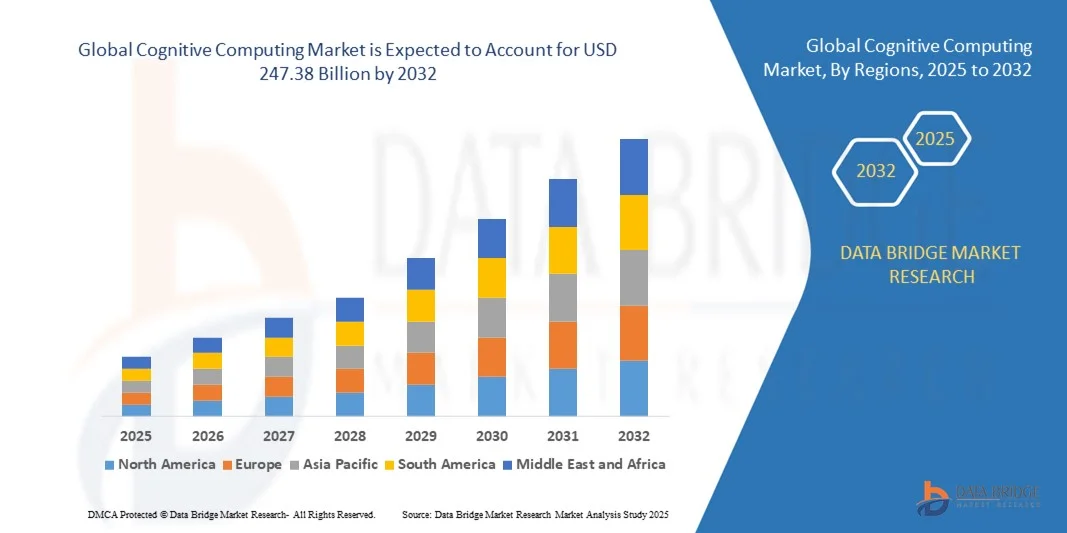
- The global cognitive computing market size was valued at USD 27.5 billion in 2024 and is expected to reach USD 247.38 billion by 2032, at a CAGR of 31.6% during the forecast period
- The market growth is largely fuelled by the increasing adoption of artificial intelligence (AI) and machine learning technologies across enterprises, rising demand for data-driven decision-making, and the need for automation in complex business processes
- Rapid digitization across industries such as healthcare, BFSI, retail, and manufacturing is driving the integration of cognitive computing solutions to enhance operational efficiency, improve customer experiences, and enable predictive analytics
Cognitive Computing Market Analysis
- Cognitive computing is transforming the enterprise landscape by providing intelligent solutions capable of mimicking human thought processes to solve business challenges. These systems combine natural language processing (NLP), machine learning, and data analytics to deliver actionable insights
- The market is witnessing increased adoption of cognitive assistants, chatbots, and recommendation engines that improve customer engagement, enhance productivity, and reduce operational costs
- North America dominated the cognitive computing market with the largest revenue share of 35.4% in 2024, driven by rapid adoption of AI technologies, growing digital transformation initiatives, and increasing demand for real-time data-driven insights across enterprises
- Asia-Pacific region is expected to witness the highest growth rate in the global cognitive computing market, driven by increasing urbanization, technological advancements, expanding enterprise adoption, and investments in smart city and AI-based industrial solutions across countries such as China, Japan, and South Korea
- The Machine Learning segment held the largest market revenue share in 2024, driven by its ability to analyze large datasets, detect patterns, and deliver actionable insights across industries. ML-enabled cognitive computing solutions often offer predictive analytics, automation, and decision-support capabilities, making them the preferred choice for enterprises seeking data-driven efficiency
Report Scope and Cognitive Computing Market Segmentation
|
Attributes |
Cognitive Computing Key Market Insights |
|
Segments Covered |
|
|
Countries Covered |
North America
Europe
Asia-Pacific
Middle East and Africa
South America
|
|
Key Market Players |
|
|
Market Opportunities |
|
|
Value Added Data Infosets |
In addition to the market insights such as market value, growth rate, market segments, geographical coverage, market players, and market scenario, the market report curated by the Data Bridge Market Research team includes in-depth expert analysis, import/export analysis, pricing analysis, production consumption analysis, and pestle analysis. |
Cognitive Computing Market Trends
Rise Of AI-Driven Decision Making And Cognitive Solutions
- The growing adoption of cognitive computing is transforming enterprise operations by enabling real-time, data-driven insights and intelligent automation. These solutions allow organizations to optimize workflows, reduce operational inefficiencies, and make informed decisions, enhancing productivity and business outcomes
- The high demand for AI-powered analytics in complex industries is accelerating the deployment of machine learning algorithms, natural language processing, and pattern recognition tools. These technologies are particularly effective in finance, healthcare, and manufacturing, helping reduce human error and improve decision-making speed
- The scalability and adaptability of modern cognitive computing platforms are making them attractive for large enterprises and SMEs alike. Organizations benefit from predictive analytics, personalized recommendations, and automation capabilities without substantial upfront IT investment, which ultimately enhances operational efficiency
- For instance, in 2023, several multinational banks in North America implemented cognitive computing solutions for fraud detection and risk management, resulting in faster decision-making, improved compliance, and reduced financial losses
- While cognitive computing is accelerating intelligent operations, its impact depends on continued AI model improvements, integration with legacy systems, and workforce training. Vendors must focus on customizable solutions, robust data management, and secure deployment strategies to fully capitalize on this growing demand
Cognitive Computing Market Dynamics
Driver
Increasing Demand For Real-Time Data-Driven Insights And AI Integration
- The surge in AI adoption and digital transformation initiatives is driving the adoption of cognitive computing solutions across enterprises. Companies seek faster, more accurate decision-making capabilities to remain competitive. The growing reliance on data-driven strategies is pushing organizations to integrate cognitive systems for operational optimization and strategic planning
- Organizations are increasingly recognizing the operational benefits of cognitive computing, such as predictive analytics, process automation, and improved customer engagement. These advantages support adoption across finance, healthcare, IT, and manufacturing sectors. Enhanced workflow efficiency, reduced errors, and better forecasting capabilities further encourage deployment across multiple industries
- Government programs and private sector initiatives promoting AI and automation are further boosting demand. Regulatory support for digital transformation and smart technologies encourages enterprises to implement cognitive solutions. In addition, public-private collaborations and funding for AI research accelerate innovation and adoption of cognitive platforms
- For instance, in 2022, several healthcare networks in Europe adopted AI-driven cognitive platforms to optimize patient care management and reduce operational bottlenecks, enhancing efficiency and decision-making speed. These implementations also enabled predictive patient outcome analysis and streamlined hospital operations
- While AI-driven insights are driving growth, the market still requires innovation in model accuracy, data processing capabilities, and seamless integration with enterprise IT systems for broader adoption. Continuous advancements in natural language processing, machine learning, and analytics frameworks are necessary to meet evolving enterprise requirements
Restraint/Challenge
High Cost Of Cognitive Computing Solutions And Complexity Of Integration
- The high cost of advanced cognitive computing platforms, including AI models, analytics tools, and hardware requirements, limits adoption among small and mid-sized enterprises. Price remains a major barrier, particularly in developing regions. The cost factor also includes software licenses, cloud infrastructure, and ongoing maintenance, making investment decisions more challenging for smaller firms
- Limited technical expertise and IT infrastructure in some organizations constrain the effective deployment and operation of cognitive computing solutions. Lack of trained personnel to manage AI algorithms and data pipelines delays integration. Organizations often require specialized training programs and external consulting to ensure smooth deployment and utilization
- Integrating cognitive computing with existing enterprise systems can be complex, requiring additional software, network upgrades, and ongoing support. This increases deployment costs and time-to-market for new solutions. Compatibility issues with legacy systems, data silos, and cybersecurity concerns add further layers of complexity
- For instance, in 2023, several mid-sized manufacturing companies in Asia reported delays in implementing cognitive analytics platforms due to compatibility and integration issues, highlighting the need for robust support and scalable solutions. These delays also affected real-time analytics capabilities and hindered strategic decision-making
- While cognitive technologies continue to advance, addressing cost, integration, and operational challenges remains critical. Market stakeholders must focus on user-friendly platforms, modular deployments, and secure data management to unlock long-term market potential. Adoption of standardized APIs, cloud-based solutions, and flexible deployment models can mitigate integration hurdles and accelerate market growth
Cognitive Computing Market Scope
The market is segmented on the basis of technology, component, size, business function, deployment type, vertical, and applications.
- By Technology
On the basis of technology, the cognitive computing market is segmented into Natural Language Processing (NLP), Machine Learning (ML), Automated Reasoning, and Others. The Machine Learning segment held the largest market revenue share in 2024, driven by its ability to analyze large datasets, detect patterns, and deliver actionable insights across industries. ML-enabled cognitive computing solutions often offer predictive analytics, automation, and decision-support capabilities, making them the preferred choice for enterprises seeking data-driven efficiency.
The Natural Language Processing (NLP) segment is expected to witness the fastest growth rate from 2025 to 2032, driven by increasing demand for AI-powered conversational interfaces, text analytics, and voice recognition applications. NLP solutions are particularly popular for their ability to enhance customer engagement, automate communication, and extract meaningful insights from unstructured data, often serving as a primary interface for cognitive systems.
- By Component
On the basis of component, the market is segmented into Platform and Service. The Platform segment held the largest revenue share in 2024 due to widespread adoption of integrated cognitive computing platforms that offer end-to-end analytics, AI modeling, and enterprise deployment capabilities.
The Service segment is expected to witness the fastest growth rate from 2025 to 2032, driven by rising demand for managed cognitive services, consulting, and technical support to help enterprises optimize AI and analytics initiatives without heavy upfront investment.
- By Size
On the basis of size, the market is segmented into Small and Medium Businesses (SMBs) and Large Enterprises. Large enterprises dominated in 2024, owing to their higher adoption of AI-driven cognitive platforms for operational efficiency, risk mitigation, and strategic decision-making.
SMBs is expected to witness the fastest growth rate from 2025 to 2032 due to increasing availability of scalable, cloud-based cognitive computing solutions tailored to cost-sensitive businesses seeking competitive advantage.
- By Business Functions
On the basis of business functions, the market is segmented into Human Resources, Legal, Finance, and Marketing and Advertising. The Finance segment held the largest revenue share in 2024, driven by the adoption of cognitive computing for fraud detection, predictive analytics, and automated reporting.
The Marketing and Advertising segment is expected to witness the fastest growth rate from 2025 to 2032, fueled by AI-driven consumer insights, targeted campaigns, and real-time engagement analytics.
- By Deployment Type
On the basis of deployment type, the market is segmented into Cloud and On-Premises. Cloud-based deployment dominated in 2024 due to scalability, cost-efficiency, and ease of integration across multiple business units and geographies.
On-Premises deployment is expected to witness the fastest growth rate from 2025 to 2032, driven by enterprises requiring high data security, customization, and control over cognitive computing infrastructure.
- By Vertical
On the basis of vertical, the market is segmented into BFSI, Consumer Goods and Retail, Aerospace and Defense, Telecom and IT, Energy and Power, Travel and Tourism, Media and Entertainment, Education and Research, and Others. BFSI dominated in 2024 due to high adoption of AI and cognitive computing for risk management, customer service automation, and regulatory compliance.
Consumer Goods and Retail is expected to witness the fastest growth rate from 2025 to 2032, fueled by AI-powered personalization, supply chain optimization, and inventory management solutions.
- By Applications
On the basis of applications, the market is segmented into Diagnostic APIs, Robots, Cyber Security, Farm Mechanization, Social Media Monitoring, Self-Driving Cars, Gaming, Video Surveillance, E-Learning, IT Infrastructure Management, and Supply Chain Management. IT Infrastructure Management held the largest share in 2024, driven by demand for AI-driven monitoring, predictive maintenance, and automated resource allocation.
Diagnostic APIs and Social Media Monitoring is expected to witness the fastest growth rate from 2025 to 2032, propelled by rising AI adoption for real-time analytics, customer insights, and intelligent automation.
Cognitive Computing Market Regional Analysis
- North America dominated the cognitive computing market with the largest revenue share of 35.4% in 2024, driven by rapid adoption of AI technologies, growing digital transformation initiatives, and increasing demand for real-time data-driven insights across enterprises
- Organizations in the region highly value operational efficiency, predictive analytics, and automation capabilities offered by cognitive computing solutions, fostering widespread deployment across sectors such as BFSI, healthcare, and IT
- This adoption is further supported by high investments in AI research, well-established IT infrastructure, and a skilled workforce, positioning North America as a key hub for cognitive computing innovation and enterprise integration
U.S. Cognitive Computing Market Insight
The U.S. cognitive computing market captured the largest revenue share in North America in 2024, fueled by early adoption of AI-powered platforms, strong enterprise demand for intelligent automation, and government initiatives supporting technology integration. Enterprises increasingly leverage cognitive computing for process optimization, fraud detection, customer engagement, and advanced analytics. The growing adoption of cloud-based cognitive platforms, combined with AI-enabled business intelligence tools, is significantly contributing to the market’s expansion.
Europe Cognitive Computing Market Insight
The Europe cognitive computing market is expected to witness the fastest growth rate from 2025 to 2032, primarily driven by increasing investments in AI research, adoption of intelligent automation across industries, and regulatory support for digital innovation. The surge in demand for enhanced analytics, predictive maintenance, and operational efficiency is fostering adoption across sectors including finance, manufacturing, and healthcare. European enterprises are also investing in cloud-based cognitive solutions and AI-powered business process optimization, driving growth across commercial and public sectors.
U.K. Cognitive Computing Market Insight
The U.K. cognitive computing market is expected to witness the fastest growth rate from 2025 to 2032, driven by government initiatives promoting AI adoption, growing enterprise focus on data-driven decision-making, and the rise of digital transformation programs. Financial services, healthcare, and IT industries are increasingly deploying cognitive computing platforms to improve operational efficiency, predictive analytics, and customer engagement. The U.K.’s strong AI research ecosystem and digital infrastructure further support market expansion.
Germany Cognitive Computing Market Insight
The Germany cognitive computing market is expected to witness the fastest growth rate from 2025 to 2032, fueled by industrial digitization, increasing adoption of AI and machine learning technologies, and government support for innovation. Enterprises in manufacturing, automotive, and healthcare sectors are increasingly leveraging cognitive computing for predictive analytics, process automation, and data-driven insights. The focus on sustainable, AI-enabled technologies aligns with local consumer expectations and enterprise efficiency goals.
Asia-Pacific Cognitive Computing Market Insight
The Asia-Pacific cognitive computing market is expected to witness the fastest growth rate from 2025 to 2032, driven by rapid urbanization, rising investments in AI technologies, and increasing digital transformation initiatives in countries such as China, Japan, and India. Organizations across BFSI, retail, and healthcare sectors are adopting cognitive computing for enhanced analytics, automation, and operational efficiency. In addition, government initiatives promoting AI integration and the region emerging as a hub for technology services are contributing to broader adoption.
Japan Cognitive Computing Market Insight
The Japan cognitive computing market is expected to witness the fastest growth rate from 2025 to 2032 due to the country’s focus on high-tech innovation, digital transformation, and demand for intelligent automation. Enterprises are increasingly deploying cognitive platforms to enhance decision-making, improve customer experience, and optimize business processes. Japan’s aging population and emphasis on productivity improvement further drive adoption in both public and private sectors.
China Cognitive Computing Market Insight
The China cognitive computing market accounted for the largest market revenue share in Asia Pacific in 2024, attributed to rapid technological adoption, strong government initiatives promoting AI, and expanding enterprise investments in intelligent systems. Organizations are leveraging cognitive computing for predictive analytics, process optimization, and enhanced decision-making across sectors such as finance, healthcare, and IT. The growth of cloud-based AI platforms and domestic technology providers is further fueling market expansion in China.
Cognitive Computing Market Share
The Cognitive Computing industry is primarily led by well-established companies, including:
- IBM (U.S.)
- Microsoft (U.S.)
- Intel Corporation (U.S.)
- Cognitive Computing Consortium (U.S.)
- Enterra Solutions (U.S.)
- Numenta (U.S.)
- Vicarious (U.S.)
- DeepMind (U.K.)
- SparkCognition (U.S.)
- TIBCO Software Inc (U.S.)
- NakaTech (U.S.)
- Wipro Limited (India)
- Marlabs (U.S.)
- SAP SE (Germany)
- Hewlett Packard Enterprise Development LP (U.S.)
- CognitiveScale (U.S.)
- oppScience (U.S.)
- e-Zest Solution (India)
Latest Developments in Global Cognitive Computing Market
- In May 2024, Wipro (India) partnered with Microsoft (U.S.) to launch generative AI-powered cognitive assistants for financial services, designed to enhance market intelligence, accelerate client onboarding, and streamline loan origination. Leveraging Microsoft Azure OpenAI and Document Intelligence, these solutions reduce paperwork, provide timely insights, and improve the overall user experience for financial professionals, driving efficiency and adoption of AI in the finance sector
- In May 2024, IBM Corporation (U.S.) and SAP SE (Germany) announced an expanded collaboration focused on generative AI and industry-specific cloud solutions, aiming to integrate AI into SAP business processes. This development enables innovation across multiple sectors, accelerates digital transformation, and provides enterprises with enhanced business value by combining IBM’s hybrid cloud and AI expertise with SAP’s enterprise solutions
- In February 2024, Microsoft (U.S.) collaborated with Mistral AI (France) to advance AI innovation and large language model development, using Azure infrastructure to deploy Mistral’s models as a service. The partnership aims to provide commercial opportunities, accelerate AI research, and make sophisticated AI models more accessible to enterprises, boosting market adoption of scalable AI solutions
- In March 2023, Nuance Communications (U.S.) launched Dragon Ambient eXperience (DAX) Express, a voice-enabled medical scribe application integrating OpenAI’s GPT-4. The tool automates clinical documentation by capturing physician-patient interactions, generating draft notes in seconds, reducing administrative burden, enhancing accuracy, and addressing physician burnout, transforming AI adoption in healthcare documentation

- Interactive Data Analysis Dashboard
- Company Analysis Dashboard for high growth potential opportunities
- Research Analyst Access for customization & queries
- Competitor Analysis with Interactive dashboard
- Latest News, Updates & Trend analysis
- Harness the Power of Benchmark Analysis for Comprehensive Competitor Tracking
Data collection and base year analysis are done using data collection modules with large sample sizes. The stage includes obtaining market information or related data through various sources and strategies. It includes examining and planning all the data acquired from the past in advance. It likewise envelops the examination of information inconsistencies seen across different information sources. The market data is analysed and estimated using market statistical and coherent models. Also, market share analysis and key trend analysis are the major success factors in the market report. To know more, please request an analyst call or drop down your inquiry.
The key research methodology used by DBMR research team is data triangulation which involves data mining, analysis of the impact of data variables on the market and primary (industry expert) validation. Data models include Vendor Positioning Grid, Market Time Line Analysis, Market Overview and Guide, Company Positioning Grid, Patent Analysis, Pricing Analysis, Company Market Share Analysis, Standards of Measurement, Global versus Regional and Vendor Share Analysis. To know more about the research methodology, drop in an inquiry to speak to our industry experts.
Data Bridge Market Research is a leader in advanced formative research. We take pride in servicing our existing and new customers with data and analysis that match and suits their goal. The report can be customized to include price trend analysis of target brands understanding the market for additional countries (ask for the list of countries), clinical trial results data, literature review, refurbished market and product base analysis. Market analysis of target competitors can be analyzed from technology-based analysis to market portfolio strategies. We can add as many competitors that you require data about in the format and data style you are looking for. Our team of analysts can also provide you data in crude raw excel files pivot tables (Fact book) or can assist you in creating presentations from the data sets available in the report.













