


Cognitive Robotics Market Size
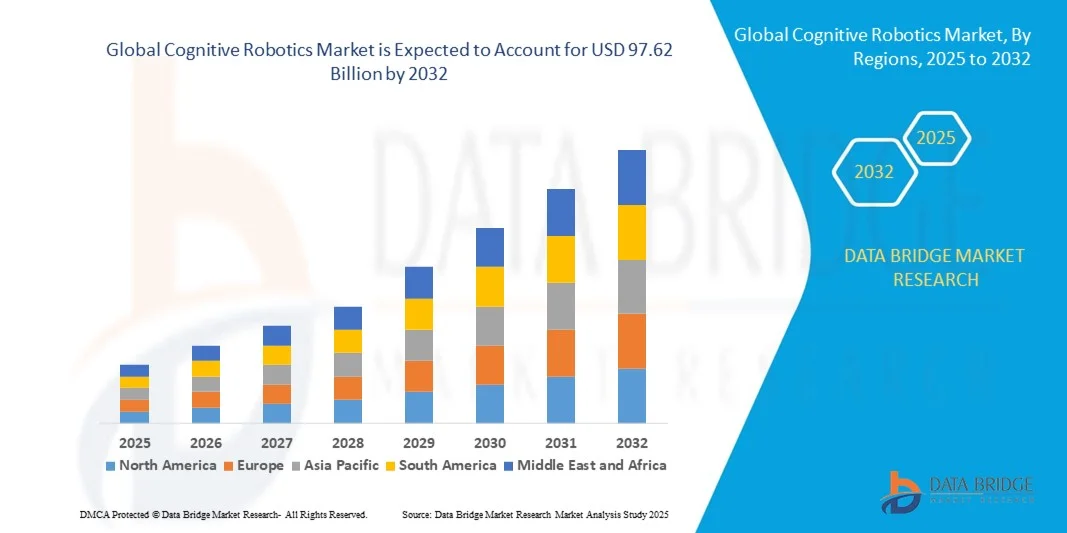
- The global cognitive robotics market size was valued at USD 6.54 billion in 2024 and is expected to reach USD 97.62 billion by 2032, at a CAGR of 40.20% during the forecast period
- The market growth is largely fuelled by the rising adoption of artificial intelligence (AI) and machine learning (ML) technologies in robotics for autonomous decision-making and adaptive learning
- Increasing demand for intelligent robots in sectors such as healthcare, manufacturing, logistics, and defense to enhance operational efficiency and reduce human intervention is further accelerating market expansion
Cognitive Robotics Market Analysis
- The cognitive robotics market is experiencing rapid growth due to advancements in neural networks, natural language processing, and computer vision, which enable robots to perform complex, human-like tasks with improved accuracy and context awareness
- The integration of cognitive systems allows robots to learn from interactions, adapt to dynamic environments, and collaborate more effectively with humans, paving the way for their deployment across industries ranging from industrial automation to personal assistance
- North America dominated the cognitive robotics market with the largest revenue share of 38.42% in 2024, driven by the rapid adoption of artificial intelligence (AI) technologies and the strong presence of leading robotics manufacturers and technology companies. The region’s focus on automation across industries such as manufacturing, healthcare, and logistics has accelerated cognitive robotics deployment
- Asia-Pacific region is expected to witness the highest growth rate in the global cognitive robotics market, driven by expanding manufacturing capabilities, supportive government initiatives for AI and robotics development, and growing adoption across commercial and healthcare applications
- The Imitation segment held the largest market revenue share in 2024, driven by its ability to enable robots to learn complex human actions by observing and replicating behaviors. This approach allows for faster training, reduced programming time, and improved adaptability in dynamic environments. Imitation learning is widely adopted across manufacturing and healthcare sectors where human-robot collaboration and precision task execution are essential
Report Scope and Cognitive Robotics Market Segmentation
|
Attributes |
Cognitive Robotics Key Market Insights |
|
Segments Covered |
|
|
Countries Covered |
North America
Europe
Asia-Pacific
Middle East and Africa
South America
|
|
Key Market Players |
|
|
Market Opportunities |
|
|
Value Added Data Infosets |
In addition to the insights on market scenarios such as market value, growth rate, segmentation, geographical coverage, and major players, the market reports curated by the Data Bridge Market Research also include in-depth expert analysis, geographically represented company-wise production and capacity, network layouts of distributors and partners, detailed and updated price trend analysis and deficit analysis of supply chain and demand. |
Cognitive Robotics Market Trends
Integration Of Cognitive Robotics With Artificial Intelligence And Machine Learning
- The increasing integration of artificial intelligence (AI) and machine learning (ML) technologies is reshaping the cognitive robotics landscape by enhancing the ability of robots to perceive, reason, and learn from their environment. This integration allows robots to perform complex, unstructured tasks autonomously across manufacturing, healthcare, and defense sectors, significantly improving operational efficiency and precision. Moreover, AI-powered robotics enable predictive analytics, real-time decision-making, and process optimization, which are essential in modern industrial automation and research applications. The fusion of cognitive and physical capabilities helps industries achieve higher throughput while reducing error rates and operational risks
- The growing demand for intelligent automation in industries is accelerating the adoption of AI-driven cognitive robots capable of adaptive decision-making. These systems can analyze real-time data, predict outcomes, and optimize performance without constant human intervention, leading to improved productivity and reduced downtime in industrial operations. Organizations are leveraging these robots to enhance flexibility in production lines and manage complex logistics workflows. This increasing reliance on AI-based robotics is fostering smarter, safer, and more efficient workplaces, especially in high-risk and precision-demanding sectors such as aerospace, automotive, and pharmaceuticals
- Companies are increasingly deploying ML-powered robots in logistics and service industries to streamline operations such as inventory management, material handling, and customer service. This adoption is further supported by advancements in natural language processing (NLP) and computer vision, which enable seamless human-robot collaboration and intuitive communication. These robots not only assist in repetitive tasks but also learn from environmental data and human behavior to deliver context-aware solutions. The combination of mobility, intelligence, and interaction capability is creating new opportunities for service automation across retail, warehousing, and healthcare environments
- For instance, in 2024, IBM partnered with Boston Dynamics to develop AI-enhanced robots for industrial applications, capable of autonomous navigation, predictive maintenance, and situational awareness, reducing human dependency in hazardous environments. The collaboration focuses on leveraging IBM’s Watson AI platform to strengthen robots’ cognitive abilities, making them capable of identifying anomalies and optimizing workflows autonomously. This partnership marks a major step toward integrating advanced analytics with robotics, setting new benchmarks for safety, precision, and reliability in high-performance industrial settings
- While AI-integrated cognitive robotics are revolutionizing automation, their full potential depends on the availability of high-quality datasets, robust computing infrastructure, and regulatory frameworks that ensure ethical deployment and transparency in decision-making. Ensuring cybersecurity and data privacy in AI-powered robots is a growing priority as automation systems become more interconnected. Industry players are focusing on developing explainable AI (XAI) systems to ensure accountability in autonomous operations. Addressing these ethical and technical challenges will be critical to fostering trust and long-term sustainability in the cognitive robotics ecosystem
Cognitive Robotics Market Dynamics
Driver
Growing Adoption Of Cognitive Robots Across Manufacturing And Healthcare Sectors
- The rapid adoption of cognitive robots in manufacturing is driven by the need for greater automation, accuracy, and flexibility in production environments. Robots equipped with cognitive capabilities can adapt to changing workflows, identify errors in real time, and perform precision-based tasks with minimal human oversight, resulting in higher productivity and cost savings. This adaptability reduces reliance on human labor for repetitive or hazardous operations, thereby improving worker safety and production consistency. As factories move toward Industry 4.0, cognitive robots are becoming indispensable assets in digital transformation strategies
- In healthcare, cognitive robotics is gaining traction for applications such as surgery assistance, rehabilitation, and patient monitoring. These systems leverage AI algorithms to analyze patient data, support diagnosis, and improve care delivery. Their ability to learn from experience enhances safety and outcomes in clinical environments. Cognitive robots are also being utilized for disinfection, sample collection, and medication delivery, significantly reducing human exposure to infectious agents. As hospitals integrate more automation, these robots are helping optimize patient care workflows and operational efficiency
- The growing collaboration between robotics manufacturers and AI companies is leading to continuous innovation in intelligent robotics systems. From automotive assembly lines to eldercare facilities, cognitive robots are being utilized to fill skill gaps and address labor shortages while improving operational continuity. Partnerships between tech giants and robotics firms are accelerating the development of scalable, cloud-connected robotic solutions. This cross-industry collaboration is fostering interoperability, enabling robots to seamlessly communicate and coordinate within integrated production and service ecosystems
- For instance, in 2023, Siemens introduced a cognitive robotic system for advanced manufacturing that uses self-learning algorithms to identify and adapt to new tasks without reprogramming, reducing production downtime and increasing flexibility. The system enhances machine learning feedback loops, enabling real-time decision-making and autonomous workflow optimization. This innovation has enabled factories to achieve faster changeovers, higher throughput, and lower maintenance costs, setting a new standard for adaptive industrial robotics in the global market
- While the adoption rate continues to rise, addressing interoperability and integration challenges between cognitive systems and existing infrastructure remains crucial to maximizing efficiency and ensuring large-scale implementation. Companies are focusing on building modular and open-source architectures to enhance compatibility across robotics platforms. Efforts are also being made to standardize communication protocols and establish AI ethics frameworks to govern cognitive decision-making. Overcoming these challenges will ensure smoother deployment and accelerate the commercial scalability of cognitive robotics solutions
Restraint/Challenge
High Development Cost And Ethical Concerns In Autonomous Decision-Making
- The high cost associated with developing and deploying cognitive robots remains a major barrier, particularly for small and medium-sized enterprises. Designing robots with advanced perception, reasoning, and self-learning capabilities requires significant investment in AI software, sensors, and computational hardware. These expenses increase further with maintenance, integration, and system upgrades. The lack of affordable options limits adoption across cost-sensitive industries, highlighting the need for scalable and modular robotics solutions that can lower entry barriers for smaller players
- Ethical and regulatory challenges surrounding autonomous decision-making also present concerns. Issues related to accountability, privacy, and data protection hinder broader acceptance, especially in applications involving direct human interaction. Governments and regulatory bodies are still developing frameworks to address these complexities. Public skepticism regarding the transparency and safety of AI-driven robots adds to the challenge, making it essential for companies to prioritize explainability and compliance in system design and operation
- Furthermore, the shortage of skilled professionals capable of integrating and maintaining advanced robotics systems limits widespread adoption, particularly in emerging economies. The lack of standardization across AI and robotics platforms increases operational complexity and implementation costs. Workforce upskilling programs and educational initiatives are being introduced to address this gap, but progress remains slow. Building a global talent pipeline in robotics engineering and AI integration is crucial for supporting sustained industry growth
- For instance, in 2024, the International Federation of Robotics (IFR) highlighted that over 60% of global manufacturers cited high initial costs and regulatory uncertainty as key barriers to adopting cognitive robotic systems in production processes. The report also emphasized the need for stronger public-private partnerships to encourage innovation funding and reduce compliance friction. Addressing these issues will help industries accelerate digital transformation while maintaining ethical and financial accountability
- While the market holds vast potential, overcoming these financial and ethical challenges through collaborative research, cost-efficient production, and transparent AI governance will be vital to ensuring sustainable market expansion. Companies are increasingly investing in shared robotics platforms and open innovation ecosystems to minimize R&D costs. Policymakers are also promoting standardized testing and certification frameworks to build confidence in autonomous systems. Together, these initiatives will pave the way for responsible, inclusive, and scalable growth in the global cognitive robotics market
Cognitive Robotics Market Scope
The market is segmented on the basis of learning type and application.
- By Learning Type
On the basis of learning type, the cognitive robotics market is segmented into Motor Babble, Imitation, and Knowledge Acquisition. The Imitation segment held the largest market revenue share in 2024, driven by its ability to enable robots to learn complex human actions by observing and replicating behaviors. This approach allows for faster training, reduced programming time, and improved adaptability in dynamic environments. Imitation learning is widely adopted across manufacturing and healthcare sectors where human-robot collaboration and precision task execution are essential.
The Knowledge Acquisition segment is expected to witness the fastest growth rate from 2025 to 2032, driven by advancements in artificial intelligence and deep learning algorithms that allow robots to independently gather, analyze, and apply new information. This capability enhances autonomous decision-making, adaptability, and continuous improvement in robotic performance. The growing integration of knowledge-based learning in AI-driven robots is accelerating their use in industries requiring high-level cognitive processing and situational awareness.
- By Application
On the basis of application, the cognitive robotics market is segmented into Aerospace and Defence, Automotive, Consumer Electronics, Healthcare, and Commercial. The Automotive segment held the largest market revenue share in 2024, fuelled by the growing adoption of cognitive robots for precision assembly, quality inspection, and production line automation. Cognitive robotics systems in this sector enhance flexibility, reduce error rates, and support predictive maintenance, making them essential for modern smart manufacturing environments.
The Healthcare segment is expected to witness the fastest growth rate from 2025 to 2032, driven by the increasing use of AI-powered robots for surgical assistance, patient rehabilitation, and diagnostic support. Cognitive robots equipped with advanced sensors and learning algorithms enable personalized care and improved safety in clinical operations. The rising demand for intelligent automation to address labor shortages and enhance efficiency in medical facilities further supports market expansion in this segment.
Cognitive Robotics Market Regional Analysis
- North America dominated the cognitive robotics market with the largest revenue share of 38.42% in 2024, driven by the rapid adoption of artificial intelligence (AI) technologies and the strong presence of leading robotics manufacturers and technology companies. The region’s focus on automation across industries such as manufacturing, healthcare, and logistics has accelerated cognitive robotics deployment
- The increasing demand for intelligent, self-learning robotic systems capable of performing complex and adaptive tasks is fostering market growth. Moreover, continuous R&D investments, government support for innovation, and the growing integration of robotics in defense and industrial automation are further driving adoption across the region
- The region’s highly developed technological infrastructure and strong collaboration between AI startups and research institutions are creating a favorable environment for market expansion, solidifying North America’s leadership in cognitive robotics innovation
U.S. Cognitive Robotics Market Insight
The U.S. cognitive robotics market captured the largest revenue share in 2024 within North America, driven by its well-established industrial base and technological leadership in AI, ML, and robotics. Major U.S. companies are investing heavily in autonomous systems to enhance manufacturing flexibility, logistics optimization, and healthcare robotics. The growing demand for intelligent service robots in commercial and defense applications further supports the country’s dominance. In addition, initiatives from organizations such as DARPA are boosting innovation and accelerating AI integration in robotics research.
Europe Cognitive Robotics Market Insight
The Europe cognitive robotics market is expected to witness significant growth from 2025 to 2032, fuelled by increasing automation in industries such as automotive, aerospace, and healthcare. The region’s strong regulatory framework promoting the ethical use of AI and robotics is enhancing consumer and enterprise confidence. European manufacturers are increasingly adopting AI-enabled robots for precision engineering, reducing human error, and improving sustainability. The growing emphasis on collaborative robots and green manufacturing practices is expected to further accelerate adoption across the continent.
U.K. Cognitive Robotics Market Insight
The U.K. cognitive robotics market is expected to witness the fastest growth rate from 2025 to 2032, driven by strong government initiatives supporting AI and robotics research and the rapid expansion of tech-driven industries. The country’s universities and research institutions are at the forefront of developing next-generation cognitive robots for industrial automation and healthcare applications. Moreover, the adoption of AI-powered service robots in commercial sectors such as retail, hospitality, and logistics is increasing, reflecting the U.K.’s growing role in shaping Europe’s robotics ecosystem.
Germany Cognitive Robotics Market Insight
The Germany cognitive robotics market is expected to witness steady growth from 2025 to 2032, propelled by the nation’s strong industrial base and focus on smart manufacturing under the Industry 4.0 framework. German companies are integrating cognitive robotics into production lines to enhance flexibility, precision, and energy efficiency. The country’s commitment to technological innovation and data security is further supporting market expansion. In addition, the collaboration between robotics firms and research institutions is driving continuous advancements in adaptive learning and autonomous robotic systems.
Asia-Pacific Cognitive Robotics Market Insight
The Asia-Pacific cognitive robotics market is expected to witness the fastest growth rate from 2025 to 2032, driven by rapid industrialization, government-backed automation initiatives, and growing investments in AI and robotics research. Countries such as China, Japan, and South Korea are leading innovation through large-scale adoption of cognitive robots in manufacturing, electronics, and healthcare sectors. The increasing presence of local robotics startups, coupled with expanding AI infrastructure, is further boosting market penetration across the region.
Japan Cognitive Robotics Market Insight
The Japan cognitive robotics market is expected to witness the fastest growth rate from 2025 to 2032, owing to the country’s advanced technological ecosystem and cultural acceptance of robotics in daily life. Cognitive robots are increasingly being used in eldercare, healthcare, and industrial automation. The nation’s focus on developing emotionally intelligent and socially assistive robots is setting new benchmarks in human-robot collaboration. Furthermore, government-supported initiatives promoting AI integration and robotics education are strengthening Japan’s leadership in intelligent automation.
China Cognitive Robotics Market Insight
The China cognitive robotics market accounted for the largest market revenue share in Asia-Pacific in 2024, driven by robust government investment in AI research, large-scale manufacturing capacity, and rapid urbanization. China’s emphasis on becoming a global AI and robotics hub under its national development strategy is accelerating deployment across industrial and commercial sectors. The widespread use of cognitive robots in assembly lines, logistics centers, and healthcare facilities is improving productivity and reducing costs. Moreover, the rise of domestic robotics manufacturers and growing demand for intelligent automation solutions are positioning China as a global leader in cognitive robotics adoption.
Cognitive Robotics Market Share
The Cognitive Robotics industry is primarily led by well-established companies, including:
• Cognitive Operational Systems, Inc. (U.S.)
• Haapie SAS (France)
• KinderLab Robotics (U.S.)
• BKIN Technologies (Canada)
• RU Robots Ltd (U.K.)
• HeronRobots (Italy)
• Perceptronics Solutions (U.S.)
• Cognitive Spring LLC (U.S.)
• IBM Corporation (U.S.)
• Blue Prism Limited (U.K.)
• WorkFusion, Inc. (U.S.)
• Automation Anywhere, Inc. (U.S.)
• UiPath (U.S.)
• Pegasystems Inc. (U.S.)
• NICE Ltd. (Israel)
• Celaton Ltd (U.K.)
• Kryon Systems (Israel)
• Kofax Inc. (U.S.)
• Cognitive Robots, SL (Spain)
• Skydio, Inc. (U.S.)
Latest Developments in Global Cognitive Robotics Market
- In June 2025, SoftBank Robotics opened a new research and development center in Paris focused on advancing cognitive robotics technologies for industrial and service applications. This initiative aims to accelerate innovation in human-robot collaboration and intelligent automation, strengthening SoftBank’s position in the European robotics ecosystem and enhancing global market competitiveness
- In May 2025, Google DeepMind partnered with Fanuc to co-develop advanced cognitive robotics solutions for manufacturing. The collaboration focuses on integrating AI-driven automation and adaptive learning capabilities to boost production efficiency and flexibility, marking a major advancement in smart factory automation
- In April 2025, Universal Robots appointed a new CEO to drive its global cognitive robotics strategy. The leadership change is expected to accelerate innovation and expansion in intelligent collaborative robotics, supporting the company’s growth across industrial automation sectors
- In March 2025, Amazon Robotics unveiled a new cognitive robotic arm designed to enhance efficiency and accuracy in fulfillment centers. The AI-powered system improves object recognition and handling precision, reinforcing Amazon’s dominance in warehouse automation and setting new industry benchmarks for operational efficiency
- In December 2024, ABB and Microsoft announced a strategic partnership to integrate Microsoft Azure AI into ABB’s cognitive robotics platforms. This integration enhances machine learning, predictive analytics, and autonomous decision-making, driving greater efficiency and intelligence across industrial operations
- In November 2024, Agility Robotics secured USD 150 million in Series C funding to scale production of its humanoid cognitive robots. The investment supports broader deployment across commercial and industrial applications, boosting innovation and competition in the global robotics market
- In September 2024, Siemens acquired a majority stake in Wandelbots, a startup specializing in cognitive robotics software for industrial automation. The acquisition strengthens Siemens’ AI capabilities and positions it as a key player in next-generation adaptive robotic solutions
- In August 2024, NVIDIA launched Isaac Nova Orin, a next-generation cognitive robotics platform designed for manufacturing, logistics, and service industries. This platform enhances processing power and perception capabilities, empowering developers to build more intelligent, responsive robotic systems
- In July 2024, SoftBank Robotics launched a new cognitive service robot tailored for healthcare environments. Equipped with advanced AI for patient interaction and support, the robot enhances care delivery and reduces the workload on medical staff, promoting wider adoption of robotics in healthcare.
- In June 2024, Boston Dynamics partnered with Hyundai to co-develop cognitive robotics solutions for logistics and warehouse operations. The collaboration combines Boston Dynamics’ robotic expertise with Hyundai’s industrial scale to improve efficiency and flexibility in supply chain automation
- In May 2024, ABB inaugurated its new robotics mega factory in Shanghai, serving as a global hub for producing next-generation cognitive and collaborative robots. The facility is expected to accelerate global robot deployment and strengthen ABB’s leadership in automation technology
- In April 2024, Covariant raised USD 75 million in funding to advance its AI-powered warehouse robotics. The investment will accelerate product development and global expansion, enabling smarter, self-learning robots to improve efficiency and reliability in logistics operations

- Interactive Data Analysis Dashboard
- Company Analysis Dashboard for high growth potential opportunities
- Research Analyst Access for customization & queries
- Competitor Analysis with Interactive dashboard
- Latest News, Updates & Trend analysis
- Harness the Power of Benchmark Analysis for Comprehensive Competitor Tracking
Global Cognitive Robotics Market, Supply Chain Analysis and Ecosystem Framework
To support market growth and help clients navigate the impact of geopolitical shifts, DBMR has integrated in-depth supply chain analysis into its Global Cognitive Robotics Market research reports. This addition empowers clients to respond effectively to global changes affecting their industries. The supply chain analysis section includes detailed insights such as Global Cognitive Robotics Market consumption and production by country, price trend analysis, the impact of tariffs and geopolitical developments, and import and export trends by country and HSN code. It also highlights major suppliers with data on production capacity and company profiles, as well as key importers and exporters. In addition to research, DBMR offers specialized supply chain consulting services backed by over a decade of experience, providing solutions like supplier discovery, supplier risk assessment, price trend analysis, impact evaluation of inflation and trade route changes, and comprehensive market trend analysis.
Data collection and base year analysis are done using data collection modules with large sample sizes. The stage includes obtaining market information or related data through various sources and strategies. It includes examining and planning all the data acquired from the past in advance. It likewise envelops the examination of information inconsistencies seen across different information sources. The market data is analysed and estimated using market statistical and coherent models. Also, market share analysis and key trend analysis are the major success factors in the market report. To know more, please request an analyst call or drop down your inquiry.
The key research methodology used by DBMR research team is data triangulation which involves data mining, analysis of the impact of data variables on the market and primary (industry expert) validation. Data models include Vendor Positioning Grid, Market Time Line Analysis, Market Overview and Guide, Company Positioning Grid, Patent Analysis, Pricing Analysis, Company Market Share Analysis, Standards of Measurement, Global versus Regional and Vendor Share Analysis. To know more about the research methodology, drop in an inquiry to speak to our industry experts.
Data Bridge Market Research is a leader in advanced formative research. We take pride in servicing our existing and new customers with data and analysis that match and suits their goal. The report can be customized to include price trend analysis of target brands understanding the market for additional countries (ask for the list of countries), clinical trial results data, literature review, refurbished market and product base analysis. Market analysis of target competitors can be analyzed from technology-based analysis to market portfolio strategies. We can add as many competitors that you require data about in the format and data style you are looking for. Our team of analysts can also provide you data in crude raw excel files pivot tables (Fact book) or can assist you in creating presentations from the data sets available in the report.













