What is Cognitive Wellness FMCG Market Size and Overview ?
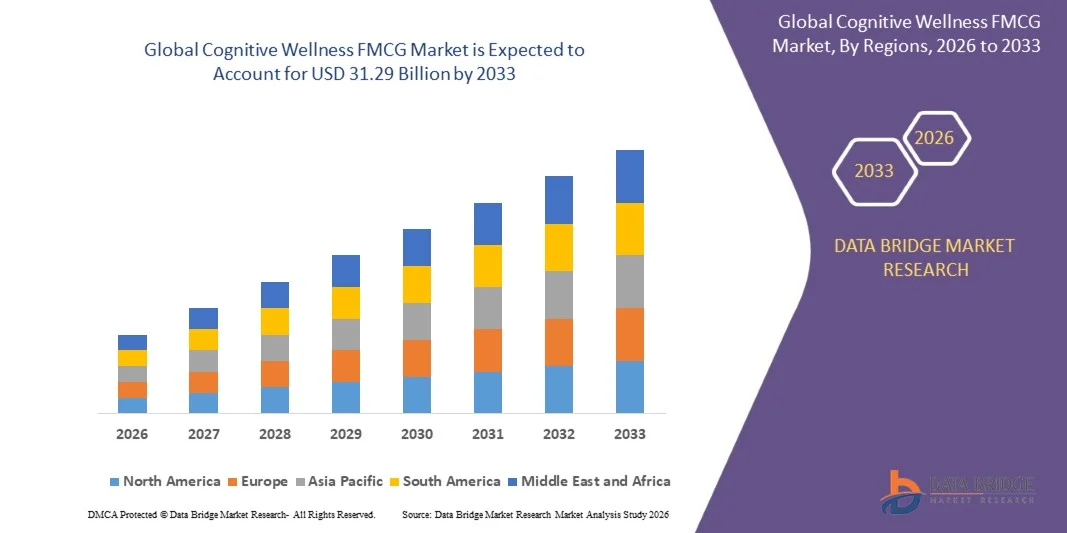
As per Data Bridge Market Research Analysis the Cognitive Wellness FMCG Market was valued at USD 13.1 billion in 2025 and is projected to reach USD 31.29 billion by 2033, growing at a CAGR of 11.50% from 2026 to 2033. The market is experiencing robust growth, driven by a fundamental shift in consumer priorities toward proactive mental health management. This market encompasses a wide range of Fast-Moving Consumer Goods, including dietary supplements, functional foods and beverages, and personal care products, all designed to support cognitive functions such as memory, focus, and mood regulation. The increasing awareness of mental well-being, fueled by digital transparency and social media, has normalized conversations around stress, focus, and productivity, thereby accelerating the adoption of these products.
Market Size & Forecast
- Global Market Value (2025): USD 13.1 Billion
- Expected Market Value (2033): USD 31.29 Billion
- Forecast CAGR (2026–2033): 11.50%
- Leading Region in 2025: Asia-Pacific
- Fastest Growing Region: North America
Key Market Trends & Insights
- Asia-Pacific dominated the Cognitive Wellness FMCG Market with the largest revenue share in 2025, supported by rising work-related stress, academic pressures, increasing disposable incomes, and strong cultural acceptance of herbal and natural remedies across countries such as China, India, and Japan.
- North America is expected to be the fastest-growing region, fueled by high consumer awareness, strong demand for science-backed nootropic products, advanced R&D capabilities, and increasing adoption of cognitive health solutions across all age groups.
- The Dietary Supplements segment led the market with a significant share in 2025, driven by consumer familiarity with capsule and powder formats, ease of integration into daily routines, and widespread use for targeted cognitive benefits such as stress relief, memory enhancement, and focus improvement.
- Functional Beverages and Foods are the fastest-growing product segments, projected to register strong CAGR growth, reflecting the surge in consumer demand for convenient, everyday consumption formats such as energy drinks, fortified waters, bars, and yogurts that offer immediate cognitive benefits.
- The Online Retail distribution channel segment is witnessing the highest CAGR, driven by consumer preference for convenience, discretion, wider product selection, personalized recommendations, and subscription models that enhance brand loyalty and accessibility.
- The Natural and Clean-Label Ingredients segment is a key growth driver, driven by increasing consumer demand for plant-based, non-GMO, and transparently sourced ingredients such as Lion's Mane, L-theanine, and ashwagandha, offering natural alternatives to synthetic stimulants.
- The "Brain Fuel" and Everyday Mental Performance segment is an emerging high-growth trend, driven by the repositioning of cognitive health products from long-term, aging-focused prevention to immediate, tangible benefits that offer sustained energy, focus, and calmness as part of daily routines.
Report Scope and Cognitive Wellness FMCG Market Segmentation
|
Attributes |
Cognitive Wellness FMCG Key Market Insights |
|
Segments Covered |
|
|
Countries Covered |
North America
Europe
Asia-Pacific
Middle East and Africa
South America
|
|
Key Market Players |
|
|
Market Opportunities |
|
|
Value Added Data Infosets |
In addition to the insights on market scenarios such as market value, growth rate, segmentation, geographical coverage, and major players, the market reports curated by the Data Bridge Market Research also include in-depth expert analysis, pricing analysis, brand share analysis, consumer survey, demography analysis, supply chain analysis, value chain analysis, raw material/consumables overview, vendor selection criteria, PESTLE Analysis, Porter Analysis, and regulatory framework. |
What is the Key Trend in Cognitive Wellness FMCG Market ?
Trend: Shift from Prevention to "Brain Fuel" for Daily Performance
The cognitive health market is undergoing a strategic shift. Instead of focusing solely on long-term brain health and aging-related decline, brands are increasingly positioning their products as "brain fuel" for immediate benefits like concentration, mental energy, and mood support. This trend is driven by younger consumers who experience cognitive strain from digital overload and fast-paced lifestyles but do not identify with traditional, prevention-focused messaging. This creates opportunities for products framed around natural energy, calm focus, and daily capability, making cognitive wellness more relevant and accessible to a broader audience
Cognitive Wellness FMCG Market Dynamics
Key Market Driver: Growing Global Focus on Brain Health and Healthy Aging
The increasing burden of neurological disorders and aging populations is driving investments in cognitive wellness institutes worldwide. Governments and healthcare organizations are emphasizing early intervention, cognitive screening, and preventive brain health programs.
In January 2024, An article published in Cerebral Circulation – Cognition and Behavior highlighted that more than 1 billion people worldwide are affected by neurological disorders and emphasized that brain health initiatives and multidisciplinary cognitive wellness programs are expanding globally to reduce neurological disability and healthcare costs. The publication noted that brain health institutes and national brain health initiatives are gaining traction through collaborations among healthcare providers, researchers, and policymakers.
Key Restraint/Challenge: Lack of Standardization in Cognitive Wellness Products
A major challenge restraining the global cognitive wellness market is the lack of harmonized regulations governing ingredient quality, dosage limits, efficacy standards, and labeling requirements across different countries. Regulatory frameworks for cognitive wellness products—including functional foods, dietary supplements, and nootropics—vary significantly between regions such as the United States, the European Union, and Asia-Pacific. These inconsistencies increase compliance costs for manufacturers, delay international product launches, and create consumer confusion regarding product safety and effectiveness. Additionally, many cognitive ingredients continue to have limited large-scale clinical evidence supporting health claims, making it difficult for companies to substantiate efficacy claims and maintain long-term consumer trust.
In September 2024, The European Food Safety Authority published updated scientific guidance on establishing Tolerable Upper Intake Levels (ULs) for vitamins and essential minerals. EFSA noted that maximum safe intake levels and regulatory approaches continue to differ across jurisdictions, and scientific risk assessments are required before harmonized limits can be established. The guidance underscores the ongoing challenge of standardizing dosage limits for supplements marketed across different regions.
Key Market Opportunity: Expansion of National Brain Health Programs and Cross-Sector Collaboration
Growing policy support for preventive mental health, cognitive wellness, and behavioral science presents significant opportunities for cognitive wellness institutes. Governments are increasingly encouraging collaboration between research institutions, healthcare providers, universities, and public health agencies to strengthen brain health strategies.
In January 2024, The WHO Regional Office for Europe published the meeting report Implementing Resolution EUR/RC72/R1: WHO Regional Meeting on Behavioural and Cultural Insights for Health. The report highlighted commitments from 48 Member States to strengthen behavioral and cognitive health research, expand institutional capacity, increase investment in human resources, and establish strategic plans supporting evidence-based cognitive wellness initiatives through 2026
Cognitive Wellness FMCG Market Dynamics
The Cognitive Wellness FMCG market is segmented on the basis of product type, ingredient, distribution channel, and consumer demographics.
- By Product Type
On the basis of product type, Cognitive Wellness FMCG Market is segmented into Dietary Supplements, Functional Beverages, Functional Foods, Personal Care Products, Other. The Dietary Supplements segment led the market in 2025 due to their convenience, consumer familiarity, and targeted benefits for stress relief and memory.
However, Functional Beverages are projected to be the fastest-growing segment, driven by their integration into daily consumption habits.
- By Distribution Channel
On the basis of Distribution Channel, the Cognitive Wellness FMCG Market is segmented into Supermarkets/Hypermarkets, Pharmacies & Health Stores, Online Retail, Specialty Stores, Direct Selling & Subscription Service. Supermarkets/Hypermarkets remain a key channel for mass-market reach.
The Online Retail segment is experiencing the highest growth. This is due to the convenience, privacy, personalized recommendations, and subscription models that digital platforms offer.
Cognitive Wellness FMCG Market Regional Analysis
Asia-Pacific accounted for the largest revenue share in 2025, driven by high stress levels, cultural acceptance of herbal remedies, and rising disposable incomes. North America is expected to witness the fastest growth, owing to high consumer awareness, strong R&D, and a high adoption rate of functional products
U.S. Cognitive Wellness FMCG Market Insight
The U.S. market is a key driver of growth in North America, underpinned by exceptionally high consumer awareness and a strong demand for science-backed solutions. A significant portion of the population, including a notable 45% of adults aged 25-34, actively seeks brain health products, making cognitive health a cross-generational concern. This demand is also influenced by lifestyle factors; for instance, 75% of U.S. consumers report an interest in improving their cognitive health for a better quality of life, with many also reporting difficulties with sleep and stress. The market is seeing rapid expansion in functional beverage formats as consumers move beyond traditional pills . This is evidenced by major retail placements, such as FOCUSfactor® products in over 1,600 Kroger stores, highlighting the mainstreaming of cognitive health products
Germany Cognitive Wellness FMCG Market Insight
Germany represents the largest single market within Europe, accounting for an estimated 22-25% of the region's demand. This strong position is supported by a robust pharmaceutical and supplement manufacturing base, a high level of consumer awareness, and a large aging population focused on cognitive maintenance. The market is characterized by a strong preference for "clean-label" products with clinically validated, natural ingredients. Demand is also fueled by a strong workplace wellness culture, where cognitive performance is linked to productivity. Consequently, corporate wellness programs are becoming an increasingly important institutional demand channel in the country.
U.K. Cognitive Wellness FMCG Market Insight
The U.K. market is at the forefront of a wave of innovation in cognitive health food and drink, moving beyond traditional supplements . A growing consumer trend toward "food as medicine" has led to significant product launches like M&S's 13-strong Brain Food range and Tribe's Protein + Focus bars . The U.K. market is a hotbed for cognitive innovation, with brands actively exploring functional ingredients like Lion's Mane mushrooms and adaptogens in everyday formats like snack bars and beverages . Consumer research shows that 39% of people have changed their diet to improve mental wellbeing, and 26% actively seek products for more energy, underlining this trend . This focus on mind and mood is also seen in the rapid growth of "relaxation drinks" like Trip
India Cognitive Wellness FMCG Market Insight
India is a rapidly growing market within the Asia-Pacific region, driven by increasing academic pressure, work-related stress, and a growing awareness of mental well-being among its young and large population . The market benefits from a deep cultural tradition of using herbal and natural remedies like ashwagandha, which are now being incorporated into modern functional food and beverage formats . Rising disposable incomes are supporting the purchase of premium FMCG products, allowing consumers to invest in preventive mental health solutions. Local brands are also innovating with region-specific formulations to cater to local tastes and preferences .
China Cognitive Wellness FMCG Market Insight
As part of the dominant Asia-Pacific region, the Chinese market is experiencing rapid growth driven by urbanization, rising disposable incomes, and increasing work-related stress . There is a high level of cultural acceptance of traditional herbal and natural remedies, which strongly supports the adoption of functional foods and supplements containing ingredients like ginkgo biloba and other botanicals . The rising academic pressure on younger demographics is also fueling demand for cognitive health products, positioning the country as a key area for preventive mental health product adoption .
Cognitive Wellness FMCG Market Share
The cognitive wellness industry is primarily led by well-established companies, including:
- Nestlé S.A. ( Switzerland)
- Danone S.A. (France)
- Abbott Laboratories ( U.S.)
- PepsiCo, Inc. ( U.S.)
- The Coca-Cola Company ( U.S.)
- Unilever PLC (United Kingdom)
- General Mills, Inc. (U.S.)
- Amway Corporation (U.S.)
- Herbalife Ltd. (U.S.)
- NOW Foods (U.S.)
- Bayer AG (Germany)
- GNC Holdings, LLC (U.S.)
- Red Bull GmbH (Austria)
- Yakult Honsha Co., Ltd. (Japan)
- DSM-Firmenich (Switzerland)
Latest Developments in Cognitive Wellness FMCG Market
- In November 2025, Nestlé was selected to join the Frontier Firm AI Initiative, a multi-year collaboration launched by Harvard's Digital Data Design Institute (D^3) and Microsoft. This positions the company to explore and shape the future of human-led, AI-driven business, which is likely to impact product development and personalization in the cognitive health space.
- In August 2025, Doseology Sciences Inc., an innovator in precision-formulated oral stimulants, acquired the "Feed That Brain" division from Joseph Mimran & Associates Inc. Feed That Brain is a Toronto-based health supplements division specializing in cognitive performance, wellness, and beauty-from-within products. The acquisition, valued at CAD$400,000, also brought Joseph Mimran on board as a strategic advisor to support Doseology's brand development and retail strateg .
- In June 2025, Restart Life Sciences Corp. announced the forthcoming launch of BrainBalls, a functional wellness snack developed in collaboration with Brain Balls Inc.. Crafted with clean-label, plant-based ingredients, it is designed to support mental clarity, cognitive performance, and sustained energy. The initial lineup includes Chocolate, Vanilla, and Blueberry flavors, available in family-size sachets and multi-pack travel options.
- In June 2025, Following the BrainBalls announcement, Restart Life Sciences introduced BrainQa, a wholly owned brand, with its first product being BrainQa Healthy Cereal . This product follows the product line established by BrainBalls in cereal form and will be produced in collaboration with the company's co-packing partner in British Columbia.
- In December 2025, Restart Life Sciences signed a binding letter of intent to acquire Holy Crap Foods Inc., a Canadian health food brand . The acquisition includes a portfolio of clean-label, plant-based products and a manufacturing facility in British Columbia . This strategic move aims to accelerate vertical integration, streamline operations, and consolidate manufacturing for the company's growing portfolio of cognitive health products .

- Interactive Data Analysis Dashboard
- Company Analysis Dashboard for high growth potential opportunities
- Research Analyst Access for customization & queries
- Competitor Analysis with Interactive dashboard
- Latest News, Updates & Trend analysis
- Harness the Power of Benchmark Analysis for Comprehensive Competitor Tracking
Data collection and base year analysis are done using data collection modules with large sample sizes. The stage includes obtaining market information or related data through various sources and strategies. It includes examining and planning all the data acquired from the past in advance. It likewise envelops the examination of information inconsistencies seen across different information sources. The market data is analysed and estimated using market statistical and coherent models. Also, market share analysis and key trend analysis are the major success factors in the market report. To know more, please request an analyst call or drop down your inquiry.
The key research methodology used by DBMR research team is data triangulation which involves data mining, analysis of the impact of data variables on the market and primary (industry expert) validation. Data models include Vendor Positioning Grid, Market Time Line Analysis, Market Overview and Guide, Company Positioning Grid, Patent Analysis, Pricing Analysis, Company Market Share Analysis, Standards of Measurement, Global versus Regional and Vendor Share Analysis. To know more about the research methodology, drop in an inquiry to speak to our industry experts.
Data Bridge Market Research is a leader in advanced formative research. We take pride in servicing our existing and new customers with data and analysis that match and suits their goal. The report can be customized to include price trend analysis of target brands understanding the market for additional countries (ask for the list of countries), clinical trial results data, literature review, refurbished market and product base analysis. Market analysis of target competitors can be analyzed from technology-based analysis to market portfolio strategies. We can add as many competitors that you require data about in the format and data style you are looking for. Our team of analysts can also provide you data in crude raw excel files pivot tables (Fact book) or can assist you in creating presentations from the data sets available in the report.