


Collapsible Tube Packaging Market Size
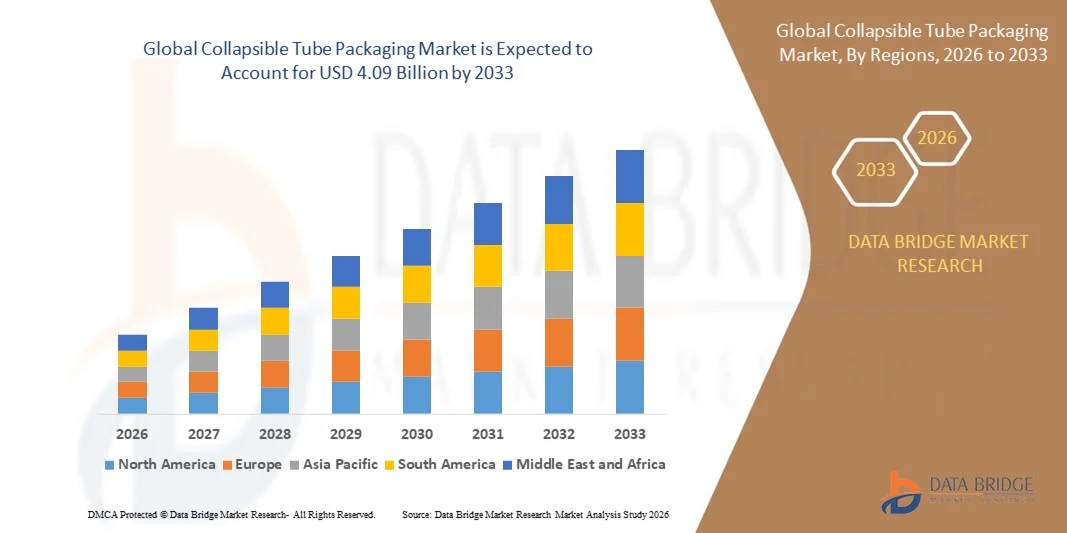
- The global collapsible tube packaging market size was valued at USD 2.14 billion in 2025 and is expected to reach USD 4.09 billion by 2033, at a CAGR of 8.42% during the forecast period
- The market growth is largely fuelled by the rising demand for sustainable and convenient packaging solutions across cosmetics, personal care, and pharmaceutical industries. Collapsible tubes offer portability, ease of use, and reduced product wastage, making them highly preferred by consumers
- Increasing consumer preference for hygienic, single-use, and travel-friendly packaging is further driving market adoption. Brands are increasingly opting for collapsible tubes to enhance product shelf appeal and meet regulatory and environmental guidelines
Collapsible Tube Packaging Market Analysis
- The market is witnessing significant growth due to increasing demand from end-use industries such as cosmetics, pharmaceuticals, and food. The convenience and sustainability of collapsible tube packaging are attracting both small and large-scale manufacturers
- Growing awareness regarding eco-friendly packaging and stricter regulations around plastic usage are pushing companies to adopt recyclable and biodegradable collapsible tubes. This shift is expected to further accelerate market expansion in the coming years
- North America dominated the collapsible tube packaging market with the largest revenue share of 38.50% in 2025, driven by growing demand for sustainable, convenient, and hygienic packaging solutions across personal care, pharmaceutical, and food industries
- Asia-Pacific region is expected to witness the highest growth rate in the global collapsible tube packaging market, driven by rising disposable incomes, expanding personal care and food industries, and growing adoption of modern and eco-friendly packaging formats
- The squeeze tube segment held the largest market revenue share in 2025, driven by its widespread use in cosmetics, pharmaceuticals, and personal care products. Squeeze tubes are favored for their ease of dispensing, lightweight design, and compatibility with a wide range of product viscosities, making them a preferred choice for manufacturers. Squeeze tubes also offer convenience for end-users, contributing to higher adoption across retail and travel-ready products
Report Scope and Collapsible Tube Packaging Market Segmentation
|
Attributes |
Collapsible Tube Packaging Key Market Insights |
|
Segments Covered |
|
|
Countries Covered |
North America
Europe
Asia-Pacific
Middle East and Africa
South America
|
|
Key Market Players |
|
|
Market Opportunities |
|
|
Value Added Data Infosets |
In addition to the insights on market scenarios such as market value, growth rate, segmentation, geographical coverage, and major players, the market reports curated by the Data Bridge Market Research also include import export analysis, production capacity overview, production consumption analysis, price trend analysis, climate change scenario, supply chain analysis, value chain analysis, raw material/consumables overview, vendor selection criteria, PESTLE Analysis, Porter Analysis, and regulatory framework. |
Collapsible Tube Packaging Market Trends
Rise of Sustainable and Functional Collapsible Tube Packaging
- The growing shift toward collapsible tube packaging is transforming the packaging landscape by offering lightweight, eco-friendly, and space-saving solutions. The ease of transport, reduced material usage, and convenience for end-users are driving adoption across personal care, pharmaceutical, and food industries. These solutions also help brands reduce logistics costs, minimize storage space, and enhance overall sustainability credentials, strengthening consumer trust and loyalty
- The increasing demand for hygienic, single-use, and resealable packaging is accelerating the adoption of collapsible tubes. These packaging formats are particularly effective in preserving product quality, preventing contamination, and extending shelf life, helping manufacturers comply with safety regulations and consumer expectations. The trend is further supported by growing consumer awareness of hygiene, particularly in health-sensitive and travel-focused applications
- The versatility and design flexibility of modern collapsible tubes are making them attractive for marketing and functional purposes, enabling distinctive shapes, sizes, and printing options. Brands benefit from increased consumer engagement and premium product positioning while optimizing packaging costs. Enhanced aesthetic appeal combined with functional advantages also encourages repeat purchases and brand differentiation
- For instance, in 2023, several global cosmetic companies reported higher sales and improved customer satisfaction after switching to collapsible tube packaging for creams and gels, highlighting convenience, portability, and sustainability advantages. This success inspired other FMCG and pharmaceutical companies to adopt similar strategies, reinforcing the market trend toward eco-friendly and consumer-centric packaging
- While collapsible tubes are gaining traction, market growth depends on continued innovation, material advancements, and compatibility with diverse product formulations. Manufacturers must focus on lightweight, recyclable, and high-barrier solutions to fully capitalize on market demand. Collaboration with material science companies and investment in R&D will remain critical to sustaining competitive advantage
Collapsible Tube Packaging Market Dynamics
Driver
Rising Demand for Sustainable, Convenient, and Protective Packaging
- The increasing awareness of environmental impact and regulatory pressure is driving manufacturers to adopt collapsible tubes as a sustainable alternative to rigid containers. The reduction in plastic usage and improved recyclability are key factors promoting adoption. In addition, government initiatives and sustainability certifications are encouraging more brands to switch to eco-friendly packaging solutions
- Companies are increasingly leveraging collapsible tubes to enhance product convenience, portability, and hygiene, especially in personal care, pharmaceuticals, and food sectors. This trend is further supported by consumer preference for easy-to-use and travel-friendly packaging. The integration of functional closures and ergonomic designs also boosts user satisfaction and product accessibility
- Innovations in material technology, barrier coatings, and tube designs are enabling better protection against contamination, UV light, and moisture, preserving product quality and extending shelf life. Manufacturers are also exploring bio-based polymers and hybrid laminates to combine sustainability with superior performance, further driving adoption
- For instance, in 2022, several European skincare brands transitioned to high-barrier collapsible tubes for creams and ointments, resulting in reduced product spoilage and increased consumer confidence. Similar approaches in pharmaceuticals and food items reinforced the perception of reliability, hygiene, and premium quality
- While sustainability and convenience are driving growth, continuous R&D and material innovation remain essential to meet evolving regulatory standards and consumer expectations. Industry players investing in automated production lines and novel material combinations are likely to gain a competitive edge
Restraint/Challenge
High Production Cost and Technical Limitations
- The higher production costs associated with advanced collapsible tubes, such as laminated and high-barrier materials, limit adoption among small and mid-sized manufacturers. These costs can impact overall profitability and pricing strategies. The need for specialized machinery and skilled labor adds further financial burden, particularly in emerging markets
- In some regions, limited access to specialized manufacturing equipment and expertise can hinder production scalability and customization. Manufacturers may face challenges in producing consistent quality at competitive costs. The lack of standardized processes may also result in higher rejection rates and operational inefficiencies
- Supply chain issues, including availability of sustainable raw materials and fluctuations in polymer pricing, can lead to inconsistent supply and delays in product launches. Global trade disruptions and dependence on key raw material suppliers can exacerbate these challenges, affecting market stability
- For instance, in 2023, several mid-sized European and Asian personal care manufacturers reported delays in product rollouts due to limited availability of high-quality laminates and aluminum tubes. These delays not only affected revenue but also delayed marketing campaigns and product launches, highlighting supply chain vulnerabilities
- While the benefits of collapsible tube packaging are clear, addressing cost pressures, technical limitations, and supply chain constraints is essential to expand global adoption and unlock long-term market potential. Strategic partnerships, investments in sustainable materials, and innovative manufacturing solutions will play a key role in overcoming these challenges
Collapsible Tube Packaging Market Scope
The market is segmented on the basis of product type, material type, closure type, capacity, and application.
- By Product Type
On the basis of product type, the collapsible tube packaging market is segmented into squeeze tube and twist tube. The squeeze tube segment held the largest market revenue share in 2025, driven by its widespread use in cosmetics, pharmaceuticals, and personal care products. Squeeze tubes are favored for their ease of dispensing, lightweight design, and compatibility with a wide range of product viscosities, making them a preferred choice for manufacturers. Squeeze tubes also offer convenience for end-users, contributing to higher adoption across retail and travel-ready products.
The twist tube segment is expected to witness the fastest growth rate from 2026 to 2033, fueled by its functional advantages in controlled dispensing and tamper-evident designs. Twist tubes are increasingly adopted in premium cosmetics, ointments, and specialty food items due to their innovative closure mechanisms and enhanced product protection. The growing consumer preference for hygiene, precise portion control, and portability further accelerates the demand for twist tubes in the global market.
- By Material Type
On the basis of material type, the market is segmented into laminated, aluminum, plastics, and others. The laminated segment held the largest market revenue share in 2025, driven by its superior barrier properties, lightweight design, and recyclability. Laminated tubes are widely used in pharmaceuticals, cosmetics, and food applications for their ability to protect product quality and extend shelf life.
The aluminum segment is expected to witness the fastest growth rate from 2026 to 2033, due to its durability, recyclability, and premium appeal. Aluminum tubes are preferred in high-end personal care and pharmaceutical products, offering excellent protection against contamination, light, and moisture. The growing emphasis on sustainability and eco-friendly packaging supports the adoption of aluminum tubes globally.
- By Closure Type
On the basis of closure type, the market is segmented into fez cap, flip top cap, nozzle cap, and standup cap. The flip top cap segment held the largest market revenue share in 2025, owing to its convenience, ease of use, and compatibility with a wide range of products. Flip top caps are particularly popular in cosmetics, personal care, and food packaging for user-friendly dispensing.
The nozzle cap segment is expected to witness the fastest growth rate from 2026 to 2033, driven by its precise dispensing capabilities and suitability for specialty creams, gels, and adhesives. Nozzle caps provide better control over product application and help reduce wastage, meeting the demand for functional and hygienic packaging.
- By Capacity
On the basis of capacity, the market is segmented into less than 20 ml, to 100 ml, and more than 100 ml. The to 100 ml segment held the largest market revenue share in 2025, fueled by its optimal size for daily use products and retail distribution. Tubes of this capacity are widely adopted in cosmetics, pharmaceuticals, and personal care for convenient handling and portability.
The more than 100 ml segment is expected to witness the fastest growth rate from 2026 to 2033, driven by increasing demand for bulk packaging in food, homecare, and industrial applications. Larger capacity tubes reduce packaging waste, improve logistics efficiency, and cater to value-conscious consumers and commercial users.
- By Application
On the basis of application, the market is segmented into cosmetics, food, homecare and personal care, industrial, and pharmaceutical. The cosmetics segment held the largest market revenue share in 2025, driven by the growing global beauty and personal care industry. Collapsible tubes in cosmetics are preferred for their ease of dispensing, portability, and attractive branding opportunities.
The pharmaceutical segment is expected to witness the fastest growth rate from 2026 to 2033, fueled by the rising demand for hygienic, single-dose, and tamper-evident packaging. Pharmaceutical tubes ensure product safety, enhance shelf life, and comply with stringent regulatory requirements, supporting adoption in global healthcare markets.
Collapsible Tube Packaging Market Regional Analysis
- North America dominated the collapsible tube packaging market with the largest revenue share of 38.50% in 2025, driven by growing demand for sustainable, convenient, and hygienic packaging solutions across personal care, pharmaceutical, and food industries
- Consumers in the region highly value lightweight, eco-friendly, and resealable tubes that offer portability, product protection, and convenience, enhancing overall user experience
- This widespread adoption is further supported by stringent environmental regulations, high consumer awareness of sustainability, and strong presence of global cosmetic and pharmaceutical brands, establishing collapsible tubes as a preferred packaging solution
U.S. Collapsible Tube Packaging Market Insight
The U.S. collapsible tube packaging market captured the largest revenue share in 2025 within North America, fueled by rising adoption in personal care and pharmaceutical sectors. Manufacturers are increasingly prioritizing eco-friendly and functional packaging that enhances product safety and shelf life. The growing preference for travel-friendly, single-use, and resealable packaging, combined with innovations in laminated and high-barrier tubes, is further driving market expansion. Moreover, U.S. companies are investing in lightweight and recyclable tubes, aligning with sustainability goals and evolving consumer demands.
Europe Collapsible Tube Packaging Market Insight
The Europe collapsible tube packaging market is expected to witness the fastest growth rate from 2026 to 2033, primarily driven by stringent environmental regulations, consumer demand for sustainable packaging, and increasing adoption in personal care and pharmaceutical products. Innovations in laminated, aluminum, and high-barrier tubes are facilitating product protection and extended shelf life. The region is also experiencing growth in premium cosmetics and healthcare packaging, where collapsible tubes provide functional and marketing advantages.
U.K. Collapsible Tube Packaging Market Insight
The U.K. collapsible tube packaging market is expected to witness the fastest growth rate from 2026 to 2033, driven by rising consumer awareness of sustainable and hygienic packaging, as well as increased demand in cosmetics and personal care sectors. Regulatory support for environmentally friendly packaging and strong retail infrastructure are boosting adoption. The trend of travel-friendly, easy-to-use tubes is expected to further stimulate market growth.
Germany Collapsible Tube Packaging Market Insight
The Germany collapsible tube packaging market is expected to witness the fastest growth rate from 2026 to 2033, fueled by the emphasis on sustainability, innovation, and eco-conscious manufacturing. German manufacturers are adopting high-barrier and laminated tubes to preserve product quality, reduce waste, and comply with environmental regulations. The integration of advanced tube designs and closures for cosmetics, pharmaceuticals, and food products is enhancing market penetration and consumer acceptance.
Asia-Pacific Collapsible Tube Packaging Market Insight
The Asia-Pacific collapsible tube packaging market is expected to witness the fastest growth rate from 2026 to 2033, driven by rapid urbanization, rising disposable incomes, and increasing demand for personal care and pharmaceutical products in countries such as China, Japan, and India. Government initiatives promoting sustainability and modern packaging technologies are further accelerating adoption. The region is also becoming a hub for manufacturing and export of high-quality collapsible tubes, making them affordable and accessible to a wider consumer base.
Japan Collapsible Tube Packaging Market Insight
The Japan collapsible tube packaging market is expected to witness the fastest growth rate from 2026 to 2033, due to the country’s high emphasis on product hygiene, innovation, and convenience. Manufacturers are adopting resealable, lightweight, and sustainable tubes for personal care, cosmetics, and pharmaceuticals. The trend of functional packaging with premium aesthetics and portability is boosting demand, while an aging population is increasing the need for easy-to-use packaging solutions.
China Collapsible Tube Packaging Market Insight
The China collapsible tube packaging market accounted for the largest market revenue share in Asia Pacific in 2025, attributed to rapid urbanization, growing personal care and pharmaceutical sectors, and high consumer awareness of sustainable packaging. The adoption of laminated and high-barrier tubes is increasing, supported by domestic manufacturers offering cost-effective and innovative solutions. The push towards eco-friendly, hygienic, and functional packaging in cosmetics, food, and healthcare products is significantly driving market growth.
Collapsible Tube Packaging Market Share
The Collapsible Tube Packaging industry is primarily led by well-established companies, including:
• ALBEA (France)
• Amcor plc (Australia)
• CCL Industries (Canada)
• Constantia Flexibles (Austria)
• Avadhoot Tube Industries (India)
• ALLTUB (Germany)
• EPL Limited (India)
• Sonoco Products Company (U.S.)
• Unette Corporation (U.S.)
• Hoffmann Neopac AG (Switzerland)
• Unicep (Brazil)
• PIONEER GROUP (India)
• MONTEBELLO PACKAGING (U.K.)
• APackaging Group (U.K.)
• Intrapac International LLC (U.S.)
• LINHARDT (Germany)
• Auber Packaging Co., Ltd. (China)
• VIVA HEALTHCARE PACKAGING (U.K.)
• Berry Global Inc. (U.S.)
• VisiPak (India)
Latest Developments in Global Collapsible Tube Packaging Market
- In June 2022, Global Tube Laminates focused on enhancing the sustainability of its laminate solutions by collaborating with the Association of Plastic Recyclers (APR) in North America. The improved laminates are used in dental care and cosmetic products, supporting eco-friendly packaging trends and strengthening the company’s market position in sustainable solutions
- In May 2022, Emballator launched a new range of mono-material tubes made from PE or aluminum, produced using green electricity. These tubes, designed for small-dose applications in cosmetics and pharmaceuticals, offer improved recyclability and align with increasing demand for environmentally responsible packaging, reinforcing the company’s innovation credentials
- In May 2022, Tubettificio Favia merged with Perfektup, a leading Turkish collapsible tube manufacturer. The acquisition allowed Perfektup to expand its European footprint and opened new international consolidation opportunities for Tubettificio Favia, boosting market reach and operational scale across the collapsible tube industry
- In January 2022, Berry Global partnered with Raw Elements USA to launch sugarcane-based tubes for moisturizers, sunscreens, and hand sanitizers. Produced in Berry’s integrated facility in Evansville, Indiana, these tubes offer sustainable, reef-friendly packaging, catering to consumer demand for eco-conscious products while reinforcing Berry’s leadership in innovative, sustainable packaging solutions

- Interactive Data Analysis Dashboard
- Company Analysis Dashboard for high growth potential opportunities
- Research Analyst Access for customization & queries
- Competitor Analysis with Interactive dashboard
- Latest News, Updates & Trend analysis
- Harness the Power of Benchmark Analysis for Comprehensive Competitor Tracking
Global Collapsible Tube Packaging Market, Supply Chain Analysis and Ecosystem Framework
To support market growth and help clients navigate the impact of geopolitical shifts, DBMR has integrated in-depth supply chain analysis into its Global Collapsible Tube Packaging Market research reports. This addition empowers clients to respond effectively to global changes affecting their industries. The supply chain analysis section includes detailed insights such as Global Collapsible Tube Packaging Market consumption and production by country, price trend analysis, the impact of tariffs and geopolitical developments, and import and export trends by country and HSN code. It also highlights major suppliers with data on production capacity and company profiles, as well as key importers and exporters. In addition to research, DBMR offers specialized supply chain consulting services backed by over a decade of experience, providing solutions like supplier discovery, supplier risk assessment, price trend analysis, impact evaluation of inflation and trade route changes, and comprehensive market trend analysis.
Data collection and base year analysis are done using data collection modules with large sample sizes. The stage includes obtaining market information or related data through various sources and strategies. It includes examining and planning all the data acquired from the past in advance. It likewise envelops the examination of information inconsistencies seen across different information sources. The market data is analysed and estimated using market statistical and coherent models. Also, market share analysis and key trend analysis are the major success factors in the market report. To know more, please request an analyst call or drop down your inquiry.
The key research methodology used by DBMR research team is data triangulation which involves data mining, analysis of the impact of data variables on the market and primary (industry expert) validation. Data models include Vendor Positioning Grid, Market Time Line Analysis, Market Overview and Guide, Company Positioning Grid, Patent Analysis, Pricing Analysis, Company Market Share Analysis, Standards of Measurement, Global versus Regional and Vendor Share Analysis. To know more about the research methodology, drop in an inquiry to speak to our industry experts.
Data Bridge Market Research is a leader in advanced formative research. We take pride in servicing our existing and new customers with data and analysis that match and suits their goal. The report can be customized to include price trend analysis of target brands understanding the market for additional countries (ask for the list of countries), clinical trial results data, literature review, refurbished market and product base analysis. Market analysis of target competitors can be analyzed from technology-based analysis to market portfolio strategies. We can add as many competitors that you require data about in the format and data style you are looking for. Our team of analysts can also provide you data in crude raw excel files pivot tables (Fact book) or can assist you in creating presentations from the data sets available in the report.













