


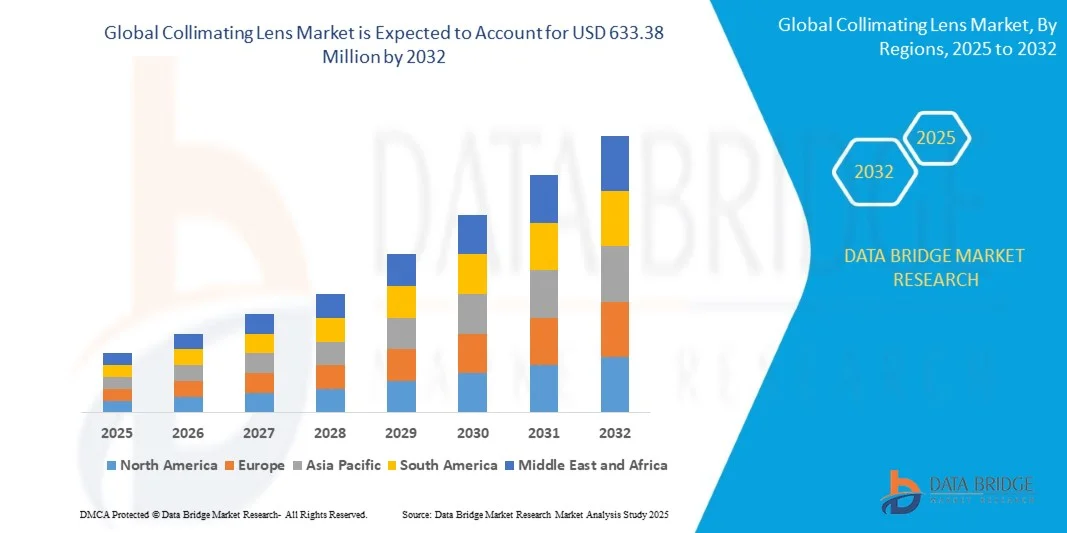
Collimating Lens Market Size
- The global collimating lens market size was valued at USD 404.36 million in 2024 and is expected to reach USD 633.38 million by 2032, at a CAGR of 5.77% during the forecast period
- The market growth is largely fueled by the rising adoption of optical technologies across industries such as spectroscopy, medical imaging, Lidar, and automotive lighting, supported by advancements in photonics and precision optics
- Furthermore, increasing demand for accurate beam alignment, higher energy efficiency, and compact optical solutions is driving the integration of collimating lenses in consumer electronics, industrial measurement, and communication systems. These converging factors are accelerating the uptake of collimating lenses, thereby significantly boosting the industry's growth
Collimating Lens Market Analysis
- Collimating lenses are precision optical components designed to transform divergent light beams into parallel rays, ensuring accuracy and uniformity in applications such as spectroscopy, laser systems, interferometry, and display measurement
- The escalating demand for collimating lenses is primarily fueled by the rapid expansion of photonics-based applications, growing reliance on high-resolution imaging and sensing technologies, and rising deployment of Lidar systems in autonomous vehicles and industrial automation
- Asia-Pacific dominated the collimating lens market with a share of 41.47% in 2024, due to rapid expansion of electronics manufacturing, strong demand from the automotive sector, and rising adoption of optical technologies in medical and industrial applications
- North America is expected to be the fastest growing region in the collimating lens market during the forecast period due to rising adoption of Lidar in autonomous vehicles, strong demand for spectroscopy in healthcare and pharmaceuticals, and growing investments in laser-based technologies
- Glass segment dominated the market with a market share of 58.7% in 2024, due to its superior optical clarity, higher resistance to thermal stress, and long lifespan in demanding industrial and scientific applications. Glass collimating lenses are widely used in spectroscopy, interferometry, and precision measurement systems where high accuracy and minimal aberration are crucial. Their suitability for high-power laser and LED sources further strengthens adoption across research laboratories, aerospace, and medical imaging sectors
Report Scope and Collimating Lens Market Segmentation
|
Attributes |
Collimating Lens Key Market Insights |
|
Segments Covered |
|
|
Countries Covered |
North America
Europe
Asia-Pacific
Middle East and Africa
South America
|
|
Key Market Players |
|
|
Market Opportunities |
|
|
Value Added Data Infosets |
In addition to the insights on market scenarios such as market value, growth rate, segmentation, geographical coverage, and major players, the market reports curated by the Data Bridge Market Research also include in-depth expert analysis, geographically represented company-wise production and capacity, network layouts of distributors and partners, detailed and updated price trend analysis and deficit analysis of supply chain and demand. |
Collimating Lens Market Trends
“Growing Use of Collimating Lenses in Lidar Systems”
- The demand for collimating lenses is rising sharply due to their critical role in Lidar systems, where precise collimation of light is essential for accurate distance measurement and object detection. The growth of autonomous vehicles, robotics, and advanced navigation systems is driving significant integration of these lenses in Lidar applications across industries
- For instance, companies such as Jenoptik supply collimating optics specifically designed for Lidar solutions, enabling highly accurate mapping and detection for autonomous driving. Similarly, Thorlabs provides collimating lens modules tailored for lasers used in both industrial and automotive Lidar installations
- Collimating lenses improve the performance of Lidar by narrowing light beams, increasing detection range, and enhancing resolution. This capability is essential for ensuring safety and accuracy in self-driving vehicles and for reliable spatial recognition in industrial robotics and drones
- The fast-growing robotics sector is also adopting Lidar systems with high-quality collimating lenses to enable automation in logistics, mining, and warehouse operations. Their integration supports precise environmental mapping and navigation in complex and dynamic surroundings
- The advancement of smart cities, digital infrastructure, and intelligent traffic systems is driving further growth in Lidar-enabled sensors. Collimating lenses enhance these devices by enabling long-range detection and consistent beam shaping, which are crucial for urban mobility and safety technologies
- Overall, the expanding use of collimating lenses in Lidar underscores their strategic importance in automotive safety, industrial efficiency, and infrastructure digitization. With increased emphasis on accuracy, safety, and intelligent automation, the demand for collimating lenses is expected to maintain a strong upward trajectory
Collimating Lens Market Dynamics
Driver
“Rising Adoption in Medical Imaging and Spectroscopy”
- Collimating lenses are seeing growing adoption in advanced medical imaging and spectroscopy applications due to their ability to enhance precision, accuracy, and reliability in optical performance. Their role in shaping and directing light is critical for diagnostic tools that require consistent beam profiles and efficient light transmission
- For instance, Edmund Optics provides specialized collimating lenses designed for spectroscopy systems, supporting researchers and diagnostic laboratories in areas such as molecular analysis and biological imaging. Companies such as Ocean Insight are also delivering collimating lenses tailored to spectroscopy setups, enabling accurate measurements in clinical and scientific environments
- Medical imaging applications such as fluorescence imaging, endoscopy, and optical coherence tomography benefit significantly from collimating lenses. These lenses contribute to higher resolution and consistent illumination, enhancing the ability of physicians and researchers to achieve reliable diagnostic insights
- Their applicability in spectroscopy extends to environmental and chemical analysis, where accurate detection of molecular compositions depends on properly collimated light sources. The adoption of collimating lenses enables institutions to meet increasing demands for precision in research and industrial processes
- The expanding role of collimating lenses in healthcare and scientific research highlights their importance in delivering enhanced accuracy, efficiency, and innovation. Their integration across diagnostic and analytical technologies aligns with the demand for advanced imaging solutions and improved spectroscopic performance
Restraint/Challenge
“High Cost of Precision Optical Components”
- The high cost of manufacturing precision collimating lenses represents a substantial restraint on market expansion, particularly for price-sensitive applications and small-scale users. Factors such as material quality, coating processes, and precision alignment contribute to the overall expense of these optical components
- For instance, manufacturers such as OptoSigma and Qioptiq emphasize the high levels of precision and advanced production techniques required for collimating lenses, which often lead to elevated product pricing. This cost barrier limits accessibility for emerging startups or research projects with constrained budgets
- The complexity of design and integration also increases costs, as collimating lenses must meet stringent requirements for optical clarity, beam accuracy, and thermal durability. These requirements are more demanding for applications such as automotive Lidar and medical imaging, where safety and performance are paramount
- Another challenge is the limited availability of affordable alternatives that match the quality standards of premium precision optics. Low-cost lenses often compromise on essential attributes such as beam uniformity, reducing their suitability for high-performance applications in automotive, medical, and scientific sectors
- To address this restraint, manufacturers are focusing on advanced production technologies, economies of scale, and innovative materials to reduce costs while maintaining quality standards. Overcoming the price challenge will be critical for enabling broader adoption of collimating lenses across high-growth industries where precision optics are indispensable
Collimating Lens Market Scope
The market is segmented on the basis of light source, material, wavelength, and end-user.
• By Light Source
On the basis of light source, the collimating lens market is segmented into LED, Laser, and Others. The LED segment dominated the largest market revenue share in 2024, driven by the extensive use of LEDs in illumination, display technologies, automotive lighting, and consumer electronics. Collimating lenses play a critical role in enhancing the efficiency and precision of LED lighting by directing beams into uniform patterns, improving brightness and reducing scattering. The cost-effectiveness and energy efficiency of LED-based applications further strengthen demand, alongside growing adoption in automotive headlamps, smart lighting systems, and display backlighting.
The Laser segment is anticipated to witness the fastest growth rate from 2025 to 2032, fueled by the rising adoption of laser technologies in medical imaging, spectroscopy, optical communication, and Lidar applications. Collimating lenses are integral for shaping coherent laser beams into precise, parallel outputs, enhancing accuracy in measurement and detection systems. Rapid advancements in laser-based medical diagnostics and the growing use of Lidar in autonomous vehicles are driving this trend. Increasing R&D investments and the growing popularity of laser projection systems also contribute to the segment’s robust expansion.
• By Material
On the basis of material, the collimating lens market is segmented into Glass and Plastic. The Glass segment dominated the market with the largest revenue share of 58.7% in 2024, owing to its superior optical clarity, higher resistance to thermal stress, and long lifespan in demanding industrial and scientific applications. Glass collimating lenses are widely used in spectroscopy, interferometry, and precision measurement systems where high accuracy and minimal aberration are crucial. Their suitability for high-power laser and LED sources further strengthens adoption across research laboratories, aerospace, and medical imaging sectors.
The Plastic segment is projected to grow at the fastest CAGR during 2025–2032, driven by its lightweight nature, low production cost, and increasing use in consumer electronics and automotive applications. Plastic lenses are increasingly preferred in compact devices and portable instruments where cost-efficiency and mass production are critical. Their rising adoption in LED lighting systems, displays, and low-power laser modules also supports strong market penetration. Advances in polymer science that improve durability and optical quality are further fueling the segment’s rapid expansion.
• By Wavelength
On the basis of wavelength, the collimating lens market is segmented into <1000 nm, 1000–1500 nm, 1500–2000 nm, and >2000 nm. The <1000 nm segment dominated the largest revenue share in 2024, as it covers visible and near-infrared applications widely used in spectroscopy, display measurement, and optical sensing devices. Collimating lenses in this range are essential for LED and laser-based illumination, imaging, and consumer electronics, where precision and compactness are critical. Growing adoption in industrial laser processing and bio-imaging further supports its market leadership.
The 1000–1500 nm segment is expected to grow at the fastest CAGR from 2025 to 2032, primarily due to its extensive role in fiber-optic communication, Lidar, and medical imaging applications. Collimating lenses within this wavelength range enhance signal transmission efficiency and detection accuracy in advanced optical networks and autonomous navigation systems. The increasing deployment of 5G infrastructure and high-speed internet services accelerates demand, while advancements in medical diagnostics using near-infrared lasers also drive adoption. Expanding use in defense surveillance and precision measurement adds to the strong growth outlook.
• By End-User
On the basis of end-user, the collimating lens market is segmented into Spectroscopy, Medical, Lidar, Automobile, Light and Display Measurement, Interferometry, and Others. The Spectroscopy segment dominated the market with the largest revenue share in 2024, as collimating lenses are indispensable in ensuring accurate beam alignment and reducing divergence in analytical instruments. They are widely used across chemical, pharmaceutical, and environmental testing industries for precise measurement and detection. The growing need for real-time monitoring, quality control, and advanced research applications further cements spectroscopy as the leading segment.
The Lidar segment is anticipated to record the fastest growth rate from 2025 to 2032, driven by the rising adoption of Lidar systems in autonomous vehicles, robotics, and geospatial mapping. Collimating lenses enhance the accuracy and range of laser beams in Lidar, making them essential for reliable object detection and environmental scanning. Growing investments in self-driving technologies, smart cities, and defense surveillance accelerate this demand. In addition, the increasing integration of Lidar in industrial automation and advanced driver-assistance systems (ADAS) further propels market expansion in this segment.
Collimating Lens Market Regional Analysis
- Asia-Pacific dominated the collimating lens market with the largest revenue share of 41.47% in 2024, driven by rapid expansion of electronics manufacturing, strong demand from the automotive sector, and rising adoption of optical technologies in medical and industrial applications
- The region’s strong manufacturing ecosystem, presence of leading semiconductor and optoelectronic players, and increasing investments in precision optics are accelerating market growth
- Supportive government initiatives, availability of skilled labor, and fast-paced industrialization in developing economies are further propelling the consumption of collimating lenses across end-use industries
China Collimating Lens Market Insight
China held the largest share in the Asia-Pacific collimating lens market in 2024, owing to its dominance in consumer electronics, LED manufacturing, and rapidly advancing automotive industry. The country’s strong supply chain for optical components, large-scale production capabilities, and supportive policies for semiconductor and photonics industries drive demand. Expanding applications in display technologies, medical devices, and autonomous driving systems further strengthen China’s market position.
India Collimating Lens Market Insight
India is witnessing the fastest growth in the Asia-Pacific collimating lens market, fueled by increasing investments in semiconductor packaging, growing LED lighting adoption, and expanding medical imaging sector. Government programs such as “Make in India” and rising domestic demand for advanced automotive technologies are key drivers. The surge in research activities, coupled with foreign investments in electronics and optics manufacturing, is positioning India as a rapidly emerging market for collimating lenses.
Europe Collimating Lens Market Insight
The Europe collimating lens market is expanding steadily, supported by strong demand in spectroscopy, interferometry, and high-precision medical diagnostics. The region emphasizes quality, precision engineering, and sustainability, making it a hub for advanced optical technologies. Increasing adoption in automotive lighting, Lidar systems, and scientific research applications is driving growth, while collaborations between research institutions and optics manufacturers further boost innovation.
Germany Collimating Lens Market Insight
Germany’s collimating lens market is driven by its leadership in precision optics, strong automotive industry, and world-class research infrastructure. The country is a major hub for Lidar technology in autonomous driving, laser-based measurement systems, and high-performance imaging devices. A strong focus on R&D collaborations between industry and academia, along with growing demand for advanced medical imaging, is sustaining Germany’s leading role in the European market.
U.K. Collimating Lens Market Insight
The U.K. market is supported by a strong photonics sector, growing demand in aerospace and defense, and expanding use of optics in life sciences research. Efforts to strengthen domestic manufacturing capabilities post-Brexit and rising collaborations between universities and optical technology companies are enhancing market growth. Increasing investments in Lidar for smart mobility projects and optical systems for healthcare diagnostics further reinforce the U.K.’s position in Europe.
North America Collimating Lens Market Insight
North America is projected to grow at the fastest CAGR from 2025 to 2032, driven by rising adoption of Lidar in autonomous vehicles, strong demand for spectroscopy in healthcare and pharmaceuticals, and growing investments in laser-based technologies. Robust R&D infrastructure, advanced manufacturing facilities, and increasing collaborations in the photonics and automotive sectors are supporting regional expansion. Expanding applications in aerospace, defense, and medical imaging add further momentum.
U.S. Collimating Lens Market Insight
The U.S. accounted for the largest share in the North America collimating lens market in 2024, underpinned by its leadership in automotive innovation, strong presence of photonics companies, and advanced research ecosystem. High demand for collimating lenses in Lidar, spectroscopy, and display measurement systems is driving growth. The country’s emphasis on next-generation optical technologies, coupled with the presence of leading semiconductor and automotive manufacturers, solidifies its leading position in the region.
Collimating Lens Market Share
The collimating lens industry is primarily led by well-established companies, including:
- LightPath Technologies (U.S.)
- Ocean Optics, Inc. (U.S.)
- INGENERIC GmbH (Germany)
- TRIOPTICS GmbH (Germany)
- Avantes BV (Netherlands)
- Auer Lighting GmbH (Germany)
- IPG Photonics Corporation (U.S.)
- Optikos (U.S.)
- Changchun Sunday Optics Co., Ltd. (China)
- Thorlabs, Inc. (U.S.)
- AMS Technologies AG (Germany)
- Edmund Optics India Private Limited (India)
- FISBA AG (Switzerland)
- Axetris AG. (Switzerland)
- Broadcom (U.S.)
- Bentham (U.K.)
- CASIX (China)
- Hamamatsu Photonics K.K. (Japan)
- OPTO-LINE, Inc. (Japan)
- Ushio America, Inc. (U.S.)
Latest Developments in Collimating Lens Market
- In October 2022, Auer Lighting GmbH received certification under the IATF 16949 technical specification issued by the International Automobile Agency, enhancing its quality control systems for automotive optics. This certification strengthens the company’s credibility as a trusted supplier of high-precision optical components and collimating lenses for the automotive sector. By ensuring compliance with global standards, Auer Lighting is well-positioned to capture growing demand for collimated light solutions in advanced vehicle lighting systems, including LED headlamps and Lidar-based safety applications
- In June 2022, Ocean Insights expanded its presence by acquiring a facility in Rochester, N.Y., dedicated to engineering, manufacturing, and customer support. The 13,528-square-foot site enhances the company’s photonics product development and strengthens its expertise in applications such as power generation, medical devices, and spectroscopy. This expansion directly supports the collimating lens market by boosting manufacturing capacity, driving innovation in spectral technologies, and enabling faster delivery of precision optics to a global customer base
- In May 2021, Thai energy firm Impact Solar partnered with Hitachi ABB Power Grids to deliver the largest privately owned microgrid energy storage system in Thailand. While centered on energy storage, the project integrates advanced optical monitoring and precision light-based systems, creating new avenues for collimating lens applications in energy infrastructure. This development highlights the growing role of optical technologies in renewable power monitoring, further broadening opportunities for collimating lenses in non-traditional sectors such as smart grids and clean energy solutions
- In January 2021, Schneider Electric announced its acquisition of DC Systems B.V., a leader in smart systems for power distribution. The move has strengthened Schneider’s position in integrating intelligent optics and precision measurement systems into energy management solutions. For the collimating lens market, this acquisition opens opportunities in smart grid monitoring, energy-efficient lighting systems, and advanced optical sensors, accelerating demand for lenses that enhance accuracy and reliability in distributed power networks
- In December 2020, Jenoptik AG launched a new line of high-performance collimating lenses designed specifically for laser-based applications, including medical imaging and industrial measurement. This product expansion reinforces Jenoptik’s role as a global leader in optical technologies and addresses rising demand for collimated beams in precision-critical industries. By delivering lenses with higher efficiency and minimal aberration, the company has strengthened the adoption of collimating optics across laser machining, diagnostics, and photonics research, supporting overall market growth

- Interactive Data Analysis Dashboard
- Company Analysis Dashboard for high growth potential opportunities
- Research Analyst Access for customization & queries
- Competitor Analysis with Interactive dashboard
- Latest News, Updates & Trend analysis
- Harness the Power of Benchmark Analysis for Comprehensive Competitor Tracking
Global Collimating Lens Market, Supply Chain Analysis and Ecosystem Framework
To support market growth and help clients navigate the impact of geopolitical shifts, DBMR has integrated in-depth supply chain analysis into its Global Collimating Lens Market research reports. This addition empowers clients to respond effectively to global changes affecting their industries. The supply chain analysis section includes detailed insights such as Global Collimating Lens Market consumption and production by country, price trend analysis, the impact of tariffs and geopolitical developments, and import and export trends by country and HSN code. It also highlights major suppliers with data on production capacity and company profiles, as well as key importers and exporters. In addition to research, DBMR offers specialized supply chain consulting services backed by over a decade of experience, providing solutions like supplier discovery, supplier risk assessment, price trend analysis, impact evaluation of inflation and trade route changes, and comprehensive market trend analysis.
Data collection and base year analysis are done using data collection modules with large sample sizes. The stage includes obtaining market information or related data through various sources and strategies. It includes examining and planning all the data acquired from the past in advance. It likewise envelops the examination of information inconsistencies seen across different information sources. The market data is analysed and estimated using market statistical and coherent models. Also, market share analysis and key trend analysis are the major success factors in the market report. To know more, please request an analyst call or drop down your inquiry.
The key research methodology used by DBMR research team is data triangulation which involves data mining, analysis of the impact of data variables on the market and primary (industry expert) validation. Data models include Vendor Positioning Grid, Market Time Line Analysis, Market Overview and Guide, Company Positioning Grid, Patent Analysis, Pricing Analysis, Company Market Share Analysis, Standards of Measurement, Global versus Regional and Vendor Share Analysis. To know more about the research methodology, drop in an inquiry to speak to our industry experts.
Data Bridge Market Research is a leader in advanced formative research. We take pride in servicing our existing and new customers with data and analysis that match and suits their goal. The report can be customized to include price trend analysis of target brands understanding the market for additional countries (ask for the list of countries), clinical trial results data, literature review, refurbished market and product base analysis. Market analysis of target competitors can be analyzed from technology-based analysis to market portfolio strategies. We can add as many competitors that you require data about in the format and data style you are looking for. Our team of analysts can also provide you data in crude raw excel files pivot tables (Fact book) or can assist you in creating presentations from the data sets available in the report.













