


Colour Sensor Market Overview
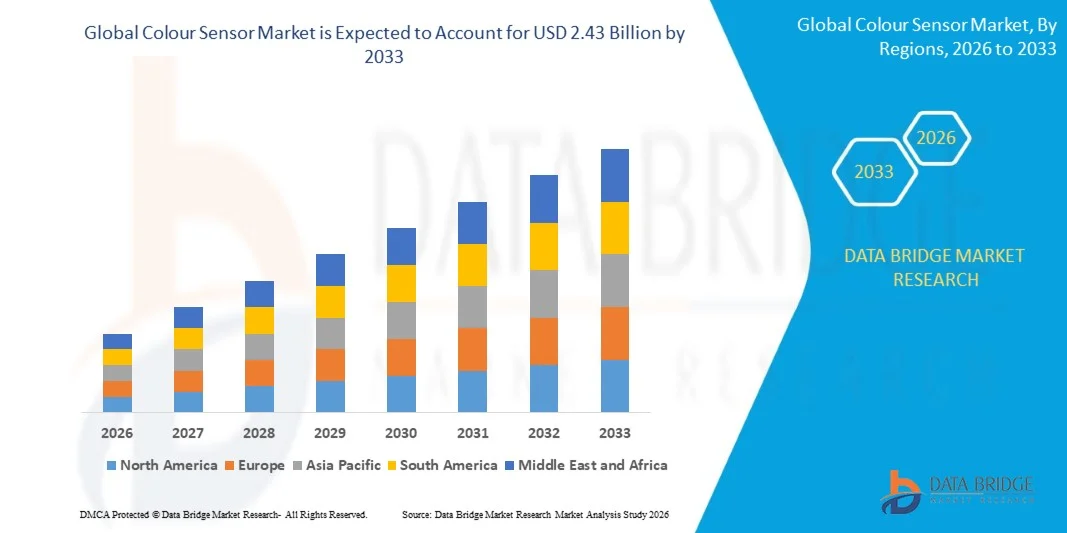
As per Data Bridge Market Research Analysis the global colour sensor market was valued at USD 1.28 billion in 2025 and is projected to reach USD 2.43 billion by 2033, growing at a CAGR of 8.25% from 2026 to 2033. The market is experiencing consistent growth driven by the increasing adoption of automation in manufacturing and processing industries, the need for stringent quality assurance, and the integration of colour sensors in consumer electronics for enhanced user experiences.
The expanding food and beverage sector, along with the textile and automotive industries, are heavily investing in colour detection technologies to ensure product consistency, safety, and sorting accuracy.
Market Size & Forecast
- Global Market Value (2025): USD 1.28 Billion
- Expected Market Value (2033): USD 2.43 Billion
- Forecast CAGR (2026–2033): 8.25%
- Leading Region in 2025: North America
- Fastest Growing Region: Asia-Pacific
Key Market Trends & Insights
- North America dominated the colour sensor market with the largest revenue share in 2025, supported by rapid adoption of industrial automation, machine vision, and automated quality inspection across manufacturing industries.
- Asia-Pacific colour sensor market is expected to witness the fastest growth rate from 2026 to 2033, supported by rapid industrialization, expanding manufacturing capabilities, and increasing investments in factory automation across China, Japan, South Korea, and India.
- The colour discrimination segment held the largest market revenue share in 2025, driven by its widespread use in industrial automation, product sorting, packaging inspection, and quality-control applications. Colour discrimination sensors are preferred due to their ability to rapidly distinguish predefined colours and support accurate product identification across automated production processes.
- The colour measurement segment is projected to register the fastest growth at a CAGR from 2026 to 2033, driven by increasing demand for precise colour analysis in printing, textiles, food and beverage, pharmaceutical, and quality-control applications. Rising adoption of advanced colour measurement technologies for consistent product appearance and automated inspection is accelerating segment expansion.
- The industrial automation segment held the largest market revenue share in 2025, driven by increasing deployment of colour sensors for product sorting, assembly verification, quality inspection, and process control applications. Colour sensors are preferred in automated manufacturing environments due to their rapid response, high detection accuracy, and ability to identify colour variations during high-speed production.
- The consumer electronics segment is projected to register the fastest growth at a CAGR from 2026 to 2033, driven by increasing integration of colour sensing technologies into smartphones, displays, cameras, smart devices, and electronic components. Rising demand for accurate colour detection, calibration, and automated component inspection is accelerating segment expansion.
Report Scope and Colour Sensor Market Segmentation
|
Attributes |
Colour Sensor Key Market Insights |
|
Segments Covered |
|
|
Countries Covered |
North America
Europe
Asia-Pacific
Middle East and Africa
South America
|
|
Key Market Players |
|
|
Market Opportunities |
|
|
Value Added Data Infosets |
In addition to the insights on market scenarios such as market value, growth rate, segmentation, geographical coverage, and major players, the market reports curated by the Data Bridge Market Research also include in-depth expert analysis, geographically represented company-wise production and capacity, network layouts of distributors and partners, detailed and updated price trend analysis and deficit analysis of supply chain and demand. |
Colour Sensor Market Trends
Trend: Rising Adoption Of Smart And High-Precision Color Sensing Technologies
Growing adoption of automation, machine vision, and intelligent inspection systems is accelerating demand for color sensors across manufacturing, packaging, automotive, electronics, and consumer goods industries. Manufacturers are increasingly deploying color sensors to identify products, verify color consistency, detect print and registration marks, and automate sorting processes with greater speed and accuracy. Advances in RGB sensing, high-resolution color detection, digital interfaces, and compact sensor designs are further improving the ability of color sensors to operate reliably across demanding industrial environments.
The rapid expansion of smart manufacturing and Industry 4.0 applications is creating sustained demand for advanced color sensing technologies across automated production lines. For instance, SICK highlights its high-resolution CSS color sensor, which can distinguish fine color nuances, detect color gradients and structured materials, and identify up to 24 colors per identification task through IO-Link connectivity. The sensor also provides automatic sensing-distance regulation and displays color values in Lab or RGB formats, supporting precise automated inspection and quality-control applications.
The growing integration of intelligent sensing, digital connectivity, and automated quality inspection is expected to reinforce long-term demand for color sensors, positioning manufacturers to benefit from increasing investments in smart factories and precision manufacturing.
Colour Sensor Market Dynamics
Key Market Driver: Increasing Adoption Of Industrial Automation And Automated Quality Inspection
The manufacturing industry continues to experience rising demand for technologies that improve production accuracy, inspection speed, and process consistency. Color sensors are increasingly being used to identify and differentiate products by color, verify product quality, detect print registration marks, and support automated sorting across packaging, electronics, automotive, food and beverage, and consumer goods applications. Their ability to provide rapid and repeatable color detection makes them increasingly valuable in automated production environments.
Leading sensor manufacturers continue developing color-sensing technologies with improved processing capabilities and easier integration into automated equipment. For instance, OMRON offers the B5WC-VB2323-1 color sensor with a built-in algorithm that converts RGB measurements into a proprietary color judgment index, helping customers reduce the development time required to create their own color-detection algorithms. OMRON states that the new sensor was developed to make color detection easier and more accurate for equipment automation applications.
As manufacturers increasingly automate inspection and product identification processes, color sensor suppliers are expected to benefit from sustained demand for high-speed, accurate, and easily integrated sensing solutions across industrial applications.
Key Restraint/Challenge: Sensitivity To Lighting Conditions And Complex Surface Characteristics
Color sensor manufacturers face technical challenges associated with variations in ambient lighting, surface reflectivity, material texture, object distance, and color characteristics. Shiny, textured, transparent, or uneven surfaces can affect reflected-light measurements and reduce detection accuracy, requiring careful sensor positioning, calibration, and application-specific configuration. These challenges can increase installation complexity and limit performance in applications involving rapidly changing production conditions.
In addition, manufacturers must ensure consistent color detection across different materials and operating environments while maintaining high production speeds. Baumer explains that its color sensors use red, green, and blue light emissions to measure reflected color proportions and incorporate teach-in procedures and selectable tolerance levels to distinguish colors. The company also notes that response times can reach as low as 0.34 milliseconds, supporting high detection rates in industrial processes.
Despite increasing adoption, variations in lighting, material properties, and surface conditions are expected to remain significant challenges, increasing calibration requirements and potentially raising installation costs for manufacturers throughout the forecast period.
Key Market Opportunity: Expansion Of Smart Manufacturing And Advanced Machine Vision Applications
Manufacturers are increasingly investing in smart factories, automated inspection, and machine vision technologies to improve productivity, reduce human error, and achieve consistent product quality. Color sensors offer significant opportunities because they provide rapid color and contrast identification while supporting automated material handling, quality control, product differentiation, and sorting operations. Integration with digital communication protocols and industrial automation platforms is further expanding their potential across manufacturing environments.
Leading companies are strengthening investments in intelligent sensing and automated inspection capabilities. For instance, in April 2025, Datalogic highlighted its AI-powered sensing and tracking solutions at Automate 2025, showcasing technologies for automated quality assurance, defect identification, and verification across automotive, electronics, food and beverage, and general manufacturing applications. Datalogic's portfolio also includes dedicated S65-V and S65-W color and contrast photoelectric sensors using RGB emission and chromaticity algorithms for advanced color detection and print registration applications.
As manufacturers accelerate investments in smart production, automated quality assurance, and machine vision, expanding applications of color sensors across packaging, electronics, automotive, food and beverage, and general manufacturing are expected to create substantial long-term growth opportunities for the global colour sensor market.
Colour Sensor Market Scope
The market is segmented on the basis of type, use cases, and verticals.
- By Type
On the basis of type, the colour sensor market is segmented into colour discrimination, colour determination, and colour measurement. The colour discrimination segment held the largest market revenue share in 2025, driven by its widespread use in industrial automation, product sorting, packaging inspection, and quality-control applications. Colour discrimination sensors are preferred due to their ability to rapidly distinguish predefined colours and support accurate product identification across automated production processes.
The colour measurement segment is projected to register the fastest growth at a CAGR from 2026 to 2033, driven by increasing demand for precise colour analysis in printing, textiles, food and beverage, pharmaceutical, and quality-control applications. Rising adoption of advanced colour measurement technologies for consistent product appearance and automated inspection is accelerating segment expansion.
- By Use Cases
On the basis of use cases, the colour sensor market is segmented into commercial and consumer printing, health and wellness, fluid and gas analysis, lighting and digital signage, consumer electronics, and industrial automation. The industrial automation segment held the largest market revenue share in 2025, driven by increasing deployment of colour sensors for product sorting, assembly verification, quality inspection, and process control applications. Colour sensors are preferred in automated manufacturing environments due to their rapid response, high detection accuracy, and ability to identify colour variations during high-speed production.
The consumer electronics segment is projected to register the fastest growth at a CAGR from 2026 to 2033, driven by increasing integration of colour sensing technologies into smartphones, displays, cameras, smart devices, and electronic components. Rising demand for accurate colour detection, calibration, and automated component inspection is accelerating segment expansion.
- By Verticals
On the basis of verticals, the colour sensor market is segmented into food and beverage, automotive, textiles, chemical, pharmaceutical, water treatment, packaging, paper and pulp, lighting and signage, consumer electronics, factory automation, and others. The factory automation segment held the largest market revenue share in 2025, driven by increasing adoption of colour sensors for automated inspection, product differentiation, sorting, assembly verification, and defect detection. Colour sensors are widely preferred in factory automation due to their ability to deliver fast and reliable colour identification across high-speed production lines.
The food and beverage segment is projected to register the fastest growth at a CAGR from 2026 to 2033, driven by increasing demand for automated product grading, sorting, quality verification, and process monitoring. Rising adoption of colour sensing technologies for detecting product variations, maintaining visual quality, and improving production efficiency is accelerating segment expansion.
Colour Sensor Market Regional Analysis
North America Colour Sensor Market Insight
North America dominated the colour sensor market with the largest revenue share in 2025, supported by rapid adoption of industrial automation, machine vision, and automated quality inspection across manufacturing industries. The region benefits from strong technological capabilities, high investments in smart manufacturing, and widespread deployment of sensors across automotive, electronics, food and beverage, packaging, and consumer goods applications. Growing demand for accurate colour identification, product sorting, defect detection, and process monitoring is further strengthening the adoption of colour sensors across industrial and commercial applications.
U.S. Colour Sensor Market Insight
U.S. colour sensor market captured the largest revenue share in 2025 within North America, fueled by strong adoption of industrial automation, machine vision, and advanced manufacturing technologies. Manufacturers are increasingly deploying colour sensors for automated inspection, product identification, sorting, and quality control across automotive, electronics, packaging, and food processing industries. Moreover, increasing investments in smart factories, robotics, and connected production systems, combined with the presence of leading sensor manufacturers, are significantly contributing to market expansion.
Europe Colour Sensor Market Insight
Europe colour sensor market is expected to witness the fastest growth rate from 2026 to 2033, primarily driven by increasing adoption of Industry 4.0, automated manufacturing, and advanced quality-control technologies. The region's strong automotive, pharmaceutical, food and beverage, packaging, and electronics industries are encouraging greater deployment of colour sensors for inspection and process automation. In addition, growing emphasis on production efficiency, precision manufacturing, and digitalization is fostering the integration of colour sensing technologies across industrial facilities.
Germany Colour Sensor Market Insight
Germany colour sensor market is expected to witness significant growth from 2026 to 2033, fueled by the country's strong industrial automation ecosystem and advanced manufacturing capabilities. Germany's well-established automotive, machinery, packaging, and electronics sectors are increasingly adopting colour sensors for automated inspection, sorting, product verification, and quality control. Furthermore, the country's focus on Industry 4.0, smart factories, and precision engineering is supporting the integration of advanced colour sensing solutions across manufacturing applications.
U.K. Colour Sensor Market Insight
U.K. colour sensor market is expected to witness strong growth from 2026 to 2033, driven by increasing automation across manufacturing, packaging, food and beverage, and pharmaceutical industries. Manufacturers are increasingly adopting colour sensors to improve product inspection, sorting accuracy, process efficiency, and quality consistency. In addition, the growing adoption of smart manufacturing technologies and investments in automated production systems are expected to stimulate demand for advanced colour sensing solutions across the country.
Asia-Pacific Colour Sensor Market Insight
The Asia-Pacific colour sensor market is expected to witness the fastest growth rate from 2026 to 2033, supported by rapid industrialization, expanding manufacturing capabilities, and increasing investments in factory automation across China, Japan, South Korea, and India. The region's strong electronics, automotive, food and beverage, packaging, and textile industries are driving demand for automated inspection and colour identification technologies. Furthermore, the expansion of smart factories, growing adoption of robotics, and increasing manufacturing investments are improving the penetration of colour sensors across the region.
Japan Colour Sensor Market Insight
Japan colour sensor market is expected to witness significant growth from 2026 to 2033 due to the country's advanced automation ecosystem, strong electronics industry, and emphasis on precision manufacturing. Japanese manufacturers increasingly use colour sensors for automated inspection, component identification, product sorting, and quality control across electronics, automotive, packaging, and industrial applications. Moreover, the integration of sensors with robotics, machine vision, and smart manufacturing systems is supporting the continued adoption of colour sensing technologies.
China Colour Sensor Market Insight
China colour sensor market accounted for the largest market revenue share in Asia Pacific in 2025, attributed to the country's extensive manufacturing base, rapid industrial automation, and expanding electronics and automotive industries. China is experiencing increasing adoption of colour sensors across factory automation, packaging, consumer electronics, food processing, and textile applications. The expansion of smart manufacturing initiatives, growing investments in automated production lines, and increasing demand for efficient quality inspection are key factors propelling the colour sensor market in China.
Colour Sensor Market Share
The colour sensor industry is primarily led by well-established companies, including:
- SICK AG (Germany)
- EMX Industries, Inc. (U.S.)
- Keyence Corporation (Japan)
- OMRON Corporation (Japan)
- Panasonic Corporation (Japan)
- Banner Engineering Corp. (U.S.)
- Baumer Holding AG (Switzerland)
- Rockwell Automation, Inc. (U.S.)
- SensoPart Industriesensorik GmbH (Germany)
- Hamamatsu Photonics K.K. (Japan)
- Pepperl+Fuchs SE (Germany)
- Datalogic S.p.A. (Italy)
- IDEC Corporation (Japan)
- Micro-Epsilon Messtechnik GmbH & Co. KG (Germany)
- NIDEC-SHIMPO CORPORATION (Japan)
Latest Developments in Colour Sensor Market
- In October 2024, STMicroelectronics N.V. expanded its portfolio of ambient light and RGB color sensors to support next-generation smartphones, tablets, wearables, and IoT devices with lower power consumption and improved display optimization. The expanded sensing capabilities enable devices to accurately detect ambient lighting and color conditions for enhanced display performance and user experience. The development supports growing demand for compact, energy-efficient sensing technologies across consumer electronics and connected devices. This innovation is expected to strengthen the adoption of advanced color sensing solutions in mobile, wearable, and IoT applications.

- Interactive Data Analysis Dashboard
- Company Analysis Dashboard for high growth potential opportunities
- Research Analyst Access for customization & queries
- Competitor Analysis with Interactive dashboard
- Latest News, Updates & Trend analysis
- Harness the Power of Benchmark Analysis for Comprehensive Competitor Tracking
Global Colour Sensor Market, Supply Chain Analysis and Ecosystem Framework
To support market growth and help clients navigate the impact of geopolitical shifts, DBMR has integrated in-depth supply chain analysis into its Global Colour Sensor Market research reports. This addition empowers clients to respond effectively to global changes affecting their industries. The supply chain analysis section includes detailed insights such as Global Colour Sensor Market consumption and production by country, price trend analysis, the impact of tariffs and geopolitical developments, and import and export trends by country and HSN code. It also highlights major suppliers with data on production capacity and company profiles, as well as key importers and exporters. In addition to research, DBMR offers specialized supply chain consulting services backed by over a decade of experience, providing solutions like supplier discovery, supplier risk assessment, price trend analysis, impact evaluation of inflation and trade route changes, and comprehensive market trend analysis.
Data collection and base year analysis are done using data collection modules with large sample sizes. The stage includes obtaining market information or related data through various sources and strategies. It includes examining and planning all the data acquired from the past in advance. It likewise envelops the examination of information inconsistencies seen across different information sources. The market data is analysed and estimated using market statistical and coherent models. Also, market share analysis and key trend analysis are the major success factors in the market report. To know more, please request an analyst call or drop down your inquiry.
The key research methodology used by DBMR research team is data triangulation which involves data mining, analysis of the impact of data variables on the market and primary (industry expert) validation. Data models include Vendor Positioning Grid, Market Time Line Analysis, Market Overview and Guide, Company Positioning Grid, Patent Analysis, Pricing Analysis, Company Market Share Analysis, Standards of Measurement, Global versus Regional and Vendor Share Analysis. To know more about the research methodology, drop in an inquiry to speak to our industry experts.
Data Bridge Market Research is a leader in advanced formative research. We take pride in servicing our existing and new customers with data and analysis that match and suits their goal. The report can be customized to include price trend analysis of target brands understanding the market for additional countries (ask for the list of countries), clinical trial results data, literature review, refurbished market and product base analysis. Market analysis of target competitors can be analyzed from technology-based analysis to market portfolio strategies. We can add as many competitors that you require data about in the format and data style you are looking for. Our team of analysts can also provide you data in crude raw excel files pivot tables (Fact book) or can assist you in creating presentations from the data sets available in the report.













