


What is the Global Combat Support Vehicle Market Size and Growth Rate?
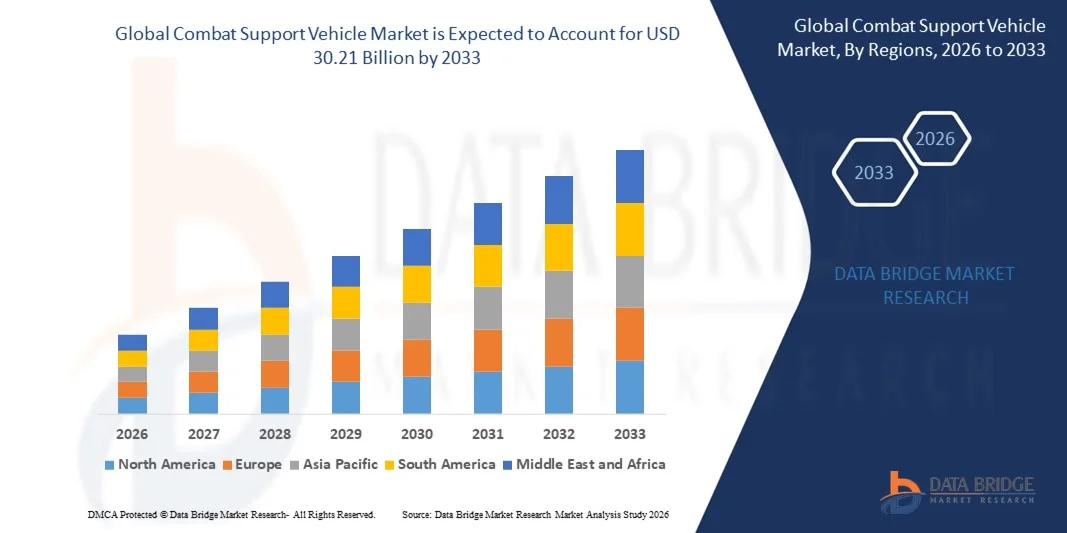
- The global combat support vehicle market size was valued at USD 19.92 billion in 2025 and is expected to reach USD 30.21 billion by 2033, at a CAGR of 5.34% during the forecast period
- Major factors that are expected to boost the growth of the combat support vehicle market in the forecast period are the rise in the demand for the combat support vehicle because of the increase in the instances of cross-border conflicts
- Furthermore, the increase in the prevalence of asymmetric warfare around the world is further propelling the growth of the combat support vehicle market
What are the Major Takeaways of Combat Support Vehicle Market?
- The shortage of major OEMs of combat support vehicles and the rise in the incidences of the mechanical, electrical and other types of failure in combat support vehicles is further responsible for the growth of the combat support vehicle market in the timeline period
- In addition, the military modernization plans around the world, the rise in the acceptance of combat support vehicles by the defence forces of several countries and the advancement of modular and scalable combat support vehicles which will further provide potential opportunities for the growth of the combat support vehicle market
- North America dominated the Combat Support Vehicle market with a 35.25% revenue share in 2025, driven by strong defense modernization programs, procurement of armored fleets, and continuous innovation in high-mobility support platforms across the U.S. and Canada
- Asia-Pacific is projected to register the fastest CAGR of 8.36% from 2026 to 2033, driven by growing defense modernization programs, cross-border security requirements, and rapid procurement of high-mobility, modular armored platforms across China, Japan, India, South Korea, and Southeast Asia
- The Metals segment dominated the market with a 48.6% share in 2025, as high-strength steel and aluminum alloys remain the primary materials for armored hulls, chassis structures, and load-bearing components
Report Scope and Combat Support Vehicle Market Segmentation
|
Attributes |
Combat Support Vehicle Key Market Insights |
|
Segments Covered |
|
|
Countries Covered |
North America
Europe
Asia-Pacific
Middle East and Africa
South America
|
|
Key Market Players |
|
|
Market Opportunities |
|
|
Value Added Data Infosets |
In addition to the insights on market scenarios such as market value, growth rate, segmentation, geographical coverage, and major players, the market reports curated by the Data Bridge Market Research also include in-depth expert analysis, pricing analysis, brand share analysis, consumer survey, demography analysis, supply chain analysis, value chain analysis, raw material/consumables overview, vendor selection criteria, PESTLE Analysis, Porter Analysis, and regulatory framework. |
What is the Key Trend in the Combat Support Vehicle Market?
Integration of Modular, Network-Enabled, and Multi-Role Combat Support Vehicles
- The combat support vehicle market is witnessing a strong shift toward modular, mission-configurable platforms designed to perform logistics, engineering, recovery, medical evacuation, and command support operations within a single adaptable architecture
- Manufacturers are introducing network-enabled vehicles equipped with advanced communication systems, battlefield management software, situational awareness sensors, and remote weapon station compatibility
- Growing demand for high-mobility, armored, and lightweight platforms capable of operating in asymmetric warfare, cross-border conflicts, and peacekeeping missions is accelerating innovation
- For instance, companies such as Oshkosh Corporation, Rheinmetall AG, BAE Systems, and General Dynamics Corporation have introduced next-generation armored support vehicles with enhanced survivability, digital integration, and hybrid mobility options
- Increasing focus on multi-domain operations and rapid deployment forces is driving procurement of interoperable and strategically deployable combat support fleets
- As modern warfare becomes increasingly technology-driven and mobility-centric, Combat Support Vehicles will remain critical for ensuring operational sustainability, force protection, and real-time battlefield coordination
What are the Key Drivers of Combat Support Vehicle Market?
- Rising defense modernization programs across the U.S., Europe, and Asia-Pacific are increasing investments in armored logistics vehicles, bridge-laying systems, engineering support units, and recovery platforms
- For instance, during 2024–2025, defense procurement initiatives in the U.S., Germany, and the U.K. emphasized upgrading armored vehicle fleets with improved blast protection, digital communication suites, and enhanced mobility systems
- Growing geopolitical tensions, border security concerns, and NATO force readiness initiatives are accelerating demand for high-performance combat service support vehicles
- Advancements in lightweight composite armor, hybrid propulsion systems, autonomous navigation, and telematics-based fleet management are strengthening vehicle efficiency and survivability
- Rising emphasis on rapid humanitarian assistance, disaster relief operations, and UN peacekeeping missions is expanding the operational scope of combat support platforms
- Supported by sustained global defense budgets and strategic military transformation programs, the Combat Support Vehicle market is expected to witness steady long-term growth
Which Factor is Challenging the Growth of the Combat Support Vehicle Market?
- High acquisition and lifecycle maintenance costs associated with advanced armored platforms, integrated electronics, and hybrid mobility systems limit procurement volumes for developing economies
- For instance, during 2024–2025, fluctuations in raw material prices, supply chain disruptions, and electronic subsystem shortages increased production costs for several global armored vehicle manufacturers
- Stringent regulatory requirements, export restrictions, and complex defense procurement procedures delay contract approvals and international sales
- Integration challenges related to cybersecurity protection, interoperability with legacy military fleets, and battlefield communication systems increase development timelines
- Competition from refurbished legacy fleets and upgrade programs creates pricing pressure for new-generation vehicle manufacturers
- To address these challenges, companies are focusing on modular production, localized manufacturing partnerships, cost-optimized variants, and digital lifecycle support solutions to enhance global adoption of combat support vehicles
How is the Combat Support Vehicle Market Segmented?
The market is segmented on the basis of material, vehicle, and application.
- By Material
On the basis of material, the combat support vehicle market is segmented into Metals, Ceramics, and Composites. The Metals segment dominated the market with a 48.6% share in 2025, as high-strength steel and aluminum alloys remain the primary materials for armored hulls, chassis structures, and load-bearing components. Metals offer proven durability, blast resistance, cost efficiency, and ease of large-scale manufacturing. Their widespread availability and established supply chains further support dominance across both developed and emerging defense markets.
The Composites segment is expected to grow at the fastest CAGR from 2026 to 2033, driven by increasing demand for lightweight armored platforms, improved fuel efficiency, and enhanced mobility. Advanced composite materials provide superior strength-to-weight ratios, corrosion resistance, and ballistic performance, making them ideal for next-generation modular combat support vehicles designed for rapid deployment and multi-role operations.
- By Vehicle
On the basis of vehicle type, the market is segmented into Tanks, Armored Fighting Vehicles (AFVs), and Civilian and Law Enforcement Vehicles. The Armored Fighting Vehicles segment dominated the market with a 44.2% share in 2025, supported by rising procurement of infantry fighting vehicles, armored personnel carriers, and recovery vehicles for logistics and battlefield support missions. AFVs provide a balance of mobility, protection, and mission adaptability, making them central to modern combat support operations.
The Civilian and Law Enforcement Vehicles segment is projected to grow at the fastest CAGR from 2026 to 2033, driven by increasing demand for armored vehicles in border security, counter-terrorism, riot control, disaster response, and peacekeeping missions. Governments worldwide are strengthening internal security infrastructure, thereby accelerating procurement of specialized support vehicles beyond traditional military applications.
- By Application
On the basis of application, the combat support vehicle market is segmented into Military and Non-Military. The Military segment dominated the market with a 72.5% share in 2025, owing to sustained defense modernization programs, armored fleet upgrades, and increasing geopolitical tensions. Combat support vehicles play a critical role in logistics transport, engineering support, recovery operations, and battlefield medical evacuation within armed forces worldwide.
The Non-Military segment is expected to grow at the fastest CAGR from 2026 to 2033, driven by rising utilization in disaster relief operations, humanitarian missions, infrastructure protection, and high-risk industrial environments. Expanding demand from paramilitary forces, homeland security agencies, and emergency response organizations is further contributing to the steady growth of non-military combat support platforms.
Which Region Holds the Largest Share of the Combat Support Vehicle Market?
- North America dominated the Combat Support Vehicle market with a 35.25% revenue share in 2025, driven by strong defense modernization programs, procurement of armored fleets, and continuous innovation in high-mobility support platforms across the U.S. and Canada. High adoption of modular, network-enabled, and multi-role vehicles enhances operational efficiency for military logistics, engineering support, and battlefield recovery operations
- Leading companies in North America, such as Oshkosh Corporation, General Dynamics Corporation, and Lockheed Martin Corporation, are introducing next-generation combat support vehicles with hybrid mobility, advanced communication suites, and modular mission payloads, strengthening the region’s technological leadership
- High concentration of engineering talent, robust defense R&D ecosystems, and sustained investment in digital integration and autonomous vehicle technologies further reinforce North America’s dominance in the Combat Support Vehicle market
U.S. Combat Support Vehicle Market Insight
The U.S. is the largest contributor in North America, supported by extensive armored fleet upgrades, high demand for rapid deployment platforms, and modernization of logistics and recovery vehicles. Continuous investment in autonomous vehicle technologies, battlefield management systems, and hybrid propulsion solutions drives demand for advanced Combat Support Vehicles capable of multi-role operations. Presence of major defense contractors, innovation hubs, and government procurement programs further accelerates market growth.
Canada Combat Support Vehicle Market Insight
Canada contributes significantly to regional growth due to investments in domestic defense programs, armored vehicle upgrades, and multi-role support platforms. Deployment of vehicles for disaster response, peacekeeping missions, and training exercises is increasing. Government-backed R&D initiatives, skilled engineering workforce, and collaboration with North American defense manufacturers support rising adoption of Combat Support Vehicles across both military and paramilitary operations.
Asia-Pacific Combat Support Vehicle Market
Asia-Pacific is projected to register the fastest CAGR of 8.36% from 2026 to 2033, driven by growing defense modernization programs, cross-border security requirements, and rapid procurement of high-mobility, modular armored platforms across China, Japan, India, South Korea, and Southeast Asia. Rising investments in hybrid mobility, autonomous support vehicles, and battlefield communication systems fuel adoption.
China Combat Support Vehicle Market Insight
China is the largest contributor in Asia-Pacific, supported by extensive domestic defense manufacturing, advanced electronics integration, and government-backed military modernization programs. Increasing demand for multi-role combat support platforms, rapid deployment logistics vehicles, and network-enabled systems is driving market growth. Competitive local production and strategic exports further expand market penetration.
Japan Combat Support Vehicle Market Insight
Japan demonstrates steady growth due to modernization of armored support fleets, integration of advanced electronics, and high-reliability engineering practices. Adoption of hybrid and network-enabled vehicles for disaster response, industrial logistics, and defense applications reinforces market expansion.
India Combat Support Vehicle Market Insight
India is emerging as a key growth hub with expanding domestic defense manufacturing, rising armored vehicle procurement, and government-backed initiatives supporting multi-role combat support platforms. Increasing demand for autonomous support vehicles, rapid deployment logistics, and mission-configurable platforms accelerates market adoption.
South Korea Combat Support Vehicle Market Insight
South Korea contributes significantly due to strong defense modernization programs, high adoption of network-enabled support vehicles, and advanced armored platforms. Rising demand for modular, lightweight, and multi-role vehicles drives adoption across both military and paramilitary sectors. Technological innovation and domestic manufacturing capabilities support sustained regional growth.
Which are the Top Companies in Combat Support Vehicle Market?
The combat support vehicle industry is primarily led by well-established companies, including:
- Lockheed Martin Corporation (U.S.)
- Northrop Grumman (U.S.)
- General Dynamics Corporation (U.S.)
- BAE Systems (U.K.)
- Rheinmetall AG (Germany)
- Oshkosh Corporation (U.S.)
- UralVagonZavod (Russia)
- Ukroboronprom (Ukraine)
- Norinco Private Limited (China)
- Textron Inc. (U.S.)
- Autonomous Solutions Inc. (U.S.)
- Clearpath Robotics Inc. (Canada)
- ICOR Technology (Canada)
- Leonardo S.p.A. (Italy)
- Cobham Limited (U.K.)
- FLIR Systems, Inc. (U.S.)
- ECA Group (France)
- L3Harris Technologies, Inc. (U.S.)
- HORIBA Ltd. (Japan)
- Nexter Group (France)

- Interactive Data Analysis Dashboard
- Company Analysis Dashboard for high growth potential opportunities
- Research Analyst Access for customization & queries
- Competitor Analysis with Interactive dashboard
- Latest News, Updates & Trend analysis
- Harness the Power of Benchmark Analysis for Comprehensive Competitor Tracking
Data collection and base year analysis are done using data collection modules with large sample sizes. The stage includes obtaining market information or related data through various sources and strategies. It includes examining and planning all the data acquired from the past in advance. It likewise envelops the examination of information inconsistencies seen across different information sources. The market data is analysed and estimated using market statistical and coherent models. Also, market share analysis and key trend analysis are the major success factors in the market report. To know more, please request an analyst call or drop down your inquiry.
The key research methodology used by DBMR research team is data triangulation which involves data mining, analysis of the impact of data variables on the market and primary (industry expert) validation. Data models include Vendor Positioning Grid, Market Time Line Analysis, Market Overview and Guide, Company Positioning Grid, Patent Analysis, Pricing Analysis, Company Market Share Analysis, Standards of Measurement, Global versus Regional and Vendor Share Analysis. To know more about the research methodology, drop in an inquiry to speak to our industry experts.
Data Bridge Market Research is a leader in advanced formative research. We take pride in servicing our existing and new customers with data and analysis that match and suits their goal. The report can be customized to include price trend analysis of target brands understanding the market for additional countries (ask for the list of countries), clinical trial results data, literature review, refurbished market and product base analysis. Market analysis of target competitors can be analyzed from technology-based analysis to market portfolio strategies. We can add as many competitors that you require data about in the format and data style you are looking for. Our team of analysts can also provide you data in crude raw excel files pivot tables (Fact book) or can assist you in creating presentations from the data sets available in the report.













