What is the Combi Ovens Market Size and Growth Rate?
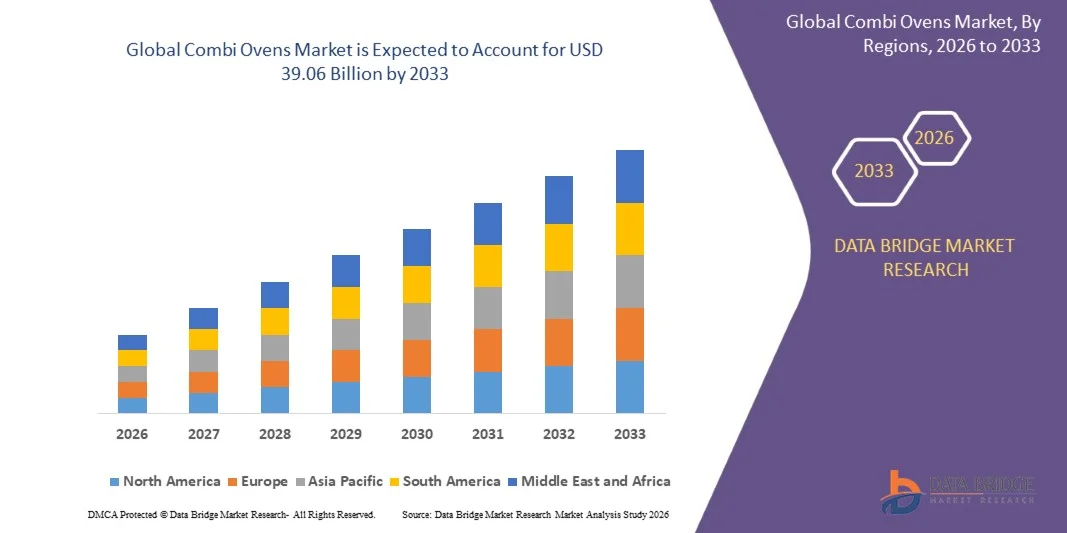
- As per Data Bridge Market Research Analysis the global combi ovens market size was valued at USD 20.18 billion in 2025 and is expected to reach USD 39.06 billion by 2033, at a CAGR of 8.60% during the forecast period
- The market growth is largely fuelled by the increasing adoption of energy-efficient and multifunctional cooking equipment in commercial kitchens
- Rising demand from the hospitality and foodservice sectors for faster cooking solutions with consistent quality
Market Size & Forecast
- Global Market Value (2025): USD 20.18 billion
- Expected Market Value (2033): USD 39.06 Billion
- Forecast CAGR (2026–2033): 8.60 %
Combi Ovens Market Analysis
- The market is witnessing strong growth due to technological innovations that combine steam, convection, and combination cooking, providing versatility to commercial kitchens
- Increasing consumer preference for quick-service restaurants and ready-to-eat food options is driving the demand for high-performance combi ovens
- North America dominated the combi ovens market with the largest revenue share of 38.75% in 2025, driven by the growing demand for energy-efficient, multifunctional cooking equipment and the expansion of the hospitality and foodservice industry
- Asia-Pacific region is expected to witness the highest growth rate in the global combi ovens market, driven by increasing disposable incomes, expansion of restaurants and hotels, technological advancements, and supportive government initiatives promoting modern foodservice equipment
- The Full-Size Single segment held the largest market revenue share in 2025, driven by its compact design, versatility, and suitability for medium to large commercial kitchens. Full-Size Single combi ovens are widely adopted in restaurants and hotels for their ability to handle multiple cooking functions without occupying excessive kitchen space
Report Scope and Combi Ovens Market Segmentation
|
Attributes |
Combi Ovens Key Market Insights |
|
Segments Covered |
|
|
Countries Covered |
North America
Europe
Asia-Pacific
Middle East and Africa
South America
|
|
Key Market Players |
|
|
Market Opportunities |
|
|
Value Added Data Infosets |
In addition to the insights on market scenarios such as market value, growth rate, segmentation, geographical coverage, and major players, the market reports curated by the Data Bridge Market Research also include in-depth expert analysis, pricing analysis, brand share analysis, consumer survey, demography analysis, supply chain analysis, value chain analysis, raw material/consumables overview, vendor selection criteria, PESTLE Analysis, Porter Analysis, and regulatory framework. |
What is the Key Trend in the Combi Ovens Market?
“Rise of Multifunctional Cooking Solutions in Commercial Kitchens”
• The increasing adoption of combi ovens is transforming commercial kitchens by combining steam, convection, and combination cooking in a single appliance. This multifunctionality allows chefs to prepare a wide variety of dishes with consistent quality, saving time and reducing labor costs. The versatility of these ovens enables simultaneous cooking of multiple items, improving kitchen workflow and reducing wait times for customers
• The demand for faster cooking and high-volume food preparation in hotels, restaurants, and catering services is accelerating the deployment of combi ovens. These ovens are particularly valuable in settings where consistent output and energy efficiency are critical. Businesses are leveraging these ovens to meet peak-hour demand without compromising on taste, texture, or presentation, enhancing overall customer satisfaction
• Modern combi ovens are increasingly equipped with digital controls and programmable cooking modes, making them user-friendly and reducing training requirements for kitchen staff. This encourages routine use and experimentation with new cooking techniques. In addition, smart sensors and automated cooking programs help reduce human error, ensuring repeatable results across different chefs and shifts
• For instance, in 2024, several fast-casual restaurant chains in Europe reported a significant reduction in food preparation time and energy consumption after integrating combi ovens into their kitchens, improving operational efficiency and customer satisfaction. The ovens also enabled standardized menu offerings across multiple locations, supporting brand consistency and quality control
• While combi ovens are gaining popularity due to efficiency and versatility, their market growth depends on continued innovation, ease of use, and cost-effectiveness. Manufacturers must focus on smart technology integration and energy-efficient designs to fully capitalize on growing demand. Growing interest in hybrid cooking technologies and automated monitoring systems is further fueling adoption
Combi Ovens Market Dynamics
Driver
“Rising Demand for Energy-Efficient and High-Performance Cooking Equipment”
• Growing emphasis on energy efficiency and sustainability in commercial kitchens is driving investment in advanced combi ovens. Businesses are prioritizing appliances that reduce energy and water consumption while maintaining cooking quality. These ovens also contribute to lower carbon footprints, aligning with corporate sustainability goals and regulatory requirements
• The expansion of the hospitality and foodservice industry globally is increasing demand for versatile cooking solutions capable of handling high volumes with minimal labor. This trend is reinforced by changing consumer preferences for consistent food quality and faster service. Operators are increasingly seeking appliances that can adapt to evolving menu offerings without requiring additional space or equipment
• Government regulations and green initiatives are also encouraging the adoption of eco-friendly cooking equipment. Incentives for energy-efficient appliances are boosting market penetration in both developed and emerging regions. Compliance with energy standards and certifications has become a key factor in purchasing decisions for commercial kitchens
• For instance, in 2023, several hotel chains in North America upgraded to combi ovens with smart energy-saving modes, reducing utility costs and improving kitchen sustainability metrics. These upgrades also enhanced kitchen safety and reduced maintenance downtime, further strengthening the business case for modern ovens
• While performance and energy efficiency are major drivers, ongoing focus on maintenance, training, and product customization is essential to sustain long-term market growth. The introduction of IoT-enabled monitoring, predictive maintenance, and modular designs is creating additional opportunities for market expansion
Restraint/Challenge
“High Initial Cost and Infrastructure Requirements”
• The high upfront cost of advanced combi ovens makes them less accessible to small restaurants and catering businesses. Premium features and smart technology integration further increase the price, limiting adoption among cost-sensitive operators. Financial constraints and limited access to credit in certain regions exacerbate these challenges
• Installation and maintenance requirements can be complex, requiring specialized kitchen layouts, trained personnel, and regular servicing. These factors create barriers for small-scale operators and new entrants. Without proper infrastructure, the efficiency and lifespan of these ovens may be compromised, reducing their return on investment
• Market penetration is further restricted in regions with limited access to after-sales service, spare parts, or technical support, which can reduce appliance lifespan and operational reliability. Operators in remote or underdeveloped areas may face delays in repairs, disrupting kitchen operations and affecting business continuity
• For instance, in 2023, several small-scale eateries in Southeast Asia delayed upgrading to combi ovens due to high procurement and installation costs, opting instead for conventional cooking methods. This prevented them from achieving operational efficiencies and adopting modern cooking techniques
• While technological advancements continue to improve usability, addressing affordability, infrastructure, and support challenges is crucial for broader adoption and sustained market growth. Partnerships between manufacturers, distributors, and financial institutions to provide leasing or financing options could help overcome these barriers and drive market expansion
Combi Ovens Market Scope
The market is segmented on the basis of product type, application, power type, and capacity
• By Product Type
On the basis of product type, the combi ovens market is segmented into Full-Size Single, Full-Size Double, Full-Size Roll-in, and Half-Size Double and Single. The Full-Size Single segment held the largest market revenue share in 2025, driven by its compact design, versatility, and suitability for medium to large commercial kitchens. Full-Size Single combi ovens are widely adopted in restaurants and hotels for their ability to handle multiple cooking functions without occupying excessive kitchen space.
The Full-Size Double segment is expected to witness the fastest growth rate from 2026 to 2033, driven by its higher cooking capacity and ability to prepare multiple dishes simultaneously. These ovens are increasingly preferred by large-scale operations and chain restaurants that require high-volume, consistent cooking performance.
• By Application
On the basis of application, the combi ovens market is segmented into Independent Restaurant, Chain Restaurant, Independent Hotels, Chain Hotel, Medical Centers, Government, and Other. The Chain Restaurant segment held the largest market revenue share in 2025, owing to standardized menu requirements and the need for high-efficiency cooking equipment. Combi ovens in chain restaurants support consistent quality across multiple locations, enhancing operational efficiency and brand reputation.
The Independent Hotel segment is expected to witness the fastest growth from 2026 to 2033, driven by increasing adoption of multifunctional cooking appliances to meet diverse culinary needs and improve kitchen productivity in boutique and small-scale hotels.
• By Power Type
On the basis of power type, the combi ovens market is segmented into Electric and Gas. The Electric segment held the largest market revenue share in 2025, driven by the ease of installation, precise temperature control, and energy efficiency offered by electric ovens. Electric combi ovens are widely preferred in urban commercial kitchens and locations with reliable electricity supply.
The Gas segment is expected to witness the fastest growth rate from 2026 to 2033, owing to its high heating efficiency, lower operational costs in certain regions, and suitability for kitchens with high-volume cooking demands. Gas-powered ovens are often favored in regions where energy cost management is a priority.
• By Capacity
On the basis of capacity, the combi ovens market is segmented into Low, Medium, and Heavy. The Medium capacity segment held the largest market revenue share in 2025, driven by its ability to balance cooking volume with energy efficiency, making it ideal for most commercial kitchens. Medium-capacity ovens are versatile and suitable for restaurants, hotels, and catering services with moderate daily cooking demands.
The Heavy capacity segment is expected to witness the fastest growth from 2026 to 2033, driven by increasing demand from large-scale foodservice operations and institutional kitchens that require high-volume, continuous cooking performance without compromising on quality.
Combi Ovens Market Regional Analysis
• North America dominated the combi ovens market with the largest revenue share of 38.75% in 2025, driven by the growing demand for energy-efficient, multifunctional cooking equipment and the expansion of the hospitality and foodservice industry
• Restaurants, hotels, and catering services in the region increasingly value the versatility, time-saving features, and consistent cooking performance offered by combi ovens, enabling high-volume food preparation with minimal labor
• This widespread adoption is further supported by high disposable incomes, technologically advanced commercial kitchens, and the rising trend of quick-service and fine-dining restaurants, establishing combi ovens as a preferred solution for both independent and chain establishments
U.S. Combi Ovens Market Insight
The U.S. combi ovens market captured the largest revenue share in 2025 within North America, fueled by the rapid modernization of commercial kitchens and growing investments in foodservice technology. Businesses are prioritizing multifunctional ovens that reduce cooking time and improve energy efficiency. The rising preference for digital controls, programmable cooking modes, and integration with kitchen management systems further propels the market. Moreover, the increasing demand for energy-efficient appliances and standardized menu offerings in restaurants is significantly contributing to market expansion.
Europe Combi Ovens Market Insight
The Europe combi ovens market is expected to witness the fastest growth rate from 2026 to 2033, primarily driven by the increasing focus on energy-efficient appliances and modernization of commercial kitchens. The expansion of chain restaurants and hotels, along with rising urbanization, is fostering the adoption of combi ovens. European businesses are attracted to the versatility, consistency, and operational efficiency these ovens provide. The region is witnessing strong growth across independent restaurants, hotels, and institutional kitchens, with combi ovens being incorporated in both new establishments and renovation projects.
U.K. Combi Ovens Market Insight
The U.K. combi ovens market is expected to witness the fastest growth rate from 2026 to 2033, driven by the growing trend of modern, high-efficiency commercial kitchens and a rising demand for faster, consistent cooking solutions. Safety and hygiene considerations, combined with the desire for energy-efficient and easy-to-use appliances, are encouraging restaurants and hotels to adopt combi ovens. In addition, the U.K.’s strong hospitality infrastructure and widespread digitalization in kitchens are expected to continue supporting market growth.
Germany Combi Ovens Market Insight
The Germany combi ovens market is expected to witness the fastest growth rate from 2026 to 2033, fueled by the adoption of technologically advanced cooking equipment and energy-saving appliances. Germany’s well-developed foodservice industry, combined with a strong focus on sustainability and operational efficiency, promotes the use of combi ovens in both commercial and institutional kitchens. Integration with smart kitchen management systems and digital monitoring solutions is becoming increasingly prevalent, aligning with local expectations for productivity and innovation.
Asia-Pacific Combi Ovens Market Insight
The Asia-Pacific combi ovens market is expected to witness the fastest growth rate from 2026 to 2033, driven by increasing urbanization, rising disposable incomes, and rapid expansion of the hospitality sector in countries such as China, Japan, and India. The growing number of hotels, restaurants, and catering services, along with government initiatives promoting modern foodservice technologies, is accelerating combi oven adoption. In addition, the region’s emergence as a manufacturing hub for kitchen equipment is making combi ovens more accessible and affordable.
Japan Combi Ovens Market Insight
The Japan combi ovens market is expected to witness the fastest growth rate from 2026 to 2033 due to high technological adoption, the modernization of commercial kitchens, and the demand for multifunctional cooking appliances. Japanese restaurants and hotels are increasingly adopting combi ovens to optimize cooking efficiency, ensure consistent food quality, and reduce energy consumption. Integration with smart kitchen systems and automation is further fueling market growth.
China Combi Ovens Market Insight
The China combi ovens market accounted for the largest revenue share in Asia-Pacific in 2025, attributed to rapid urbanization, expansion of the hospitality industry, and high adoption of modern kitchen technologies. China represents one of the largest markets for commercial cooking equipment, with combi ovens increasingly used in hotels, restaurants, and institutional kitchens. The push for energy-efficient kitchens, rising disposable incomes, and availability of affordable and locally manufactured options are key factors driving market growth.
Which are the Top Companies in Combi Ovens Market?
The Combi Ovens industry is primarily led by well-established companies, including:
- Alto‑Shaam, Inc. (U.S.)
- The Middleby Corporation (U.S.)
- RETIGO s.r.o (Czech Republic)
- Henny Penny (U.S.)
- Illinois Tool Works Inc. (U.S.)
- Naru Equipment (India)
- Mish Horeca Services (India)
- Wang Professionals Private Limited (India)
- EssEmm Corporation (U.S.)
- Crescent Kitchen Equipments (India)
- RATIONAL AG (Germany)
- FUJIMAK Corporation (Japan)
- Fagor Automation (Spain)
- Welbilt, Inc. (U.S.)
- Electrolux (Sweden)
- UNOX SpA (Italy)
- BKI (U.S.)
- Ali Group S.r.l. (Italy)
Latest Developments in Global Combi Ovens Market
- In August 2025, Rational AG (Germany) launched a new line of AI-enabled combi ovens designed to optimize cooking processes using real-time data. This innovation enhances cooking precision and energy efficiency, providing customers with more consistent results and reduced operational costs. The move strengthens Rational’s position as a technology leader in the market and differentiates it from competitors, potentially boosting its market share and brand reputation
- In September 2025, Alto-Shaam Inc. (U.S.) formed a partnership with a leading energy management firm to develop energy-efficient cooking solutions. This collaboration focuses on sustainability, allowing Alto-Shaam to offer eco-friendly appliances that reduce energy consumption and appeal to environmentally conscious customers. The initiative positions the company to capitalize on the rising demand for green kitchen equipment, reinforcing its competitive edge in the market
- In October 2025, Electrolux Professional (Sweden) introduced a digital platform integrating combi ovens with cloud-based analytics. The platform enables remote monitoring and optimization of cooking processes, improving operational efficiency and workflow management. By focusing on digital transformation, Electrolux caters to tech-savvy users seeking innovative, connected kitchen solutions, strengthening its market presence and technological leadership

- Interactive Data Analysis Dashboard
- Company Analysis Dashboard for high growth potential opportunities
- Research Analyst Access for customization & queries
- Competitor Analysis with Interactive dashboard
- Latest News, Updates & Trend analysis
- Harness the Power of Benchmark Analysis for Comprehensive Competitor Tracking
Data collection and base year analysis are done using data collection modules with large sample sizes. The stage includes obtaining market information or related data through various sources and strategies. It includes examining and planning all the data acquired from the past in advance. It likewise envelops the examination of information inconsistencies seen across different information sources. The market data is analysed and estimated using market statistical and coherent models. Also, market share analysis and key trend analysis are the major success factors in the market report. To know more, please request an analyst call or drop down your inquiry.
The key research methodology used by DBMR research team is data triangulation which involves data mining, analysis of the impact of data variables on the market and primary (industry expert) validation. Data models include Vendor Positioning Grid, Market Time Line Analysis, Market Overview and Guide, Company Positioning Grid, Patent Analysis, Pricing Analysis, Company Market Share Analysis, Standards of Measurement, Global versus Regional and Vendor Share Analysis. To know more about the research methodology, drop in an inquiry to speak to our industry experts.
Data Bridge Market Research is a leader in advanced formative research. We take pride in servicing our existing and new customers with data and analysis that match and suits their goal. The report can be customized to include price trend analysis of target brands understanding the market for additional countries (ask for the list of countries), clinical trial results data, literature review, refurbished market and product base analysis. Market analysis of target competitors can be analyzed from technology-based analysis to market portfolio strategies. We can add as many competitors that you require data about in the format and data style you are looking for. Our team of analysts can also provide you data in crude raw excel files pivot tables (Fact book) or can assist you in creating presentations from the data sets available in the report.