


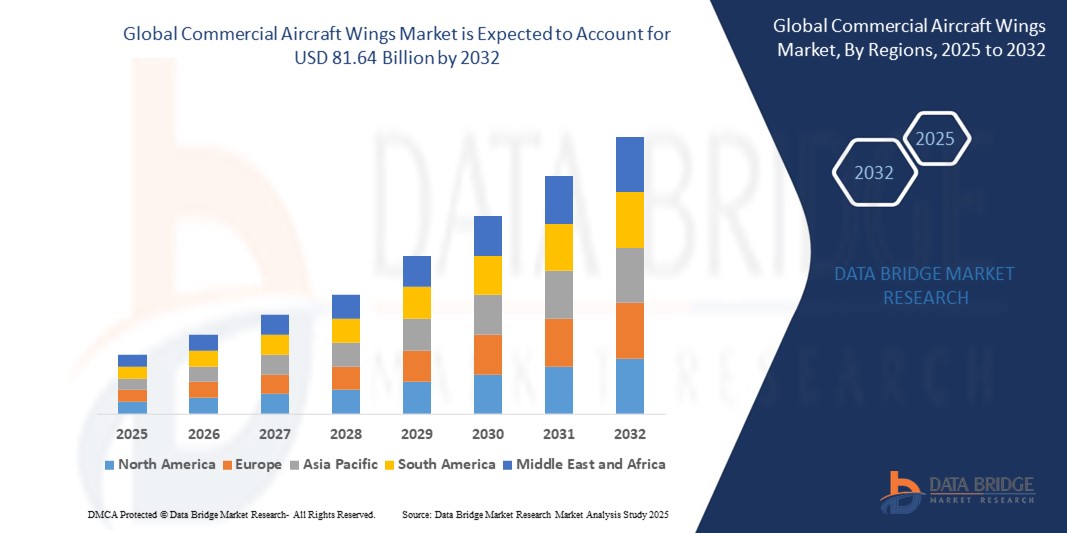
What is the Global Commercial Aircraft Wings Market Size and Growth Rate?
- The global commercial aircraft wings market size was valued at USD 46.32 billion in 2024 and is expected to reach USD 81.64 billion by 2032, at a CAGR of 7.34% during the forecast period
- The commercial aircraft wings market is experiencing significant growth driven by technological advancements and evolving methods. The latest method gaining traction is the use of advanced composite materials, including carbon fiber-reinforced polymers (CFRPs)
- These materials offer superior strength-to-weight ratios, enhancing fuel efficiency and aerodynamic performance. The integration of winglets upturned tips on wings is another advancement that reduces drag and improves fuel efficiency, contributing to lower operational costs
What are the Major Takeaways of Commercial Aircraft Wings Market?
- Technology such as 3D printing is revolutionizing the production of wing components, allowing for more complex geometries and reduced manufacturing time. Innovations in wing design, such as adaptive wings with morphing capabilities, are also emerging, enabling aircraft to adjust wing shape in real-time based on flight conditions
- The growth in this market is further supported by increased air travel demand and advancements in aerospace engineering. With airlines focusing on reducing operational costs and improving environmental performance, the commercial aircraft wings market is expected to expand significantly, driven by these technological advancements and increasing adoption of innovative materials and designs
- Asia-Pacific dominated the commercial aircraft wings market with the largest revenue share of 41.6% in 2024, driven by rising air travel demand, increasing defense budgets, and expanding aircraft production capacity in countries such as China, India, and Japan
- Europe is expected to witness the fastest CAGR of 9.3% from 2025 to 2032, driven by the region’s focus on sustainable aviation, innovation in aerodynamics, and investment in lightweight composite wing structures
- The Passenger Aircraft segment dominated the market with the largest revenue share of 58.7% in 2024, attributed to the high demand for commercial airliners driven by growing passenger air travel, fleet expansion by airlines, and increasing international connectivity
Report Scope and Commercial Aircraft Wings Market Segmentation
|
Attributes |
Commercial Aircraft Wings Key Market Insights |
|
Segments Covered |
|
|
Countries Covered |
North America
Europe
Asia-Pacific
Middle East and Africa
South America
|
|
Key Market Players |
|
|
Market Opportunities |
|
|
Value Added Data Infosets |
In addition to the insights on market scenarios such as market value, growth rate, segmentation, geographical coverage, and major players, the market reports curated by the Data Bridge Market Research also include in-depth expert analysis, pricing analysis, brand share analysis, consumer survey, demography analysis, supply chain analysis, value chain analysis, raw material/consumables overview, vendor selection criteria, PESTLE Analysis, Porter Analysis, and regulatory framework. |
What is the Key Trend in the Commercial Aircraft Wings Market?
- A major trend reshaping the commercial aircraft wings market is the growing use of advanced composite materials and the integration of smart wing technologies such as morphing surfaces and embedded sensors. These innovations aim to improve fuel efficiency, reduce weight, and enhance aerodynamic performance
- Aircraft manufacturers are increasingly adopting carbon-fiber-reinforced polymers (CFRPs) and other lightweight materials to produce stronger and more durable wings. For instance, Airbus's A350 XWB features wings made almost entirely of composites, contributing to a 25% reduction in fuel burn compared to previous models
- The rise of adaptive wing technologies including variable camber systems and winglets enables wings to change shape in-flight based on aerodynamic needs. Boeing’s ecoDemonstrator program has tested such technologies to improve lift-to-drag ratios
- Embedded sensors within wings are also gaining traction, allowing real-time structural health monitoring. These systems help airlines predict maintenance needs more accurately, reducing downtime and improving safety
- As sustainability becomes a key focus, innovations in wing design are contributing significantly to lower carbon emissions. Companies such as Northrop Grumman and GKN Aerospace are investing in smart wing research to support the development of next-generation aircraft
- These advances signal a shift toward intelligent, lightweight, and fuel-efficient aircraft wings, aligned with the broader goals of carbon neutrality and operational cost efficiency in commercial aviation
What are the Key Drivers of Commercial Aircraft Wings Market?
- One of the key drivers is the increasing global demand for fuel-efficient aircraft due to high fuel prices and stringent emission regulations imposed by bodies such as ICAO and the EU
- Aircraft OEMs are actively redesigning wings to reduce drag and improve fuel economy. For instance, in March 2024, Boeing advanced the testing of its Transonic Truss-Braced Wing (TTBW) concept under NASA’s Sustainable Flight Demonstrator project, aimed at achieving 30% fuel efficiency gains
- The rapid growth in global air traffic, especially in emerging markets across Asia-Pacific and the Middle East, is pushing airline fleets to modernize with newer, more efficient aircraft, fueling demand for advanced wings
- In addition, the proliferation of narrow-body and regional aircraft—especially with airlines emphasizing point-to-point travel—necessitates lightweight and modular wing solutions optimized for shorter routes and operational flexibility
- The increasing number of airline orders for next-generation aircraft such as the Airbus A321XLR and Boeing 737 MAX, both equipped with advanced wing designs, is a testament to this trend
Which Factor is challenging the Growth of the Commercial Aircraft Wings Market?
- A significant challenge is the high manufacturing cost and complexity associated with advanced wing technologies, particularly those utilizing carbon composites and smart systems
- The initial capital investment and specialized infrastructure required to produce composite wings limit scalability and adoption, especially for smaller aircraft manufacturers and suppliers
- For instance, despite the performance benefits of CFRP wings, their time-consuming layup processes, autoclave curing, and specialized labor requirements result in longer production cycles and higher costs
- Another constraint is the supply chain vulnerability for raw materials such as aerospace-grade carbon fiber and resin systems, which saw disruptions during the COVID-19 pandemic and continue to face geopolitical instability
- In addition, integration of smart wing technologies requires high R&D spending and rigorous certification from aviation regulatory bodies, which can delay market introduction
- Overcoming these hurdles will require continued investment in automated production techniques, expanded supplier networks, and stronger collaboration between OEMs, research institutes, and regulatory bodies to reduce costs and improve scalability
How is the Commercial Aircraft Wings Market Segmented?
The market is segmented on the basis of type, type of wing, shape of wing, ratio, and application.
• By Type
On the basis of type, the commercial aircraft wings market is segmented into Passenger Aircraft, Corporate Jets, Freighter, and Others. The Passenger Aircraft segment dominated the market with the largest revenue share of 58.7% in 2024, attributed to the high demand for commercial airliners driven by growing passenger air travel, fleet expansion by airlines, and increasing international connectivity. Passenger aircraft require efficient, lightweight, and fuel-saving wings, pushing demand for advanced wing technologies in this segment.
The Corporate Jets segment is expected to witness the fastest CAGR from 2025 to 2032, propelled by rising business travel and private aviation trends, especially in North America and Europe. Increasing customization and the integration of next-gen lightweight wings are also accelerating growth in this segment.
• By Type of Wing
On the basis of wing type, the market is segmented into Fixed-Wing Aircraft and Rotary Wing Aircraft. The Fixed-Wing Aircraft segment held the largest market share of 72.4% in 2024, due to its dominant use in commercial aviation, long-distance travel, and freight operations. Fixed wings are favored for their superior lift generation, fuel efficiency, and structural flexibility, making them the standard for most commercial aircraft models.
The Rotary Wing Aircraft segment is expected to grow steadily through 2032, supported by its applications in regional transport, emergency medical services, and defense. Innovations in rotor blade technology and urban air mobility (UAM) developments are fueling interest in this segment.
• By Shape of Wing
On the basis of wing shape, the market is segmented into Delta Wing, Straight Wing, and Swept Back Wing. The Swept Back Wing segment led the market with the highest revenue share of 49.8% in 2024, owing to its aerodynamic efficiency at high speeds, making it the go-to design for most modern commercial jets. The swept-back configuration helps reduce drag at transonic and supersonic speeds, improving fuel efficiency.
The Delta Wing segment is projected to register the highest growth rate during the forecast period due to its rising use in next-generation supersonic and hypersonic aircraft concepts, offering enhanced maneuverability and high-speed stability.
• By Ratio
On the basis of aspect ratio, the market is segmented into Low Aspect Ratio, Moderate Aspect Ratio, and High Aspect Ratio. The Moderate Aspect Ratio segment accounted for the largest market share of 46.5% in 2024, as it balances structural efficiency and aerodynamic performance, making it suitable for a wide range of commercial aircraft. Aircraft with moderate aspect ratios optimize fuel consumption without compromising lift capabilities.
The High Aspect Ratio segment is projected to experience the fastest growth due to its increasing adoption in long-range and fuel-efficient aircraft. These wings offer higher lift-to-drag ratios and are favored in the design of next-generation sustainable aircraft.
• By Application
By application, the commercial aircraft wings market is segmented into Subsonic Aircraft and Hypersonic Aircraft. The Subsonic Aircraft segment dominated the market with the highest revenue share of 81.3% in 2024, driven by the dominance of commercial passenger and cargo flights operating at subsonic speeds. These aircraft depend heavily on efficient wing designs to ensure operational cost savings and regulatory compliance.
The Hypersonic Aircraft segment, while still in early stages, is expected to witness rapid growth from 2025 to 2032, spurred by R&D initiatives in defense and aerospace sectors targeting ultra-high-speed travel and military applications.
Which Region Holds the Largest Share of the Commercial Aircraft Wings Market?
- Asia-Pacific dominated the commercial aircraft wings market with the largest revenue share of 41.6% in 2024, driven by rising air travel demand, increasing defense budgets, and expanding aircraft production capacity in countries such as China, India, and Japan. The region is experiencing rapid growth in both commercial aviation and military aerospace sectors, resulting in high demand for advanced wing technologies
- The presence of major OEMs and Tier 1 suppliers, coupled with supportive government policies for indigenized aircraft production, is further fueling market growth. Nations such as China are accelerating domestic programs such as COMAC’s C919, which rely heavily on cutting-edge wing structures
- Strong economic growth, increasing urbanization, and investments in aerospace infrastructure have positioned Asia-Pacific as a central hub for aircraft manufacturing and fleet expansion, driving sustained demand for next-generation wings across passenger and cargo aircraft
China Commercial Aircraft Wings Market Insight
China commercial aircraft wings market accounted for the largest share within Asia-Pacific in 2024, supported by the rapid expansion of its domestic aviation industry, strong government backing, and increasing commercial aircraft deliveries. China's growing focus on reducing dependence on foreign suppliers has led to significant R&D in wing technologies and localized production. The emergence of players such as COMAC and partnerships with global aerospace firms continue to bolster the market.
India Commercial Aircraft Wings Market Insight
India commercial aircraft wings market is poised for robust growth throughout the forecast period, fueled by government initiatives such as “Make in India” and rising investment in aerospace manufacturing clusters. The country's expanding airline industry, rising passenger traffic, and new airport development projects are creating substantial demand for efficient, lightweight wing structures in both narrow-body and regional aircraft.
Japan Commercial Aircraft Wings Market Insight
Japan commercial aircraft wings market is experiencing steady growth due to its established aerospace industry, high R&D spending, and participation in multinational aircraft programs. Japan's technological expertise supports the production of composite wing components and integration of smart materials. The nation's aging commercial fleet and interest in next-gen aircraft further support the need for improved wing performance and efficiency.
Which Region is the Fastest Growing in the Commercial Aircraft Wings Market?
Europe is expected to witness the fastest CAGR of 9.3% from 2025 to 2032, driven by the region’s focus on sustainable aviation, innovation in aerodynamics, and investment in lightweight composite wing structures. The region's ambitious decarbonization goals and emphasis on next-generation aircraft, such as Airbus’s ZEROe hydrogen-powered concept, are promoting extensive R&D in wing technologies. European manufacturers are increasingly adopting smart wings, high-aspect-ratio designs, and fuel-efficient configurations. The strong presence of established aerospace players, including Airbus, GKN Aerospace, and Leonardo, combined with collaborative projects under the EU’s Clean Sky and Horizon Europe initiatives, is further accelerating growth.
U.K. Commercial Aircraft Wings Market Insight
U.K. commercial aircraft wings market is growing steadily due to its world-class aerospace engineering capabilities and strong involvement in Airbus programs. The focus on advanced composites and sustainability is driving the development of lightweight and morphing wing structures, supporting both civil and defense applications.
Germany Commercial Aircraft Wings Market Insight
Germany commercial aircraft wings market is expanding at a significant pace, propelled by the country's leadership in materials innovation, automation, and aerospace manufacturing. Germany plays a vital role in producing high-precision wing components and is a key participant in EU-funded sustainable aviation initiatives, ensuring ongoing technological advancement and market growth.
Which are the Top Companies in Commercial Aircraft Wings Market?
The commercial aircraft wings industry is primarily led by well-established companies, including:
- Airbus (France)
- Boeing (U.S.)
- Bombardier (Canada)
- EMBRAER (Brazil)
- Mitsubishi Aircraft Corporation (Japan)
- Lockheed Martin Corporation (U.S.)
- General Dynamics Corporation (U.S.)
- Northrop Grumman Corporation (U.S.)
- Raytheon Technologies Corporation (U.S.)
- LISI AEROSPACE (France)
- RUAG Group (Switzerland)
- Triumph Group (U.S.)
- GKN Aerospace Services Limited (U.K.)
What are the Recent Developments in Global Commercial Aircraft Wings Market?
- In August 2023, The U.S. Air Force announced plans to invest in JetZero, focusing on the next phase of a blended wing body prototype. JetZero aims to develop sustainable jet aircraft with innovative designs to significantly reduce fuel consumption, marking a step forward in eco-friendly aviation technology
- In March 2023, Tata Group and Lockheed Martin have initiated production of fighter wing sets at their joint venture, Tata Lockheed Martin Aerostructures Limited (TLMAL), in Hyderabad. The agreement covers the manufacture of 29 fighter wing sets, with additional sets possible, beginning deliveries in 2025 to enhance military aviation capabilities
- In December 2022, Advanced Aircraft Company secured a NASA contract to design and build tilt-wing prototype uncrewed aerial vehicles. This contract involves developing advanced distributed electric propulsion tilt-wing aircraft to NASA’s specifications, contributing to the evolution of uncrewed vehicle technology for future aerospace applications
- In March 2022, Airbus partnered with Spirit AeroSystems for the development of CityAirbus NextGen wings. Spirit AeroSystems will produce these wings in Belfast, aiming for minimal weight and maximum safety. This collaboration seeks to explore cutting-edge aircraft designs and adhere to rigorous regulatory standards for future urban air mobility

- Interactive Data Analysis Dashboard
- Company Analysis Dashboard for high growth potential opportunities
- Research Analyst Access for customization & queries
- Competitor Analysis with Interactive dashboard
- Latest News, Updates & Trend analysis
- Harness the Power of Benchmark Analysis for Comprehensive Competitor Tracking
Data collection and base year analysis are done using data collection modules with large sample sizes. The stage includes obtaining market information or related data through various sources and strategies. It includes examining and planning all the data acquired from the past in advance. It likewise envelops the examination of information inconsistencies seen across different information sources. The market data is analysed and estimated using market statistical and coherent models. Also, market share analysis and key trend analysis are the major success factors in the market report. To know more, please request an analyst call or drop down your inquiry.
The key research methodology used by DBMR research team is data triangulation which involves data mining, analysis of the impact of data variables on the market and primary (industry expert) validation. Data models include Vendor Positioning Grid, Market Time Line Analysis, Market Overview and Guide, Company Positioning Grid, Patent Analysis, Pricing Analysis, Company Market Share Analysis, Standards of Measurement, Global versus Regional and Vendor Share Analysis. To know more about the research methodology, drop in an inquiry to speak to our industry experts.
Data Bridge Market Research is a leader in advanced formative research. We take pride in servicing our existing and new customers with data and analysis that match and suits their goal. The report can be customized to include price trend analysis of target brands understanding the market for additional countries (ask for the list of countries), clinical trial results data, literature review, refurbished market and product base analysis. Market analysis of target competitors can be analyzed from technology-based analysis to market portfolio strategies. We can add as many competitors that you require data about in the format and data style you are looking for. Our team of analysts can also provide you data in crude raw excel files pivot tables (Fact book) or can assist you in creating presentations from the data sets available in the report.













