


What is the Commercial Helicopters Market Size and Growth Rate?
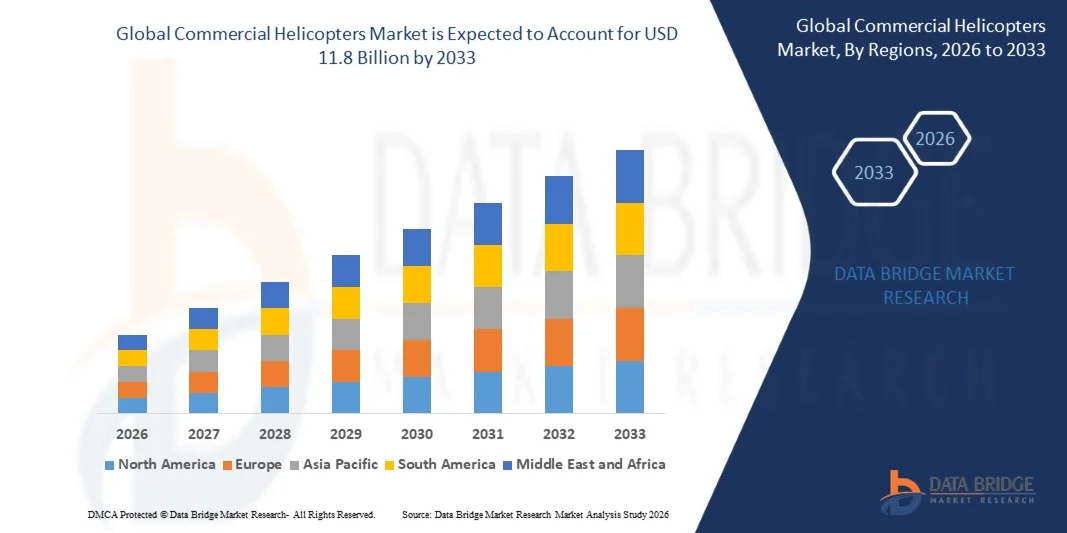
- As per Data Bridge Market Research analysis, the commercial helicopters market was valued at USD 6.96 billion in 2025 and is projected to reach USD 11.8 billion by 2033, growing at a CAGR of 4.60% from 2026 to 2033.
- The market is experiencing consistent growth driven by rising demand for offshore transportation, emergency medical services, and utility operations, increasing fleet modernization among commercial operators, and expanding investment in hybrid-electric and next-generation helicopter propulsion technologies.
- The increasing reliance on helicopters for offshore energy support, emergency medical response, and corporate and VIP transport, combined with growing regulatory focus on noise reduction and emissions, is compelling commercial operators and government agencies to invest in next-generation helicopter platforms. Digital glass cockpits and fly-by-wire flight control systems are increasingly complementing conventional flight control architectures in many markets, offering improved safety, reduced pilot workload, and enhanced operational flexibility.
Market Size & Forecast
- Global Market Value (2025): USD 6.96 Billion
- Expected Market Value (2033): USD 11.8 Billion
- Forecast CAGR (2026–2033): 4.60%
- Leading Region in 2025: North America
- Fastest Growing Region: Asia-Pacific
What are the Major Takeaways of the Commercial Helicopters Market?
- North America dominated the global commercial helicopters market in 2025, supported by the region's extensive offshore oil & gas support operations, strong presence of leading helicopter OEMs, and well-established emergency medical services and law enforcement aviation infrastructure.
- Asia-Pacific is expected to be the fastest-growing region from 2026 to 2033, fueled by expanding tourism and charter operations, rising government investment in disaster relief and public safety aviation, and growing offshore wind and infrastructure support activity across China, Japan, and Southeast Asia.
- The light helicopters segment dominates the market by helicopter class, supported by widespread adoption across corporate transport, tourism, law enforcement, and training missions where lower acquisition and operating costs are valued.
- The medium helicopters segment is witnessing the fastest growth by helicopter class, driven by rising demand for offshore transportation and emergency medical services requiring greater payload and range.
- The twin-engine segment leads the market by engine configuration, given its widespread adoption across offshore, EMS, and corporate transport missions requiring redundancy and higher safety margins.
- The hybrid-electric propulsion segment is witnessing the fastest growth by propulsion technology, driven by accelerating industry investment in electrified helicopter demonstrator programs.
Report Scope and Commercial Helicopters Market Segmentation
|
Attributes |
Commercial Helicopters Key Market Insights |
|
Segments Covered |
|
|
Countries Covered |
North America
Europe
Asia-Pacific
South America
Middle East and Africa
|
|
Key Market Players |
|
|
Market Opportunities |
|
|
Value Added Data Infosets |
In addition to insights on market value, growth rate, segmentation, geographic coverage, and major players, reports curated by Data Bridge Market Research also include in-depth expert analysis, geographically represented company-wise production and capacity, distributor and partner network layouts, detailed and updated price trend analysis, and deficit analysis of supply and demand. |
What is the Key Trend in the Commercial Helicopters Market?
- Helicopter OEMs are increasingly pursuing hybrid-electric propulsion demonstrator programs that combine conventional turboshaft engines with electric motors to validate fuel efficiency and emissions reduction ahead of full commercial certification.
- These demonstrator programs enable manufacturers to de-risk certification pathways and quantify performance benefits before committing to clean-sheet hybrid-electric helicopter designs.
- For instance, Airbus Helicopters' PioneerLab hybrid-electric demonstrator is targeting flight in 2027, combining a Pratt & Whitney turboshaft engine with Collins Aerospace electric motors to explore hybrid-electric propulsion architectures for future commercial helicopter platforms.
- As commercial operators continue to prioritize fuel efficiency, noise reduction, and emissions performance, the development of hybrid-electric and next-generation propulsion technology is expected to accelerate, reinforcing propulsion innovation as a core enabler of the commercial helicopters market's long-term growth.
What are the Key Drivers of the Commercial Helicopters Market?
- The sustained demand for fleet modernization among commercial operators has significantly increased orders for new helicopters capable of meeting evolving mission requirements across EMS, offshore, and corporate transport applications.
- For instance, at Verticon 2025, Airbus Helicopters unveiled its next-generation H140 light twin-engine helicopter, securing 61 firm orders at launch, including 12 units from Metro Aviation as one of the type's launch customers, while Air Methods separately ordered 27 Bell helicopters as part of a global fleet expansion agreement.
- Helicopter OEMs are reporting strong order momentum as commercial and parapublic operators continue to expand and renew their fleets across established civil helicopter markets.
- For instance, Airbus Helicopters reported 544 gross helicopter orders in 2025, an increase of close to 20% in units compared with the prior year, delivering 392 helicopters and securing a 51% unit market share of the global civil and parapublic helicopter market.
- With commercial operators, government agencies, and offshore energy companies increasingly relying on helicopters for time-critical, mission-specific operations, commercial helicopters will remain indispensable across passenger transport, EMS, offshore, and utility applications.
Which Factors are Challenging the Growth of the Commercial Helicopters Market?
- Commercial helicopter acquisition and operation require significant capital investment, including high upfront purchase costs, specialized maintenance infrastructure, and pilot training programs.
- These high costs, combined with the lengthy certification timelines associated with new propulsion and automation technologies, can limit the pace at which smaller operators are able to modernize their fleets.
- For instance, hybrid-electric helicopter demonstrator programs such as Airbus Helicopters' PioneerLab are targeting first flight only in 2027, reflecting the substantial technical development and certification timeline required before hybrid-electric propulsion becomes commercially available to operators.
- The high capital investment and lengthy certification timelines associated with next-generation helicopter platforms continue to restrict the pace of fleet renewal, particularly among smaller regional operators.
- This barrier slows market penetration in price-sensitive and emerging markets, limiting the widespread deployment of next-generation helicopter technologies despite growing mission demand.
How is the Commercial Helicopters Market Segmented?
The commercial helicopters market is segmented on the basis of helicopter class, engine configuration, maximum take-off weight, seating capacity, rotor configuration, propulsion technology, level of automation, mission type, cabin configuration, landing gear type, end user and sales channel.
- By Helicopter Class
On the basis of helicopter class, the global commercial helicopters market is segmented into light helicopters, medium helicopters, heavy helicopters, and super medium helicopters. The light helicopters segment dominates the market, owing to widespread adoption across corporate transport, tourism, law enforcement, and training missions where lower acquisition and operating costs make them the preferred choice for a broad range of commercial operators.
The medium helicopters segment is witnessing the fastest growth, driven by rising demand for offshore transportation and emergency medical services requiring greater payload capacity, range, and multi-mission flexibility.
- By Engine Configuration
On the basis of engine configuration, the global commercial helicopters market is segmented into single-engine, twin-engine, and multi-engine helicopters. The twin-engine segment dominates the market, supported by widespread adoption across offshore, EMS, and corporate transport missions requiring engine redundancy and higher safety margins.
The multi-engine helicopters segment is witnessing the fastest growth, driven by rising demand for heavy-lift and offshore transport missions requiring greater power reserves and operational resilience.
- By Maximum Take-Off Weight (MTOW)
On the basis of maximum take-off weight, the global commercial helicopters market is segmented into below 2 tons, 2–4 tons, 4–7 tons, 7–10 tons, and above 10 tons. The 2–4 tons segment dominates the market due to its widespread adoption across light single- and twin-engine helicopters used in corporate transport, tourism, and law enforcement missions, increasing demand for cost-efficient, versatile platforms, and growing fleet renewal activity among commercial operators. additionally, rising focus on operating economics, mission flexibility, and pilot training compatibility further supports the strong adoption of aircraft in this MTOW segment.
The 7–10 tons segment is anticipated to witness the fastest growth, driven by this growth is fueled by the increasing reliance on medium and super medium helicopters for offshore transportation and emergency medical services requiring higher payload and range. commercial operators, offshore energy companies, and EMS providers are adopting helicopters in this weight class to conduct cost-effective, multi-mission operations. additionally, the integration of these helicopters into expanding offshore wind support programs is enhancing their relevance, further driving segment growth.
- By Seating Capacity
On the basis of seating capacity, the global commercial helicopters market is segmented into up to 4 passengers, 5–8 passengers, 9–15 passengers, and more than 15 passengers. The 5–8 passengers segment dominates the market due to its widespread adoption across light twin-engine and medium helicopter platforms serving corporate transport, tourism, and EMS missions.
The 9–15 passengers segment is witnessing the fastest growth, driven by rising demand for offshore transportation and utility operations requiring higher passenger and cargo capacity per flight.
- By Rotor Configuration
On the basis of rotor configuration, the global commercial helicopters market is segmented into single main rotor, coaxial rotor, tandem rotor, intermeshing rotor, and NOTAR (no tail rotor). The single main rotor segment dominates the market due to its widespread adoption across the vast majority of commercial helicopter platforms, supported by established design maturity, proven reliability, and extensive maintenance infrastructure. the widespread presence of single main rotor helicopters across commercial fleets facilitates strong parts availability and reinforces this segment's leading market position.
The NOTAR segment is witnessing the fastest growth, driven by this growth is primarily driven by increasing demand for reduced noise signatures and enhanced safety in confined urban and law enforcement operating environments.
- By Propulsion Technology
On the basis of propulsion technology, the global commercial helicopters market is segmented into conventional turboshaft, hybrid-electric, hydrogen-ready, and sustainable aviation fuel (SAF) compatible. The conventional turboshaft segment dominates the market due to its widespread adoption across the existing global commercial helicopter fleet and its proven reliability, certification history, and established maintenance infrastructure.
The hybrid-electric segment is witnessing the fastest growth, driven by accelerating industry investment in electrified propulsion demonstrator programs aimed at improving fuel efficiency and reducing emissions on commercial helicopter missions.
- By Level of Automation
On the basis of level of automation, the global commercial helicopters market is segmented into conventional flight control, digital glass cockpit, fly-by-wire, advanced flight assistance, and autonomous flight-ready. The digital glass cockpit segment dominates the market due to its widespread adoption across modern commercial helicopter platforms offering improved situational awareness and reduced pilot workload compared to legacy analog instrumentation.
The autonomous flight-ready segment is witnessing the fastest growth, driven by rising development activity around uncrewed and optionally piloted helicopter variants for utility, cargo, and surveillance missions.
- By Mission Type
On the basis of mission type, the global commercial helicopters market is segmented into passenger transport, offshore transportation, emergency medical services, search & rescue, firefighting, law enforcement & public safety, utility operations, agriculture, corporate & VIP transport, and training. The passenger transport segment dominates the market, given the central role of helicopters in scheduled, charter, and tourism transport services globally.
The offshore transportation segment is witnessing the fastest growth, driven by rising demand for offshore oil & gas crew transport and expanding offshore wind farm support operations requiring dedicated helicopter services.
- By Cabin Configuration
On the basis of cabin configuration, the global commercial helicopters market is segmented into passenger, cargo, convertible passenger/cargo, medical configuration, VIP configuration, and utility configuration. The passenger segment dominates the market due to its widespread use across corporate transport, tourism, and scheduled passenger services.
The medical configuration segment is witnessing the fastest growth, driven by rising investment in emergency medical services and air ambulance operations requiring specialized cabin outfitting for critical care transport.
- By Landing Gear Type
On the basis of landing gear type, the global commercial helicopters market is segmented into skid landing gear, wheeled landing gear, retractable landing gear, and amphibious landing gear. The skid landing gear segment dominates the market due to its widespread use across light and medium helicopter platforms, offering simplicity, lower weight, and reduced maintenance requirements.
The amphibious landing gear segment is witnessing the fastest growth, driven by rising demand for offshore, search and rescue, and firefighting missions requiring water landing and rough-terrain operational flexibility.
- By End User
On the basis of end user, the global commercial helicopters market is segmented into commercial helicopter operators, offshore oil & gas companies, emergency medical service providers, government & public safety agencies, law enforcement agencies, corporate & business aviation operators, tourism & charter operators, utility & infrastructure companies, agriculture & forestry operators, training organizations, and humanitarian & disaster relief organizations. The commercial helicopter operators segment dominates the market, given their central role in operating diversified helicopter fleets across multiple mission types.
The emergency medical service providers segment is witnessing the fastest growth, driven by rising investment in air ambulance and critical care transport infrastructure among healthcare systems and dedicated EMS operators.
- By Sales Channel
On the basis of sales channel, the global commercial helicopters market is segmented into OEM direct sales, authorized dealers, leasing companies, and the pre-owned helicopter market. The OEM direct sales segment dominates the market, supported by long-term relationships between helicopter manufacturers and commercial operators, government agencies, and offshore energy companies.
The leasing companies segment is witnessing the fastest growth, driven by rising preference among commercial operators for leased helicopter capacity to manage fleet flexibility and capital expenditure.
Which Region Holds the Largest Share of the Commercial Helicopters Market?
- North America dominated the commercial helicopters market, supported by the region's extensive offshore oil & gas support operations, strong presence of leading helicopter OEMs, and well-established emergency medical services and law enforcement aviation infrastructure across the U.S. and Canada.
- The region also benefits from sustained investment in hybrid-electric propulsion demonstrator programs, growing commercial operator fleet renewal activity, and continued expansion of EMS and corporate transport operations. Rising investment in next-generation avionics and automation technology continues to strengthen North America's leadership position in the global market.
U.S. Commercial Helicopters Market Insight
The U.S. commercial helicopters market is experiencing steady growth, supported by the country's large offshore energy and emergency medical services sectors, expanding corporate and law enforcement aviation fleets, and increasing investment in hybrid-electric and digital cockpit technology. Rising investments in fleet modernization and expanding EMS air ambulance networks are contributing to market growth. Furthermore, growing operator focus on fleet expansion agreements with leading OEMs is reinforcing the U.S. position as the leading market for commercial helicopters.
Canada Commercial Helicopters Market Insight
The Canada commercial helicopters market is expanding steadily due to the country's reliance on helicopters for remote and offshore connectivity, growing investment in utility and infrastructure support operations, and increasing collaboration between helicopter manufacturers and commercial operators. Continuous advancements in fleet modernization and rising demand for EMS and search and rescue operations are further driving market growth in Canada.
Asia-Pacific Commercial Helicopters Market Insight
The Asia-Pacific commercial helicopters market is expected to witness the fastest growth globally, driven by expanding tourism and charter operations, rising government investment in disaster relief and public safety aviation, and growing offshore wind and infrastructure support activity across China, Japan, and Southeast Asia. Growing awareness regarding fleet modernization, rising adoption of digital cockpit and automation technologies, and increasing demand for domestically operated helicopter fleets are supporting regional market expansion. Additionally, the growing presence of regional EMS networks and government aviation programs is accelerating helicopter demand across the region.
China Commercial Helicopters Market Insight
The China commercial helicopters market is witnessing consistent growth due to rising investments in domestic helicopter manufacturing capabilities, expanding utility and infrastructure support operations, and growing government focus on aerospace self-sufficiency. Helicopter manufacturers, commercial operators, and government agencies are increasingly investing in domestic helicopter platforms to reduce reliance on imported aircraft. Moreover, increasing integration of advanced avionics and the country's focus on efficient, resilient regional aviation infrastructure are further contributing to market growth.
Japan Commercial Helicopters Market Insight
The Japan commercial helicopters market is growing steadily, driven by the country's strong reliance on helicopters for disaster response, EMS, and remote island connectivity, and rising investment in next-generation helicopter technologies. Growing adoption of digital cockpit and advanced flight assistance platforms across commercial and government aviation programs is significantly boosting market demand. In addition, rising investments in fleet modernization and increasing collaboration with global helicopter OEMs are positioning Japan as a key growth market for commercial helicopters.
Which are the Top Companies in the Commercial Helicopters Market?
The commercial helicopters industry is primarily led by well-established companies, including:
- Airbus Helicopters
- Bell Helicopter Textron Inc.
- Leonardo S.p.A.
- Robinson Helicopter Company
- Kawasaki Heavy Industries, Ltd.
- MD Helicopters LLC
- Sikorsky (Lockheed Martin)
- Enstrom Helicopter Corporation
- Avicopter (AVIC Aviation Industry Corp.)
- Rostec (Russian Helicopters)
- Guimbal Helicopters
- Hindustan Aeronautics Limited (HAL)
- Korea Aerospace Industries (KAI)
- Cicaré Helicópteros
- Dynali Helicopter Company
- Curti Aerospace
- Konner Helicopters
- Fama Helicopters
- Brantly International
- Hungarocopter
What are Latest Developments in the Commercial Helicopters Market?
- In January 2026, Airbus Helicopters reported 544 gross helicopter orders for 2025, an increase of close to 20% in units compared with the prior year, delivering 392 helicopters and securing a 51% unit market share of the global civil and parapublic helicopter market.
- At Verticon 2025, Airbus Helicopters unveiled its next-generation H140 light twin-engine helicopter, securing 61 firm orders at launch, with Metro Aviation ordering 12 units and options for 24 more as one of the type's launch customers.
- At Verticon 2025, Air Methods ordered 27 Bell helicopters, including 15 IFR-configured Bell 407GXis and a Bell 429, as part of a Global Fleet Agreement to support its fleet expansion strategy.
- Airbus Helicopters' PioneerLab hybrid-electric demonstrator is targeting flight in 2027, combining a Pratt & Whitney turboshaft engine with Collins Aerospace electric motors to explore hybrid-electric propulsion architectures for future commercial helicopter platforms.
- In December 2025, Spain formalized a 100-unit rotorcraft order with Airbus Helicopters comprising H145M, NH90, H135, and H175M variants, with Spain becoming the launch customer for the H175M and Airbus Helicopters expanding its Albacete facility with a new customisation and international training centre.

- Interactive Data Analysis Dashboard
- Company Analysis Dashboard for high growth potential opportunities
- Research Analyst Access for customization & queries
- Competitor Analysis with Interactive dashboard
- Latest News, Updates & Trend analysis
- Harness the Power of Benchmark Analysis for Comprehensive Competitor Tracking
Data collection and base year analysis are done using data collection modules with large sample sizes. The stage includes obtaining market information or related data through various sources and strategies. It includes examining and planning all the data acquired from the past in advance. It likewise envelops the examination of information inconsistencies seen across different information sources. The market data is analysed and estimated using market statistical and coherent models. Also, market share analysis and key trend analysis are the major success factors in the market report. To know more, please request an analyst call or drop down your inquiry.
The key research methodology used by DBMR research team is data triangulation which involves data mining, analysis of the impact of data variables on the market and primary (industry expert) validation. Data models include Vendor Positioning Grid, Market Time Line Analysis, Market Overview and Guide, Company Positioning Grid, Patent Analysis, Pricing Analysis, Company Market Share Analysis, Standards of Measurement, Global versus Regional and Vendor Share Analysis. To know more about the research methodology, drop in an inquiry to speak to our industry experts.
Data Bridge Market Research is a leader in advanced formative research. We take pride in servicing our existing and new customers with data and analysis that match and suits their goal. The report can be customized to include price trend analysis of target brands understanding the market for additional countries (ask for the list of countries), clinical trial results data, literature review, refurbished market and product base analysis. Market analysis of target competitors can be analyzed from technology-based analysis to market portfolio strategies. We can add as many competitors that you require data about in the format and data style you are looking for. Our team of analysts can also provide you data in crude raw excel files pivot tables (Fact book) or can assist you in creating presentations from the data sets available in the report.












