


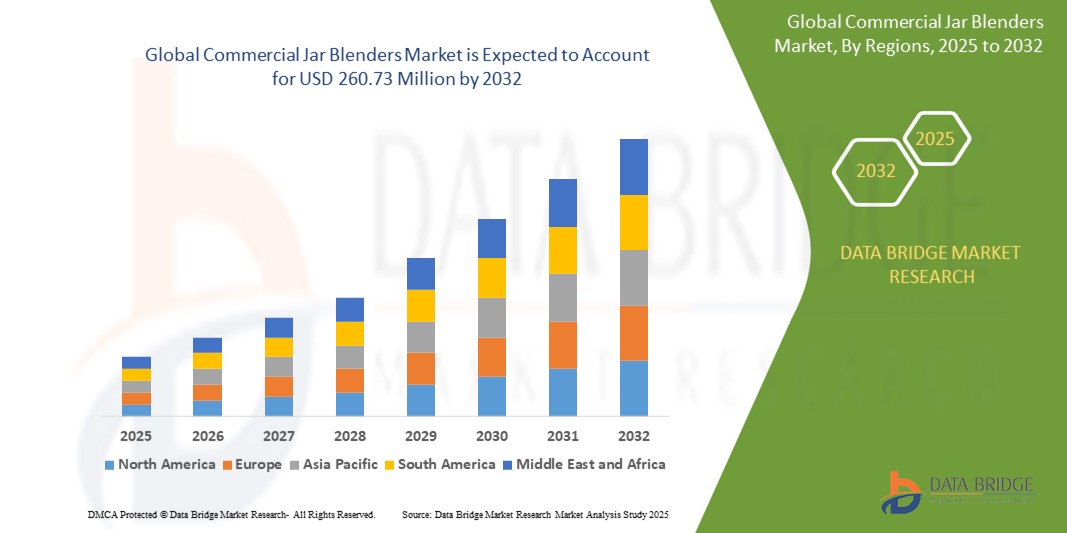
Commercial Jar Blenders Market Size
- The global commercial jar blenders market size was valued at USD 187.61 million in 2024 and is expected to reach USD 260.73 million by 2032, at a CAGR of 4.2% during the forecast period
- The market growth is largely fueled by the rapid expansion of the global foodservice industry and increasing consumer preference for blended beverages such as smoothies, shakes, and functional drinks, particularly across cafés, restaurants, and institutional kitchens
- Furthermore, rising demand for high-performance, energy-efficient, and user-friendly food preparation equipment is establishing commercial jar blenders as essential appliances in both foodservice and food processing sectors. These converging factors are accelerating the deployment of advanced blending solutions, thereby significantly boosting the industry's growth
Commercial Jar Blenders Market Analysis
- Commercial jar blenders are high-powered food processing appliances used in foodservice and industrial settings to blend, purée, mix, and emulsify various ingredients at scale. They feature large-capacity jars, robust motors, and customizable control systems to support continuous, high-volume operation
- The rising adoption of commercial jar blenders is primarily driven by increased demand for consistent food quality, faster preparation times, and growing health trends encouraging freshly made beverages. Enhanced product innovations such as noise reduction, digital interfaces, and programmable settings—are further contributing to market expansion
- North America dominated the commercial jar blenders market with a share of 34.5% in 2024, due to the strong presence of foodservice chains, cafés, and institutional kitchens
- Asia-Pacific is expected to be the fastest growing region in the commercial jar blenders market with a share of during the forecast period due to rapid urbanization, the expansion of the foodservice industry, and the rise of health-conscious consumer habits
- Beverages segment dominated the market with a market share of 58.6% in 2024, due to the booming global smoothie, juice, and specialty coffee markets. Blenders used in beverage applications are critical for achieving consistent textures and taste, particularly in franchises and quick-service restaurants
Report Scope and Commercial Jar Blenders Market Segmentation
|
Attributes |
Commercial Jar Blenders Key Market Insights |
|
Segments Covered |
|
|
Countries Covered |
North America
Europe
Asia-Pacific
Middle East and Africa
South America
|
|
Key Market Players |
|
|
Market Opportunities |
|
|
Value Added Data Infosets |
In addition to the insights on market scenarios such as market value, growth rate, segmentation, geographical coverage, and major players, the market reports curated by the Data Bridge Market Research also include in-depth expert analysis, pricing analysis, brand share analysis, consumer survey, demography analysis, supply chain analysis, value chain analysis, raw material/consumables overview, vendor selection criteria, PESTLE Analysis, Porter Analysis, and regulatory framework. |
Commercial Jar Blenders Market Trends
“Increasing Demand for Smoothies and Specialty Beverages”
- A significant and accelerating trend in the commercial jar blenders market is the growing popularity of smoothies, protein shakes, and specialty beverages, which is driving demand for high-performance blending equipment in the foodservice industry
- For instance, restaurants, cafes, and juice bars are increasingly investing in advanced commercial jar blenders from leading brands such as Blendtec, Vitamix, and Breville to efficiently prepare a wide range of blended drinks and menu items that cater to health-conscious consumers and evolving taste preferences
- The shift toward healthier eating habits and the desire for freshly prepared foods are encouraging operators to offer diverse beverage options, fueling the need for powerful and durable blenders capable of handling high volumes and tough ingredients
- Technological advancements, such as blenders with higher horsepower motors, improved blade designs, and sound enclosures, are enhancing blending efficiency, durability, and user experience, making them increasingly attractive to commercial kitchens
- The market is also witnessing a trend toward energy-efficient and easy-to-clean models, with manufacturers focusing on features that reduce labor time and operational costs while maintaining consistent product quality
- Companies are adopting strategic partnerships, product innovation, and targeted marketing to expand their reach and differentiate their offerings in a competitive landscape, reflecting the importance of brand reputation and feature-rich solutions in purchasing decisions
Commercial Jar Blenders Market Dynamics
Driver
“Growing Foodservice Industry”
- The expansion of the global foodservice industry is a major driver for the commercial jar blenders market, as more restaurants, cafes, hotels, and juice bars seek reliable equipment to meet rising consumer demand for blended beverages and foods
- For instance, as urbanization accelerates and disposable incomes rise, especially in Asia-Pacific and North America, foodservice operators are increasing their investments in commercial-grade blenders to improve menu variety and operational efficiency
- The proliferation of health-focused establishments and quick-service restaurants is further boosting demand for blenders that can handle high throughput and deliver consistent results in busy environments
- The need for operational efficiency, reduced preparation time, and enhanced product consistency is prompting foodservice businesses to upgrade to advanced blending solutions that support high-volume production and diverse menu offerings
- The market is also benefiting from the growth of online food delivery services, which require efficient back-of-house operations and reliable blending equipment to meet order volumes and customer expectations. As the foodservice sector continues to evolve, the demand for innovative, durable, and easy-to-maintain commercial jar blenders is expected to remain strong
Restraint/Challenge
“High Maintenance and Operational Costs”
- High maintenance and operational costs present a significant challenge in the commercial jar blenders market, particularly for small and medium-sized foodservice operators with limited budgets
- For instance, commercial-grade blenders from leading brands such as Vitamix and Blendtec often require substantial upfront investment, and ongoing expenses related to repairs, replacement parts, and routine servicing can add to the total cost of ownership
- The intensive use of blenders in busy kitchens can lead to frequent wear and tear, increasing downtime and impacting productivity if not managed effectively. Energy consumption and the need for specialized cleaning and maintenance procedures further contribute to operational expenses, making cost management a key consideration for buyers
- Companies are responding by developing more durable, energy-efficient models and offering extended warranties or service packages, but the perception of high long-term costs can still deter some potential customers from upgrading or expanding their equipment fleets
- Addressing this challenge will require continued innovation in product durability, ease of maintenance, and cost-effective service solutions to support broader market adoption
Commercial Jar Blenders Market Scope
The market is segmented on the basis of product type, type, application, control type, mode of operation, end user, and distribution channel.
- By Product Type
On the basis of product type, the commercial jar blenders market is segmented into plastic jar, metal jar, glass jar, and others. The plastic jar segment accounted for the largest market revenue share in 2024, owing to its lightweight nature, cost-effectiveness, and resistance to breakage, which makes it ideal for high-frequency use in commercial kitchens. Operators in food service environments favor plastic jars due to their safety, durability, and ease of handling, especially in fast-paced settings where the risk of breakage is high.
The glass jar segment is anticipated to register the fastest growth rate from 2025 to 2032, driven by increasing demand for chemical resistance and aesthetic presentation in front-of-house applications such as juice bars and premium cafes. Glass jars are preferred for their non-reactive properties and transparency, offering both hygiene and visual appeal, which are increasingly valued in consumer-facing settings.
- By Type
On the basis of type, the market is categorized into heavy duty blenders, medium duty blenders, and light duty blenders. The heavy duty blenders segment dominated the market in 2024 with the largest revenue share due to their powerful motors, high-volume capacity, and ability to handle continuous, high-stress blending tasks in food processing establishments. These units are integral to high-output operations such as smoothie chains, catering services, and industrial kitchens that demand consistent performance.
The medium duty blenders segment is projected to witness the highest growth rate from 2025 to 2032, fueled by rising adoption across mid-sized food service establishments that require versatility without the capital investment of industrial-grade machines. Their adaptability for both soft and semi-hard ingredients, combined with moderate pricing, makes them ideal for cafes, small restaurants, and institutional kitchens.
- By Application
On the basis of application, the market is segmented solely into food and beverages. The beverages segment commanded the majority share of 58.6% in 2024, driven by the booming global smoothie, juice, and specialty coffee markets. Blenders used in beverage applications are critical for achieving consistent textures and taste, particularly in franchises and quick-service restaurants.
The food segment is expected to grow steadily through 2032, supported by increased use in preparing sauces, soups, batters, and purees in both foodservice and food processing contexts. Enhanced blending technology that ensures uniformity and precision is broadening application potential in commercial kitchens.
- By Control Type
On the basis of control type, the commercial jar blenders market is divided into electronic control, toggle control, and others. The electronic control segment held the largest revenue share in 2024, supported by demand for programmable settings, digital displays, and automation in food preparation. These advanced systems reduce operational errors and enhance repeatability, making them ideal for standardized recipes in franchise outlets and high-end kitchens.
Toggle control blenders are expected to exhibit the fastest growth rate from 2025 to 2032, as smaller food outlets and budget-conscious users favor simple, mechanical interfaces that offer reliability and ease of use. The reduced maintenance requirements and immediate response of toggle controls make them especially attractive in low-tech or high-turnover environments.
- By Mode of Operation
On the basis of mode of operation, the market is segmented into automatic and manual. The automatic segment dominated in 2024, driven by the growing emphasis on labor-saving and time-efficient kitchen solutions. Automatic blenders with programmable cycles are preferred in high-volume operations to ensure consistent blending results without the need for constant supervision.
The manual segment is projected to witness notable growth through 2032, particularly in food trucks, pop-up cafes, and small eateries where operational simplicity and control are prioritized. Manual operation appeals to chefs seeking flexibility in blending textures and timing, especially in custom or artisanal food preparation.
- By End User
On the basis of end user, the market is segmented into food processing establishments, food service establishments, and others. The food service establishments segment held the largest revenue share in 2024 due to the widespread use of commercial blenders in restaurants, cafes, hotels, and quick-service outlets. High customer turnover and the need for rapid preparation of beverages and sauces are major demand drivers.
The food processing establishments segment is anticipated to record the highest CAGR from 2025 to 2032, as industrial food manufacturers increasingly adopt high-performance blenders to streamline large-batch preparation, reduce labor dependency, and ensure ingredient consistency in packaged foods.
- By Distribution Channel
On the basis of distribution channel, the market is segmented into store based and non-store based. The store-based segment led in terms of revenue share in 2024, as many commercial buyers still prefer in-person equipment demonstrations and the reliability of after-sales support through retail and distributor networks.
The non-store-based segment, which includes e-commerce platforms, is expected to grow at the fastest pace through 2032, driven by increasing online procurement of commercial kitchen equipment. Competitive pricing, wide product availability, and direct-to-door delivery are encouraging more businesses, particularly startups and small-scale operators, to opt for digital purchasing channels.
Commercial Jar Blenders Market Regional Analysis
- North America dominated the commercial jar blenders market with the largest revenue share of 34.5% in 2024, driven by the strong presence of foodservice chains, cafés, and institutional kitchens
- The region’s demand is supported by rising health consciousness, a growing preference for smoothies and blended beverages, and early adoption of technologically advanced kitchen equipment
- High replacement rates, a culture of fast-paced food preparation, and strong investments in foodservice infrastructure have positioned commercial jar blenders as essential equipment across various segments
U.S. Commercial Jar Blenders Market Insight
The U.S. commercial jar blenders market captured the largest revenue share in 2024 within North America, driven by the widespread penetration of quick-service restaurants, juice bars, and health-focused eateries. The strong preference for high-capacity, programmable blenders in foodservice operations is further bolstered by rising consumer demand for customization and speed. In addition, the growing trend of plant-based diets and functional beverages is accelerating demand for powerful, durable blending equipment in the country.
Europe Commercial Jar Blenders Market Insight
The Europe commercial jar blenders market is projected to grow at a significant CAGR during the forecast period, led by increasing adoption across hotels, restaurants, and institutional kitchens. Emphasis on food safety regulations, energy-efficient appliances, and hygiene standards is supporting the uptake of commercial-grade blenders. The region also benefits from culinary innovation and the growth of organic and wellness-focused food offerings, necessitating precise blending for texture and consistency.
U.K. Commercial Jar Blenders Market Insight
The U.K. commercial jar blenders market is expected to expand at a notable CAGR, propelled by growing demand in independent cafés, fast-casual dining outlets, and smoothie bars. The rising consumer interest in healthy food options and functional beverages is encouraging foodservice providers to invest in high-performance blenders. In addition, the increasing prevalence of small-format kitchens and food trucks is fostering demand for compact yet efficient blending solutions.
Germany Commercial Jar Blenders Market Insight
The Germany commercial jar blenders market is anticipated to grow steadily through the forecast period, supported by a robust food processing sector and strong adoption of automation in kitchen operations. Germany’s focus on durability, energy efficiency, and engineering precision is aligned with the growing need for heavy-duty blenders capable of sustained use. The popularity of juice bars and modern bakeries is also expanding application use cases for commercial jar blenders.
Asia-Pacific Commercial Jar Blenders Market Insight
The Asia-Pacific commercial jar blenders market is projected to grow at the fastest CAGR from 2025 to 2032, fueled by rapid urbanization, the expansion of the foodservice industry, and the rise of health-conscious consumer habits. Countries such as China, India, and Japan are witnessing a surge in café culture and restaurant chains, boosting demand for high-efficiency blending equipment. Local manufacturing and competitive pricing are also making blenders more accessible to mid-tier and small food operators.
Japan Commercial Jar Blenders Market Insight
The Japan commercial jar blenders market is gaining traction as the country embraces modern culinary trends and small-format foodservice models. The preference for silent operation, compact designs, and multifunctional units is shaping blender demand in both traditional and fusion cuisine environments. As convenience and consistency remain critical, programmable electronic controls and automatic blending cycles are becoming increasingly favored.
China Commercial Jar Blenders Market Insight
The China commercial jar blenders market held the largest revenue share in Asia Pacific in 2024, backed by the growing number of cafés, smoothie outlets, and online-first foodservice brands. Domestic manufacturing strength and cost-effective product availability are accelerating adoption across both urban and semi-urban markets. Rising health trends, coupled with increasing consumer demand for freshly blended beverages and quick meals, are positioning China as a dominant market in the region.
Commercial Jar Blenders Market Share
The commercial jar blenders industry is primarily led by well-established companies, including:
- Newell Brands (U.S.)
- Aarul Industries India Private Limited (India)
- NAND KITCHEN EQUIPMENT & DESIGN (India)
- Whirlpool Corporation (U.S.)
- Vita-Mix Corporation (U.S.)
- SANTOS (France)
- Cleanblend (U.S.)
- Spectrum Brands, Inc. (U.S.)
- Blendtec (U.S.)
- Hamilton Beach Brands, Inc. (U.S.)
- Zhongshan Cranddi Electrical Appliance Co., Ltd. (China)
- Ceado Srl (Italy)
- Foshan Canmax Electric Appliance Co., Ltd. (China)
- WARING COMMERCIAL (U.S.)
- Optimum Appliances (Australia)
- Sammic S.L. (Spain)
- NutriBullet, LLC (U.S.)
- HANS APPLIANCES (India)
Latest Developments in Global Commercial Jar Blenders Market
- In January 2024, Bosch Appliance Corporation launched the PowerMaster Pro, a commercial-grade jar blender equipped with a powerful 3-horsepower motor and a 12-liter capacity. This product introduction strengthened Bosch’s position in the high-capacity segment and expanded its reach into industrial-scale foodservice operations, contributing to increased competition and innovation in the market
- In March 2024, Waring Commercial and Blendtec formed a strategic partnership to co-brand and distribute select Blendtec models under the Waring brand. This collaboration allowed both companies to enhance their product offerings and widen market access, thereby intensifying competitive dynamics and encouraging brand consolidation in the commercial blender space
- In May 2024, Hamilton Beach Brands Holding Corporation acquired Silverson Machines, a prominent manufacturer of industrial mixing equipment. This acquisition expanded Hamilton Beach’s commercial jar blender portfolio and enabled entry into new verticals, bolstering its market share and diversifying its revenue base
- In February 2025, the European Union implemented new regulations on food processing equipment, including commercial jar blenders, mandating stricter safety and hygiene standards. These regulatory changes prompted manufacturers to upgrade product designs and invest in compliant technologies, accelerating product innovation and opening new growth opportunities across the European market

- Interactive Data Analysis Dashboard
- Company Analysis Dashboard for high growth potential opportunities
- Research Analyst Access for customization & queries
- Competitor Analysis with Interactive dashboard
- Latest News, Updates & Trend analysis
- Harness the Power of Benchmark Analysis for Comprehensive Competitor Tracking
Global Commercial Jar Blender Market, Supply Chain Analysis and Ecosystem Framework
To support market growth and help clients navigate the impact of geopolitical shifts, DBMR has integrated in-depth supply chain analysis into its Global Commercial Jar Blender Market research reports. This addition empowers clients to respond effectively to global changes affecting their industries. The supply chain analysis section includes detailed insights such as Global Commercial Jar Blender Market consumption and production by country, price trend analysis, the impact of tariffs and geopolitical developments, and import and export trends by country and HSN code. It also highlights major suppliers with data on production capacity and company profiles, as well as key importers and exporters. In addition to research, DBMR offers specialized supply chain consulting services backed by over a decade of experience, providing solutions like supplier discovery, supplier risk assessment, price trend analysis, impact evaluation of inflation and trade route changes, and comprehensive market trend analysis.
Data collection and base year analysis are done using data collection modules with large sample sizes. The stage includes obtaining market information or related data through various sources and strategies. It includes examining and planning all the data acquired from the past in advance. It likewise envelops the examination of information inconsistencies seen across different information sources. The market data is analysed and estimated using market statistical and coherent models. Also, market share analysis and key trend analysis are the major success factors in the market report. To know more, please request an analyst call or drop down your inquiry.
The key research methodology used by DBMR research team is data triangulation which involves data mining, analysis of the impact of data variables on the market and primary (industry expert) validation. Data models include Vendor Positioning Grid, Market Time Line Analysis, Market Overview and Guide, Company Positioning Grid, Patent Analysis, Pricing Analysis, Company Market Share Analysis, Standards of Measurement, Global versus Regional and Vendor Share Analysis. To know more about the research methodology, drop in an inquiry to speak to our industry experts.
Data Bridge Market Research is a leader in advanced formative research. We take pride in servicing our existing and new customers with data and analysis that match and suits their goal. The report can be customized to include price trend analysis of target brands understanding the market for additional countries (ask for the list of countries), clinical trial results data, literature review, refurbished market and product base analysis. Market analysis of target competitors can be analyzed from technology-based analysis to market portfolio strategies. We can add as many competitors that you require data about in the format and data style you are looking for. Our team of analysts can also provide you data in crude raw excel files pivot tables (Fact book) or can assist you in creating presentations from the data sets available in the report.













