


What is the Commercial Lighting Market Size and Growth Rate?
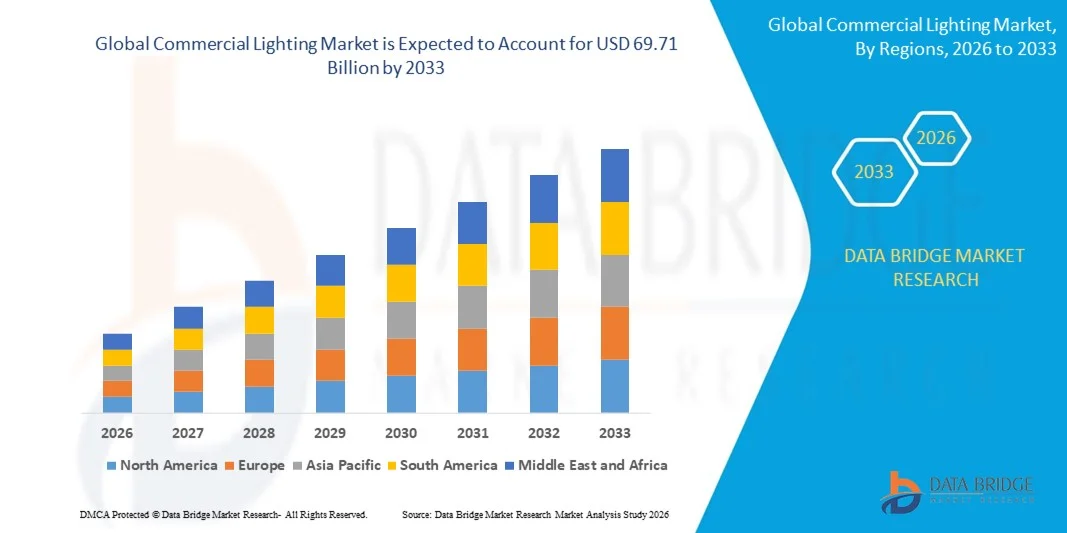
- As per Data Bridge Market Research Analysis the global commercial lighting market size was valued at USD 16.10 billion in 2025 and is expected to reach USD 69.71 billion by 2033, at a CAGR of 20.10% during the forecast period
- The market growth is largely fuelled by the increasing adoption of energy-efficient lighting solutions such as LED systems to reduce electricity consumption and operational costs
- Rising construction of commercial infrastructure such as offices, retail spaces, hospitals, and educational institutions is accelerating the demand for advanced lighting systems
Market Size & Forecast
- Global Market Value (2025): USD 16.10 billion
- Expected Market Value (2033): USD 69.71 billion
- Forecast CAGR (2026–2033): 20.10%
Commercial Lighting Market Analysis
- The market is witnessing strong growth due to the shift from conventional lighting to energy-efficient and environmentally sustainable lighting technologies
- Increasing awareness regarding energy conservation and government regulations promoting efficient lighting are encouraging adoption
- North America dominated the commercial lighting market with the largest revenue share in 2025, driven by the strong presence of commercial infrastructure and the rapid adoption of energy-efficient lighting systems
- Asia-Pacific region is expected to witness the highest growth rate in the global commercial lighting market, driven by large-scale infrastructure development, rising investments in commercial real estate, growing awareness of energy-efficient lighting, and increasing deployment of smart lighting systems across emerging economies such as China, India, and Southeast Asia
- The Hardware segment held the largest market revenue share in 2025 driven by the high demand for lighting fixtures such as LED luminaires, lamps, drivers, and control components across commercial facilities. Hardware forms the core of lighting infrastructure and is essential for both new construction and upgrade projects, making it the primary revenue contributor. The increasing replacement of conventional lighting with LED fixtures has further strengthened the growth of this segment
Report Scope and Commercial Lighting Market Segmentation
|
Attributes |
Commercial Lighting Key Market Insights |
|
Segments Covered |
|
|
Countries Covered |
North America
Europe
Asia-Pacific
Middle East and Africa
South America
|
|
Key Market Players |
|
|
Market Opportunities |
|
|
Value Added Data Infosets |
|
What is the Key Trend in the Commercial Lighting Market?
Adoption of Smart and Energy-Efficient Lighting Technologies
- The increasing focus on energy efficiency and intelligent infrastructure is significantly shaping the commercial lighting market, as businesses increasingly prefer lighting systems that reduce power consumption and operating costs. Commercial lighting solutions such as LED and smart lighting are gaining traction due to their ability to deliver enhanced illumination, automation, and long service life while supporting sustainability goals. This trend is strengthening adoption across offices, retail spaces, healthcare facilities, and educational institutions, encouraging manufacturers to develop advanced and connected lighting systems that align with modern building requirements
- Increasing awareness regarding energy conservation, carbon reduction, and operational efficiency has accelerated the demand for commercial lighting in commercial buildings and public infrastructure. Facility owners and operators are actively investing in advanced lighting systems that provide improved brightness, reduced maintenance, and automated controls, prompting manufacturers to introduce innovative and cost-effective solutions. This has also led to collaborations between lighting manufacturers and technology providers to enhance performance, connectivity, and overall system efficiency
- Energy efficiency and smart building trends are influencing purchasing decisions, with businesses emphasizing intelligent controls, automation compatibility, and environmentally responsible lighting solutions. These factors are helping companies improve energy management and meet sustainability targets, while also driving the adoption of connected lighting platforms. Companies are increasingly promoting energy savings and automation benefits through marketing initiatives to strengthen product positioning and attract commercial buyers
- For instance, in 2024, Signify in the Netherlands and Acuity Brands in the U.S. expanded their commercial smart lighting portfolios with connected LED systems for offices and retail environments. These solutions were introduced to address rising demand for intelligent and energy-efficient lighting, with availability through distributors and project partners. The systems were also positioned as sustainable solutions, improving customer adoption and long-term operational savings
- While demand for commercial lighting is increasing, sustained market growth depends on continuous innovation, cost optimization, and integration with smart building platforms. Manufacturers are focusing on improving system interoperability, scalability, and energy performance while ensuring reliability and affordability to support widespread adoption across commercial sectors
Commercial Lighting Market Dynamics
Driver
Increasing Adoption of Energy-Efficient and Smart Lighting Solutions
- Rising demand for energy-efficient lighting systems is a major driver for the commercial lighting market. Businesses are increasingly replacing traditional lighting with LED and smart lighting solutions to reduce electricity consumption, maintenance costs, and environmental impact. This trend is also encouraging investment in intelligent lighting technologies that enhance energy management and operational efficiency, supporting long-term cost savings and sustainability goals
- Expanding construction of commercial infrastructure such as offices, retail centers, hospitals, and educational facilities is influencing market growth. Commercial lighting plays a critical role in ensuring proper visibility, comfort, and energy efficiency, enabling facility operators to improve operational performance and meet regulatory standards. The increasing adoption of smart buildings globally is further reinforcing demand for advanced lighting systems
- Lighting manufacturers and technology providers are actively promoting advanced lighting solutions through product innovation, partnerships, and digital integration. These efforts are supported by the growing emphasis on automation, sustainability, and energy optimization, and they also encourage collaboration between lighting companies and building automation providers to enhance system capabilities
- For instance, in 2023, OSRAM in Germany and Zumtobel Group in Austria reported increased deployment of LED and connected lighting systems in commercial facilities. This expansion followed higher demand for efficient and smart lighting solutions, improving energy savings and operational efficiency. Both companies also emphasized intelligent lighting features to strengthen their market position and customer engagement
- Although increasing adoption of efficient lighting supports market growth, wider implementation depends on affordability, technological compatibility, and awareness. Investment in advanced technologies, improved product performance, and system integration will be essential for meeting rising commercial demand and maintaining competitive advantage
Restraint/Challenge
High Initial Investment and Integration Complexity
- The relatively high upfront cost of advanced commercial lighting systems compared to traditional lighting remains a key challenge, limiting adoption among cost-sensitive businesses. Initial expenses associated with smart lighting, installation, and control systems can be significant. In addition, additional costs related to system customization and integration can further affect purchasing decisions and return on investment timelines
- Awareness and technical expertise remain uneven, particularly among small and medium-sized enterprises with limited budgets and infrastructure. Limited understanding of long-term benefits and savings restricts adoption across certain commercial sectors. This also leads to slower adoption in facilities where conventional lighting systems are still widely used
- Integration and compatibility challenges also impact market growth, as advanced lighting systems often require connection with existing automation and electrical infrastructure. Technical complexities and upgrade requirements increase installation time and operational disruption. Companies must invest in skilled professionals, compatible systems, and proper planning to ensure successful implementation
- For instance, in 2024, commercial facility operators in Southeast Asia working with lighting providers such as Cree LED in the U.S. and Panasonic in Japan reported slower adoption due to high installation costs and integration challenges with legacy systems. Budget constraints and technical limitations also affected project timelines and investment decisions, reducing adoption speed among certain businesses
- Overcoming these challenges will require cost reduction, simplified installation processes, and improved awareness regarding long-term benefits. Collaboration between manufacturers, contractors, and technology providers can help improve accessibility and adoption. Furthermore, developing cost-effective and easy-to-integrate lighting solutions will be essential for supporting the long-term growth of the global commercial lighting market
Commercial Lighting Market Scope
The market is segmented on the basis of offering, installation type, application, and end-user.
- By Offering
On the basis of offering, the commercial lighting market is segmented into Hardware, Software, and Services. The Hardware segment held the largest market revenue share in 2025 driven by the high demand for lighting fixtures such as LED luminaires, lamps, drivers, and control components across commercial facilities. Hardware forms the core of lighting infrastructure and is essential for both new construction and upgrade projects, making it the primary revenue contributor. The increasing replacement of conventional lighting with LED fixtures has further strengthened the growth of this segment.
The Software segment is expected to witness the fastest growth rate from 2026 to 2033, driven by the increasing adoption of smart lighting control systems and automation platforms. Lighting software enables remote monitoring, energy management, scheduling, and integration with building management systems, improving operational efficiency. Businesses are increasingly adopting software solutions to optimize lighting performance and reduce energy consumption, supporting segment growth.
- By Installation Type
On the basis of installation type, the commercial lighting market is segmented into New and Retrofit. The New segment held the largest market revenue share in 2025 driven by the rapid construction of commercial buildings such as offices, retail complexes, hospitals, and educational institutions. New construction projects allow the direct integration of modern and energy-efficient lighting systems, improving performance and reducing long-term operational costs. The growing adoption of smart building technologies has also contributed to the dominance of this segment.
The Retrofit segment is expected to witness the fastest growth rate from 2026 to 2033, driven by the increasing need to upgrade existing lighting systems to energy-efficient alternatives. Retrofit installations help organizations reduce electricity consumption, maintenance costs, and carbon emissions without requiring complete infrastructure replacement. Government regulations and energy-saving initiatives are further encouraging businesses to adopt retrofit lighting solutions.
- By Application
On the basis of application, the commercial lighting market is segmented into Indoor Lighting and Outdoor Lighting. The Indoor Lighting segment held the largest market revenue share in 2025 driven by its extensive use in offices, retail stores, healthcare facilities, and educational institutions. Indoor lighting plays a critical role in ensuring proper visibility, comfort, and productivity, making it an essential component of commercial infrastructure. The increasing adoption of LED and smart indoor lighting systems has further supported segment growth.
The Outdoor Lighting segment is expected to witness the fastest growth rate from 2026 to 2033, driven by the rising demand for lighting in parking areas, building exteriors, campuses, and public infrastructure. Outdoor lighting improves safety, security, and visibility while enhancing the overall appearance of commercial properties. The adoption of energy-efficient and automated outdoor lighting systems is further accelerating segment expansion.
- By End-User
On the basis of end-user, the commercial lighting market is segmented into Industrial and Commercial. The Commercial segment held the largest market revenue share in 2025 driven by the widespread use of lighting in offices, retail centers, hospitality, and healthcare facilities. Commercial establishments require efficient and reliable lighting to support daily operations, enhance customer experience, and improve workplace productivity. The increasing adoption of smart and energy-efficient lighting solutions has further strengthened this segment.
The Industrial segment is expected to witness the fastest growth rate from 2026 to 2033, driven by the increasing demand for high-performance lighting in manufacturing facilities, warehouses, and production units. Industrial lighting is essential for ensuring worker safety, operational efficiency, and regulatory compliance. The shift toward LED and automated lighting systems is further supporting the growth of this segment.
Commercial Lighting Market Regional Analysis
- North America dominated the commercial lighting market with the largest revenue share in 2025, driven by the strong presence of commercial infrastructure and the rapid adoption of energy-efficient lighting systems
- Businesses in the region highly prioritize advanced lighting solutions that offer energy savings, automation, and improved workplace productivity, supporting widespread deployment across offices, retail spaces, and healthcare facilities
- This widespread adoption is further supported by high investment capacity, strong technological awareness, and the growing implementation of smart building systems, establishing advanced commercial lighting as a preferred solution across multiple industries
U.S. Commercial Lighting Market Insight
The U.S. commercial lighting market captured the largest revenue share in 2025 within North America, fueled by the increasing adoption of LED lighting and smart lighting control systems. Businesses are increasingly focusing on reducing operational costs and improving energy efficiency through advanced lighting technologies. The growing trend of intelligent buildings, combined with strong demand for automated and connected lighting systems, is further driving the market. Moreover, the presence of major lighting manufacturers and ongoing commercial construction activities are significantly contributing to market expansion.
Europe Commercial Lighting Market Insight
The Europe commercial lighting market is expected to witness the fastest growth rate from 2026 to 2033, primarily driven by stringent energy efficiency regulations and sustainability initiatives. The increasing focus on reducing carbon emissions and improving energy management is encouraging businesses to adopt modern lighting systems. European organizations are also emphasizing smart infrastructure development, supporting the integration of connected lighting technologies. The market is experiencing significant growth across offices, retail, and public infrastructure projects, with lighting upgrades and new installations supporting demand.
U.K. Commercial Lighting Market Insight
The U.K. commercial lighting market is expected to witness the fastest growth rate from 2026 to 2033, driven by the rising adoption of energy-efficient lighting and smart building solutions. Increasing commercial construction and renovation activities are encouraging the deployment of modern lighting systems. In addition, growing awareness regarding sustainability and operational efficiency is supporting adoption. The country’s strong commercial sector and infrastructure modernization efforts are expected to further accelerate market growth.
Germany Commercial Lighting Market Insight
The Germany commercial lighting market is expected to witness the fastest growth rate from 2026 to 2033, fueled by strong demand for advanced and energy-efficient lighting technologies. Germany’s emphasis on sustainability, innovation, and industrial efficiency is promoting the adoption of modern lighting systems across commercial facilities. The increasing integration of smart lighting with building automation systems is also supporting market expansion. Furthermore, ongoing infrastructure upgrades and energy efficiency initiatives are strengthening demand.
Asia-Pacific Commercial Lighting Market Insight
The Asia-Pacific commercial lighting market is expected to witness the fastest growth rate from 2026 to 2033, driven by rapid urbanization, expanding commercial infrastructure, and growing adoption of LED lighting. Increasing investments in smart cities and commercial developments are supporting demand for advanced lighting systems. Furthermore, the region’s strong manufacturing base and improving economic conditions are making commercial lighting more accessible, contributing to market growth.
Japan Commercial Lighting Market Insight
The Japan commercial lighting market is expected to witness the fastest growth rate from 2026 to 2033 due to the country’s technological advancement and strong focus on energy efficiency. Businesses are increasingly adopting smart and automated lighting systems to improve operational efficiency and reduce energy consumption. The growing number of intelligent buildings and infrastructure modernization projects is fueling market growth. Moreover, the emphasis on sustainable development is supporting the adoption of advanced lighting technologies.
China Commercial Lighting Market Insight
The China commercial lighting market accounted for the largest market revenue share in Asia Pacific in 2025, attributed to rapid commercial construction, urban expansion, and high adoption of LED lighting. China represents one of the largest markets for commercial infrastructure, with strong demand from offices, retail centers, and industrial facilities. The increasing focus on energy conservation and smart city development, along with the presence of major domestic manufacturers, is driving the commercial lighting market in China.
Which are the Top Companies in Commercial Lighting Market?
The Commercial Lighting industry is primarily led by well-established companies, including:
- Signify Holding (Netherlands)
- Legrand (France)
- Acuity Brands Lighting, Inc (U.S.)
- GE Current (U.S.)
- Leviton Manufacturing Co., Inc (U.S.)
- Lutron Electronics Co., Inc (U.S.)
- Hubbell (U.S.)
- LEDVANCE (Germany)
- Schneider Electric (France)
- IDEAL INDUSTRIES, INC (U.S.)
- Zumtobel Group (Austria)
- Dialight (U.K.)
- OSRAM GmbH (Germany)
Latest Developments in Global Commercial Lighting Market
- In October 2025, Signify announced an expansion, investing EUR 120 million (USD 128 million) in its Suzhou LED module plant to add automated production lines, which will reduce assembly costs by 22%, improve operational efficiency, and strengthen its cost competitiveness, thereby accelerating affordable LED adoption and increasing market penetration globally
- In September 2025, Acuity Brands completed an acquisition, purchasing Distech Controls’ lighting integration software division for USD 215 million to integrate BACnet and Modbus capabilities into its Atrius platform, enhancing smart building connectivity, expanding its intelligent lighting portfolio, and reinforcing its leadership in integrated lighting and building automation solutions
- In August 2025, Wipro Lighting received certification, achieving WELL certification for its MediLux hospital lighting series covering 12 SKUs, which validates its focus on health-centric lighting, strengthens its positioning in healthcare infrastructure projects, and supports growing demand for wellness-focused commercial lighting solutions
- In July 2025, Zumtobel announced a partnership, collaborating with Fraunhofer IPMS to develop Li-Fi-enabled luminaires for operating theaters with EUR 8 million (USD 8.5 million) in federal funding, enabling high-speed secure data transmission through lighting systems and advancing next-generation smart hospital infrastructure
- In June 2025, Hubbell launched a product, introducing the Litecontrol Synapse cloud-based lighting management platform deployed across 250 North American offices, which enhances remote monitoring, energy efficiency, and centralized lighting control, supporting the expansion of IoT-enabled commercial lighting systems and digital building transformation

- Interactive Data Analysis Dashboard
- Company Analysis Dashboard for high growth potential opportunities
- Research Analyst Access for customization & queries
- Competitor Analysis with Interactive dashboard
- Latest News, Updates & Trend analysis
- Harness the Power of Benchmark Analysis for Comprehensive Competitor Tracking
Global Commercial Lighting Market, Supply Chain Analysis and Ecosystem Framework
To support market growth and help clients navigate the impact of geopolitical shifts, DBMR has integrated in-depth supply chain analysis into its Global Commercial Lighting Market research reports. This addition empowers clients to respond effectively to global changes affecting their industries. The supply chain analysis section includes detailed insights such as Global Commercial Lighting Market consumption and production by country, price trend analysis, the impact of tariffs and geopolitical developments, and import and export trends by country and HSN code. It also highlights major suppliers with data on production capacity and company profiles, as well as key importers and exporters. In addition to research, DBMR offers specialized supply chain consulting services backed by over a decade of experience, providing solutions like supplier discovery, supplier risk assessment, price trend analysis, impact evaluation of inflation and trade route changes, and comprehensive market trend analysis.
Data collection and base year analysis are done using data collection modules with large sample sizes. The stage includes obtaining market information or related data through various sources and strategies. It includes examining and planning all the data acquired from the past in advance. It likewise envelops the examination of information inconsistencies seen across different information sources. The market data is analysed and estimated using market statistical and coherent models. Also, market share analysis and key trend analysis are the major success factors in the market report. To know more, please request an analyst call or drop down your inquiry.
The key research methodology used by DBMR research team is data triangulation which involves data mining, analysis of the impact of data variables on the market and primary (industry expert) validation. Data models include Vendor Positioning Grid, Market Time Line Analysis, Market Overview and Guide, Company Positioning Grid, Patent Analysis, Pricing Analysis, Company Market Share Analysis, Standards of Measurement, Global versus Regional and Vendor Share Analysis. To know more about the research methodology, drop in an inquiry to speak to our industry experts.
Data Bridge Market Research is a leader in advanced formative research. We take pride in servicing our existing and new customers with data and analysis that match and suits their goal. The report can be customized to include price trend analysis of target brands understanding the market for additional countries (ask for the list of countries), clinical trial results data, literature review, refurbished market and product base analysis. Market analysis of target competitors can be analyzed from technology-based analysis to market portfolio strategies. We can add as many competitors that you require data about in the format and data style you are looking for. Our team of analysts can also provide you data in crude raw excel files pivot tables (Fact book) or can assist you in creating presentations from the data sets available in the report.













