


What is the Commercial Touch Display Market Size and Growth Rate?
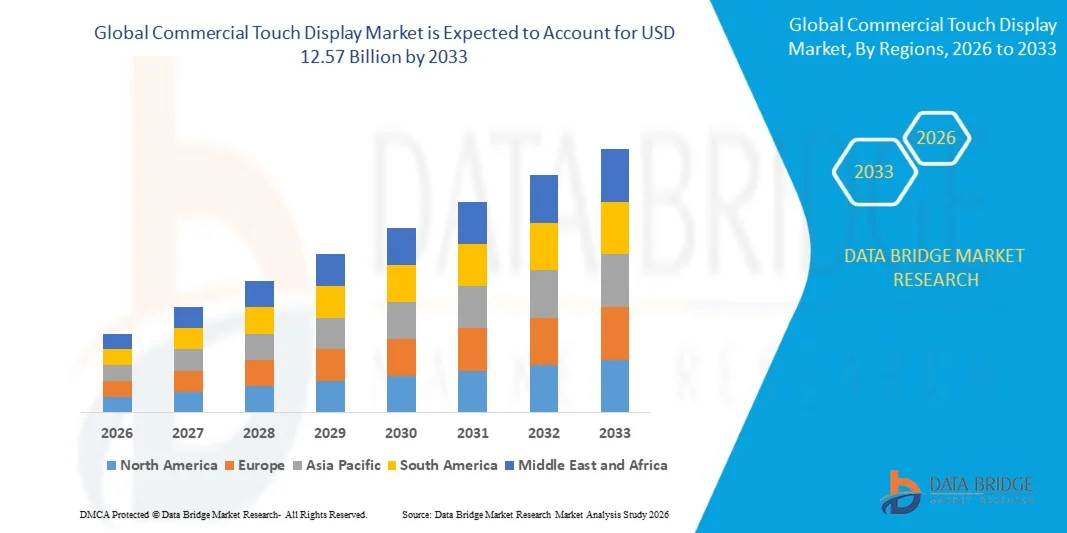
- As per Data Bridge Market Research Analysis the global commercial touch display market size was valued at USD 6.42 billion in 2025 and is expected to reach USD 12.57 billion by 2033, at a CAGR of 8.75% during the forecast period
- The market growth is largely fuelled by the increasing adoption of interactive displays across retail, hospitality, healthcare, and education sectors, enhancing customer engagement and operational efficiency
- Rising demand for digital signage, self-service kiosks, and interactive kiosks in commercial spaces is driving the expansion of the market
Market Size & Forecast
- Global Market Value (2025): USD 6.42 Billion
- Expected Market Value (2033): USD 12.57 Billion
- Forecast CAGR (2026–2033): 8.75%
What are the Major Takeaways of Commercial Touch Display Market?
- The commercial touch display market is witnessing robust growth due to the integration of touch technology in various business operations and the rising trend of smart workplaces
- The proliferation of digital transformation initiatives, along with increasing investments in interactive solutions to improve customer experience and workflow efficiency, is supporting market expansion
- North America dominated the commercial touch display market with the largest revenue share of 38.5% in 2025, driven by the rising adoption of interactive solutions in corporate, retail, and educational sectors
- Asia-Pacific region is expected to witness the highest growth rate in the global commercial touch display market, driven by increasing corporate and educational infrastructure, rising disposable incomes, government initiatives promoting digitalization, and the region’s role as a manufacturing hub for display technologies
- The Capacitive touch segment held the largest market revenue share in 2025, driven by its highly responsive and multi-touch capabilities, which provide a smooth and interactive user experience. Capacitive touch displays are widely adopted in corporate, retail, and hospitality sectors due to their durability, accuracy, and seamless integration with interactive applications
Report Scope and Commercial Touch Display Market Segmentation
|
Attributes |
Commercial Touch Display Key Market Insights |
|
Segments Covered |
|
|
Countries Covered |
North America
Europe
Asia-Pacific
Middle East and Africa
South America
|
|
Key Market Players |
|
|
Market Opportunities |
|
|
Value Added Data Infosets |
In addition to the insights on market scenarios such as market value, growth rate, segmentation, geographical coverage, and major players, the market reports curated by the Data Bridge Market Research also include in-depth expert analysis, geographically represented company-wise production and capacity, network layouts of distributors and partners, detailed and updated price trend analysis and deficit analysis of supply chain and demand. |
What is the Key Trend in the Commercial Touch Display Market?
“Rising Demand for Interactive And Smart Display Solutions”
• The growing emphasis on digitalization and interactive customer engagement is significantly shaping the commercial touch display market, as businesses increasingly prefer solutions that enhance user experience, provide real-time information, and support multimedia content. Touch displays are gaining traction due to their ability to improve communication, convenience, and operational efficiency across retail, hospitality, healthcare, and corporate sectors. This trend strengthens their adoption and encourages manufacturers to innovate with larger screens, advanced touch technologies, and customizable interfaces
• Increasing integration with IoT devices, cloud platforms, and AI-powered analytics has accelerated the demand for commercial touch displays in smart offices, educational institutions, airports, and hospitals. Organizations are actively seeking displays that provide real-time data, remote management, and multi-user interaction, prompting companies to offer solutions that are energy-efficient, user-friendly, and compatible with existing infrastructure
• Interactivity and digital transformation trends are influencing purchasing decisions, with businesses emphasizing connectivity, customization, and scalability. These factors help brands differentiate service offerings in competitive environments and enhance operational efficiency, while also driving the adoption of advanced touch technologies and commercial-grade certifications. Companies are increasingly using marketing and demo campaigns to highlight these benefits to decision-makers and end-users
• For instance, in 2024, Samsung in South Korea and LG Electronics in South Korea expanded their commercial touch display portfolios by incorporating larger screens, multi-touch capabilities, and smart software integrations. These launches were introduced in response to rising business demand for interactive, intuitive, and connected display solutions, with deployment across retail, corporate, and public sectors. The products were also marketed as durable and high-performance choices, enhancing client satisfaction and repeat business
• While demand for commercial touch displays is growing, sustained market expansion depends on continuous R&D, cost-effective production, and maintaining technological performance comparable to emerging alternatives. Manufacturers are also focusing on improving scalability, distribution networks, and developing innovative solutions that balance cost, quality, and functionality for broader adoption
Commercial Touch Display Market Dynamics
Driver
“Growing Preference for Interactive And Smart Display Solutions”
• Rising business demand for interactive and visually engaging displays is a major driver for the commercial touch display market. Organizations are increasingly replacing conventional displays with touch-enabled solutions to improve customer engagement, streamline operations, and comply with modern digital requirements. This trend is also pushing research into innovative touch technologies, such as capacitive, infrared, and optical touch, supporting product differentiation
• Expanding applications across retail, hospitality, education, healthcare, and corporate offices are influencing market growth. Commercial touch displays help enhance communication, operational efficiency, and user experience while providing a platform for interactive and dynamic content, enabling organizations to meet evolving business needs. The increasing adoption of smart office solutions globally further reinforces this trend
• Display manufacturers and technology providers are actively promoting commercial touch display-based solutions through product innovation, software integration, and industry partnerships. These efforts are supported by the growing business preference for digital transformation and smart infrastructure, and they also encourage collaborations between hardware and software providers to improve product performance and reduce operational complexity
• For instance, in 2023, NEC Display Solutions in Japan and Sharp Corporation in Japan reported increased deployment of commercial touch displays in airports, retail stores, and corporate offices. This expansion followed higher organizational demand for interactive, user-friendly, and high-performance display solutions, driving repeat purchases and product differentiation. Both companies also highlighted reliability and integration features in marketing campaigns to strengthen customer trust and adoption
• Although rising interactivity and digitalization trends support growth, wider adoption depends on cost optimization, technological advancement, and scalable production processes. Investment in supply chain efficiency, software compatibility, and advanced touch technologies will be critical for meeting global demand and maintaining competitive advantage
Restraint/Challenge
“High Cost And Limited Awareness Of Advanced Display Capabilities”
• The relatively higher cost of commercial touch displays compared to traditional displays remains a key challenge, limiting adoption among cost-sensitive businesses. High production costs, advanced materials, and integration complexities contribute to elevated pricing. In addition, fluctuating component supply can further affect cost stability and market penetration
• Business awareness and technical expertise remain uneven, particularly in developing regions where digital transformation is still emerging. Limited understanding of advanced touch functionalities restricts adoption across certain sectors. This also leads to slower technology uptake in emerging economies where educational initiatives on interactive display solutions are minimal
• Supply chain and distribution challenges also impact market growth, as commercial touch displays require sourcing of high-quality components and adherence to strict quality standards. Logistical complexities and delicate handling requirements increase operational costs. Companies must invest in proper storage, installation, and maintenance to ensure product longevity
• For instance, in 2024, distributors in Southeast Asia supplying retail and corporate clients reported slower uptake due to higher prices and limited awareness of advanced touch functionalities. Installation requirements and compatibility concerns were additional barriers. These factors also prompted some businesses to continue using traditional displays, affecting market expansion
• Overcoming these challenges will require cost-efficient production, expanded distribution networks, and focused educational initiatives for businesses and end-users. Collaboration with system integrators, IT service providers, and certification bodies can help unlock the long-term growth potential of the global commercial touch display market. Furthermore, developing cost-competitive, reliable, and feature-rich solutions will be essential for widespread adoption
How is the Commercial Touch Display Market Segmented?
The market is segmented on the basis of touch technology, aspect ratio, screen size, resolution, and end-use.
• By Touch Technology
On the basis of touch technology, the commercial touch display market is segmented into Infrared touch, Resistive touch, Optical imaging, Capacitive touch, and Surface acoustic wave. The Capacitive touch segment held the largest market revenue share in 2025, driven by its highly responsive and multi-touch capabilities, which provide a smooth and interactive user experience. Capacitive touch displays are widely adopted in corporate, retail, and hospitality sectors due to their durability, accuracy, and seamless integration with interactive applications.
The Optical imaging segment is expected to witness the fastest growth rate from 2026 to 2033, driven by its cost-effectiveness, large-format scalability, and compatibility with gesture-based control systems. Optical imaging-based displays are particularly preferred in education, healthcare, and sports & entertainment applications, where large touch surfaces and intuitive interaction are key factors.
• By Aspect Ratio
On the basis of aspect ratio, the market is segmented into Square and Wide. The Wide segment held the largest revenue share in 2025 due to the increasing adoption of widescreen displays for corporate presentations, digital signage, and interactive kiosks. Wide aspect ratio screens provide enhanced visibility, better layout flexibility, and an improved user experience in both professional and public environments.
The Square segment is expected to witness significant growth from 2026 to 2033, driven by its suitability for specialized applications such as point-of-sale terminals, self-service kiosks, and interactive information panels, where compact form factors are preferred.
• By Screen Size
On the basis of screen size, the market is segmented into 7 Inches to 27 Inches, 28 Inches to 65 Inches, and Above 65 Inches. The 28 Inches to 65 Inches segment held the largest market revenue share in 2025, owing to its versatility for classrooms, conference rooms, and retail spaces. This size range balances visibility, interactivity, and installation feasibility, making it the most widely used category across commercial applications.
The Above 65 Inches segment is expected to witness the fastest growth from 2026 to 2033, driven by the increasing deployment of large-format interactive displays in stadiums, airports, and corporate lobbies, offering immersive visual experiences and advanced collaboration features.
• By Resolution
On the basis of resolution, the market is segmented into High Definition (HD), Full High Definition (FHD), and 4K resolution. The FHD segment held the largest revenue share in 2025, attributed to its high clarity, affordability, and compatibility with most commercial applications, including corporate meetings, retail advertising, and educational setups.
The 4K resolution segment is projected to witness the fastest growth from 2026 to 2033, driven by the rising demand for ultra-high-definition displays in healthcare imaging, sports broadcasting, and premium corporate environments, where superior visual quality is critical.
• By End-use
On the basis of end-use, the market is segmented into BFSI, Corporate, Education, Hospitality, Healthcare, Retail, Sports & entertainment, Transportation, and Others. The Corporate segment held the largest market revenue share in 2025 due to the growing adoption of interactive displays for presentations, video conferencing, and collaborative workspaces.
The Education segment is expected to witness the fastest growth rate from 2026 to 2033, driven by the increasing integration of smart classrooms, e-learning tools, and interactive training systems, enhancing engagement and learning outcomes for students.
Which Region Holds the Largest Share of the Commercial Touch Display Market?
• North America dominated the commercial touch display market with the largest revenue share of 38.5% in 2025, driven by the rising adoption of interactive solutions in corporate, retail, and educational sectors
• Consumers and businesses in the region highly value the enhanced engagement, productivity, and interactive experience offered by commercial touch displays, particularly in collaboration, digital signage, and learning environments
• This widespread adoption is further supported by high disposable incomes, strong technological infrastructure, and the growing preference for smart, connected, and collaborative workspaces, establishing touch displays as a preferred solution across multiple commercial applications
U.S. Commercial Touch Display Market Insight
The U.S. commercial touch display market captured the largest revenue share in 2025 within North America, fueled by increasing investments in smart offices, educational institutions, and retail spaces. Businesses are focusing on improving collaboration and customer engagement through interactive displays, while schools and universities are adopting smart classrooms. The growing trend of remote learning and hybrid work models, coupled with demand for seamless connectivity with software applications and cloud platforms, further supports market growth. Moreover, the integration of displays with IoT-enabled systems and digital signage networks is driving adoption.
Europe Commercial Touch Display Market Insight
The Europe commercial touch display market is expected to witness the fastest growth rate from 2026 to 2033, primarily driven by rising digital transformation initiatives and government support for smart infrastructure. The demand for interactive solutions in education, healthcare, retail, and corporate sectors is increasing, with a focus on user-friendly, energy-efficient, and sustainable technology. European consumers and businesses are attracted to touch displays for their intuitive interface and ability to enhance engagement, productivity, and operational efficiency across multiple applications.
U.K. Commercial Touch Display Market Insight
The U.K. commercial touch display market is expected to witness the fastest growth rate from 2026 to 2033, driven by the growing adoption of digital learning tools, interactive kiosks, and collaborative corporate solutions. Concerns regarding efficiency, user experience, and customer engagement are encouraging organizations to implement touch-enabled displays. The U.K.’s mature IT infrastructure, strong e-commerce ecosystem, and focus on smart retail and office solutions are expected to further support market expansion.
Germany Commercial Touch Display Market Insight
The Germany commercial touch display market is expected to witness the fastest growth rate from 2026 to 2033, fueled by a focus on innovation, high-tech adoption, and smart building initiatives. The country’s emphasis on advanced technology, energy efficiency, and productivity enhancement promotes the use of commercial touch displays across corporate, educational, and healthcare sectors. Integration with interactive software solutions and IoT-enabled systems is becoming increasingly prevalent, reflecting local consumer and business preferences for secure, efficient, and collaborative environments.
Asia-Pacific Commercial Touch Display Market Insight
The Asia-Pacific commercial touch display market is expected to witness the fastest growth rate from 2026 to 2033, driven by rapid urbanization, rising disposable incomes, and the expansion of corporate and educational infrastructures in countries such as China, Japan, and India. The region’s growing adoption of smart classrooms, interactive kiosks, and digital signage is accelerating market demand. In addition, APAC’s role as a manufacturing hub for display technologies is increasing affordability and availability, allowing a wider adoption across commercial and public sectors.
Japan Commercial Touch Display Market Insight
The Japan commercial touch display market is expected to witness the fastest growth rate from 2026 to 2033, driven by the country’s high-tech culture, emphasis on education, and need for enhanced user interaction. Interactive displays are increasingly integrated into corporate offices, schools, and public facilities to improve productivity, engagement, and operational efficiency. Moreover, Japan’s focus on smart building initiatives and IoT connectivity is supporting the widespread adoption of commercial touch displays across sectors.
China Commercial Touch Display Market Insight
The China commercial touch display market accounted for the largest revenue share in Asia-Pacific in 2025, attributed to the country’s expanding corporate, education, and retail infrastructure, as well as high technology adoption rates. China is one of the largest markets for interactive displays, with widespread use in schools, offices, retail stores, and public spaces. Government initiatives promoting smart campuses, digital signage networks, and smart buildings, along with a strong domestic manufacturing base, are key factors propelling the market in China.
Which are the Top Companies in Commercial Touch Display Market?
The Commercial Touch Display industry is primarily led by well-established companies, including:
- Samsung Electronics (South Korea)
- LG Electronics (South Korea)
- Sharp Corporation (Japan)
- Sony Corporation (Japan)
- Panasonic Corporation (Japan)
- ViewSonic (U.S.)
- NEC Display Solutions (Japan)
- BenQ Corporation (Taiwan)
- Dell Technologies (U.S.)
- HP Inc. (U.S.)
- Acer Inc. (Taiwan)
- Elo Touch Solutions (U.S.)
- Philips (Netherlands)
- Toshiba Corporation (Japan)
- Hitachi Ltd. (Japan)
What are Latest Developments in Commercial Touch Display Market?
- In June 2023, HIKVISION expanded its presence in Thailand's commercial display market by launching a commercial display service center and showcasing advanced audio-visual innovations. The development included high-definition LED screens, interactive flat panels, and new commercial touch displays for retail and hospitality applications. This initiative aims to strengthen HIKVISION’s position in corporate and government sectors, enhance service capabilities, and drive adoption of advanced display solutions in the region
- In April 2023, MicroTouch introduced the OF-270P-A1, a 27-inch open-frame touch monitor with FHD resolution, 10-point touch support, and an anti-glare surface. This product targets retail and hospitality environments, providing superior optical performance and flexible integration. The launch addresses commercial display needs in bright settings and is expected to boost market adoption of high-quality, interactive touch solutions

- Interactive Data Analysis Dashboard
- Company Analysis Dashboard for high growth potential opportunities
- Research Analyst Access for customization & queries
- Competitor Analysis with Interactive dashboard
- Latest News, Updates & Trend analysis
- Harness the Power of Benchmark Analysis for Comprehensive Competitor Tracking
Global Commercial Touch Display Market, Supply Chain Analysis and Ecosystem Framework
To support market growth and help clients navigate the impact of geopolitical shifts, DBMR has integrated in-depth supply chain analysis into its Global Commercial Touch Display Market research reports. This addition empowers clients to respond effectively to global changes affecting their industries. The supply chain analysis section includes detailed insights such as Global Commercial Touch Display Market consumption and production by country, price trend analysis, the impact of tariffs and geopolitical developments, and import and export trends by country and HSN code. It also highlights major suppliers with data on production capacity and company profiles, as well as key importers and exporters. In addition to research, DBMR offers specialized supply chain consulting services backed by over a decade of experience, providing solutions like supplier discovery, supplier risk assessment, price trend analysis, impact evaluation of inflation and trade route changes, and comprehensive market trend analysis.
Data collection and base year analysis are done using data collection modules with large sample sizes. The stage includes obtaining market information or related data through various sources and strategies. It includes examining and planning all the data acquired from the past in advance. It likewise envelops the examination of information inconsistencies seen across different information sources. The market data is analysed and estimated using market statistical and coherent models. Also, market share analysis and key trend analysis are the major success factors in the market report. To know more, please request an analyst call or drop down your inquiry.
The key research methodology used by DBMR research team is data triangulation which involves data mining, analysis of the impact of data variables on the market and primary (industry expert) validation. Data models include Vendor Positioning Grid, Market Time Line Analysis, Market Overview and Guide, Company Positioning Grid, Patent Analysis, Pricing Analysis, Company Market Share Analysis, Standards of Measurement, Global versus Regional and Vendor Share Analysis. To know more about the research methodology, drop in an inquiry to speak to our industry experts.
Data Bridge Market Research is a leader in advanced formative research. We take pride in servicing our existing and new customers with data and analysis that match and suits their goal. The report can be customized to include price trend analysis of target brands understanding the market for additional countries (ask for the list of countries), clinical trial results data, literature review, refurbished market and product base analysis. Market analysis of target competitors can be analyzed from technology-based analysis to market portfolio strategies. We can add as many competitors that you require data about in the format and data style you are looking for. Our team of analysts can also provide you data in crude raw excel files pivot tables (Fact book) or can assist you in creating presentations from the data sets available in the report.













