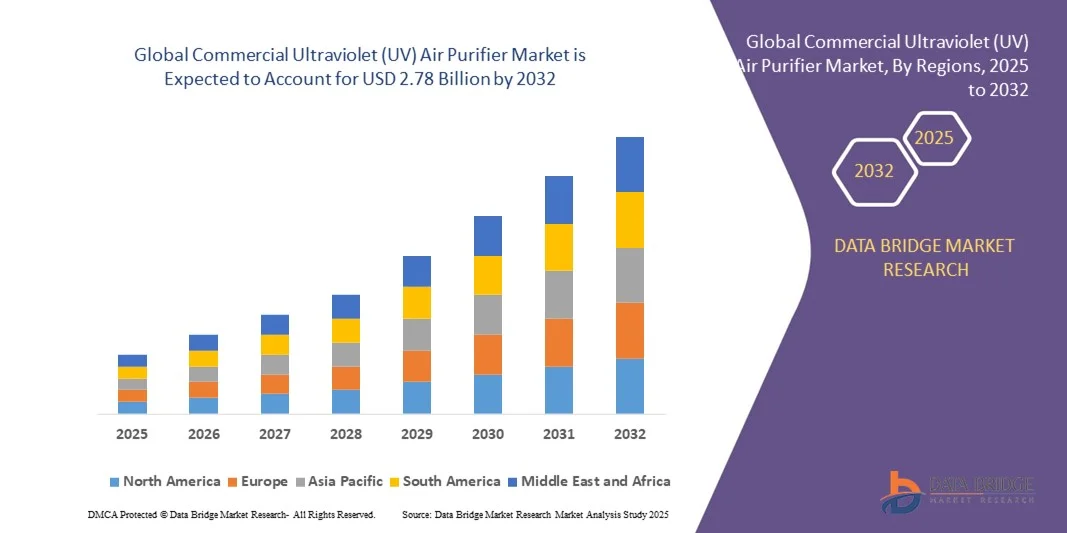
Commercial Ultraviolet (UV) Air Purifier Market Size
- The global commercial ultraviolet (UV) air purifier market size was valued at USD 1.28 billion in 2024 and is expected to reach USD 2.78 billion by 2032, at a CAGR of 10.10% during the forecast period
- The market growth is largely fuelled by the increasing adoption of advanced air purification systems in commercial spaces such as offices, hospitals, and educational institutions to combat airborne pathogens and pollutants
- Rising awareness of indoor air quality (IAQ) and stringent government regulations regarding air hygiene in public and commercial buildings are further driving demand
Commercial Ultraviolet (UV) Air Purifier Market Analysis
- The market is witnessing significant growth due to increasing concerns over airborne infections, including COVID-19, influenza, and other respiratory illnesses, prompting businesses to invest in UV-based air purification solutions
- Commercial sectors are increasingly adopting UV air purifiers for sustainable and energy-efficient air cleaning solutions, combining germicidal UV light with HEPA filtration for comprehensive indoor air treatment
- North America dominated the commercial ultraviolet (UV) air purifier market with the largest revenue share of 36.45% in 2024, driven by growing concerns over indoor air quality and health safety in commercial spaces, as well as increased adoption of air disinfection technologies
- Asia-Pacific region is expected to witness the highest growth rate in the global commercial ultraviolet (UV) air purifier market, driven by expanding commercial infrastructure, government initiatives promoting healthy indoor environments, and rising awareness of air purification technologies
- The Stand-Alone segment held the largest market revenue share in 2024, driven by its ease of installation, portability, and suitability for smaller commercial spaces. Stand-alone UV purifiers offer flexibility in placement and allow facility managers to target specific high-risk zones, making them a preferred choice for offices, clinics, and retail environments
Report Scope and Commercial Ultraviolet (UV) Air Purifier Market Segmentation
|
Attributes |
Commercial Ultraviolet (UV) Air Purifier Key Market Insights |
|
Segments Covered |
|
|
Countries Covered |
North America
Europe
Asia-Pacific
Middle East and Africa
South America
|
|
Key Market Players |
|
|
Market Opportunities |
|
|
Value Added Data Infosets |
In addition to the insights on market scenarios such as market value, growth rate, segmentation, geographical coverage, and major players, the market reports curated by the Data Bridge Market Research also include in-depth expert analysis, pricing analysis, brand share analysis, consumer survey, demography analysis, supply chain analysis, value chain analysis, raw material/consumables overview, vendor selection criteria, PESTLE Analysis, Porter Analysis, and regulatory framework. |
Commercial Ultraviolet (UV) Air Purifier Market Trends
Rise of UV-Based Air Purification in Commercial Spaces
- The increasing adoption of ultraviolet (UV) air purifiers is transforming commercial indoor air quality management by enabling continuous inactivation of airborne pathogens. These systems reduce exposure to viruses, bacteria, and mold spores, creating safer workspaces in high-density environments such as offices, hospitals, and educational institutions. The rapid disinfection capability also helps organizations comply with strict health and safety regulations while maintaining operational continuity
- The growing demand for clean and sanitized air in offices, hospitals, schools, and retail environments is accelerating the installation of UV air purifiers. These devices are particularly effective in confined or poorly ventilated spaces where traditional filtration is insufficient. Businesses benefit from improved employee productivity and reduced absenteeism due to lower transmission of airborne diseases
- The integration of UV air purifiers with HVAC systems and smart building technologies is making them attractive for energy-efficient and automated air management. Facility managers can monitor air quality in real-time and optimize system performance, reducing energy consumption and operational costs. In addition, enhanced indoor air quality contributes to higher occupant satisfaction and long-term asset value
- For instance, in 2023, several multinational office complexes in North America reported a significant reduction in airborne infection incidents after implementing commercial UV air purifiers in their ventilation systems. The improved air quality positively impacted employee health, reduced sick leaves, and minimized operational disruptions. Such case studies are driving wider adoption across corporate and institutional facilities
- While UV air purifiers are gaining traction, their effectiveness depends on proper installation, system design, and regular maintenance. Manufacturers are investing in next-generation UV lamp technology, smart sensors, and modular designs to maximize efficacy. Energy efficiency, safety certifications, and compatibility with existing infrastructure are key focus areas for meeting growing commercial demand
Commercial Ultraviolet (UV) Air Purifier Market Dynamics
Driver
Rising Awareness of Indoor Air Quality and Health Safety in Commercial Settings
- The increasing concerns over airborne pathogens and indoor air pollution are driving the demand for UV air purifiers in commercial establishments. Businesses are prioritizing safer environments for employees, customers, and visitors, particularly in healthcare, hospitality, and educational institutions. Adoption is further boosted by growing public health initiatives and pandemic preparedness measures
- Facility managers are recognizing the benefits of UV-based disinfection in reducing operational disruptions and enhancing occupant confidence. Integration with centralized HVAC systems allows continuous, automated sanitization with minimal manual intervention, ensuring compliance with industry standards and improving overall facility safety
- Regulatory standards and building guidelines emphasizing indoor air quality are promoting the adoption of UV air purifiers. Companies are investing in certified UV systems that adhere to international safety norms, which strengthens brand trust and corporate responsibility. Real-time monitoring and reporting features also aid compliance with local and national regulations
- For instance, in 2022, several commercial hospitals across Europe adopted UV air purifiers as part of their infection control programs. The initiative significantly reduced airborne microbial load, enhanced patient safety, and minimized healthcare-associated infections. Similar programs are encouraging broader adoption in commercial and public facilities worldwide
- While awareness and regulatory support are driving adoption, ongoing innovation in UV lamp technology, energy efficiency, and system scalability remains critical. Manufacturers are exploring multi-lamp configurations, advanced coatings, and IoT-enabled air quality monitoring to increase adoption rates and meet evolving market demands
Restraint/Challenge
High Initial Cost and Maintenance Requirements
- The higher upfront cost of commercial UV air purifiers compared to conventional air filtration systems limits adoption among small and medium-sized enterprises. Initial investment includes professional installation, integration with HVAC, and certification costs, which can be prohibitive in cost-sensitive regions
- Maintenance and periodic replacement of UV lamps or components add recurring costs, and improper maintenance can compromise system effectiveness. Facilities with limited technical expertise may struggle with upkeep, reducing the reliability of disinfection and diminishing return on investment
- Limited awareness regarding the correct usage, placement, and safety precautions of UV air purifiers in commercial settings can hinder market penetration. Misconceptions about UV exposure, ozone production, and lamp efficacy may lead to underutilization or improper installation, limiting overall benefits
- For instance, in 2023, several small office buildings in Southeast Asia reported reduced adoption due to perceived high costs and insufficient technical knowledge. This resulted in continued reliance on conventional filtration methods, higher infection rates, and lost opportunities for improved indoor air quality
- While the benefits of UV air purification are well-established, overcoming cost barriers, providing training and education, and ensuring consistent product quality are essential. Manufacturers and service providers must focus on scalable, energy-efficient, and easy-to-maintain solutions to expand global adoption and ensure sustainable long-term market growth
Commercial Ultraviolet (UV) Air Purifier Market Scope
The market is segmented on the basis of type, price, application, and distribution channel
- By Type
On the basis of type, the commercial ultraviolet (UV) air purifier market is segmented into Stand-Alone and Built-in Commercial HVAC. The Stand-Alone segment held the largest market revenue share in 2024, driven by its ease of installation, portability, and suitability for smaller commercial spaces. Stand-alone UV purifiers offer flexibility in placement and allow facility managers to target specific high-risk zones, making them a preferred choice for offices, clinics, and retail environments.
The Built-in Commercial HVAC segment is expected to witness the fastest growth rate from 2025 to 2032, fueled by its integration with existing HVAC systems, enabling continuous and automated air disinfection. Built-in solutions provide energy-efficient operation, broader coverage, and enhanced indoor air quality monitoring, which makes them increasingly attractive for large commercial buildings, hospitals, and educational institutions.
- By Price
On the basis of price, the market is segmented into < US$ 50, US$ 50–US$ 200, and > US$ 200. The US$ 50–US$ 200 segment held the largest revenue share in 2024, driven by its balance of affordability and advanced disinfection features. Devices in this range offer certified UV-C lamps, ease of use, and reliable performance, making them ideal for small to medium-sized commercial establishments.
The > US$ 200 segment is expected to witness the fastest growth from 2025 to 2032, fueled by rising adoption of premium UV air purifiers with integrated smart controls, multi-layer filtration, and enhanced energy efficiency. These higher-priced units are increasingly favored in hospitals, large corporate offices, and high-traffic public facilities that prioritize comprehensive air quality management.
- By Application
On the basis of application, the market is segmented into Hotels and Restaurants, Hospitals and Clinics, Schools and Institutes, Corporate Buildings, Shopping Malls, Public Utilities, and Others. The Hospitals and Clinics segment held the largest revenue share in 2024, driven by the critical need for pathogen control and adherence to strict hygiene protocols. UV purifiers help reduce nosocomial infections and provide safer environments for patients and staff.
The Corporate Buildings segment is expected to witness the fastest growth from 2025 to 2032, fueled by increased workplace health awareness, regulatory compliance for indoor air quality, and rising demand for automated, energy-efficient air purification solutions. Businesses are investing in integrated UV systems to protect employees and reduce absenteeism due to airborne illnesses.
- By Distribution Channel
On the basis of distribution channel, the market is segmented into Online and Offline channels. The Offline segment held the largest revenue share in 2024, driven by direct sales to commercial clients, partnerships with HVAC contractors, and professional installation services. Many buyers prefer offline channels for customized solutions and after-sales support.
The Online segment is expected to witness the fastest growth from 2025 to 2032, fueled by the increasing trend of e-commerce, digital marketing, and direct-to-consumer sales. Online platforms provide easy comparison of product features, pricing, and certifications, making it convenient for businesses to purchase commercial UV air purifiers efficiently.
Commercial Ultraviolet (UV) Air Purifier Market Regional Analysis
- North America dominated the commercial ultraviolet (UV) air purifier market with the largest revenue share of 36.45% in 2024, driven by growing concerns over indoor air quality and health safety in commercial spaces, as well as increased adoption of air disinfection technologies
- Consumers and facility managers in the region highly value the ability of UV air purifiers to continuously inactivate airborne pathogens, improve employee and occupant health, and integrate seamlessly with existing HVAC systems
- This widespread adoption is further supported by stringent regulatory standards, high awareness of air quality issues, and the growing trend of energy-efficient and smart building management systems, establishing UV air purifiers as a preferred solution for offices, hospitals, and public spaces
U.S. Commercial UV Air Purifier Market Insight
The U.S. market captured the largest revenue share in North America in 2024, fueled by rising concerns over airborne pathogens in workplaces, healthcare, and educational institutions. Businesses are prioritizing safer environments through the adoption of UV air purifiers, especially integrated with commercial HVAC systems for automated and continuous disinfection. The increasing focus on regulatory compliance, corporate wellness, and smart building technologies further propels market growth, enhancing public confidence in indoor air quality.
Europe Commercial UV Air Purifier Market Insight
The Europe market is expected to witness the fastest growth rate from 2025 to 2032, driven by strict indoor air quality regulations, rising urbanization, and the growing need for hygienic commercial spaces. European businesses are investing in UV-based air disinfection systems to comply with health and safety standards, reduce airborne infection risks, and improve energy efficiency in buildings. The adoption spans offices, hospitals, schools, and retail spaces, with significant expansion in both new constructions and retrofit projects.
U.K. Commercial UV Air Purifier Market Insight
The U.K. market is projected to witness rapid growth from 2025 to 2032 due to increasing awareness of indoor air pollution, growing corporate safety initiatives, and widespread adoption of smart building solutions. Concerns over airborne pathogen transmission in workplaces, hospitality, and healthcare sectors are motivating facility managers to install UV air purifiers. The U.K.’s strong focus on regulatory compliance, technology-driven building management, and energy-efficient solutions supports the market expansion.
Germany Commercial UV Air Purifier Market Insight
Germany is expected to witness substantial growth from 2025 to 2032, fueled by heightened awareness of workplace health, regulatory emphasis on indoor air quality, and adoption of technologically advanced, eco-friendly systems. German commercial establishments are increasingly integrating UV air purifiers with HVAC networks to ensure continuous pathogen inactivation, minimize maintenance costs, and improve occupant safety. The market benefits from strong infrastructural support, sustainability initiatives, and consumer preference for high-quality air purification solutions.
Asia-Pacific Commercial UV Air Purifier Market Insight
The Asia-Pacific market is projected to witness the fastest growth rate from 2025 to 2032, driven by rapid urbanization, rising disposable incomes, and increasing awareness of indoor air quality in commercial spaces across China, Japan, India, and Southeast Asian countries. Government initiatives promoting healthier workplaces, coupled with the region’s emergence as a manufacturing hub for UV systems, are boosting affordability and accessibility. The adoption spans offices, hospitals, schools, and retail environments, facilitating safer indoor environments and better public health.
Japan Commercial UV Air Purifier Market Insight
Japan’s market is expected to witness rapid growth from 2025 to 2032 due to high technological adoption, emphasis on workplace health, and increasing concern over indoor air quality. The rising number of connected commercial buildings and integration of UV purifiers with smart HVAC systems are driving market adoption. Moreover, Japan’s aging workforce is increasing demand for safer indoor environments, making UV air purifiers essential for both commercial and healthcare facilities.
China Commercial UV Air Purifier Market Insight
China accounted for the largest revenue share in the Asia-Pacific region in 2024, driven by urbanization, expanding commercial infrastructure, and heightened awareness of airborne infection risks. Businesses, hospitals, and educational institutions are increasingly adopting UV air purifiers to ensure continuous disinfection and regulatory compliance. The growing push towards smart and energy-efficient buildings, combined with domestic manufacturing capabilities and cost-effective solutions, is significantly propelling market growth.
Commercial Ultraviolet (UV) Air Purifier Market Share
The Commercial Ultraviolet (UV) Air Purifier industry is primarily led by well-established companies, including:
- Honeywell International Inc. (U.S.)
- Xiaomi (China)
- LG Electronics (South Korea)
- Unilever (U.K.)
- COWAY CO.,LTD. (South Korea)
- Koninklijke Philips N.V. (Netherlands)
- Sunbeam Products, Inc. (U.S.)
- Sharp Electronics Corporation (Japan)
- Alen Corporation (U.S.)
- Whirlpool of India (India)
- Austin Air (U.S.)
- Camfil (Sweden)
- Daikin Airconditioning India Pvt. Ltd. (India)
- Eureka Forbes (India)
- IQAir (Switzerland)
- Panasonic India (India)
- Rabbit Air (U.S.)
- SAMSUNG (South Korea)
- Winix Inc. (South Korea)
- Hamilton Beach Brands, Inc. (U.S.)

- Interactive Data Analysis Dashboard
- Company Analysis Dashboard for high growth potential opportunities
- Research Analyst Access for customization & queries
- Competitor Analysis with Interactive dashboard
- Latest News, Updates & Trend analysis
- Harness the Power of Benchmark Analysis for Comprehensive Competitor Tracking
Data collection and base year analysis are done using data collection modules with large sample sizes. The stage includes obtaining market information or related data through various sources and strategies. It includes examining and planning all the data acquired from the past in advance. It likewise envelops the examination of information inconsistencies seen across different information sources. The market data is analysed and estimated using market statistical and coherent models. Also, market share analysis and key trend analysis are the major success factors in the market report. To know more, please request an analyst call or drop down your inquiry.
The key research methodology used by DBMR research team is data triangulation which involves data mining, analysis of the impact of data variables on the market and primary (industry expert) validation. Data models include Vendor Positioning Grid, Market Time Line Analysis, Market Overview and Guide, Company Positioning Grid, Patent Analysis, Pricing Analysis, Company Market Share Analysis, Standards of Measurement, Global versus Regional and Vendor Share Analysis. To know more about the research methodology, drop in an inquiry to speak to our industry experts.
Data Bridge Market Research is a leader in advanced formative research. We take pride in servicing our existing and new customers with data and analysis that match and suits their goal. The report can be customized to include price trend analysis of target brands understanding the market for additional countries (ask for the list of countries), clinical trial results data, literature review, refurbished market and product base analysis. Market analysis of target competitors can be analyzed from technology-based analysis to market portfolio strategies. We can add as many competitors that you require data about in the format and data style you are looking for. Our team of analysts can also provide you data in crude raw excel files pivot tables (Fact book) or can assist you in creating presentations from the data sets available in the report.