


What is the Competitive Intelligence Tools Market Size and Growth Rate?
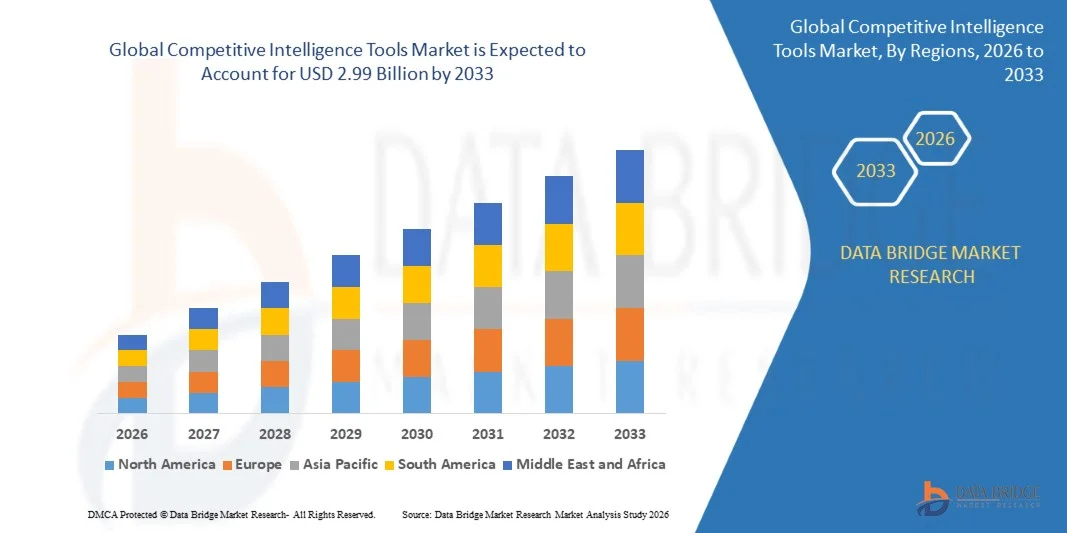
- As per Data Bridge Market Research analysis, the competitive intelligence tools market was valued at USD 0.69 billion in 2025 and is projected to reach USD 2.99 billion by 2033, growing at a CAGR of 20.10% from 2026 to 2033.
- The market is experiencing exceptionally strong growth driven by rapidly intensifying competitive pressures across nearly every industry, growing enterprise demand for real-time market and competitor monitoring capabilities, and rapid advancement of AI and natural language processing technologies enabling automated analysis of vast volumes of unstructured competitive data.
- The growing recognition that timely, accurate competitive insight directly supports better strategic and sales decision-making is compelling enterprises of all sizes to move beyond manual competitor research toward automated, continuously updated intelligence platforms. AI-powered tools capable of automatically aggregating, summarizing, and alerting teams to competitor moves are increasingly complementing and, in many cases, replacing traditional manual research and static quarterly competitive reports.
- The accelerating pace of product releases and go-to-market announcements across nearly every industry is compressing the window in which competitive information remains actionable, further reinforcing enterprise demand for real-time, automated monitoring over periodic manual research cycles.
Market Size & Forecast
- Global Market Value (2025): USD 0.69 Billion
- Expected Market Value (2033): USD 2.99 Billion
- Forecast CAGR (2026–2033): 20.10%
- Leading Region in 2025: North America
- Fastest Growing Region: Asia-Pacific
What are the Major Takeaways of the Competitive Intelligence Tools Market?
- North America dominated the global competitive intelligence tools market with the largest revenue share of 41.28% in 2025, supported by high concentration of leading software vendors, strong enterprise SaaS adoption, and mature corporate strategy and product marketing functions actively investing in competitive intelligence programs.
- Asia-Pacific is expected to be the fastest-growing region at a CAGR of 24.6% from 2026 to 2033, fueled by rapidly expanding technology and e-commerce sectors, growing enterprise digitalization, and increasing awareness of competitive intelligence practices among businesses across China, India, and Japan.
- The software/platform component segment led the market with a 74.36% share in 2025, driven by widespread enterprise adoption of subscription-based competitive intelligence platforms offering automated data aggregation and analysis capabilities.
- The AI/machine learning-based technology segment is the fastest-growing category, projected to register a CAGR of 25.3%, reflecting rapid enterprise adoption of AI-powered tools capable of automatically surfacing relevant competitive signals from vast volumes of unstructured data.
- The competitor analysis & benchmarking application segment dominated the application category with a 32.84% revenue share in 2025, led by its foundational role in helping enterprises understand relative market positioning across product, pricing, and messaging dimensions.
- Cloud-based deployment accounted for 78.62% of the market share in 2025, preferred due to lower upfront costs, faster implementation, and continuous access to updated data and features without on-premises infrastructure management.
- The IT & telecommunications end-user segment is the fastest-growing category, with a CAGR of 23.8%, driven by intense competitive dynamics within the technology sector requiring continuous monitoring of rapidly evolving competitor product launches and positioning.
- The competitor analysis & benchmarking application accounted for the largest application share in 2025, reflecting its role as the entry-point use case around which most enterprise competitive intelligence programs are initially built.
- The large enterprises organization size segment held a 63.47% share in 2025, supported by greater budget capacity for dedicated competitive intelligence platform subscriptions across multiple business units.
Report Scope and Competitive Intelligence Tools Market Segmentation
|
Attributes |
Competitive Intelligence Tools Key Market Insights |
|
Segments Covered |
|
|
Countries Covered |
North America
Europe
Asia-Pacific
Middle East and Africa
South America
|
|
Key Market Players |
|
|
Market Opportunities |
|
|
Value Added Data Infosets |
In addition to the market insights such as market value, growth rate, market segments, geographical coverage, market players, and market scenario, the market report curated by the Data Bridge Market Research team includes in-depth expert analysis, import/export analysis, pricing analysis, production consumption analysis, and pestle analysis. |
What is the Key Trend in the Competitive Intelligence Tools Market?
- Competitive intelligence vendors are increasingly integrating generative AI and AI agents to automate competitor research, analyze large datasets, and convert competitive signals into actionable insights for sales, marketing, and strategy teams.
- For instance, in May 2025, Similarweb launched Similarweb AI Agents, a suite of specialized AI agents designed to analyze digital data across websites, apps, search keywords, and companies for applications including sales outreach, SEO, and market trend discovery.
- Competitive intelligence platforms are increasingly connecting their intelligence with enterprise AI and collaboration environments, allowing employees to access competitor insights without leaving their existing workflows.
- For instance, in October 2025, Crayon launched its Competitive Intelligence MCP Server, enabling competitive intelligence content to be connected with AI tools through the Model Context Protocol. Crayon also described integrations that deliver competitive answers through Slack, enterprise AI tools, and other internal applications.
- Vendors are expanding competitive intelligence beyond traditional competitor monitoring toward AI-search and digital-visibility intelligence, helping companies understand how competitors and brands appear across emerging generative-AI platforms.
- For instance, in July 2025, Similarweb launched its GenAI Intelligence Toolkit, providing visibility into brand traffic and presence across AI chatbots including ChatGPT, Gemini, Perplexity, Grok, and Copilot.
- Competitive intelligence platforms are also increasingly using AI to automatically summarize competitor developments and prioritize important signals, helping teams reduce the time spent manually reviewing large amounts of information.
- For instance, Crayon's platform uses AI to summarize competitor news and apply importance scoring, enabling users to prioritize relevant competitive developments rather than manually reviewing every collected signal.
- As enterprises increasingly adopt AI for market monitoring, sales enablement, and strategic analysis, the competitive intelligence tools market is shifting toward AI-agent-driven, continuously updated, and workflow-integrated intelligence, with vendors increasingly positioning their platforms as infrastructure connecting competitive data with enterprise AI and decision-making workflows.
What are the Key Drivers of the Competitive Intelligence Tools Market?
- The rapidly intensifying pace of competitive activity across nearly every industry, driven by accelerating product development cycles and increasingly crowded markets, has significantly increased enterprise demand for continuous, automated competitive monitoring capabilities.
- For instance, in April 2025, Crayon expanded its enterprise customer base significantly as software and technology companies increasingly sought automated competitive intelligence solutions to keep pace with rapid competitor product releases and market positioning shifts.
- The growing recognition among sales and marketing leaders that well-equipped sales teams with real-time competitive insights achieve measurably higher win rates is driving sustained enterprise investment in competitive intelligence platforms as a core component of sales enablement strategy.
- For instance, in December 2024, AlphaSense expanded its enterprise customer contracts with several Fortune 500 companies seeking to centralize competitive and market intelligence gathering across corporate strategy, investor relations, and product teams within a single platform.
- The growing volume and diversity of publicly available digital data, spanning company websites, review platforms, social media, patent filings, and regulatory disclosures, is creating an increasingly rich data landscape that automated competitive intelligence tools are well-positioned to continuously monitor and synthesize at a scale impossible for manual research teams.
- With rising competitive intensity across global markets, growing recognition of intelligence-driven sales performance benefits, and continued advancement of AI-powered data analysis capabilities, competitive intelligence tools will remain a rapidly expanding category within the broader enterprise software and business intelligence industry.
Which Factors are Challenging the Growth of the Competitive Intelligence Tools Market?
- Data privacy and collection restrictions create challenges because automated scraping of websites and third-party platforms can face legal, licensing, and terms-of-service limitations. For example, Similarweb restricts automated methods such as scraping and bots under its platform terms. Data quality and accuracy issues can reduce customer confidence, as intelligence platforms differ in source coverage, freshness, and reliability.
- For instance, a 2026 Cognism study found that 74.5% of revenue leaders identified data quality as their biggest challenge with sales intelligence tools. Cognism study
- General-purpose AI tools are creating an alternative for smaller businesses that need basic competitor research, potentially reducing demand for specialized subscription-based platforms.
- Integration and implementation complexity can increase adoption costs, particularly for enterprises requiring integration with CRM, sales, analytics, security, and existing business workflows.
How is the Competitive Intelligence Tools Market Segmented?
The competitive intelligence tools market is segmented on the basis of component, deployment mode, organization size, application, end user, and technology.
- By Component
On the basis of component, the global competitive intelligence tools market is segmented into software/platform and services. The software/platform segment dominated the market with a 74.36% share in 2025, owing to widespread enterprise adoption of subscription-based competitive intelligence platforms offering automated data aggregation and analysis capabilities. These platforms remain the preferred choice for organizations seeking scalable, continuously updated competitive monitoring without the overhead of manual research processes.
The services segment is projected to register the fastest growth at a CAGR of 22.7% from 2026 to 2033, driven by rising enterprise demand for specialized implementation, customization, and analyst support services that help organizations extract maximum strategic value from increasingly sophisticated competitive intelligence platforms.
- By Deployment Mode
On the basis of deployment mode, the global competitive intelligence tools market is segmented into cloud-based and on-premises. The cloud-based segment led the market with a 78.62% share in 2025, supported by lower upfront costs, faster implementation timelines, and continuous access to updated data feeds and platform features without requiring dedicated on-premises infrastructure management.
The on-premises segment continues to serve a smaller niche among large enterprises in highly regulated industries with strict internal data governance requirements, though this segment’s relative share is expected to continue declining as cloud security assurances improve and cloud-based solutions become the default deployment preference across most industries.
- By Organization Size
On the basis of organization size, the global competitive intelligence tools market is segmented into large enterprises and small & medium enterprises. The large enterprises segment dominated the market with a share of 63.47% in 2025 due to their greater budget capacity for dedicated competitive intelligence platform subscriptions and more complex organizational needs spanning multiple departments and business units. the widespread adoption of enterprise-wide competitive intelligence programs among Fortune 1000 companies is reinforcing this segment’s leading position.
The small & medium enterprises segment is expected to witness the fastest CAGR of 23.4% from 2026 to 2033, driven by this growth is fueled by the growing availability of more affordable, self-service competitive intelligence tools tailored to the budget constraints and simpler organizational structures of smaller businesses.
- By Application
On the basis of application, the global competitive intelligence tools market is segmented into competitor analysis & benchmarking, market & industry trend monitoring, pricing intelligence, social media & sentiment monitoring, patent & IP intelligence, and sales & win-loss intelligence. The competitor analysis & benchmarking segment dominated the market with a share of 32.84% in 2025 due to its foundational role in helping enterprises understand relative market positioning across product, pricing, and messaging dimensions. the widespread integration of benchmarking insights into strategic planning processes is reinforcing this segment’s leading position.
The sales & win-loss intelligence segment is expected to witness the fastest CAGR of 24.1% from 2026 to 2033, driven by rising enterprise focus on quantifying and improving sales team performance through systematic analysis of why deals are won or lost against specific named competitors.
- By End User
On the basis of end user, the global competitive intelligence tools market is segmented into BFSI, retail & e-commerce, IT & telecommunications, healthcare & pharmaceuticals, manufacturing, media & entertainment, and others. The IT & telecommunications segment dominated the market with a share of 28.63% in 2025 due to the technology sector’s characteristically rapid product development cycles and intense competitive dynamics requiring continuous market monitoring. the widespread adoption of competitive intelligence tools among software companies for product and pricing strategy is reinforcing this segment’s leading position.
The IT & telecommunications segment is also expected to witness the fastest CAGR of 23.8% from 2026 to 2033, driven by intense competitive dynamics within the technology sector requiring continuous monitoring of rapidly evolving competitor product launches, feature releases, and market positioning strategies.
- By Technology
On the basis of technology, the global competitive intelligence tools market is segmented into AI/machine learning-based, natural language processing-based, and web scraping & data aggregation-based. The web scraping & data aggregation-based segment led the market with a 44.28% share in 2025, supported by its foundational role in gathering raw competitive data from diverse public sources across the web that feeds subsequent analysis and reporting functions.
The AI/machine learning-based segment is expected to witness the fastest CAGR of 25.3% from 2026 to 2033, driven by rapid enterprise adoption of AI-powered tools capable of automatically surfacing relevant competitive signals, generating narrative summaries, and prioritizing the most strategically significant insights from vast volumes of unstructured competitive data.
Which Region Holds the Largest Share of the Competitive Intelligence Tools Market?
- North America dominated the competitive intelligence tools market and accounted for the largest revenue share of 41.28% in 2025, supported by high concentration of leading software vendors, strong enterprise SaaS adoption, and mature corporate strategy and product marketing functions actively investing in competitive intelligence programs.
- The region also benefits from a dense concentration of venture-backed competitive intelligence startups, strong enterprise software buying culture, and widespread integration of competitive intelligence practices into standard sales enablement and product marketing workflows. Continued innovation investment from leading domestic vendors continues to strengthen North America’s leadership position in the global market.
U.S. Competitive Intelligence Tools Market Insight
The U.S. competitive intelligence tools market holds the largest share within North America, driven by high concentration of leading software vendors, mature enterprise SaaS adoption culture, and widespread integration of competitive intelligence into corporate strategy and sales enablement functions. Rising enterprise investment in AI-powered platforms and growing recognition of competitive intelligence’s role in improving sales win rates are further supporting market growth. Additionally, continued venture capital investment in competitive intelligence startups is reinforcing the country’s position as the global center for competitive intelligence tool innovation.
Canada Competitive Intelligence Tools Market Insight
Canada’s competitive intelligence tools market is expanding as businesses increasingly adopt data-driven strategies to monitor competitors, market trends, pricing, and customer behavior. Demand is supported by growing digital transformation, AI-powered analytics, and cloud-based intelligence platforms across technology, retail, finance, healthcare, and manufacturing. Key opportunities include automated data collection, predictive analytics, real-time market monitoring, and AI-driven insights. Data privacy requirements and integration complexity remain important challenges for market participants.
Asia-Pacific Competitive Intelligence Tools Market Insight
The Asia-Pacific competitive intelligence tools market is expected to witness rapid growth, driven by rapidly expanding technology and e-commerce sectors, growing enterprise digitalization, and increasing awareness of competitive intelligence practices among businesses across China, India, and Japan. Rising investment in enterprise software adoption and growing recognition of the strategic value of automated competitive monitoring are supporting regional market expansion. Additionally, the growing presence of international competitive intelligence vendors establishing regional operations is accelerating market adoption across the region.
India Competitive Intelligence Tools Market Insight
The India competitive intelligence tools market is witnessing robust growth, driven by rapidly expanding technology and startup ecosystem, growing enterprise software adoption, and increasing awareness of data-driven strategic decision-making among businesses. Growing adoption of competitive intelligence platforms among both domestic enterprises and multinational corporations with regional operations is supporting market expansion. Additionally, the presence of domestic competitive intelligence software providers offering cost-effective solutions is further accelerating adoption across the country.
China Competitive Intelligence Tools Market Insight
The China competitive intelligence tools market is growing rapidly, driven by intense domestic competitive dynamics across the technology and e-commerce sectors, rising enterprise digitalization, and growing adoption of AI-powered business intelligence tools. Growing adoption of competitive intelligence platforms among domestic technology companies navigating highly competitive market conditions is significantly boosting market demand. In addition, rising domestic AI and data analytics capabilities are positioning China as one of the fastest-growing markets for competitive intelligence tools globally.
Which are the Top Companies in Competitive Intelligence Tools Market?
The competitive intelligence tools industry is primarily led by well-established companies, including:
- Klue Labs Inc. (Canada)
- Crayon (U.S.)
- Similarweb Ltd. (Israel)
- Meltwater N.V. (Norway/Netherlands)
- Semrush Holdings, Inc. (U.S.)
- Ahrefs Pte. Ltd. (Singapore)
- Crunchbase Inc. (U.S.)
- Cipher Systems, LLC (U.S.)
- AlphaSense, Inc. (U.S.)
- Contify (India)
- Brandwatch (Cision Ltd.) (U.K.)
- Sprout Social, Inc. (U.S.)
- Talkwalker (Hootsuite) (Luxembourg)
- Visualping Inc. (Canada)
- Wiser Solutions, Inc. (U.S.)
- Prisync (Turkey)
- Competera Ltd. (Ukraine/U.S.)
- PatSnap Limited (U.K./Singapore)
- Owler (Meltwater) (U.S.)
- Kompyte (Semrush) (U.S./France)
What are Latest Developments in Competitive Intelligence Tools Market?
- In September 2025, Klue launched a new generative AI-powered competitive summary feature that automatically generates executive-ready competitor briefings from aggregated data sources, reducing manual analysis time for enterprise product marketing teams.
- In January 2025, Similarweb expanded its data coverage to include enhanced e-commerce competitive benchmarking capabilities, providing retail and online business customers with deeper visibility into competitor traffic sources and customer acquisition strategies.
- In November 2025, AlphaSense introduced an expanded expert call transcript library integration, allowing enterprise customers to combine primary research insights with automated competitive intelligence data within a single unified research platform.
- In November 2024, Crayon launched a new sales battlecard automation feature that dynamically updates competitive positioning content based on real-time changes in competitor messaging and pricing detected by the platform.
- In June 2023, Contify partnered with several enterprise customers across the technology and financial services sectors to conduct field validation of its AI-based competitive signal prioritization algorithm, demonstrating improved relevance of surfaced insights compared to traditional keyword-based alert systems.
- In August 2024, Meltwater expanded its competitive intelligence module within its broader media intelligence platform, integrating social listening and news monitoring data to provide customers with a more comprehensive view of competitor public perception and market positioning.

- Interactive Data Analysis Dashboard
- Company Analysis Dashboard for high growth potential opportunities
- Research Analyst Access for customization & queries
- Competitor Analysis with Interactive dashboard
- Latest News, Updates & Trend analysis
- Harness the Power of Benchmark Analysis for Comprehensive Competitor Tracking
Data collection and base year analysis are done using data collection modules with large sample sizes. The stage includes obtaining market information or related data through various sources and strategies. It includes examining and planning all the data acquired from the past in advance. It likewise envelops the examination of information inconsistencies seen across different information sources. The market data is analysed and estimated using market statistical and coherent models. Also, market share analysis and key trend analysis are the major success factors in the market report. To know more, please request an analyst call or drop down your inquiry.
The key research methodology used by DBMR research team is data triangulation which involves data mining, analysis of the impact of data variables on the market and primary (industry expert) validation. Data models include Vendor Positioning Grid, Market Time Line Analysis, Market Overview and Guide, Company Positioning Grid, Patent Analysis, Pricing Analysis, Company Market Share Analysis, Standards of Measurement, Global versus Regional and Vendor Share Analysis. To know more about the research methodology, drop in an inquiry to speak to our industry experts.
Data Bridge Market Research is a leader in advanced formative research. We take pride in servicing our existing and new customers with data and analysis that match and suits their goal. The report can be customized to include price trend analysis of target brands understanding the market for additional countries (ask for the list of countries), clinical trial results data, literature review, refurbished market and product base analysis. Market analysis of target competitors can be analyzed from technology-based analysis to market portfolio strategies. We can add as many competitors that you require data about in the format and data style you are looking for. Our team of analysts can also provide you data in crude raw excel files pivot tables (Fact book) or can assist you in creating presentations from the data sets available in the report.













