


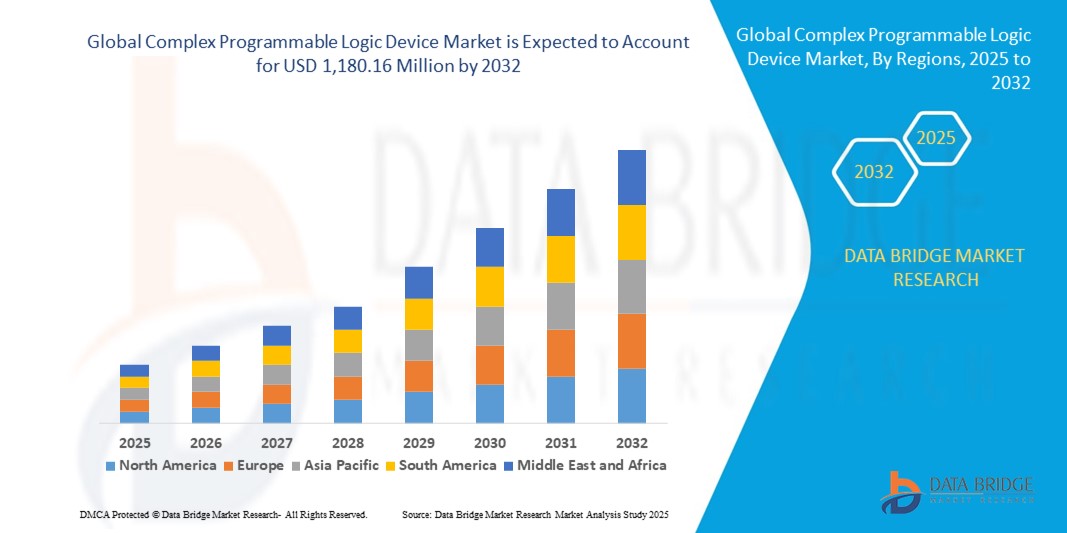
Complex Programmable Logic Device Market Size
- The global complex programmable logic device market size was valued at USD 651.95 million in 2024 and is expected to reach USD 1,180.16 million by 2032, at a CAGR of 7.70% during the forecast period
- The market growth is primarily driven by the increasing demand for high-performance, low-power programmable logic solutions in consumer electronics, automotive, and telecommunication sectors, along with rising adoption in industrial automation and medical devices
- Growing awareness of the benefits of complex programmable logic device, such as flexibility in design, reduced time-to-market, and cost efficiency, is further propelling demand across OEM and aftermarket channels
Complex Programmable Logic Device Market Analysis
- The complex programmable logic device market is experiencing robust growth due to the increasing need for customizable, high-speed, and power-efficient solutions in various industries
- These technologies enhance the programmability and efficiency of complex programmable logic device by enabling advanced logic optimization, real-time reconfiguration, and predictive fault detection
- Asia-Pacific dominated the complex programmable logic device market with the largest revenue share of 41.2% in 2024, fueled by a strong electronics manufacturing base, rapid industrialization, and increasing adoption of complex programmable logic device in countries such as China, Japan, and South Korea
- North America is expected to be the fastest-growing region during the forecast period, driven by technological advancements, increasing investments in automotive and telecommunication infrastructure, and growing demand for medical devices incorporating complex programmable logic device
- The EEPROM-based segment dominated the largest market revenue share of 65% in 2024, driven by its reprogram ability and reliability in maintaining programmed logic during power outages. EEPROM-based complex programmable logic device are ideal for applications requiring frequent updates and adjustments, offering a cost-effective and flexible solution for small to medium-scale digital logic designs
Report Scope and Complex Programmable Logic Device Market Segmentation
|
Attributes |
Complex Programmable Logic Device Key Market Insights |
|
Segments Covered |
|
|
Countries Covered |
North America
Europe
Asia-Pacific
Middle East and Africa
South America
|
|
Key Market Players |
|
|
Market Opportunities |
|
|
Value Added Data Infosets |
In addition to the insights on market scenarios such as market value, growth rate, segmentation, geographical coverage, and major players, the market reports curated by the Data Bridge Market Research also include in-depth expert analysis, geographically represented company-wise production and capacity, network layouts of distributors and partners, detailed and updated price trend analysis and deficit analysis of supply chain and demand. |
Complex Programmable Logic Device Market Trends
Increasing Adoption of AI and Machine Learning in Design
- The Global Complex Programmable Logic Device (CPLD) market is experiencing a notable trend toward integrating Artificial Intelligence (AI) and Machine Learning (ML) into complex programmable logic device design and functionality
- These technologies enhance the programmability and efficiency of complex programmable logic device by enabling advanced logic optimization, real-time reconfiguration, and predictive fault detection
- AI-driven complex programmable logic device solutions facilitate adaptive systems that can dynamically adjust to varying operational demands, improving performance in applications such as consumer electronics and automotive systems
- For instances, companies are developing AI-enhanced complex programmable logic device that optimize signal processing for telecommunication networks or enable smarter power management in medical devices
- This trend is increasing the appeal of complex programmable logic device for industries requiring high flexibility and performance, particularly in Asia-Pacific, the dominating region for complex programmable logic device adoption
- AI algorithms can analyze complex logic patterns, enabling faster design iterations and reducing time-to-market for innovative products
Complex Programmable Logic Device Market Dynamics
Driver
Growing Demand for Flexible and High-Performance Electronics
- The rising need for customizable, high-performance electronic systems in industries such as consumer electronics, telecommunication, and automotive is a key driver for the complex programmable logic device market
- Complex programmable logic device provide versatile solutions for applications requiring rapid prototyping, real-time processing, and low-latency performance, such as in-vehicle infotainment systems and 5G network infrastructure
- Government initiatives, particularly in Asia-Pacific, promoting smart manufacturing and IoT adoption are accelerating the integration of complex programmable logic device in industrial applications
- The proliferation of 5G technology and IoT ecosystems is further boosting demand for complex programmable logic device , as they support faster data processing and seamless connectivity in advanced devices
- Manufacturers are increasingly incorporating complex programmable logic device as standard components in devices to meet consumer expectations for smarter, more efficient electronics, especially in North America, the fastest-growing region
Restraint/Challenge
High Development Costs and Concerns Over Design Complexity
- The significant initial investment required for designing, programming, and integrating complex programmable logic device into electronic systems can be a barrier, particularly for small and medium-sized enterprises in emerging markets
- Developing complex programmable logic device -based solutions involves complex design processes, requiring specialized tools and expertise, which can increase costs and time
- In addition, concerns about intellectual property (IP) protection and design security pose challenges, as complex programmable logic device often handle sensitive logic configurations that are vulnerable to reverse engineering or unauthorized access
- The diverse regulatory standards across regions, such as data protection laws in North America and Asia-Pacific, complicate compliance for manufacturers operating globally
- These factors can hinder market growth, particularly in cost-sensitive regions or industries with stringent security requirements
Complex Programmable Logic Device market Scope
The market is segmented on the basis of type, application, and sales channel.
- By Type
On the basis of type, the global complex programmable logic device (CPLD) market is segmented into EEPROM-based, Flash-based, and others. The EEPROM-based segment dominated the largest market revenue share of 65% in 2024, driven by its reprogram ability and reliability in maintaining programmed logic during power outages. EEPROM-based complex programmable logic device are ideal for applications requiring frequent updates and adjustments, offering a cost-effective and flexible solution for small to medium-scale digital logic designs. Their non-volatile nature ensures instant operation post power-up, making them highly appealing to industries such as consumer electronics and industrial automation.
The Flash-based segment is expected to register the fastest growth rate from 2025 to 2032, as industries increasingly demand high-performance and scalable complex programmable logic device . Flash-based complex programmable logic device offer superior reprogrammability and higher density, making them suitable for dynamic applications such as telecommunications and automotive systems. Their ability to support complex designs and faster processing speeds aligns with the growing need for advanced, energy-efficient solutions in modern electronics.
- By Application
On the basis of application, the global complex programmable logic device market is categorized into consumer electronics, telecommunication, automotive, medical devices, industrial, and others. The consumer electronics segment accounted for the highest revenue share in 2024, driven by the rising demand for compact, low-power, and versatile digital solutions in devices such as wearables, smart home systems, and IoT-enabled gadgets. complex programmable logic device enable rapid prototyping and frequent design modifications, which are critical for manufacturers introducing new features and real-time processing capabilities in consumer products.
The telecommunication segment is anticipated to grow at the fastest CAGR from 2025 to 2032, propelled by the global rollout of 5G networks and the need for programmable logic devices in signal processing, baseband, and networking equipment. complex programmable logic device provide the flexibility and scalability required for high-speed data processing and adaptive network configurations, supporting the expansion of telecommunication infrastructure and IoT applications. The increasing integration of complex programmable logic device into system-on-chip (SoC) architectures further accelerates this segment’s growth.
- By Sales Channel
On the basis of sales channel, the global complex programmable logic device market is segmented into direct and indirect. The indirect sales channel held the largest revenue share in 2024, attributed to the widespread use of distributors and resellers in reaching diverse markets, particularly in the Asia-Pacific region. Indirect channels provide access to a broad customer base, including small and medium enterprises (SMEs), and offer value-added services such as technical support and customized solutions, making them a preferred choice for complex programmable logic device manufacturers.
The direct sales channel is projected to grow at the fastest rate from 2025 to 2032, driven by increasing demand from large enterprises seeking tailored complex programmable logic device solutions. Direct sales allow manufacturers to build stronger relationships with high-volume clients, particularly in industries such as automotive and telecommunications, where customized and scalable logic devices are critical. The shift toward direct engagement is also supported by the growing need for technical expertise and faster delivery times in complex projects.
Complex Programmable Logic Device Market Regional Analysis
- Asia-Pacific dominated the complex programmable logic device market with the largest revenue share of 41.2% in 2024, fueled by a strong electronics manufacturing base, rapid industrialization, and increasing adoption of complex programmable logic device in countries such as China, Japan, and South Korea
- Increasing demand for compact, high-performance devices and growing awareness of energy-efficient solutions boost market growth
- Government initiatives promoting smart manufacturing and digital infrastructure further encourage the adoption of advanced CPLDs across direct and indirect sales channels
Japan Complex Programmable Logic Device Market Insight
Japan’s complex programmable logic device market is experiencing rapid growth due to strong consumer and manufacturer preference for high-quality, programmable logic solutions that enhance device performance and reliability. The presence of major electronics manufacturers and the integration of complex programmable logic device in OEM designs accelerate market penetration. Rising interest in aftermarket customization also contributes to growth.
China Complex Programmable Logic Device Market Insight
China holds the largest share of the Asia-Pacific complex programmable logic device market, propelled by rapid urbanization, increasing electronics consumption, and strong domestic manufacturing capabilities. The country’s growing middle class and focus on smart technologies support the adoption of advanced complex programmable logic device . Competitive pricing and robust supply chains enhance market accessibility, particularly in consumer electronics and industrial applications.
U.S. Complex Programmable Logic Device Market Insight
The U.S. complex programmable logic device market is expected to witness significant growth, fueled by robust demand in consumer electronics and automotive sectors. The increasing focus on IoT devices and smart infrastructure drives the adoption of complex programmable logic device for their flexibility and performance. Regulatory emphasis on energy-efficient electronics and rising consumer awareness of advanced programmable solutions contribute to market growth. The integration of complex programmable logic device in both OEM designs and aftermarket applications enhances market penetration.
North America Complex Programmable Logic Device Market Insight
North America is expected to witness the fastest growth rate in the complex programmable logic device market, driven by a mature semiconductor industry and increasing demand for advanced programmable logic solutions in consumer electronics and automotive applications. The U.S. dominated the region with the highest revenue share in 2024, propelled by strong demand for complex programmable logic device in telecommunications and medical devices. Growing investments in research and development, coupled with the trend toward smart and connected devices, further boost market expansion. The adoption of complex programmable logic device in both direct and indirect sales channels supports a diverse product ecosystem.
Europe Complex Programmable Logic Device Market Insight
The Europe complex programmable logic device market is experiencing steady growth, supported by a strong emphasis on innovation in automotive and industrial applications. Consumers and manufacturers prioritize complex programmable logic device for their reliability and customization capabilities. Growth is prominent in countries such as Germany and the U.K., driven by advancements in telecommunication infrastructure and rising demand for medical devices. The adoption of complex programmable logic device in both direct and indirect sales channels supports market expansion.
U.K. Complex Programmable Logic Device Market Insight
The U.K. market for complex programmable logic device is witnessing significant growth, driven by increasing demand for high-performance electronics in telecommunications and consumer applications. The trend toward smart devices and the need for energy-efficient solutions encourage complex programmable logic device adoption. Evolving regulations promoting sustainable electronics further influence market dynamics, balancing performance with compliance.
Germany Complex Programmable Logic Device Market Insight
Germany is a key player in the European complex programmable logic device market, attributed to its advanced manufacturing sector and focus on automotive and industrial applications. German industries prefer technologically advanced complex programmable logic device that enhance system efficiency and reduce power consumption. The integration of complex programmable logic device in premium electronic systems and aftermarket solutions supports sustained market growth.
Complex Programmable Logic Device Market Share
The complex programmable logic device industry is primarily led by well-established companies, including:
- Intel Corporation (U.S.)
- Xilinx, Inc. (U.S.)
- Lattice Semiconductor (U.S.)
- Microchip Technology Inc. (U.S.)
- Texas Instruments Incorporated. (U.S.)
- Altera Global (U.S.)
- Cypress Semiconductor (U.S.)
- Atmel Corporation (U.S.)
- STMicroelectronics (Switzerland)
- Maxim Integrated Products, Inc (U.S.)
- Acme Chip Technology Co. Ltd. (China)
- Advanced Micro Devices, Inc. (U.S.)
- Extreme Engineering Solutions, Inc. (U.S.)
- Henkosino Technology Co.,Ltd. (China)
- Infineon Technologies AG (Germany)
What are the Recent Developments in Global Complex Programmable Logic Device Market?
- In October 2023, Altera (an Intel company) unveiled a cutting-edge CPLD solution engineered for low-power, high-performance applications in automotive electronics. This advanced device emphasizes rapid processing and seamless integration, making it ideal for mission-critical systems such as in-vehicle communication networks. Designed to meet stringent automotive standards, it supports robust operation in high-temperature environments and ensures reliability in safety-sensitive contexts. The solution reflects Altera’s commitment to innovation in embedded control and connectivity, offering designers a compact, energy-efficient platform for modern automotive architectures
- In September 2023, Intel's Programmable Solutions Group (PSG) expanded its FPGA portfolio by introducing six new programmable platforms, including the Agilex 3 series. The Agilex 3 C-series FPGAs are tailored to support a wide range of CPLD and FPGA applications across industries such as industrial, broadcast, medical, and telecommunications. These devices offer enhanced capabilities in compact, power-efficient form factors, making them ideal for diverse workloads and embedded systems. Intel’s investment in this product line reflects its commitment to meeting evolving market demands with scalable, flexible solutions
- In July 2023, Lattice Semiconductor introduced a new generation of ultra-low-power CPLDs designed specifically for portable and battery-operated devices. These devices, such as the ispMACH 4000ZE family, offer high performance with minimal power consumption—standby currents as low as 10 μA—making them ideal for energy-sensitive consumer electronics. With flexible I/O standards, compact packaging, and robust temperature support, they simplify integration into commercial and industrial designs. Lattice’s innovation addresses the growing demand for efficient, compact logic solutions in mobile and embedded applications
- In February 2022, AMD completed its USD 35 billion acquisition of Xilinx, significantly enhancing its capabilities in the semiconductor industry. This strategic move brought together AMD’s high-performance CPUs and GPUs with Xilinx’s expertise in FPGAs, adaptive SoCs, and CPLDs. The merger positioned AMD to offer a broader portfolio of adaptive computing solutions, targeting markets such as automotive, aerospace, and data centers. Xilinx’s legacy in CPLDs, including the CoolRunner series, added depth to AMD’s programmable logic offerings, although some older CPLD lines were later discontinued

- Interactive Data Analysis Dashboard
- Company Analysis Dashboard for high growth potential opportunities
- Research Analyst Access for customization & queries
- Competitor Analysis with Interactive dashboard
- Latest News, Updates & Trend analysis
- Harness the Power of Benchmark Analysis for Comprehensive Competitor Tracking
Global Complex Programmable Logic Device Market, Supply Chain Analysis and Ecosystem Framework
To support market growth and help clients navigate the impact of geopolitical shifts, DBMR has integrated in-depth supply chain analysis into its Global Complex Programmable Logic Device Market research reports. This addition empowers clients to respond effectively to global changes affecting their industries. The supply chain analysis section includes detailed insights such as Global Complex Programmable Logic Device Market consumption and production by country, price trend analysis, the impact of tariffs and geopolitical developments, and import and export trends by country and HSN code. It also highlights major suppliers with data on production capacity and company profiles, as well as key importers and exporters. In addition to research, DBMR offers specialized supply chain consulting services backed by over a decade of experience, providing solutions like supplier discovery, supplier risk assessment, price trend analysis, impact evaluation of inflation and trade route changes, and comprehensive market trend analysis.
Data collection and base year analysis are done using data collection modules with large sample sizes. The stage includes obtaining market information or related data through various sources and strategies. It includes examining and planning all the data acquired from the past in advance. It likewise envelops the examination of information inconsistencies seen across different information sources. The market data is analysed and estimated using market statistical and coherent models. Also, market share analysis and key trend analysis are the major success factors in the market report. To know more, please request an analyst call or drop down your inquiry.
The key research methodology used by DBMR research team is data triangulation which involves data mining, analysis of the impact of data variables on the market and primary (industry expert) validation. Data models include Vendor Positioning Grid, Market Time Line Analysis, Market Overview and Guide, Company Positioning Grid, Patent Analysis, Pricing Analysis, Company Market Share Analysis, Standards of Measurement, Global versus Regional and Vendor Share Analysis. To know more about the research methodology, drop in an inquiry to speak to our industry experts.
Data Bridge Market Research is a leader in advanced formative research. We take pride in servicing our existing and new customers with data and analysis that match and suits their goal. The report can be customized to include price trend analysis of target brands understanding the market for additional countries (ask for the list of countries), clinical trial results data, literature review, refurbished market and product base analysis. Market analysis of target competitors can be analyzed from technology-based analysis to market portfolio strategies. We can add as many competitors that you require data about in the format and data style you are looking for. Our team of analysts can also provide you data in crude raw excel files pivot tables (Fact book) or can assist you in creating presentations from the data sets available in the report.













